Introduction: Who Is the Boss?
The six earlier books in this series were about systems and the people who govern them. This book is about the people whom systems now help to manage, and about the managers who are asked, in turn, to manage software. Its question is the one in its title: when artificial intelligence takes over parts of the manager's work, who is the boss, and who answers for what happens to the person being managed? The book answers by dividing management into five functions that can be delegated, measured and governed one by one: M1 Direction, M2 Evaluation, M3 Consequence, M4 Development and M5 Care. As the opening of Part I, this chapter states the question, the thesis and what would refute it, the functions and degrees of delegation, why the question is European and urgent in 2026, the book's rules, the two organisations and four people the reader will follow, and paths through the book.
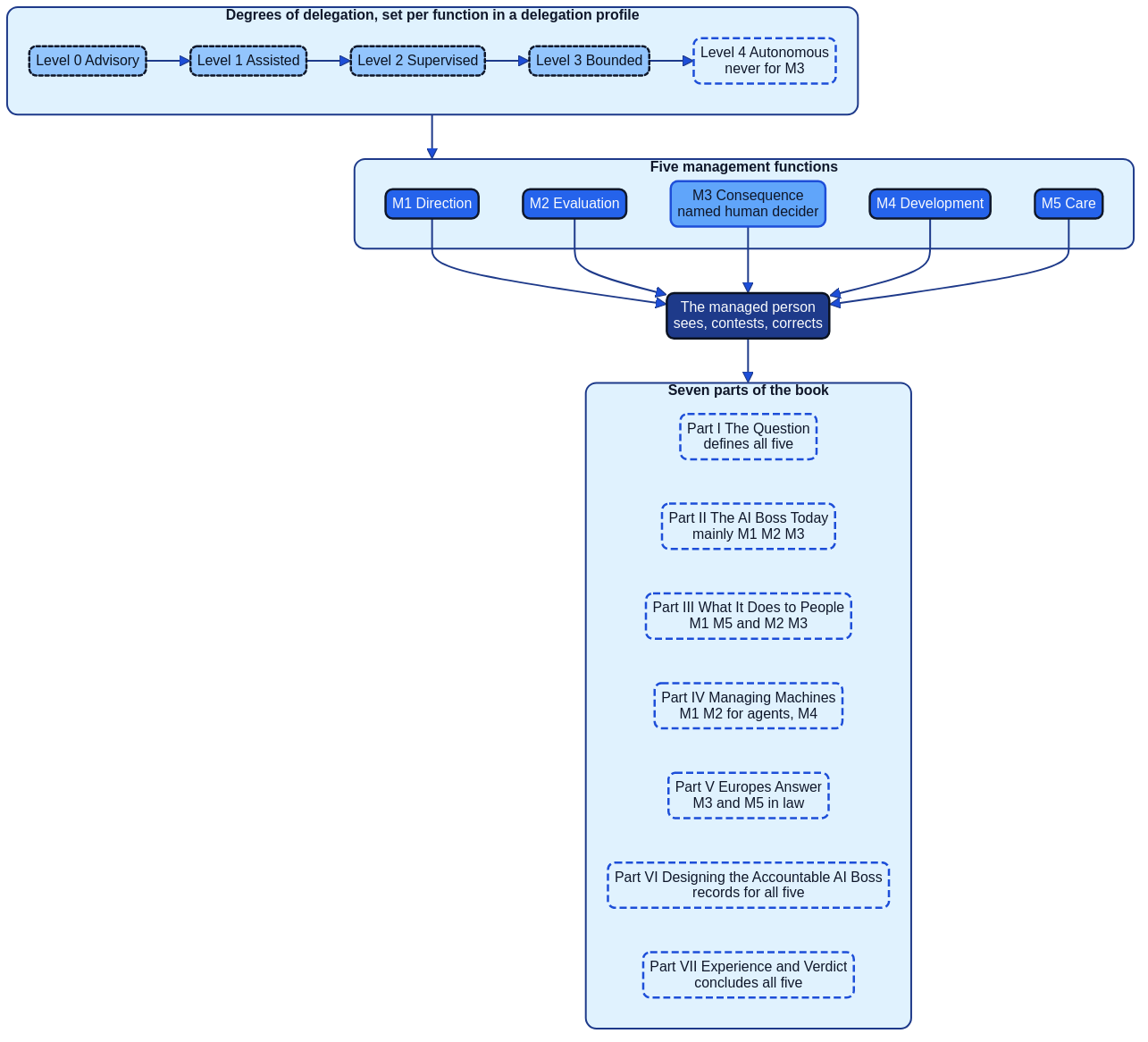
Figure 1.1: The map of the book: five management functions around the managed person, a degree of delegation for each, and the seven parts that examine them.
Who is the boss?
Three scenes from the same November show the question in its ordinary form.
In a ward of one of Nordvik Region's two local hospitals, a four-week roster appears in the unit manager's approval queue. ShiftWise, the rostering system the Region procured under tender NR-2025-089, drafted it from demand forecasts, staff preferences, competences and working-time rules. The unit manager approves it, as every roster must be approved, and the system offers the remaining open shifts to staff who opted in. In the Strandvik home-care unit, Mikael Strand is preparing for the moment when the same system starts to draft his staff's visit routes: which assistant nurse goes to which resident, in which order, with how many minutes between doors.
In Hamburg, a motor claim arrives in Hansa Mutual's core claims system. The claims-triage agent, an autonomous production agent that already routes the group's claims, places it in the queue of one of the twenty or so claims handlers in Jana Petersen's team, within allocation rules that the group head of claims operations owns. Jana can reassign it. Most days she does not need to, and some days she does not notice that she might have.
Jana has also been told that from January her team will be one of two in a pilot in which people direct a small set of agents, one that reads incoming documents and one that drafts recovery letters. She has twelve years of experience in motor and property claims and has never managed software.
None of these scenes is dramatic. In each, part of a manager's work is done or shaped by a system, and in the third a manager takes on a new kind of team. The question of who is the boss becomes concrete when a roster leaves no time to travel between two visits, nine complex claims go to a handler on a reduced schedule, or an agent's letter reaches the wrong customer. Then it is a question about decision rights, records and accountability, the territory of this series.
The AI boss is not science fiction
Algorithmic management is observable, and it has been studied long enough to have a literature. The term entered research through a study of ride-hailing drivers, whose work was assigned, optimised and evaluated by software through tracked data (127, Lee et al., 2015). Kellogg, Valentine and Christin's review of research on algorithms at work found that employers use them to direct workers by restricting and recommending, to evaluate them by recording and rating, and to discipline them by replacing and rewarding (137, Kellogg et al., 2020).
The practice has left the platforms. The European Commission's Joint Research Centre, in its Algorithmic Management and Platform Work survey of workers in Spain and Germany, found that a small but significant proportion of workers in both countries are subject to digital monitoring and algorithmic management at work to some degree (145, Fernández-Macías et al., 2023). A joint report of the International Labour Organization and the Joint Research Centre found algorithmic management practices expanding into regular workplaces in logistics and healthcare, with effects on job quality that depended at least partly on the institutional and regulatory framework (147, International Labour Organization, 2024). An OECD survey of more than 6,000 firms in six countries found algorithmic management tools already in common use in most of them; managers reported better decisions and also cited unclear accountability and difficulty in following the tools' logic (149, Milanez et al., 2025).
The cases that Part II examines show where the loop closes on a person. In 2019 a letter from Amazon's attorney, reported by The Verge, said that the company's system tracked each warehouse associate's productivity and "automatically generates any warnings or terminations regarding quality or productivity without input from supervisors", while Amazon said supervisors could override the process; about 300 full-time associates at one Baltimore facility were terminated for inefficiency over roughly a year (187, Lecher, 2019). In 2021 the Italian data protection authority fined Foodinho, a platform of the Glovo group, 2.6 million euros over the way its system managed riders (194, Garante, 2021). In 2023 the Amsterdam Court of Appeal held that Uber had not shown meaningful human involvement in the deactivation of three drivers for alleged fraud, while accepting that a personal conversation held with a fourth driver before his deactivation was such involvement (67, Gerechtshof Amsterdam, 2023).
The office is where the newest form appears. Microsoft's Work Trend Index for 2025, based on a survey of 31,000 knowledge workers in 31 markets, announced that "as agents increasingly join the workforce, we'll see the rise of the agent boss: someone who builds, delegates to, and manages agents" (151, Microsoft, 2025). This book quotes the phrase and does not adopt it. Agents that assign tickets and allocate cases to people are observable; people directing agents in line management is observable in pilots; the spread of AI-directed work across European knowledge work is expected; and the claim that every employee becomes a manager of agents is speculation until it is measured in real teams.
The question the series had not asked
AI Threat asked whether the dystopias of science fiction are coming true, from the individual mind to the end of the world (44, Nordqvist, 2026). Four of its conclusions are this book's starting point.
The first (F66) is that relying on AI reduces effort, recall and, among those who trust the tool, checking; that automation erodes the skills of the people who must catch its errors; and that automating junior work removes the route by which experts are made (AI Threat, Chapters 6 and 14). Management has junior work too, drafting rosters and allocating cases, and Chapter 19 asks who becomes a manager when systems do it first. The second (F67) is that agents acting beyond their mandate are observable, and that controls moved from the agent's compliance into the environment (AI Threat, Chapters 25 and 35). Chapters 16 and 17 apply this to agents that allocate work. The third (F69) is that small delegations erode skill, process, capacity, interfaces and memory until the documented fallback no longer exists, and that a delegation register and reversibility tests show the sum of what has been delegated and whether it can be undone (AI Threat, Chapter 26). This book extends the register to management functions. The fourth (F70) is the series' argument in one sentence: keep decisions as records that can be corrected, keep the ability to stop outside the system being stopped, keep people able to do the work and judge the output, keep dependence reversible, match autonomy to reversibility, and attend to the quiet harms first (AI Threat, Chapter 35).
The Transformed Security Architect described what had happened to one role on which the series' conclusions depend (46, Nordqvist, 2026). Its conclusions supply the other half of the starting point. The role is transformed, not abolished, because what remains scarce is accountable human judgement (F71). An agent team works under a written mandate manifest at an autonomy level matched to reversibility, and the person who conducts it remains the accountable verifier of everything it proposes (F75; The Transformed Security Architect, Chapter 13). Verification when the reviewer depends on the AI needs seeded errors, an oversight-quality metric and review that does not start from the AI's answer (F76; Chapter 14 of that book), and keeping the craft is a design decision (F77; Chapter 15 of that book). AI Governance had already concluded that human oversight must be designed, not declared, and that approvals given in seconds signal rubber-stamping (F21; AI Governance, Chapters 10 and 21) (41, Nordqvist, 2026).
What none of the volumes asked is what happens when AI takes the manager's chair: when it directs, paces, scores, rewards, disciplines and dismisses people, and when people in turn become the managers of agents. Two open questions frame the book: which management functions may be delegated to AI, to what degree, and who decides and records the delegation (Q1); and who should be the boss in 2036, a person, a system or a person conducting systems, and for which functions (Q12). The ten questions between them, from accountability for a recommendation accepted without reading (Q2) to the public authority that procures its AI boss (Q10), are answered, answered in part or left open in Chapter 33.
The working thesis
The book tests a thesis in four claims. Each is the book's own, to be judged in Chapters 29 and 33, and each comes with the evidence that would refute it.
First: AI may direct work, but it may not, on its own, decide about people. The functions that assign and pace work can be delegated at a degree matched to how easily a mistake can be undone. The functions that carry consequences for a person, hiring, pay, promotion, discipline, dismissal, deactivation and access to work, always have a named human decider who can be identified, contested and held to account. The series' rule that Level 4 Autonomous is never used for irreversible actions becomes, in this book, the rule that Level 4 is never used for an M3 Consequence decision about a person. The claim would be weakened by evidence that fully automated consequence decisions produce fairer and safer outcomes than human decisions made with records and an appeal.
Second: every management decision that AI makes or shapes about a person is a record that the person can see, contest and have corrected. The book's instrument is the Management Decision Record (MDR), the sibling of the Architecture Decision Record of Architecture as Code and the AI Decision Record of the AI volumes (40, Nordqvist, 2025) (42, Nordqvist, 2026). What has been delegated is itself recorded, in a delegation register of management functions, so that the sum of delegations is visible before it becomes irreversible. The claim would be weakened if records proved unreadable to the people they concern, or if organisations that kept them corrected no more errors than those that did not.
Third: the manager's role is transformed, not abolished. It moves from supervisor of tasks to accountable leader of people and conductor of agents, which applies Shift 4 of The Transformed Security Architect, from sole author to conductor of an AI team, to every line manager. The claim would be weakened by evidence that algorithmic direction without human leadership sustains performance and wellbeing over years, not quarters.
Fourth: the quiet harms deserve attention before the loud ones. Loss of autonomy and dignity, unsustainable pace, ill health, the deskilling of managers and the chilling of voice arrive gradually and are measured late. The claim would be weakened if the quiet harms, measured properly, proved small next to the gains, or reversible once noticed.
Part III tests the claims against the evidence and says where it supports, weakens or cannot yet judge them. The thesis is a claim under test, not a forecast.
Five functions and five degrees
Chapter 2 derives the five management functions from the management literature and the employer's legal duties. They are the book's red thread.
M1 Direction is assigning, sequencing, pacing and instructing work: the roster, the route, the queue, the next task and the time it is expected to take. Delegation has gone furthest here, because decisions are frequent and usually reversible; the risks are accumulation, since a thousand allocations add up to a working life, and pace, since whoever sets the rate sets the strain.
M2 Evaluation is measuring, rating and judging performance and conduct: the throughput figure, the score, the dashboard, the summary of who did what. Its risk is that a figure collected to run the work becomes, without anyone deciding it, a judgement about the person who did it.
M3 Consequence is hiring, pay, promotion, discipline, dismissal, deactivation and access to work. Decisions here are hardest to undo, harm and litigation concentrate here, and the book's rule is strictest here.
M4 Development is feedback, learning, coaching and career. Its harms appear over years, it is the least regulated of the five, and the work through which people learn is often the work systems take over first.
M5 Care is safety, health, wellbeing, voice and the duty of care. It rests on the Framework Directive on safety and health at work (49, Council of the European Communities, 1989), on Article 31 of the Charter of Fundamental Rights, which guarantees every worker working conditions that respect their health, safety and dignity (48, European Union, 2012), and on national work-environment law. Part of it is a relationship that no system records: the manager who notices that someone is struggling.
Each function can be delegated to a system at a degree. The book reuses the series' autonomy levels from AI Red Team, Chapter 6 (43, Nordqvist, 2026), and applies them per management function as degrees of delegation. At Level 0 Advisory the system suggests and a person decides and acts; at Level 1 Assisted it drafts and a person carries out the action under their own authority; at Level 2 Supervised it acts after explicit approval of each action; at Level 3 Bounded it carries out pre-approved, reversible actions within a codified playbook while a person can stop it; at Level 4 Autonomous it acts without per-action approval. A delegation profile states the degree per function for one system or team, and Chapter 4 sets default ceilings: Level 3 Bounded for M1 Direction under written conditions, Level 2 Supervised for M2 Evaluation with individual ratings at Level 1 Assisted, Level 2 Supervised for M3 Consequence and Level 1 Assisted for adverse consequence decisions, Level 1 Assisted for M4 Development, and in M5 Care Level 1 Assisted for flags and Level 3 Bounded only for blocks that protect people. Level 4 Autonomous is never used for M3 Consequence.
The degree says who decides each action; the series' usage modes say how the AI is deployed and whose identity it uses (AI Governance, Chapter 2; AI Platform and Security, Chapter 2). AI that assists a manager under the manager's own identity, in Mode 1 Conversational assistants, Mode 2 Embedded workplace assistants and Mode 3 Agentic work tools, leaves the manager as the visible actor even when the assistant drafted the decision. AI applications built or procured to perform a management function, in Mode 4 Built AI applications, such as a rostering system or a screening module, perform the function as the organisation's system. Agents that direct work with identities of their own, in Mode 5 Autonomous production agents, such as an agent that allocates claims to handlers, act in their own name. Mode 0 Ambient AI, features arriving inside licensed software, often touches a management function without anyone having decided that it should.
Why Europe, and why now
The AI Act, Regulation (EU) 2024/1689, lists as high-risk the AI systems intended for recruitment or selection (Annex III, point 4(a)) and those intended to make decisions affecting terms of work-related relationships, promotion or termination, to allocate tasks based on individual behaviour or personal traits, or to monitor and evaluate the performance and behaviour of persons in such relationships (point 4(b)) (1, European Union, 2024). Read against the five functions, that covers M3 Consequence throughout, M2 Evaluation wherever individuals are monitored or rated, and M1 Direction wherever allocation draws on behaviour or traits. Article 5(1)(f) prohibits AI systems that infer the emotions of a natural person in the workplace, except for medical or safety reasons, and has applied since February 2025. Article 26(7) requires deployers who are employers to inform workers' representatives and the affected workers before putting a high-risk system into service or using it at the workplace. Article 86 gives a person affected by a decision taken on the basis of a high-risk system's output the right to clear and meaningful explanations of the system's role. The Digital Omnibus on AI, Regulation (EU) 2026/1744, moved the application of the high-risk obligations of Chapter III, Sections 1 to 3, to 2 December 2027 for systems listed in Annex III (2, European Union, 2026). That gives employers a decided date, which is expected law, not a reason to wait.
The Platform Work Directive, Directive (EU) 2024/2831, regulates algorithmic management for people performing platform work and must be transposed by 2 December 2026, under its Article 29 (47, European Union, 2024). Its chapter on algorithmic management limits processing, requires information, requires oversight with the involvement of workers' representatives (Article 10), requires that any decision to restrict, suspend or terminate a person's account or contractual relationship be taken by a human being (Article 10(5)), and gives a right to an explanation and to review (Article 11). It binds platforms, not every employer, but it is the clearest benchmark Europe has written, and Chapter 5 tests an internal dispatcher against it.
Beneath these instruments lie older ones. Article 22 of the GDPR gives a right not to be subject to a decision based solely on automated processing that produces legal or similarly significant effects, and Article 88 allows member states, by law or collective agreement, to set more specific rules for employee data (5, European Union, 2016). In Germany, BetrVG §87(1) no. 6 gives the works council a right of co-determination over the introduction and use of technical equipment designed to monitor employees' behaviour or performance, and §§ 94 and 95 add rights over personnel questionnaires and selection guidelines (9, Germany, 2001). In Sweden, MBL §11 obliges the employer, before deciding on an important change to its activity or to the conditions of work, to negotiate on its own initiative with the unions with which it has a collective agreement (205, Sveriges riksdag, 1976).
Two things make the question urgent in the autumn of 2026. The dates converge: the Platform Work Directive's transposition date on 2 December 2026, Article 86 already in the text, and the high-risk obligations for Annex III systems on 2 December 2027. And practice has run ahead of the dates: the cases above are judgments, fines and documents. The organisational implication, not a legal conclusion, is that each of these articles becomes a delegation profile, a record, a notice or an appeal path only if someone designs it, and that an employer can show it has discharged its duties only through records it chose to keep. The instruments are observable law; one coherent set of records for all of them is the book's recommendation, set out in Part VI.
Practical guide: Locating your organisation on the five functions in an afternoon
Purpose. Find out, before reading further, where AI already takes part in managing people in one unit of your organisation, including the Mode 0 features nobody decided on. The result is a function map in miniature, which Chapter 2 develops in full.
Roles. A line manager of the chosen unit, an HR business partner, a representative of the works council, union or safety representatives, the data protection officer or a delegate, and someone from IT who can read the admin settings of the HR and office systems.
Steps.
- Choose one unit of 15 to 40 people where you suspect systems already take part in management. Agree with the representatives that the exercise is a description, not an evaluation of anyone.
- List every system the unit's people and manager use, from HR and rostering to queues, office suites and dashboards. Ask IT to list the AI features enabled in each, including those switched on by vendor releases; these are usually Mode 0 Ambient AI or Mode 2 Embedded workplace assistants.
- For each system, write which of the five functions it touches. Use the test of Chapter 10: a system touches a function when its output names a person, takes effect by default, leaves a trace that can inform a judgement about a person, or sets who gets which work.
- For each touch, write the degree of delegation in practice, not on paper: who acts on the output, how often they depart from it and how long they take. Where nobody knows, write "unknown"; that is a finding.
- For each touch, write who decided that the system should perform the function, with a reference to a decision record, works agreement or negotiation protocol. Where nobody decided, write "not decided"; that is the most important finding.
- Mark every touch of M3 Consequence and check that a named human decider exists for it. Mark every touch of M5 Care and check whether the system sets pace without a health constraint.
- Record the result as a short file, agree the next review date with the representatives, and give the findings to the person who will own the answer, normally the HR director.
Definition of done. A function map exists for one unit, reviewed with the representatives, in which every system that touches a management function has a mode, a degree in practice, the person who decided it, or the finding "not decided". Adapt the scope and the representatives' involvement to your collective agreement or works agreement.
The miniature below is a template filled with illustrative values; the full schema is in Chapter 2.
# management/function-map.yaml (illustrative miniature; full schema in Chapter 2)
function_map:
  id: FMAP-EXAMPLE-UNIT-01
  unit: example shift-based unit, 28 staff
  prepared: 2026-11-30
  prepared_with: [line manager, HR business partner, union representative, DPO delegate]
  next_review: 2027-05-31
  touches:
    - system: rostering module of the workforce-management suite
      mode: Mode 4 Built AI applications
      functions: [M1 Direction, M5 Care]
      degree_in_practice: Level 2 Supervised    # manager approves each roster
      decided_by: negotiation protocol 2025-04
    - system: open-shift offers in the same module
      mode: Mode 4 Built AI applications
      functions: [M1 Direction, M3 Consequence]  # offered hours set pay for hourly staff
      degree_in_practice: Level 3 Bounded
      decided_by: not decided                  # finding
    - system: meeting-summary feature of the office suite
      mode: Mode 0 Ambient AI
      functions: [M1 Direction, M2 Evaluation]   # names owners of action items
      degree_in_practice: unknown              # finding
      decided_by: not decided                  # enabled by vendor release
  consequence_check:
    named_human_decider_for_every_M3_touch: false
  findings: 3
  answer_owner: HR director
Rules of the book
Constructive debate. Part III, Chapters 11 to 15, stages each debate in the form AI Threat used: the case for concern, the case for calm, where the positions meet and what can be done, followed by a verdict. Each position is stated at its strongest, in the words and with the evidence of those who hold it.
Observable, expected or speculation. Every statement about the future of work, management or the technology carries one of the three labels of AI Governance, Chapter 22: observable (happening and documented), expected (supported by a stated trend or a decided instrument) or speculation (plausible but unsupported by present evidence). The author's own projections are confined to Chapters 29 and 33 and labelled as such.
People described by what studies measured. Effects on autonomy, stress, health, pay, fairness, voice and skill are reported with the population, the period and the method. Nobody in this book is called lazy, stupid or replaceable.
No anthropomorphism. A system ranks, assigns, flags, scores, recommends or drafts; it does not want or judge. The book writes "decides" for a system only where a decision was formally delegated to it, and then names who delegated it, under which delegation profile and at which degree.
Defensive and constructive. The book describes monitoring, scoring and profiling systems at the level needed to assess, negotiate and govern them, and contains no instructions for covert monitoring, for circumventing the rights of works councils, unions or workers' representatives, or for evading labour law, data protection law or the AI Act.
Legal content as implications. Legal statements are attributed to the instrument and article, verified against the live text, and framed as organisational and architectural implications, not legal advice. Where national law differs, the book says which member state's law an example uses.
Artefacts as code. Wherever the book recommends an artefact, it shows one: the Management Decision Record (MDR-*), the delegation register of management functions with its delegation profiles (DLG-*), oversight records, contestation records (CNT-*), worker information notices, mandate manifests for the agents a manager directs (MND-*), and AI Decision Records in this book's range AIDR-0600 to AIDR-0699. Every example is illustrative. The book builds on the six earlier volumes and never lets a reference to one stand in for an external source.
Across the usage modes and degrees of delegation
The table shows how the AI boss appears in each usage mode, who is the visible actor and the degree at which Part II usually finds it.
| Usage mode | How the AI boss appears | Visible actor | Typical degree found in Part II |
|---|---|---|---|
| Mode 0 Ambient AI | Features in HR and office suites that summarise, score or suggest without a decision to use them | Nobody, until someone asks | Level 0 Advisory on paper, unknown in practice |
| Mode 1 Conversational assistants | A manager drafts a warning, an appraisal or a job advert with an assistant | The manager | Level 0 Advisory or Level 1 Assisted |
| Mode 2 Embedded workplace assistants | Meeting assistants that name owners of action items and summarise contributions | The manager or chair | Level 0 Advisory, drifting towards Level 1 Assisted |
| Mode 3 Agentic work tools | Tools that act in a manager's workspace, for example scheduling or sending tasks | The manager | Level 1 Assisted to Level 2 Supervised |
| Mode 4 Built AI applications | Rostering, screening, scoring and dashboards procured or built for a management function | The organisation's system | Level 1 Assisted to Level 3 Bounded |
| Mode 5 Autonomous production agents | Agents that allocate work to people with identities of their own, and agents that people direct | The agent, under an owner | Level 2 Supervised to Level 3 Bounded; never Level 4 for M3 Consequence |
Two organisations
Two fictional organisations run through the book, as through the earlier AI volumes; this book adds the people they manage and who manage them.
Nordvik Region is a regional public authority in a Nordic member state of the European Union, with about 6,000 employees, about 1,900 of them in its two local hospitals and about 1,100 in the home-care service it runs for five smaller municipalities. Its AI boss is mostly procured. ShiftWise drafts rosters for the hospital wards and is about to draft visit schedules and routes in home care, a high-risk system under Annex III, point 4(b), for which the Region is a deployer and holds the fundamental rights impact assessment FRIA-2026-007. Unit managers approve every roster, and one class of action, offering open shifts to staff who opted in, runs at Level 3 Bounded. A recruitment-screening module was piloted in the spring of 2026 and paused in September, when the union for municipal and care workers asked how the ranking was made and the supplier could not show it (AIDR-0601). Home-care dashboards show planned against actual time per visit. Co-determination follows the Swedish model: a duty to negotiate with the public-sector unions, sector collective agreements and safety representatives in every workplace.
Hansa Mutual is a mutual insurance group headquartered in Hamburg, with about 9,500 employees in seven countries inside and outside the European Union, about 3,600 of them in claims. Its AI boss is mostly built. The claims-triage agent allocates claims to individual handlers at Level 3 Bounded within allocation rules, producing throughput figures per handler; whether that allocation falls under Annex III, point 4(b), is reopened in this book (AIDR-0651). TalentLens ranks applications and scores transcripts of structured video interviews in Poland and Germany, with its affect and voice analysis switched off group-wide; a sales-performance score is one input to variable pay; and from January 2027 the agent-boss pilot HM-AB-PILOT-01 asks two teams to direct small sets of agents. In Germany a Konzernbetriebsrat co-determines under the BetrVG and has agreed the group works agreement on IT systems KBV-IT-2024; a European Works Council and six national bodies, from the Dutch ondernemingsraad to the Swiss employee committee, complete the picture.
Four people carry the story, and Chapter 30 follows them through a year. Ingrid Halvorsen has been Nordvik Region's HR director since 2023, after leading HR in its hospitals. Mikael Strand is unit manager of the Strandvik home-care unit, line manager of about 35 assistant nurses and care assistants, a third of them part-time or hourly; his unit will be the first in home care to use ShiftWise routes and the time-per-visit dashboard. Jana Petersen is a claims team leader in Hamburg, with about 20 claims handlers whose work the claims-triage agent allocates and, from January, the pilot's agents under the mandate manifest MND-HM-CLM-01. Thomas Brandt has chaired Hansa Mutual's Konzernbetriebsrat since 2022, is a former underwriter, negotiated KBV-IT-2024 and sits on the European Works Council; in October 2026 he asked the group to put TalentLens's selection criteria before the council under BetrVG §95.
Each organisation receives the question in November 2026, from a different direction. At Nordvik it follows the screening pause and the planned go-live of ShiftWise routes in home care, a supplier's system about to direct the working days of its most exposed staff. At Hansa it comes from the board: an agent already allocates work to people, an agent-boss pilot is about to begin, and a Dutch sales employee has just contested a quarterly score that compared her with the wrong baseline (CNT-HM-0001). By Chapter 32 each has answered its own question. Nordvik's is which management functions it may let procured systems perform, at which degree and with which records, and how a public employer shows that to its staff. Hansa's is what one group policy on AI in management can hold across seven legal regimes, agreed with the bodies that co-determine it.
Worked example: The commission and the board request as decision records
Illustrative example. Both organisations record the question as an AI Decision Record, following the schema of AI Platform and Security, Chapter 5, so that every later decision in the book can refer to it. Nordvik's regional director endorses the HR director's commission.
# decisions/aidr/AIDR-0600.yaml (illustrative, Nordvik Region)
id: AIDR-0600
title: Govern algorithmic management across the Region
status: accepted
date: 2026-11-16
deciders: [regional-director]
accountable: hr-director            # Ingrid Halvorsen
reviewers: [ai-governance-lead, data-protection-officer, chair-central-work-environment-committee]
relates_to: [AIDR-0601, NR-2025-089, FRIA-2026-007]
context: >
  ShiftWise drafts hospital rosters and will draft home-care routes.
  The recruitment-screening pilot was paused under AIDR-0601. Dashboards
  show time per visit, with individual figures visible to unit managers.
  No record states which management functions any system performs.
question: >
  Which management functions may the Region's systems perform, to which
  degree, with which records, and how is that shown to staff and unions?
deliverables:
  - function maps for units where AI touches management (FMAP-NR-*)
  - delegation profile for ShiftWise before routes go live in home care
  - delegation register of management functions
  - worker information notices and a route of appeal
report_to: regional-executive-committee
report_due: 2027-06-30
constraints:
  - duty to negotiate with the unions before important changes
  - collective agreements set pay and working time
  - public access, archiving and the duty to give reasons apply
  - M3 Consequence never above Level 1 Assisted without a new decision
review_by: 2027-11-16
A week later Hansa's executive board asks a different question of two board-level owners and invites the co-determination body into the review.
# decisions/aidr/AIDR-0650.yaml (illustrative, Hansa Mutual)
id: AIDR-0650
title: Group policy on AI in management
status: accepted
date: 2026-11-23
deciders: [executive-board]
accountable: [chief-hr-officer, chief-risk-officer]
reviewers: [group-ai-governance-board, group-data-protection-officer]
invited_to_review: [Konzernbetriebsrat]
relates_to: [AIDR-0024, AIDR-0034, AIDR-0063, KBV-IT-2024, HM-AB-PILOT-01]
systems_in_scope:
  - {name: claims-triage-agent, mode: 5, function: M1 Direction, degree: 3}
  - {name: TalentLens, mode: 4, function: M3 Consequence, degree: 1}
  - {name: sales-performance-score, mode: 4, function: M3 Consequence, degree: 0}
  - {name: HM-AB-PILOT-01, mode: 5, starts: 2027-01}
context: >
  An agent already allocates work to claims handlers. Teams will direct
  agents from January. A sales employee has contested a quarterly score.
question: >
  Which management functions may AI perform in the group, to which degree,
  under which records, and with which bodies in each market?
first_report: 2027-04-30
constraints:
  - BetrVG 87(1) no. 6, 94 and 95 in Germany; KBV-IT-2024 in force
  - seven legal regimes; AI Act as group policy outside the EU
  - European Works Council informed on transnational matters
  - TalentLens affect and voice analysis stays switched off
review_by: 2027-11-23
Nordvik's commission concerns procured systems under one regime and a duty to negotiate; Hansa's concerns built agents under seven regimes and a duty to co-determine. Both name the person accountable for the answer, the reviewers, a report date and the constraints that will shape the answer.
How to read this book
The book has seven parts. Part I, The Question (Chapters 1 to 4), defines the functions, a century of managing by measurement and the AI boss itself. Part II, The AI Boss Today (Chapters 5 to 10), shows where the AI boss already works, from platforms to the office. Part III, What It Does to People (Chapters 11 to 15), stages the debates on what it does to people and whether it works. Part IV, Managing Machines (Chapters 16 to 20), turns to people who manage agents, orchestrators, mixed teams, the route into management and decision rights. Part V, Europe's Answer (Chapters 21 to 24), reads the law as requirements. Part VI, Designing the Accountable AI Boss (Chapters 25 to 29), designs the records, the oversight, the appeal, the transparency and the transformed manager. Part VII, Experience and Verdict (Chapters 30 to 33), follows a year, collects cases and judges the thesis.
The chapters can be read in order, and readers who do not know the earlier volumes will find each conclusion summarised where it is used. Readers with a particular responsibility can take a shorter path.
| Reader | Start with | Then | Use as reference |
|---|---|---|---|
| Line manager or team leader | Chapters 1, 2 and 29 | Chapters 9, 11, 14, 16 and 18 | Chapter 26 for real oversight |
| HR director or HR business partner | Chapters 1, 2 and 4 | Chapters 7, 8, 19, 25 and 28 | Chapter 30 for a year in practice |
| Executive or management body | Chapters 1 and 4 | Chapters 15, 20 and 32 | Chapter 33 for the verdict |
| Works council, union or safety representative | Chapters 1 and 2 | Chapters 13, 14, 23 and 27 | Chapter 28 for what workers must be told |
| Procurement or programme leader in a public authority | Chapters 1 and 4 | Chapters 9, 21 and 24 | Chapter 32 for Nordvik's plan |
| AI architect, platform or product team | Chapters 1 and 4 | Chapters 16, 17, 20 and 25 | Appendix A for full artefacts |
| Risk, compliance, data protection or internal audit | Chapters 1 and 21 | Chapters 22, 25 and 26 | Chapter 31 for anti-patterns |
Nordvik Region and Hansa Mutual
At Nordvik Region, Ingrid Halvorsen's commission (AIDR-0600) arrives in a public authority whose AI boss is bought, high-risk and about to reach the staff with the least slack in their day. Her first instruments are the function map, which Mikael Strand prepares for the Strandvik unit in Chapter 2, and a delegation profile for ShiftWise negotiated with the unions before routes go live, which Chapter 4 records. The binding constraints are a supplier that may not be able to explain its system, a duty to negotiate and a public employer's duty to give reasons, so Nordvik's work is mostly procurement and negotiation.
At Hansa Mutual, the executive board's request (AIDR-0650) arrives in a group whose AI boss is built and already allocates work to people, and whose people are about to direct agents. Its first instruments are the function map of Jana Petersen's team, the reassessment of the claims-triage agent's allocation under Annex III, point 4(b), and the terms of the pilot. The binding constraints are co-determination with Thomas Brandt's Konzernbetriebsrat and the arrangements of six other entities, so Hansa's work is mostly about who answers for an agent's allocation, and who may change it, in seven markets. Where Nordvik's answer in Chapter 32 is procurement-first, Hansa's is co-determination-first; in both, consequence decisions stay with named people.
Summary
Algorithmic management is observable. Platforms dispatch and deactivate, warehouses measure pace, screening systems rank applicants, rostering systems allocate shifts and agents assign office work, while people are asked to direct agents. Courts, regulators and researchers have documented the loop closing on a person; the spread of AI-directed knowledge work is expected.
This book asks the question the six earlier volumes did not: what happens when AI takes the manager's chair. It builds on AI Threat and The Transformed Security Architect. Its working thesis has four claims: AI may direct work but may not, on its own, decide about people; every management decision AI makes or shapes is a record the person can see and contest; the manager's role is transformed, not abolished; and the quiet harms come first. Each claim names the evidence that would weaken it, and Chapters 29 and 33 judge them.
The book's red thread is five management functions, M1 Direction, M2 Evaluation, M3 Consequence, M4 Development and M5 Care, each delegated at a degree from Level 0 Advisory to Level 4 Autonomous and recorded in a delegation profile, with the rule that Level 4 is never used for M3 Consequence. The question is European because the AI Act, the Platform Work Directive, due for transposition on 2 December 2026, the GDPR and national co-determination law already constrain what an employer may delegate.
Nordvik Region has recorded its commission as AIDR-0600 and Hansa Mutual its board request as AIDR-0650, and Ingrid Halvorsen, Mikael Strand, Jana Petersen and Thomas Brandt will carry both through the book. Chapter 2 defines the five management functions and maps who performs each today in a home-care unit and a claims team.
Sources
- European Parliament and Council of the European Union (2024). Regulation (EU) 2024/1689 laying down harmonised rules on artificial intelligence (Artificial Intelligence Act). Official Journal of the European Union. (1, European Union, 2024)
- European Parliament and Council of the European Union (2026). Regulation (EU) 2026/1744 (Digital Omnibus on AI). Official Journal of the European Union. (2, European Union, 2026)
- European Parliament and Council of the European Union (2016). Regulation (EU) 2016/679 (General Data Protection Regulation). Official Journal of the European Union. (5, European Union, 2016)
- Federal Republic of Germany (2001). Betriebsverfassungsgesetz (BetrVG). (9, Germany, 2001)
- Nordqvist, G. (2025). Architecture as Code. (40, Nordqvist, 2025)
- Nordqvist, G. (2026). AI Governance: Governing Artificial Intelligence in European Enterprises and Public Authorities. (41, Nordqvist, 2026)
- Nordqvist, G. (2026). AI Platform and Security: Building and Securing AI Platforms in European Enterprises and Public Authorities. (42, Nordqvist, 2026)
- Nordqvist, G. (2026). AI Red Team: AI as an Active Part of Cyber Defence in European Enterprises and Public Authorities. (43, Nordqvist, 2026)
- Nordqvist, G. (2026). AI Threat: Are the Dystopias Coming True? Evidence, Risk and Response for European Enterprises and Public Authorities. (44, Nordqvist, 2026)
- Nordqvist, G. (2026). The Transformed Security Architect: Role, Craft and Career in the Age of AI in European Enterprises and Public Authorities. (46, Nordqvist, 2026)
- European Parliament and Council of the European Union (2024). Directive (EU) 2024/2831 of 23 October 2024 on improving working conditions in platform work. Official Journal of the European Union. (47, European Union, 2024)
- European Union (2012). Charter of Fundamental Rights of the European Union. (48, European Union, 2012)
- Council of the European Communities (1989). Council Directive 89/391/EEC on the introduction of measures to encourage improvements in the safety and health of workers at work. (49, Council of the European Communities, 1989)
- Gerechtshof Amsterdam (2023). Judgment of 4 April 2023, ECLI:NL:GHAMS:2023:793 (drivers and App Drivers & Couriers Union v Uber). Rechtspraak.nl. (67, Gerechtshof Amsterdam, 2023)
- Lee, M. K., Kusbit, D., Metsky, E. & Dabbish, L. (2015). Working with Machines: The Impact of Algorithmic and Data-Driven Management on Human Workers. (127, Lee et al., 2015)
- Kellogg, K. C., Valentine, M. A. & Christin, A. (2020). Algorithms at Work: The New Contested Terrain of Control. (137, Kellogg et al., 2020)
- Fernández-Macías, E., Urzì Brancati, C., Wright, S. & Pesole, A. (2023). The platformisation of work: Evidence from the JRC Algorithmic Management and Platform Work survey (AMPWork). European Commission, Joint Research Centre. (145, Fernández-Macías et al., 2023)
- International Labour Organization (2024). Algorithmic management practices in regular workplaces are already a reality. (147, International Labour Organization, 2024)
- Milanez, A., Lemmens, A. & Ruggiu, C. (2025). Algorithmic management in the workplace: New evidence from an OECD employer survey. OECD Publishing. (149, Milanez et al., 2025)
- Microsoft (2025). 2025: The Year the Frontier Firm Is Born. Work Trend Index Annual Report. (151, Microsoft, 2025)
- Lecher, C. (2019). How Amazon automatically tracks and fires warehouse workers for 'productivity'. The Verge. (187, Lecher, 2019)
- Garante per la protezione dei dati personali (2021). Ordinanza ingiunzione nei confronti di Foodinho s.r.l. – 10 giugno 2021. (194, Garante, 2021)
- Sveriges riksdag (1976). Lag (1976:580) om medbestämmande i arbetslivet (MBL). (205, Sveriges riksdag, 1976)