Surveillance at Work and the Chilling Effect
An AI boss cannot direct or evaluate what it cannot see. Every system that assigns visits, allocates claims or scores performance runs on data about the people it manages: when they start and stop, where they are, how fast they work and, in some products, how they sound and look. This chapter concerns two management functions: M2 Evaluation, because monitoring data becomes the evidence on which performance and conduct are judged, and M5 Care, because the same data can protect health and safety or erode the voice and psychological safety on which a healthy workplace depends. It describes what algorithmic management needs to observe, what European courts and authorities have decided, and what research measured, then stages the debate between those who see pervasive monitoring as a chilling force and those who see proportionate, negotiated monitoring as lawful and protective.
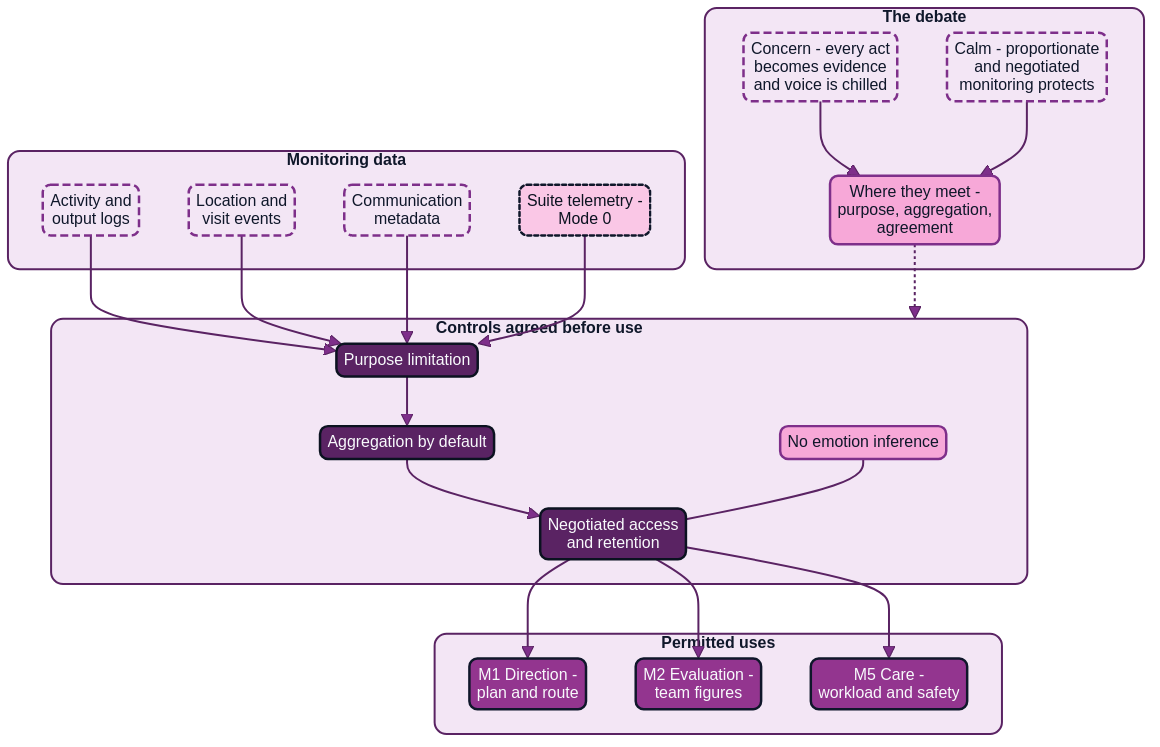
Figure 13.1: Monitoring data passes through controls agreed before use; the positions in the debate meet on purpose, aggregation and agreement.
What the AI boss needs to see
Algorithmic management turns work into data before it manages it. Kellogg, Valentine and Christin's review of research on algorithms at work found that employers use algorithms to direct workers by restricting and recommending, to evaluate them by recording and rating, and to discipline them by replacing and rewarding (137, Kellogg et al., 2020). Recording underlies the rest: an allocation rule needs to know who is free, a rate needs a count, a score needs a history. The joint ILO and Joint Research Centre case studies found algorithmic management already established in regular workplaces in logistics and healthcare, and named surveillance among its risks to job quality where legal safeguards are weak (147, International Labour Organization, 2024).
Four families of data feed a management system: activity and output (claims closed, items scanned, idle intervals), location (a vehicle position, the start and end of a home visit), communication (from metadata to content) and physiological and behavioural signals (voice, face, typing rhythm). The Article 29 Working Party listed the technologies that generate them, from tracking of application use by software the employee does not see and cloud office applications that allow very detailed logging of activity to wearable devices, and warned that an all-in-one suite may observe all use of information technology at work (60, Article 29 Data Protection Working Party, 2017).
The distinction that matters is between what a management system requires and what it invites. A visit-routing system requires the start and end of each visit; a claims-allocation agent requires a queue and the handlers' capacity. Neither requires private messages, location between tasks or an estimate of mood. Yet the by-products invite further use: once times exist per person, a figure per person can be computed, then a ranking, then a pay input. Karen Levy's study of long-haul trucking shows the mechanism. Fleet management systems aggregated real-time data at a remote dispatcher, who could then evaluate drivers on new metrics and challenge their accounts of local and bodily conditions (128, Levy, 2015); her later book follows electronic logging devices that regulation required to address driver fatigue and that then supported additional monitoring by firms (142, Levy, 2023). Data collected for safety became data for control.
Two features of the AI boss sharpen the pattern. Systems in Mode 4 Built AI applications and Mode 5 Autonomous production agents collect monitoring data as a side effect of directing work, so purpose limitation has to be designed into the system that directs, not added to a reporting layer afterwards. And much monitoring arrives in Mode 0 Ambient AI, as features of licensed suites. AI Red Team, Chapters 8 and 28, concluded that Mode 0 is the blind spot whose use must be established and recorded before it is relied on (43, Nordqvist, 2026); an analytics feature enabled by a licence update can create a profile of every employee that no manager requested. AI Threat, Chapter 13, concluded that the harm of surveillance lies less in a single observation than in the profile that accumulates (44, Nordqvist, 2026). At work that profile is held by the party that sets pay and can dismiss, which is why European law treats workplace monitoring as a distinct problem.
What courts and authorities decided
The decisions follow a common pattern: monitoring is not unlawful as such, but it must be known, limited to a legitimate purpose, the least intrusive means available, and accompanied by safeguards.
Bărbulescu and López Ribalda
Mr Bărbulescu, a sales engineer, had created an instant-messaging account at his employer's request to answer customers' enquiries. The internal regulations prohibited personal use of company resources but said nothing about monitoring. The employer recorded his messages, including personal exchanges with his brother and his fiancée, and dismissed him. In 2017 the Grand Chamber of the European Court of Human Rights found, by eleven votes to six, a violation of Article 8 of the Convention, because the national courts had not properly balanced the interests at stake (223, European Court of Human Rights, 2017). It set out the questions to ask: whether the employee was told clearly and in advance of the possibility and nature of monitoring; its extent and intrusiveness, distinguishing flow from content and taking account of limits in time and space and of how many people saw the results; whether there were legitimate reasons; whether less intrusive methods would have sufficed; what the consequences were and whether the results were used for the declared aim; and whether adequate safeguards existed.
In 2019 the Grand Chamber applied the criteria to a harder case. A Spanish supermarket manager facing losses installed visible cameras, of which staff were told, and hidden cameras over the tills, of which they were not; fourteen employees, among them the five applicants, were dismissed after recordings showed thefts. The Court found, by fourteen votes to three, no violation (224, European Court of Human Rights, 2019). It gave weight to a reasonable suspicion of serious misconduct, the extent of the losses, the ten-day duration, the public checkout area and the few people who viewed the recordings, among them a union representative. It also stated limits: the slightest suspicion could not justify covert surveillance, and expectations of privacy remain high in closed working areas such as offices. For algorithmic management the decisive criteria are extent and use: a system that observes everyone continuously and feeds every observation into evaluation fails on extent before anyone asks whether it was disclosed.
The Article 29 Working Party's opinion
The European data protection authorities' opinion of June 2017 remains the clearest statement of supervisors' expectations (60, Article 29 Data Protection Working Party, 2017). Consent is highly unlikely to be a valid legal basis at work, because employees can rarely refuse without adverse consequences. Contract or legitimate interests can be invoked only where processing is strictly necessary for a legitimate purpose and proportionate. Employees must receive effective information. A proportionality assessment should precede any monitoring technology and be repeated at least annually, asking whether less invasive means exist. Where private use of a vehicle is allowed, employees should be able to switch off location tracking, for example for a visit to a doctor. The opinion notes that some countries require works-council approval of monitoring policies and recommends that a representative sample of employees take part in assessing necessity in all cases.
The H&M fine
In October 2020 the Hamburg Commissioner for Data Protection and Freedom of Information fined H&M about EUR 35.3 million for monitoring several hundred employees at a service centre in Nuremberg (190, Legal Tribune Online, 2020). After holidays and sick leave, supervisors held welcome-back talks and recorded holiday experiences, symptoms and diagnoses, and some recorded family problems and religious beliefs. The records formed profiles used for employment decisions and came to light when a technical error briefly exposed them across the site. The Commissioner called the combination of inquiry into private lives with continuous recording of activities a particularly intensive intrusion. No AI was involved; the case shows by hand the profile that a management system could assemble routinely.
The Amazon warehouse decision
In December 2023 the CNIL fined Amazon France Logistique EUR 32 million for monitoring warehouse staff through hand-held scanners. In December 2025 the Conseil d'État reduced the fine to EUR 15 million, and its reasons cut both ways (204, Conseil d'État, 2025). It accepted, as based on legitimate interests, three real-time indicators the CNIL had condemned: one flagging two stowing scans less than 1.25 seconds apart, used to detect handling errors; one recording scanner inactivity of more than ten minutes, which did not govern breaks; and one confined to short periods around breaks. It upheld the finding that keeping every quality and productivity indicator for every employee, undifferentiated, for 31 days and several purposes breached data minimisation under Article 5(1)(c) of the GDPR, because the company could not show why each indicator needed that period for each purpose. The lesson for design is precise: a narrow indicator tied to a stated purpose can be lawful even when it observes individual actions, while a general store of everything about everyone fails because nobody can justify it purpose by purpose. Chapter 6 discusses the indicators as pace; this chapter takes from the case the principle of retention by purpose.
Article 88 and national law
Article 88(1) of the GDPR allows member states, by law or by collective agreements, to adopt more specific rules on employee data, and Article 88(2) requires those rules to include suitable and specific measures to safeguard human dignity, legitimate interests and fundamental rights, with particular regard to transparency and monitoring systems at the workplace (5, European Union, 2016). In March 2023 the Court of Justice, in a case about live-streamed lessons brought by the Hessian teachers' main staff council, held that national legislation which does not satisfy Article 88(2) cannot be a more specific rule and must be disregarded unless it is a valid legal basis under Article 6(3) (64, CJEU, 2023). A national rule that merely repeats the GDPR's general conditions adds nothing.
Two organisational implications follow, offered as a reading and not as legal advice. An employer cannot treat a national employee-data provision as blanket authorisation for monitoring. And because Article 88(1) names collective agreements, a works agreement on monitoring is stronger when it names purposes, aggregation levels, access rights and retention periods than when it lists systems and says that data protection law applies.
Two instruments now draw hard lines. The AI Act, Regulation (EU) 2024/1689, prohibits in Article 5(1)(f) placing on the market, putting into service for this purpose or using AI systems to infer emotions of a natural person in the areas of workplace and education institutions, except for medical or safety reasons (1, European Union, 2024); the Digital Omnibus of 2026 inserted new prohibitions into Article 5(1) but left point (f) unchanged (2, European Union, 2026). The Commission's guidelines explain that, because emotion recognition is defined by reference to biometric data, inference from written text is outside the prohibition while inference from keystrokes, facial expressions, posture or voice is inside it; that the workplace includes candidates in recruitment; that a call centre tracking its employees' emotions by webcam and voice, or a system inferring the emotional tone of hybrid teams from video calls, is prohibited; and that the safety exception does not cover general stress monitoring or detection of burnout (58, European Commission, 2025). A monitoring system that is not prohibited may still be high-risk under Annex III, point 4(b), which covers systems intended to monitor and evaluate the performance and behaviour of persons in work-related relationships, and then carries the deployer duty in Article 26(7) to inform workers' representatives and affected workers before use (1, European Union, 2024).
The Platform Work Directive, Directive (EU) 2024/2831, goes further for platforms. Article 7 forbids processing, by automated monitoring or decision-making systems, data on a worker's emotional or psychological state, private conversations including exchanges with representatives, data collected while the person is not offering or performing platform work, and data used to predict the exercise of fundamental rights such as freedom of association (47, European Union, 2024). Transposition is due by 2 December 2026. Organisations outside its scope can adopt the list as policy. The Charter frames both: Article 8 protects personal data, and Article 31(1) gives every worker the right to working conditions that respect health, safety and dignity (48, European Union, 2012).
Suited to monitor
Labour law reached the problem before data protection law did. In Germany, § 87(1) no. 6 of the Works Constitution Act gives the works council co-determination over technical equipment intended to monitor employees' behaviour or performance (9, Germany, 2001). The Federal Labour Court reads "intended" objectively: equipment is covered when it is objectively suited to collect and record such information, whatever the employer's intention. In 2016 it held that an employer's Facebook page whose visitor-posting function let the public comment on the conduct and performance of employees was such equipment, and that offering the function required the group works council's agreement (71, Bundesarbeitsgericht, 2016). A claims-allocation agent, an office suite with analytics or a dashboard fed by a phone app is suited to monitor whatever anyone intends, so its introduction and every material change fall within co-determination; Chapter 23 treats systems that change faster than agreements.
In Switzerland, Article 26(1) of Ordinance 3 to the Employment Act provides that monitoring and control systems intended to monitor employees' behaviour at the workplace may not be used, and Article 26(2) requires systems needed for other reasons to be designed so that health and freedom of movement are not impaired (80, Swiss Confederation, 1993). The rule sits in health protection, which ties it directly to M5 Care. In Poland, Article 22² of the Labour Code allows video monitoring only where necessary for safety, property, production control or confidentiality, excludes rooms used by the company trade union and, in principle, sanitary rooms, cloakrooms, canteens and smoking rooms, limits retention to three months, and requires purposes, scope and method to be set in the collective agreement, work regulations or a notice, with staff informed at least two weeks before; Article 22³ extends these conditions to email and, in § 4, to other forms of monitoring (79, Rzeczpospolita Polska, 1974). Across these orders three elements recur: a reason that can be stated, notice to or agreement of those monitored, and data and inferences that are off limits.
What research measured
The research on workplace monitoring is older than algorithmic management and smaller than the debate. Three findings carry most weight, each to be read with its method.
Pierce, Snow and McAfee used theft and sales data from 392 restaurant locations of five firms that adopted a theft-monitoring product at different dates, with difference-in-differences models. Theft fell and revenue rose, driven by changed behaviour of existing staff rather than turnover, and the gains benefited the firms and waiting staff's legitimate tip earnings (129, Pierce et al., 2015). The monitoring observed transactions for one form of misconduct; the study did not measure wellbeing or voice.
Ethan Bernstein's field work in a large mobile-phone factory in China found that workers who knew they were observed concealed improvements and shortcuts through codes and other costly means. In a field experiment, a modest increase in privacy at the level of the production line significantly and sustainably improved line performance. Bernstein called this the transparency paradox: observability can reduce performance by inducing concealment, while zones of privacy support productive deviance, experimentation and continuous improvement (122, Bernstein, 2012). The study concerns human observation of groups; its relevance is the mechanism.
Amy Edmondson's study of 51 work teams in a manufacturing company found that team psychological safety, a shared belief that the team is safe for interpersonal risk-taking, was associated with learning behaviour, which mediated performance (117, Edmondson, 1999). It did not measure monitoring. The link to surveillance is an interpretation, though a direct one: if admitting a mistake or questioning a decision becomes recorded behaviour that may feed evaluation, the interpersonal risk rises.
Kirstie Ball's overview finds that monitoring affects wellbeing, work culture, productivity, creativity and motivation, that its intensity says much about how a company views its employees, and that task design, supervision and employees' expectations can mitigate the harms (126, Ball, 2010). Stark and Levy add that customers are now enlisted to observe and manage service workers through ratings (132, Stark & Levy, 2018), so monitoring is distributed beyond the employer. What is missing is as important: few longitudinal studies of AI-based monitoring in European workplaces, few that measure voice before and after a system is introduced, and almost none comparing individual-level with team-level monitoring of the same work.
Practical guide: A proportionality review of monitoring data used by a management system
Purpose. Establish, before a management system uses monitoring data and at least annually afterwards, that each data element serves a stated purpose, is aggregated as far as the purpose allows, is kept no longer than needed and is seen only by those who need it. The review applies the Bărbulescu criteria, the Working Party's opinion and the retention reasoning of the Amazon decision, and can form part of the data protection impact assessment and the fundamental rights impact assessment under Article 27 of the AI Act.
Roles. The system owner leads; the data protection officer advises and records; the workers' representatives (works council, union or safety representative) take part from the first step; HR and the line managers who will see the data describe their intended uses; a sample of affected workers reviews the result.
Steps.
- Inventory the data. List every element collected or received, including by-products and Mode 0 features, with its source, granularity and whether it is observed, derived or inferred.
- State the purpose per element. Link each to M1 Direction, M2 Evaluation or M5 Care and a specific use. No purpose, no collection.
- Exclude the forbidden. Remove emotion inference from biometric signals (AI Act Article 5(1)(f)), content of private communications, data outside working time and anything that could predict union activity, treating the Platform Work Directive's Article 7 list as policy.
- Aggregate by default. Choose the highest aggregation that serves each purpose: team or route before person, week before day. Individual figures need a written reason and a named role.
- Set access by role. Name who sees what, log every individual-level view, and give representatives the right to review the log, by default quarterly.
- Set retention by purpose. Give each element and purpose its own justified period. Default: raw individual events in weeks, not months; planning aggregates up to 24 months.
- Close or record the route to M3 Consequence. If an element may inform pay, discipline or dismissal, it is never the sole basis, the person is told and heard, and the decision is recorded in a Management Decision Record (Chapter 25).
- Record the less intrusive alternative considered for every individual-level element.
- Inform before use through the worker information notice (Chapter 28) and, for high-risk systems, the Article 26(7) duty.
- Record and review the result as a decision record linked to the delegation profile, on every material change and at least annually.
Definition of done. Every element has a purpose, an aggregation level, an access list, a retention period and a stated route or no route to M3 Consequence; the representatives have reviewed and, where the law gives them the right, agreed the result; notice has been given; the next review is dated. Adapt the defaults to the collective agreement, the works agreement and the organisation's risk appetite.
Worked example: Nordvik Region's review of the visit-registration data
Illustrative. Nordvik Region's home-care staff register the start and end of each visit on an app on their work phones, and the home-care dashboards compare planned and actual time per visit and route, showing individual figures to the unit manager at Level 0 Advisory under DLG-NR-HCD-01. When the Strandvik unit began to use ShiftWise routes, the data protection officer and the unit's safety representative ran the review. They found that the app also stored a location trace between visits, collected to estimate travel times. They removed it from the data the dashboard may use, kept location only as confirmation at the start and end of a visit, and replaced the estimate with route-level averages.
aidr: AIDR-0604
title: Proportionality review of visit-registration data for home-care dashboards
organisation: Nordvik Region
status: accepted
date: 2027-01-20
commission: AIDR-0600
delegation_profile: DLG-NR-HCD-01
system: home-care performance dashboards
management_functions: [M2 Evaluation, M5 Care]
reviewers:
  - role: data protection officer
  - role: safety representative, Strandvik home-care unit
  - role: unit manager, Strandvik home-care unit
union_negotiation: completed under the co-determination act before use
data_elements:
  - element: visit start and end time per person
    purposes: [M1 route planning, M2 unit and route figures, M5 workload review]
    aggregation_default: route and week
    individual_access: [unit manager]
    individual_access_logged: true
    retention: {raw_events: 60 days, route_aggregates: 24 months}
  - element: location at visit start and end
    purposes: [confirm visit took place at the client's address]
    aggregation_default: not displayed
    individual_access: []
    retention: {raw_events: 60 days}
  - element: location trace between visits
    decision: removed from dashboard data; collection stopped
    reason: route-level travel averages serve planning; trace reveals movement outside visits
excluded:
  - emotion or stress inference of any kind
  - content of messages in the app
  - data outside rostered working time
route_to_m3_consequence:
  allowed: false
  rule: dashboard figures are never a basis for pay, discipline or dismissal
review:
  triggers: [new data element, new dashboard view, ShiftWise model change]
  next_scheduled: 2028-01-20
Worked example: The conditions in Hansa Mutual's group works agreement
Illustrative. Hansa Mutual's claims-triage agent allocates claims to handlers at Level 3 Bounded under DLG-HM-CTA-01 and produces throughput figures per handler as a by-product. The group works agreement KBV-IT-2024, negotiated by Thomas Brandt for the Konzernbetriebsrat, treats the agent as equipment suited to monitor under BetrVG § 87(1) no. 6 and sets the conditions below in its annex on the agent's figures. AIDR-0654 records how the group applies the principle in entities the German agreement does not bind.
agreement: KBV-IT-2024
annex: claims-triage agent figures
parties: [Hansa Mutual group management, Konzernbetriebsrat]
legal_basis_de: BetrVG 87(1) no. 6
system: claims-triage agent
delegation_profile: DLG-HM-CTA-01
conditions:
  individual_throughput:
    visible_to: [the handler, the handler's own team leader]
    not_visible_to: [second-line managers, HR, other team leaders]
    ranking_lists: prohibited
    use_in_rating_pay_or_discipline: never as sole basis; handler informed and heard
    retention: 13 weeks
  team_throughput:
    visible_to: [team leader, department head, HR, Konzernbetriebsrat]
    retention: 24 months
  access_log:
    individual_views_logged: true
    review_by_works_council: quarterly
  prohibited:
    - emotion inference from voice, text rhythm or video
    - wellbeing and collaboration analytics in the office suite
  change_control: new metrics or new recipients require works-council consent
entity_overlays:
  decision_record: AIDR-0654
  switzerland: team figures only; ArGV 3 Art. 26 assessed by the Swiss employee committee
  poland: purposes set in the work regulations; staff informed two weeks before use
  netherlands: consent of the ondernemingsraad under the WOR
  sweden: negotiation with the unions under MBL
The debate
Monitoring as a by-product of directing work costs almost nothing, so the question becomes not what an employer can afford to watch but what it refrains from using. The four steps below give each position its strongest form.
The case for concern
The case for concern starts with the asymmetry of the workplace. Foucault described power that works through the permanent possibility of being seen, so that the observed person behaves as if always watched and power operates automatically (105, Foucault, 1977). Those who hold this position argue that algorithmic management realises the design more completely than any prison: it observes everyone, continuously, through the tools they need for their work. Zuboff's account of data collected for one service becoming raw material for prediction (154, Zuboff, 2019) applies directly: data collected to route visits becomes material for ranking and discipline.
The second strand is the chilling effect. When every action may enter an evaluation, every action becomes potential evidence. A handler who helps a colleague, a care assistant who stays with a lonely client, an employee who questions a decision in a team chat: each has an observable cost and an unobservable benefit. Bernstein's workers hid the improvements a learning organisation needs (122, Bernstein, 2012), and Edmondson showed that learning depends on interpersonal risk feeling safe (117, Edmondson, 1999). Monitoring then damages the quality and safety that M5 Care exists to protect.
The third strand is the profile. Levy's dispatchers used data introduced for safety to contest drivers' own accounts of their conditions (128, Levy, 2015), and the H&M supervisors combined private life with activity records (190, Legal Tribune Online, 2020). An AI boss holds a fuller profile of each person than any manager held, and the person rarely sees it. No bad faith is needed: the data exist, are cheap to combine, and the pressure to use them in M2 Evaluation is continuous.
The case for calm
The case for calm starts with the law and its enforcement. Monitoring is lawful in Europe when it is known, necessary, proportionate and safeguarded, and courts enforce exactly those limits: Bărbulescu won because he had not been told, the H&M fine punished a profile of private lives, and the Conseil d'État upheld minimisation against Amazon while accepting narrow indicators tied to operational purposes (223, European Court of Human Rights, 2017) (204, Conseil d'État, 2025). The framework already distinguishes good monitoring from bad, and the cases show it working.
The second strand is protection. Registered visit times show that a care assistant was where she should have been when a complaint arrives; recorded working time supports overtime claims; an allocation log shows when a team was overloaded. The Working Party accepted that some tracking may be required to demonstrate compliance with other obligations, such as the safety of employees who drive (60, Article 29 Data Protection Working Party, 2017). Without data, a manager's view of who works hard rests on impression, with its own biases, and the employee has no record with which to contest it.
The third strand is evidence and negotiation. The restaurant study found less theft, higher productivity and higher legitimate earnings (129, Pierce et al., 2015), and Ball concludes that monitoring conducted in a humane, balanced way, case by case, can benefit employees (126, Ball, 2010). In much of Europe monitoring is negotiated, not imposed: co-determined in Germany, set out in advance in Poland, and prohibited for behaviour in Switzerland (9, Germany, 2001) (79, Rzeczpospolita Polska, 1974) (80, Swiss Confederation, 1993). The chilling effect is real where monitoring is covert, total and unilateral, and European law already makes it none of those.
Where the positions meet
Both positions accept that the same data can protect or chill, and that the difference lies in what is collected, for what purpose, at what aggregation, for how long and for whose eyes. Both accept that covert, continuous, individual monitoring of everyone, fed into evaluation, is what the law and evidence treat most harshly, and that narrow indicators tied to stated purposes are treated most leniently. Both accept the prohibition of emotion inference at work. Both accept the gap in the evidence: the productivity gains and the transparency paradox were each measured in one setting, neither concerned AI-based monitoring of individuals, and long-term effects on voice are unmeasured. AI Red Team, Chapters 6 and 15, reached the same point for approval-quality metrics in security teams: because they observe employees, they are agreed with works councils first and reported in aggregate (43, Nordqvist, 2026).
What can be done
Workers can read the information notice and monitoring policy, use the right of access under Article 15 of the GDPR to see what a management system holds about them (5, European Union, 2016), and raise monitoring with their safety representative as a work-environment matter.
Line managers can ask whether the team figure answers the question before opening an individual one, and refuse to use monitoring data as the sole basis for any judgement about a person.
Employers can run the proportionality review for every management system, aggregate by default, set retention by purpose, close or record the route from monitoring data to M3 Consequence, keep Mode 0 analytics off until reviewed, and never infer emotions. AI Governance, Chapter 17, concluded that the line between decision support and automated decision is drawn in the data model and the audit log (41, Nordqvist, 2026); the line between monitoring for direction and monitoring for evaluation is drawn in the same place.
Workers' representatives can treat every management system as equipment suited to monitor and negotiate purposes, aggregation, access lists, retention and access logs rather than general clauses.
Supervisory authorities can test proportionality purpose by purpose, as the Conseil d'État did, and make emotion inference and off-duty collection enforcement priorities.
Verdict
Monitoring by management systems, and the decisions against its excesses, are observable: the Strasbourg judgments, the Working Party's opinion, the H&M fine and the Amazon decision document both the practice and its limits. That algorithmic management generates monitoring data as a by-product of direction, and that Mode 0 features can create profiles nobody requested, is also observable.
The prohibition of emotion recognition in AI Act Article 5(1)(f) and the limits in Article 7 of the Platform Work Directive are observable in law; their enforcement against management systems is expected as authorities take up the prohibition and member states transpose the directive. Closer scrutiny of individual productivity data in data protection enforcement is expected on the trend the French and German cases set.
That algorithmic monitoring chills voice rests on mechanisms measured elsewhere, concealment under observation and the dependence of learning on psychological safety; a lasting effect on voice in AI-managed workplaces is expected where monitoring is individual, continuous and linked to evaluation, but has not been measured. That proportionate, negotiated monitoring improves outcomes without harm is expected only where monitoring is as narrow as in the restaurant study. That monitoring destroys trust in every form is speculation.
What people and organisations can influence is almost everything that decides between these outcomes: which data are collected, for which purpose, at which aggregation, for how long, for whose eyes, with whose agreement, and whether any of it may reach a decision on pay, discipline or dismissal.
Across the usage modes
| Usage mode | Monitoring data typically generated | Main risk | Control |
|---|---|---|---|
| Mode 0 Ambient AI | Activity, collaboration and wellbeing analytics in licensed suites | Profiles nobody requested, switched on by a licence update | Inventory features; off until reviewed and agreed |
| Mode 1 Conversational assistants | Prompts and usage logs per employee | Usage logs read as performance or conduct data | Purpose-bound logging; no individual usage league tables |
| Mode 2 Embedded workplace assistants | Meeting summaries, task lists with named owners | Summaries become records of who said what | Retention by purpose; no sentiment from voice or video |
| Mode 3 Agentic work tools | Action logs under the employee's identity | Logs used to evaluate the person directing the agent | Separate agent logs from personal evaluation |
| Mode 4 Built AI applications | Visit, case and output events per person | Individual figures computed because they can be | Aggregation by default; proportionality review |
| Mode 5 Autonomous production agents | Allocation and throughput per person as a by-product | Evaluation fed continuously by the system that directs | Purpose limitation designed into the agent; works agreement |
Nordvik Region and Hansa Mutual
At Nordvik Region, the data protection officer and the Strandvik safety representative ran the proportionality review recorded as AIDR-0604, and the Region removed location traces between visits from the data the home-care dashboard may use. Mikael Strand keeps individual figures, because he needs to see when a person's routes are consistently overrun, but the route from dashboard figures to pay or discipline is closed. Under one legal regime and a co-determination act, the review was a negotiation with the unions before use, and the Region's openness traditions let it show the review to staff.
Hansa Mutual's KBV-IT-2024 confines individual throughput figures from the claims-triage agent to the handler and the handler's own team leader, and the office suite's wellbeing and collaboration analytics stay switched off. Jana Petersen sees her handlers' figures but cannot export a ranking, and the Konzernbetriebsrat reviews the access log quarterly. Thomas Brandt asks how the principle would travel if the agent's allocation, recorded for Germany only, reached other entities. The Swiss entity, under an ordinance that prohibits systems intended to monitor behaviour, would receive team figures only while its employee committee assesses the agent; the Polish service centre would set the purposes in its work regulations and inform staff two weeks before use, as the Labour Code requires. AIDR-0654 records the group principle and the overlays. Nordvik reviews one data stream under one regime; Hansa must express one principle in seven legal orders through an agreement that binds only its German entities.
Summary
Algorithmic management needs data about people to direct and evaluate their work, and collects far more than it needs as a by-product, through built applications, autonomous agents and, often unnoticed, licensed software. The research shows both faces of monitoring: less theft and higher productivity where monitoring was narrow, concealment of improvements where observation was constant, and a dependence of learning on psychological safety that pervasive recording puts at risk.
European law applies a consistent test. Strasbourg requires notice, limited extent, legitimate reasons, less intrusive alternatives, attention to consequences and safeguards; the GDPR and the Working Party require necessity, proportionality and information; the Court of Justice requires national employee-data rules to add real safeguards; authorities have fined profiles of private lives and undifferentiated retention; the AI Act prohibits emotion recognition at work; the Platform Work Directive forbids monitoring of emotional state, private conversations and time off work. German co-determination, the Swiss prohibition of behavioural monitoring and the Polish Labour Code reach the same point through labour law.
The chapter concerns M2 Evaluation and M5 Care. The debate ends where both positions meet: purpose limitation, aggregation by default, retention by purpose, negotiated access and no emotion inference decide whether monitoring protects workers or chills them. The proportionality review turns those principles into a procedure that Nordvik Region and Hansa Mutual have applied to a dashboard and to an allocation agent.
Chapter 14 turns from what monitoring does to voice to what algorithmic direction does to body and mind: health, pace, burnout and the duty of care that the same data can serve or undermine.
Sources
- Kellogg, K. C., Valentine, M. A. & Christin, A. (2020). Algorithms at Work: The New Contested Terrain of Control. Academy of Management Annals. (137, Kellogg et al., 2020)
- International Labour Organization (2024). Algorithmic management practices in regular workplaces are already a reality. ILO. (147, International Labour Organization, 2024)
- Article 29 Data Protection Working Party (2017). Opinion 2/2017 on data processing at work (WP 249). (60, Article 29 Data Protection Working Party, 2017)
- Levy, K. E. C. (2015). The Contexts of Control: Information, Power, and Truck-Driving Work. The Information Society. (128, Levy, 2015)
- Levy, K. (2023). Data Driven: Truckers, Technology, and the New Workplace Surveillance. Princeton University Press. (142, Levy, 2023)
- Nordqvist, G. (2026). AI Red Team: AI as an Active Part of Cyber Defence in European Enterprises and Public Authorities. The Architecture as Code Series, Book 4. (43, Nordqvist, 2026)
- Nordqvist, G. (2026). AI Governance: Governing Artificial Intelligence in European Enterprises and Public Authorities. The Architecture as Code Series, Book 2. (41, Nordqvist, 2026)
- Nordqvist, G. (2026). AI Threat: Are the Dystopias Coming True? Evidence, Risk and Response for European Enterprises and Public Authorities. The Architecture as Code Series, Book 5. (44, Nordqvist, 2026)
- European Court of Human Rights (2017). Bărbulescu v. Romania [GC], Application no. 61496/08. HUDOC. (223, European Court of Human Rights, 2017)
- European Court of Human Rights (2019). López Ribalda and Others v. Spain [GC], Applications nos. 1874/13 and 8567/13. HUDOC. (224, European Court of Human Rights, 2019)
- Legal Tribune Online (2020). Datenschutzverstöße: 35 Millionen Euro Bußgeld für H&M. LTO. (190, Legal Tribune Online, 2020)
- Conseil d'État (2025). Décision n° 492830 du 23 décembre 2025, Société Amazon France Logistique. ArianeWeb. (204, Conseil d'État, 2025)
- European Parliament and Council of the European Union (2016). Regulation (EU) 2016/679 (General Data Protection Regulation). Official Journal of the European Union. (5, European Union, 2016)
- Court of Justice of the European Union (2023). Judgment of 30 March 2023, Hauptpersonalrat der Lehrerinnen und Lehrer beim Hessischen Kultusministerium, Case C-34/21. EUR-Lex. (64, CJEU, 2023)
- European Parliament and Council of the European Union (2024). Regulation (EU) 2024/1689 (Artificial Intelligence Act). Official Journal of the European Union. (1, European Union, 2024)
- European Parliament and Council of the European Union (2026). Regulation (EU) 2026/1744 (Digital Omnibus on AI). Official Journal of the European Union. (2, European Union, 2026)
- European Commission (2025). Commission Guidelines on prohibited artificial intelligence practices established by Regulation (EU) 2024/1689 (AI Act). (58, European Commission, 2025)
- European Parliament and Council of the European Union (2024). Directive (EU) 2024/2831 on improving working conditions in platform work. Official Journal of the European Union. (47, European Union, 2024)
- European Union (2012). Charter of Fundamental Rights of the European Union. Official Journal of the European Union. (48, European Union, 2012)
- Federal Republic of Germany (2001). Betriebsverfassungsgesetz (BetrVG). Gesetze im Internet. (9, Germany, 2001)
- Bundesarbeitsgericht (2016). Beschluss vom 13. Dezember 2016, 1 ABR 7/15. (71, Bundesarbeitsgericht, 2016)
- Swiss Confederation (1993). Verordnung 3 zum Arbeitsgesetz (ArGV 3, Gesundheitsschutz). Fedlex. (80, Swiss Confederation, 1993)
- Rzeczpospolita Polska (1974). Ustawa z dnia 26 czerwca 1974 r. Kodeks pracy. (79, Rzeczpospolita Polska, 1974)
- Pierce, L., Snow, D. C. & McAfee, A. (2015). Cleaning House: The Impact of Information Technology Monitoring on Employee Theft and Productivity. Management Science. (129, Pierce et al., 2015)
- Bernstein, E. S. (2012). The Transparency Paradox: A Role for Privacy in Organizational Learning and Operational Control. Administrative Science Quarterly. (122, Bernstein, 2012)
- Edmondson, A. (1999). Psychological Safety and Learning Behavior in Work Teams. Administrative Science Quarterly. (117, Edmondson, 1999)
- Ball, K. (2010). Workplace surveillance: an overview. Labor History. (126, Ball, 2010)
- Stark, L. & Levy, K. (2018). The surveillant consumer. Media, Culture & Society. (132, Stark & Levy, 2018)
- Foucault, M. (1977). Discipline and Punish: The Birth of the Prison. Pantheon Books. (105, Foucault, 1977)
- Zuboff, S. (2019). The Age of Surveillance Capitalism. PublicAffairs. (154, Zuboff, 2019)