From Scientific Management to Algorithmic Management: A Century of Managing by Measurement
The AI boss has ancestors, and a reader who does not know them will mistake the old for the new. This chapter follows a century of managing by measurement, from the foreman and the stopwatch to the platform app and the office agent, and asks of each step which of the five management functions of Chapter 2 was measured, which was handed to a system, and what the step assumed about the people managed. M1 Direction and M2 Evaluation were the first functions to be measured and built into tools, rules and machines; M3 Consequence followed whenever a measure was tied to pay or to keeping a job; M4 Development and M5 Care were defended by the counter-movements, usually after harm had been measured. Algorithmic management, the chapter argues, inherits scientific management's ambition to make work measurable and directable and adds three properties: direction and evaluation at the scale and speed of software, opacity to the people managed, and the possibility of a consequence for a person without a human decision. The history is observable; the claim that algorithmic management is Taylorism plus these three properties is the book's interpretation, which Part II tests.
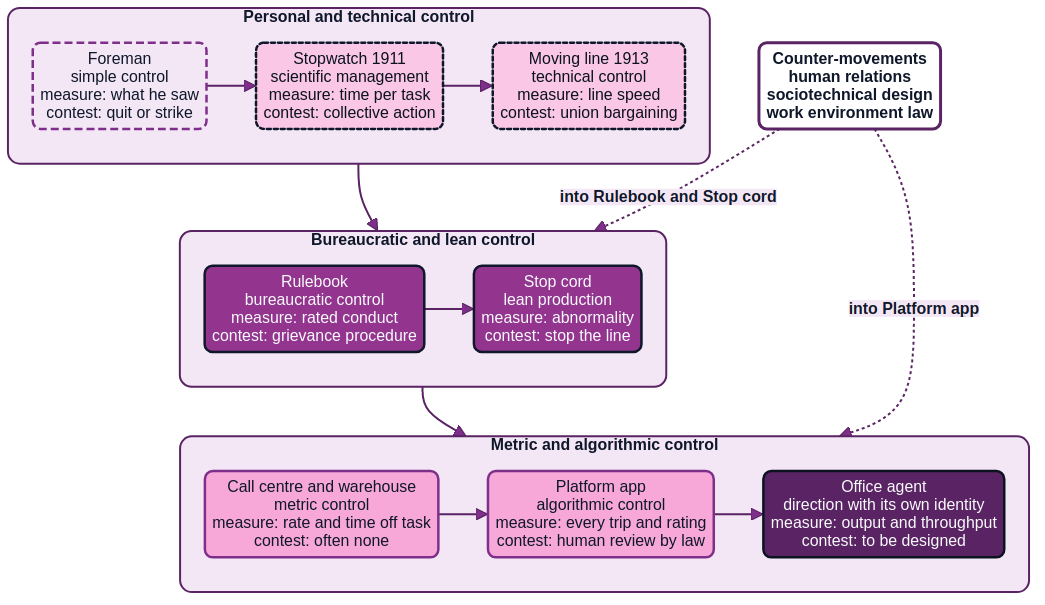
Figure 03.1: A century of managing by measurement, from the foreman to the office agent, with the control regime, the measure and the worker's means of contest at each step.
The foreman and the one best way
Before management was measured it was personal. Richard Edwards called the regime of the nineteenth-century workshop simple control: the owner or the foreman directed work, watched it, hired, paid, disciplined and dismissed, all in person and largely at will (108, Edwards, 1979). All five management functions sat in one person; the worker could leave or act with others.
Frederick Winslow Taylor's The Principles of Scientific Management set out to replace that judgement with measurement. Taylor's diagnosis was "soldiering", workers deliberately restricting output (96, Taylor, 1911), and his remedy gave management four new duties. Managers were to gather "all of the traditional knowledge which in the past has been possessed by the workmen" and reduce it to rules, laws and formulae; to select and train workers scientifically; to cooperate with them so that work followed the science; and to take over "all work for which they are better fitted than the workmen". The central device was the task idea: work planned by management at least a day in advance, with written instructions specifying "not only what is to be done but how it is to be done and the exact time allowed for doing it", with a bonus of 30 to 100 per cent for meeting the task within the time.
In Taylor's best-known illustration, pig iron at the Bethlehem Steel works, the men had loaded about 12.5 tons per man per day, that study showed 47 tons to be "a proper day's work", and a labourer he calls Schmidt reached the new rate for a wage raised from $1.15 to $1.85 a day (96, Taylor, 1911). The figures are Taylor's own account; the logic is the point. The stopwatch measured, the planning department set the standard, the instruction card directed, and pay rewarded compliance. Taylor stated the principle without ambiguity: "In the past the man has been first; in the future the system must be first."
Mapped onto the five functions, scientific management moved M1 Direction from the worker and the foreman to a planning department, made M2 Evaluation a comparison of observed time with a standard time, and coupled both to M3 Consequence through differential pay. M4 Development appeared as selection and training to fit the worker to the task; M5 Care hardly appeared. The assumption was that people respond chiefly to money and, left to themselves, restrict output. Taylor's system was made of clerks and paper, but it was the architecture that algorithmic management would fill with software: planning separated from doing, the plan held by management and the measure held against the person.
The moving line and the five-dollar day
Henry Ford turned Taylor's planning into machinery. In his account, the company first tried a moving assembly line around 1 April 1913, on the flywheel magneto: one worker doing the whole job had taken about twenty minutes per assembly, and spread across twenty-nine operations on a moving line the time fell eventually to five minutes; the motor was divided into eighty-four operations (208, Ford & Crowther, 1922). Edwards called this technical control: direction built into the physical structure of production, so that the line, not the foreman, set the pace (108, Edwards, 1979). M1 Direction had moved into a machine.
The line had a cost that Ford's book states plainly. In 1914 the company had about 14,000 employees and had needed to hire at a rate of about 53,000 a year to keep that number (208, Ford & Crowther, 1922). Its answer, announced in January 1914, was a minimum income of five dollars a day and a working day cut from nine hours to eight. The five dollars were conditional, paid as a share of profits to employees with six months' service who met standards of "cleanliness and citizenship", and the company employed about fifty investigators in its Social Department to check, among other things, that married men lived with and took proper care of their families. Ford himself wrote that "a certain amount of paternalism did develop" and that the plan was readjusted.
The five-dollar day is the first large-scale case here of a recurring pattern: once pay depends on a measure, evaluation spreads to whatever the employer believes predicts it, including conduct outside work. M3 Consequence pulled M2 Evaluation into the home. Technical control assumed that people were interchangeable at a task, and that turnover and conduct were problems for incentive and inspection rather than for the design of the work.
Deskilling and control
Two books of the 1970s gave this history its critical vocabulary. Harry Braverman's Labor and Monopoly Capital argued that scientific management and its successors degraded work by separating its conception from its execution, moving knowledge from the people who did the work into management and its systems (104, Braverman, 1974). His thesis set off a long debate about whether technology necessarily deskills or whether employers, workers and unions shape what it does.
Edwards's Contested Terrain supplied the typology this chapter uses. After simple and technical control came bureaucratic control: direction and evaluation through written rules, job ladders, rated conduct and procedures (108, Edwards, 1979). Bureaucratic control gave workers something the earlier regimes lacked: a rule to appeal to. A grievance procedure or a disciplinary hearing made M3 Consequence contestable, because the decision had to be justified against a text both sides could read. Edwards's title names his thesis: each regime of control is a settlement of a contest between employers and workers, not a neutral improvement.
William Ouchi explained why measurement matters so much to control. Organisations, he argued, can coordinate people through markets, which measure and reward individual contributions precisely; through bureaucracies, which combine close evaluation with accepted common objectives; or through clans, which rely on socialisation when neither output nor behaviour can be measured well (109, Ouchi, 1979). The choice depends on what can be measured. When software makes previously invisible behaviour measurable, the pressure to move from clan-like trust to bureaucratic or market-like control rises, whether or not anyone decides it.
Forty years later, Katherine Kellogg, Melissa Valentine and Angèle Christin used Edwards's frame to synthesise research on algorithms at work, finding six mechanisms of algorithmic control: employers use algorithms to direct workers by restricting and recommending, to evaluate them by recording and rating, and to discipline them by replacing and rewarding (137, Kellogg et al., 2020). The mechanisms map onto M1 Direction, M2 Evaluation and M3 Consequence in that order. Kellogg and colleagues argue that algorithmic control is a form of rational control distinct from the technical and bureaucratic control of the past century, and they name the individual and collective resistance it provokes "algoactivism". The contest Edwards described has moved into the software.
The deskilling debate has a second edge. AI Threat, Chapter 14, concluded that automation erodes the skills of the people who must catch its errors and removes the route by which experts are made (F66) (44, Nordqvist, 2026). When AI performs parts of M1 Direction and M2 Evaluation, the people deskilled may include the managers themselves, which Chapter 19 takes up.
The counter-movements
Each regime of control produced critics who changed practice. The human-relations school grew from the studies at Western Electric's Hawthorne works. Elton Mayo's account argued that output depended on the social life of the working group, on attention and on informal norms, not only on physical conditions and pay (98, Mayo, 1933). Whatever the limits of the studies' method, they made the manager's relationship with people a subject of management, the ground of M4 Development and M5 Care. Douglas McGregor later made the assumption about people explicit. His Theory X described management that assumes people dislike work and must be directed and controlled; Theory Y described management that assumes people will exercise self-direction toward objectives they are committed to (101, McGregor, 1960). Every regime in this chapter, and every AI system that directs work, sits somewhere between the two.
The sociotechnical tradition went further, into the design of work itself. Eric Trist and Ken Bamforth described how the mechanised longwall method in British coal mines broke up the small, largely self-regulating groups of the older methods into specialised tasks spread across shifts (99, Trist & Bamforth, 1951). The lesson drawn was that technical and social systems must be designed together. Job-design research then measured what the tradition had argued. Hackman and Oldham's job characteristics model identified autonomy and feedback from the work itself among the properties that predict motivation and satisfaction (106, Hackman & Oldham, 1976), and Karasek's demand-control model associated high job demands combined with low decision latitude with mental strain (107, Karasek, 1979). Chapter 14 returns to them, because algorithmic pacing can raise demands and narrow latitude at once.
In the Nordic countries the counter-movement became law. The Swedish Work Environment Act (Arbetsmiljölag 1977:1160), in Chapter 2, Section 1, as it now reads, requires that the worker be given the opportunity to take part in shaping their own work situation, that technology and work organisation be designed so that the worker is not exposed to strain that can cause ill health, and that strictly controlled or tied work ("starkt styrt eller bundet arbete") be avoided or limited (75, Sveriges riksdag, 1977). The Co-determination in the Workplace Act (MBL), Section 11, obliges an employer bound by a collective agreement to negotiate with the union before deciding on an important change in its activity or in its members' working conditions (205, Sveriges riksdag, 1976). In Germany, the Works Constitution Act gives the works council a right of co-determination over the introduction and use of technical equipment designed to monitor employees' behaviour or performance (BetrVG §87(1) no. 6) (9, Germany, 2001). These provisions write the counter-movement's settlement as duties: M5 Care as an obligation of design, and voice as a right exercised before a system of control is introduced.
A different counter-movement came from production itself. The Toyota Production System, which Taiichi Ohno describes as resting on just-in-time and autonomation (114, Ohno, 1988), gave line workers a right that technical control had taken away. In Toyota's description, jidoka is "automation with a human touch": when an abnormality occurs, a machine stops automatically or an operator pulls the stop cord, the andon board lights up, and people respond to the problem (209, Toyota Motor Corporation, n.d.). Among his fourteen points, W. Edwards Deming wrote that work standards (quotas) on the factory floor should be eliminated and leadership substituted, as should management by objective and management by numbers (113, Deming, 1986). This chapter does not claim lean production as humane; it has been practised in many ways. Its lesson is narrower: it gave the person at the line a right to stop it, and treated a deviation as a signal about the system rather than a verdict on a person.
The control revolution and the smart machine
James Beniger placed these developments in a longer frame. In his account, the application of steam power in the early nineteenth century raised the speed, volume and complexity of industrial processes beyond the capacity of existing means to control them; between the 1840s and the 1920s came most of the information-processing and communication technologies still in use, from telegraphy and modern bureaucracy to the punch card, and he called that response the control revolution (112, Beniger, 1986). Seen this way, whenever production outruns the ability to coordinate it, organisations invest in information processing as a means of control, and algorithmic management is the latest stage, prompted by work dispersed across platforms, sites and screens that no supervisor can see.
Shoshana Zuboff's study of computerisation in American workplaces in the 1980s added a distinction that remains the most useful in the literature. Information technology, she argued, does not only automate work; it also informates it, producing a record of the work that makes it visible and can be read (115, Zuboff, 1988). Who reads that record, and for what, is a choice. The same data that could let workers understand and improve their process could let managers watch them; Zuboff's fieldwork described both, and the panoptic possibility recalls Foucault's account of discipline through constant visibility (105, Foucault, 1977). In the terms of this book, the record of the work can feed M4 Development, by giving the worker and the team information to learn from, or M2 Evaluation, by giving management a score per person, and only a design decision determines which.
Call centres, warehouses and the quantified workplace
The immediate ancestors of the AI boss appeared where work was mediated by a screen or a scanner. Phil Taylor and Peter Bain, drawing on two surveys of call centres in Scotland in 1997, during the rapid growth of call centres in the United Kingdom, described the work in the title of their article as "an assembly line in the head" (210, Taylor & Bain, 1999). The phrase captures the transfer of technical control from the moving line to the telephone system: software queues and distributes the calls, and what it records becomes the basis of M2 Evaluation.
Warehouses carried the pattern further. In 2019 The Verge reported a letter from a lawyer representing Amazon in a labour dispute, which stated that the company's system "tracks the rates of each individual associate's productivity" and "automatically generates any warnings or terminations regarding quality or productivity without input from supervisors"; Amazon said that supervisors could override the process, and a spokesperson said that roughly 300 full-time associates at one Baltimore fulfilment centre had been terminated for inefficiency between August 2017 and September 2018 (187, Lecher, 2019). The same report described the tracking of "time off task". Chapter 6 treats the warehouse in detail, including Alessandro Delfanti's study (140, Delfanti, 2021) and a United States Senate majority staff report on speed and injury (202, U.S. Senate Committee on Health et al., 2024). For the history, the warehouse is the first well-documented case in which a measure computed per person by software was connected, by design, to M3 Consequence.
Karen Levy's study of American truck drivers showed fleet-management systems that record and transmit fine-grained data about location and behaviour, which let remote dispatchers evaluate drivers on new metrics and challenge the drivers' own accounts of road and bodily conditions (128, Levy, 2015). Two findings qualify the belief that more measurement brings more performance. Ethan Bernstein's field experiment at a large mobile-phone factory in China found that a modest increase in privacy for production lines improved line performance significantly and sustainably, because constantly observed workers concealed the local experiments through which they improved the process (122, Bernstein, 2012). Avraham Kluger and Angelo DeNisi's meta-analysis of feedback interventions, covering 607 effect sizes and 23,663 observations, found that feedback improved performance on average but that more than a third of the interventions decreased it, and that effectiveness fell as feedback drew attention away from the task and toward the self (116, Kluger & DeNisi, 1996). Neither finding says that measurement is harmful; both say that its effect depends on who sees it and what it is used for.
The algorithm as manager
The term algorithmic management entered the research literature with a study of ride-hailing drivers. Min Kyung Lee and colleagues studied Uber and Lyft drivers whose jobs were "assigned, optimized, and evaluated through algorithms and tracked data", and how they used online forums to make sense of the software together (127, Lee et al., 2015). Alex Rosenblat and Luke Stark's nine-month study of Uber drivers concluded that the application's information and power asymmetries were fundamental to the company's control of nominally independent drivers (130, Rosenblat & Stark, 2016). Alex Wood and colleagues, interviewing 107 remote gig workers in six countries and surveying 679, found that algorithmic control offered flexibility, autonomy and task variety, and could also result in low pay, social isolation, irregular hours, overwork, sleep deprivation and exhaustion (134, Wood et al., 2019). Mareike Möhlmann and colleagues distinguished two uses of the same platform algorithms, matching and control (138, Möhlmann et al., 2021).
Data & Society's explainer defined algorithmic management as "a diverse set of technology tools and techniques that structure the conditions of work and remotely manage workforces", relying on data collection and surveillance of workers (133, Mateescu & Nguyen, 2019). A joint report of the International Labour Organization and the European Commission's Joint Research Centre found algorithmic management practices expanding into regular workplaces, with case studies in logistics and healthcare in France, Italy, India and South Africa (147, International Labour Organization, 2024). An OECD survey of more than 6,000 firms in France, Germany, Italy, Japan, Spain and the United States found algorithmic management tools already in common use in most of the countries studied; managers reported better decisions and job satisfaction, and also cited unclear accountability, difficulty following the tools' logic and inadequate protection of workers' health (149, Milanez et al., 2025). Eurofound's literature review traces the implications for work, employment and social dialogue (150, Riso et al., 2025).
The latest step moved the AI boss into the office. Microsoft's Work Trend Index for 2025 predicted that "every employee becomes an agent boss", someone who "builds, delegates to, and manages agents" (151, Microsoft, 2025). That is a supplier's forecast: expected for the spread of agents in knowledge work, speculation for "every employee". Chapter 10 examines the office; Chapter 16 the person who manages agents.
What is new
Algorithmic management is in one respect entirely familiar. Its ambition is Taylor's: to know the work better than the worker, plan it centrally, measure it against a standard and connect the measure to pay and employment. Its contest is Edwards's. What changes is the medium, which brings three properties no earlier regime combined.
The first is scale and speed. Taylor's planning department planned a day ahead for each worker; a dispatch algorithm re-plans continuously for thousands of people, and evaluation runs on every recorded action. A supervisor who reviews each case cannot keep pace. AI Governance, Chapters 10 and 21, concluded that human oversight must be designed, not declared, and that approvals given in seconds signal rubber-stamping (F21) (41, Nordqvist, 2026). The warning applies to every manager who approves a roster or accepts an allocation.
The second is opacity. Taylor's instruction card, Ford's line speed and a bureaucratic rule could all be read by the people they governed. A ranking produced by a statistical model is often unreadable by the worker and, as the OECD survey found, sometimes by the manager who uses it (149, Milanez et al., 2025). The asymmetry Rosenblat and Stark documented is part of how the control works (130, Rosenblat & Stark, 2016), and it removes the precondition of bureaucratic contest, a criterion both sides can read.
The third is consequence without a human decision. In every earlier regime a person made the consequence decision, however perfunctorily. The warehouse letter of 2019 described warnings and terminations generated by a system "without input from supervisors" (187, Lecher, 2019). The Platform Work Directive requires that any decision to restrict, suspend or terminate the contractual relationship or the account of a person performing platform work, or any other decision of equivalent detriment, be taken by a human being (Directive (EU) 2024/2831, Article 10(5)), and Member States must transpose it by 2 December 2026 (Article 29) (47, European Union, 2024). The AI Act lists as high-risk AI systems intended to make decisions affecting terms of work-related relationships, promotion or termination, to allocate tasks based on individual behaviour or personal traits, or to monitor and evaluate performance and behaviour (Annex III, point 4(b)), and requires deployers who are employers to inform workers' representatives and the affected workers before putting such a system into service or using it at the workplace (Article 26(7)) (1, European Union, 2024). Under the Digital Omnibus, the high-risk obligations for Annex III systems apply from 2 December 2027 (2, European Union, 2026). These are organisational implications, not legal advice; Part V treats them.
A fourth property is emerging: direction by an agent with an identity and permissions of its own. The only precedent is the moving line, which also directed work without a person giving instructions, but could not re-plan, choose between workers or report on anyone. An agent can do all three. The series' rule for agents, "agents draft; humans approve", with exceptions carrying a named human approval in the audit trail (Architecture as Code (Chapter 20); F12) (165, Lee, 2018), was written for agents acting on systems. Applied to agents acting on people, it becomes this book's thesis: AI may direct work, but a consequence for a person needs a named human decider. Chapter 4 turns that into degrees of delegation per function.
Worked example: control regimes from foreman to agent
The table compares the regimes of this chapter on the questions that recur in every later chapter. It is illustrative: each row compresses a large literature into a line, and the sources are those cited above.
| Regime | Typical period | What was measured | Functions held by the system | Who decided consequences | How a worker could contest | What it assumed about people |
|---|---|---|---|---|---|---|
| Simple control | Nineteenth-century workshop | What the foreman saw | None | Foreman or owner, at will | Leave or act collectively | Loyalty and fear motivate |
| Scientific management | From 1911 | Time per task against a standard | M1 planned centrally; M2 by stopwatch; M3 by differential pay | Management, by rule linked to the standard | Collective action against the standard | Money motivates; output is restricted unless measured |
| Technical control | From 1913 | Line speed and output | M1 built into the machine | Management; conduct also inspected for pay | Union bargaining over speed | Workers are interchangeable at a task |
| Bureaucratic control | Mid-twentieth century | Rated conduct against written criteria | M2 and M3 by procedure | Supervisor within written rules | Grievance and disciplinary procedures | Fair rules secure cooperation |
| Lean production | From the 1950s | Abnormalities and flow | M1 standardised; stop right with the worker | Management | Pull the stop cord; improvement proposals | Workers improve the system they work in |
| Metric control | 1990s to 2010s | Handling time, rate, time off task | M1 by software queues; M2 per person; M3 in some cases generated automatically | Supervisor, or a system with supervisor override | Often none in practice | Visible effort is effort |
| Algorithmic control | From the 2010s | Every trip, task, rating and pause | M1, M2 and parts of M3 in the platform | Platform; by law in the EU a human for suspension and termination | Explanation and human review under the Platform Work Directive | Workers are independent yet steerable by information |
| Agent direction | From the mid-2020s | Output, throughput, task status | M1 by an agent with its own identity; M2 inputs | To be designed: a named human decider | To be designed: records and appeal | Open: the book's question |
Nordvik Region turned the lesson into a decision record when it reviewed the history of one measure before its home-care dashboards computed it per person. The record is illustrative and follows the series' AI Decision Record form.
# Illustrative: Nordvik Region, decisions/AIDR-0624-time-per-visit-lineage.yaml
aidr_id: AIDR-0624
title: Lineage review of the home-care time-per-visit measure
status: accepted
date: 2027-01-18
organisation: Nordvik Region
parent_record: AIDR-0600
decision_owner: HR director (Ingrid Halvorsen)
consulted:
  - Unit manager, Strandvik home-care unit (Mikael Strand)
  - Union for municipal and care workers, local representative
  - Data protection officer
  - Chair, central work-environment committee
system:
  name: Home-care performance dashboards
  delegation_profile: DLG-NR-HCD-01
  usage_mode: Mode 4 Built AI applications
measure_lineage:
  - period: planned visit times agreed with the municipalities
    regime: bureaucratic control
    unit_of_measure: visit type, per municipality
    used_for: [M1 Direction]
  - period: visit-registration app and dashboards
    regime: algorithmic control
    unit_of_measure: visit, route and person
    used_for: [M1 Direction, M2 Evaluation]
risk_identified: >
  A planning standard is becoming a per-person figure. The history of
  rate and time-off-task metrics shows such figures drifting into pay
  and discipline once they exist.
decision:
  m2_evaluation_level: Level 0 Advisory
  m3_consequence: not an input to pay, discipline or dismissal
  variance_rule: a route above planned time for four consecutive weeks
    triggers a review of the planned times first, not of the person
  worker_access: each worker sees their own figures and the planned times
  contest_path: contestation record CNT-NR-* within 14 days
review:
  next_review: 2027-06-30
  reopen_if: the figure is proposed as an input to any M3 Consequence decision
The record names the regime the measure came from and the one it is entering, closes the drift from M2 Evaluation into M3 Consequence in advance, and directs attention first to the standard rather than the person.
When the measure becomes the target
The measurement literature explains why the drift recurs. Donald Campbell, writing about the evaluation of social programmes, stated what he called a pessimistic law: "The more any quantitative social indicator is used for social decisionmaking, the more subject it will be to corruption pressures and the more apt it will be to distort and corrupt the social processes it is intended to monitor" (110, Campbell, 1979). Jerry Muller's The Tyranny of Metrics traces the same pattern across institutions: metric fixation, the belief that measured performance can replace judgement, combined with rewards and penalties tied to the measure, produces gaming and the neglect of what is not measured (123, Muller, 2018).
Taylor's own account began with workers who had learnt to keep the measure low (96, Taylor, 1911); Ford's evaluation reached into homes once pay depended on it (208, Ford & Crowther, 1922); Bernstein's factory workers hid their best improvements from observation (122, Bernstein, 2012); warehouse workers were reported to avoid breaks to keep time off task down (187, Lecher, 2019); platform drivers developed the collective tactics Kellogg and colleagues call algoactivism (137, Kellogg et al., 2020). Each response is rational for the person measured, and each degrades the information the measure was meant to provide.
AI makes the mechanism harder to see. Under scientific management a person chose the standard, which could be read and disputed. A model trained to optimise a target selects proxies from the data, and the proxy that drives direction or evaluation may not be named in any document. In home care the purpose is good care delivered safely; the planned time per visit is a proxy for the resources that care needs; the actual time per visit is a proxy for the proxy. When a system computes the last figure per person, the history predicts that it will be gamed and that unmeasured care will be squeezed. The response the history supports is not to abandon measurement but to keep the measure in M1 Direction and in improvement, where Deming placed it (113, Deming, 1986), and to require a human judgement and a record wherever it touches M3 Consequence.
What history teaches and what it cannot
Five lessons carry over from the century to the AI boss, and each is the book's own conclusion from the sources above.
The first is that every regime that measured more eventually needed a way for the measured to contest: simple control had only exit, bureaucratic control produced the grievance procedure, lean production gave the stop cord, and the Platform Work Directive gives explanation and human review. Algorithmic management without a contest path is a return to the foreman's arbitrariness at software scale.
The second is that measures built for M1 Direction and M2 Evaluation drift into M3 Consequence unless the drift is closed in advance. Taylor's bonus, Ford's conditional profit share and the warehouse's automated warnings are points on one line. The series already has the instrument: AI Threat, Chapter 26, concluded that small delegations add up to a loss that only a register of the whole can show (F69) (44, Nordqvist, 2026), and a delegation register can record, per system and function, what a measure may be used for.
The third is that M4 Development and M5 Care were recovered by counter-movements, not given by the regimes that measured: by research that measured harm, by collective agreements and by law such as the Swedish Work Environment Act, the MBL and BetrVG §87(1) no. 6. Those instruments apply to software, and they work best as the starting point of design rather than a final hurdle.
The fourth is that visibility cuts both ways. Zuboff, Bernstein, and Kluger and DeNisi show that the effect of a record depends on who reads it and what follows. Whether data serves learning or a score per person is a decision, and it should be recorded as one.
The fifth is that the right to stop was a design choice. Toyota put it with the person at the line (209, Toyota Motor Corporation, n.d.); an organisation can give the people an AI boss manages, and their line manager, a comparable right to halt a direction that is unsafe or wrong.
History cannot answer four questions the past did not face: how oversight works when decisions arrive faster than any person can review them (Chapter 26); how to contest a ranking no one can fully explain (Chapter 27); what happens when agents direct agents, or people manage agents and are directed by them (Part IV); and whether algorithmic management works over years rather than quarters, in productivity, quality, health and retention as well as output. AI Threat, Chapter 14, left the last question open, and this book records it as Q4 (44, Nordqvist, 2026); any claim about the long-run answer is speculation, and Chapter 15 sets out the shorter-run evidence.
Following the horizon discipline of AI Governance, Chapter 22, the outlooks carry labels (F32) (41, Nordqvist, 2026). Algorithmic management in platforms, warehouses, logistics, healthcare and offices is observable. Transposition of the Platform Work Directive by 2 December 2026 and application of the AI Act's Annex III obligations from 2 December 2027 are expected. Agents directing a large share of office work is speculation in the form Microsoft states it.
Practical guide: tracing the lineage of a measure before AI computes it per person
Purpose. Before an AI system computes an existing measure per person, or acts on it, establish where the measure came from and which management function it is about to enter.
Roles. The system owner, the line manager, an HR business partner, the union or works-council representative, the data protection officer and at least one worker whose work the measure describes.
Steps.
- Name the measure, its unit, its source system and the decision or display it will feed.
- Write its lineage: when it was introduced, by whom, for which purpose and at which unit of aggregation (team, route, visit type or person).
- Place the old and the new use on the five management functions. Flag any move into M2 Evaluation of a person and any path, direct or indirect, into M3 Consequence.
- Identify each use's control regime from the table in this chapter and the means of contest under the old regime; if the new use removes one, record its replacement.
- Ask the worker and the representative how the measure could be gamed and what unmeasured work it could squeeze; record the answers as risks.
- Decide the degree of delegation for each function the measure touches, following Chapter 4, and state explicitly whether the measure may be an input to any M3 Consequence decision. The default is that it may not until a Management Decision Record process and an appeal path exist (Chapters 25 and 27).
- Set a variance rule that reviews the standard before the person, as in AIDR-0624, and a review date no later than twelve months ahead.
- Before go-live, complete the information and negotiation steps that apply: Article 26(7) of the AI Act where the system is high-risk, MBL §11 or BetrVG §87(1) no. 6 where national law requires it, and the collective or works agreement. Adapt the defaults in steps 6 and 7 to that agreement.
Definition of done. A decision record names the measure, its lineage, the functions it may feed and at which degree, the variance rule, the contest path and the review date, and the workers' representatives have seen it before go-live.
Across the usage modes
Earlier regimes had no usage modes, but each mode reproduces one of them, and the comparison shows where the new properties enter.
| Usage mode | Historical analogue | Regime reproduced | What is new |
|---|---|---|---|
| Mode 0 Ambient AI | The clerk who files observations nobody asked for | Metric control by default | Measures switched on by a supplier's release, not by a decision |
| Mode 1 Conversational assistants | The manager's notebook | Simple control, with the manager's judgement | A drafted assessment of a person that reads as authoritative |
| Mode 2 Embedded workplace assistants | The supervisor's tally sheet | Bureaucratic control, informal | Summaries and task lists that assign owners by default |
| Mode 3 Agentic work tools | The planning clerk | Scientific management, at the manager's request | Plans executed under the manager's identity at speed |
| Mode 4 Built AI applications | The planning department and its rulebook | Bureaucratic and technical control in software | Scale, speed and opacity of the rules |
| Mode 5 Autonomous production agents | The moving line | Technical control | Direction that can re-plan, choose between people and report, with an identity of its own |
Nordvik Region and Hansa Mutual
Nordvik Region's home-care service has measured visits for a decade through planned visit times agreed with the municipalities it serves. That was bureaucratic control: a written standard per visit type, used to plan routes and account to the municipalities. The visit-registration app and the time-per-visit dashboard turn that standard into a figure per visit, route and person: the step from bureaucratic to algorithmic control. Mikael Strand, who manages the Strandvik unit's about 35 staff, can now see individual figures under DLG-NR-HCD-01 at Level 0 Advisory. AIDR-0624 records the Region's decision to keep those figures out of M3 Consequence, to review planned times before people, and to give each worker their own figures and a contest path. The Region's co-determination model gives the unions a right to negotiate such a change before it is made.
Hansa Mutual's claims operation has long measured handling time and backlog per team. The claims-triage agent, a Mode 5 Autonomous production agents system, adds what the history marks as new: M1 Direction of individual handlers by an agent with an identity of its own, and throughput figures per handler as a per-person input to M2 Evaluation. The group works agreement KBV-IT-2024 confines individual figures to team leaders such as Jana Petersen in Hamburg, a settlement reached under BetrVG §87(1) no. 6 that Thomas Brandt, chair of the Konzernbetriebsrat, negotiated. Whether the agent's allocation function is high-risk under Annex III, point 4(b), is the question of AIDR-0651. The two differ in where their AI boss stands in the lineage: Nordvik's is a Mode 4 application reproducing bureaucratic control in software; Hansa's includes a Mode 5 agent with no precedent beyond the moving line.
Summary
Algorithmic management has a history of more than a century: the foreman's simple control, scientific management's separation of planning from doing, the line's technical control, the rulebook's bureaucratic control, lean production's stop cord, per-person metrics in call centres and warehouses, and now platforms and agents that direct, evaluate and sometimes sanction through software. At every step M1 Direction and M2 Evaluation were measured and handed to a system first, and M3 Consequence followed whenever the measure was tied to pay or employment.
The counter-movements, from human relations and sociotechnical design to Nordic and German work law, recovered M4 Development and M5 Care and gave workers voice before change, through instruments that still apply to software. The measurement literature, from Campbell's law to the tyranny of metrics, explains why a measure that is used to decide about people distorts the work it was meant to describe.
What is new is a combination of three properties: direction and evaluation at the scale and speed of software, opacity to the people managed and the possibility of a consequence without a human decision, with a fourth emerging in agents that direct work with identities of their own. European law has begun to respond, in Article 10(5) of the Platform Work Directive and Annex III, point 4, of the AI Act. The claim that algorithmic management is Taylorism plus these properties is the book's interpretation, which Part II tests.
The history teaches that every measuring regime needed a contest path, that measures drift from direction into consequence unless the drift is closed in advance, that care and voice were won rather than given, that visibility serves learning or control by design, and that the right to stop is a design choice. It cannot answer the questions of machine speed, unexplainable rankings, agents managing agents and long-run effects. Chapter 4 turns these lessons into the book's working instruments: a definition of the AI boss, degrees of delegation per management function, the rule that Level 4 Autonomous is never used for M3 Consequence, and the records that make accountability visible.
Sources
- Taylor, F. W. (1911). The Principles of Scientific Management. Harper & Brothers. (96, Taylor, 1911)
- Ford, H. & Crowther, S. (1922). My Life and Work. Doubleday, Page & Company. (208, Ford & Crowther, 1922)
- Edwards, R. (1979). Contested Terrain: The Transformation of the Workplace in the Twentieth Century. Basic Books. (108, Edwards, 1979)
- Braverman, H. (1974). Labor and Monopoly Capital: The Degradation of Work in the Twentieth Century. Monthly Review Press. (104, Braverman, 1974)
- Ouchi, W. G. (1979). A Conceptual Framework for the Design of Organizational Control Mechanisms. Management Science. (109, Ouchi, 1979)
- Kellogg, K. C., Valentine, M. A. & Christin, A. (2020). Algorithms at Work: The New Contested Terrain of Control. Academy of Management Annals. (137, Kellogg et al., 2020)
- Nordqvist, G. (2026). AI Threat: Are the Dystopias Coming True? Evidence, Risk and Response for European Enterprises and Public Authorities. aithreat.geon.se. (44, Nordqvist, 2026)
- Mayo, E. (1933). The Human Problems of an Industrial Civilization. Macmillan. (98, Mayo, 1933)
- McGregor, D. (1960). The Human Side of Enterprise. McGraw-Hill. (101, McGregor, 1960)
- Trist, E. L. & Bamforth, K. W. (1951). Some Social and Psychological Consequences of the Longwall Method of Coal-Getting. Human Relations. (99, Trist & Bamforth, 1951)
- Hackman, J. R. & Oldham, G. R. (1976). Motivation through the design of work: Test of a theory. Organizational Behavior and Human Performance. (106, Hackman & Oldham, 1976)
- Karasek, R. A. (1979). Job Demands, Job Decision Latitude, and Mental Strain: Implications for Job Redesign. Administrative Science Quarterly. (107, Karasek, 1979)
- Sveriges riksdag (1977). Arbetsmiljölag (1977:1160). Riksdagen. (75, Sveriges riksdag, 1977)
- Sveriges riksdag (1976). Lag (1976:580) om medbestämmande i arbetslivet. Riksdagen. (205, Sveriges riksdag, 1976)
- Federal Republic of Germany (2001). Betriebsverfassungsgesetz (BetrVG). Gesetze im Internet. (9, Germany, 2001)
- Ohno, T. (1988). Toyota Production System: Beyond Large-Scale Production. Productivity Press. (114, Ohno, 1988)
- Toyota Motor Corporation (n.d.). Toyota Production System. Toyota Motor Corporation official global website. (209, Toyota Motor Corporation, n.d.)
- Deming, W. E. (1986). Out of the Crisis. MIT Center for Advanced Engineering Study. (113, Deming, 1986)
- Beniger, J. R. (1986). The Control Revolution: Technological and Economic Origins of the Information Society. Harvard University Press. (112, Beniger, 1986)
- Zuboff, S. (1988). In the Age of the Smart Machine: The Future of Work and Power. Basic Books. (115, Zuboff, 1988)
- Foucault, M. (1977). Discipline and Punish: The Birth of the Prison. Pantheon Books. (105, Foucault, 1977)
- Taylor, P. & Bain, P. (1999). 'An assembly line in the head': work and employee relations in the call centre. Industrial Relations Journal. (210, Taylor & Bain, 1999)
- Lecher, C. (2019). How Amazon automatically tracks and fires warehouse workers for 'productivity'. The Verge. (187, Lecher, 2019)
- Delfanti, A. (2021). The Warehouse: Workers and Robots at Amazon. Pluto Press. (140, Delfanti, 2021)
- U.S. Senate Committee on Health, Education, Labor and Pensions, Majority Staff (2024). The "Injury-Productivity Trade-off": How Amazon's Obsession with Speed Creates Uniquely Dangerous Warehouses. U.S. Senate. (202, U.S. Senate Committee on Health et al., 2024)
- Levy, K. E. C. (2015). The Contexts of Control: Information, Power, and Truck-Driving Work. The Information Society. (128, Levy, 2015)
- Bernstein, E. S. (2012). The Transparency Paradox: A Role for Privacy in Organizational Learning and Operational Control. Administrative Science Quarterly. (122, Bernstein, 2012)
- Kluger, A. N. & DeNisi, A. (1996). The effects of feedback interventions on performance: A historical review, a meta-analysis, and a preliminary feedback intervention theory. Psychological Bulletin. (116, Kluger & DeNisi, 1996)
- Lee, M. K., Kusbit, D., Metsky, E. & Dabbish, L. (2015). Working with Machines: The Impact of Algorithmic and Data-Driven Management on Human Workers. CHI 2015. (127, Lee et al., 2015)
- Rosenblat, A. & Stark, L. (2016). Algorithmic Labor and Information Asymmetries: A Case Study of Uber's Drivers. International Journal of Communication. (130, Rosenblat & Stark, 2016)
- Wood, A. J., Graham, M., Lehdonvirta, V. & Hjorth, I. (2019). Good Gig, Bad Gig: Autonomy and Algorithmic Control in the Global Gig Economy. Work, Employment and Society. (134, Wood et al., 2019)
- Möhlmann, M., Zalmanson, L., Henfridsson, O. & Gregory, R. W. (2021). Algorithmic Management of Work on Online Labor Platforms: When Matching Meets Control. MIS Quarterly. (138, Möhlmann et al., 2021)
- Mateescu, A. & Nguyen, A. (2019). Explainer: Algorithmic Management in the Workplace. Data & Society. (133, Mateescu & Nguyen, 2019)
- International Labour Organization (2024). Algorithmic management practices in regular workplaces are already a reality. ILO. (147, International Labour Organization, 2024)
- Milanez, A., Lemmens, A. & Ruggiu, C. (2025). Algorithmic management in the workplace: New evidence from an OECD employer survey. OECD Publishing. (149, Milanez et al., 2025)
- Riso, S., Adăscăliţei, D. & Oosterwijk, G. R. (2025). Implications of algorithmic management for work, employment and social dialogue: Literature review. Eurofound. (150, Riso et al., 2025)
- Microsoft (2025). 2025: The Year the Frontier Firm Is Born. Work Trend Index Annual Report. (151, Microsoft, 2025)
- Nordqvist, G. (2026). AI Governance: Governing Artificial Intelligence in European Enterprises and Public Authorities. aig.geon.se. (41, Nordqvist, 2026)
- European Parliament and Council of the European Union (2024). Directive (EU) 2024/2831 on improving working conditions in platform work. Official Journal of the European Union. (47, European Union, 2024)
- European Parliament and Council of the European Union (2024). Regulation (EU) 2024/1689 (Artificial Intelligence Act). Official Journal of the European Union. (1, European Union, 2024)
- European Parliament and Council of the European Union (2026). Regulation (EU) 2026/1744 (Digital Omnibus on AI). Official Journal of the European Union. (2, European Union, 2026)
- Nordqvist, G. (2025). Architecture as Code. aac.geon.se. (40, Nordqvist, 2025)
- Campbell, D. T. (1979). Assessing the impact of planned social change. Evaluation and Program Planning. (110, Campbell, 1979)
- Muller, J. Z. (2018). The Tyranny of Metrics. Princeton University Press. (123, Muller, 2018)