Nordvik Region and Hansa Mutual: Conclusions for Two Organisations
In November 2026 two governing bodies asked the same question about the same thing. Nordvik Region's HR director, Ingrid Halvorsen, was commissioned, with the regional director's endorsement, to govern algorithmic management across the Region's about 6,000 staff and to report to the regional executive committee by 30 June 2027, a commission recorded as AIDR-0600. A week later Hansa Mutual's executive board asked the chief HR officer and the chief risk officer for a group policy on AI in management, with the Konzernbetriebsrat invited to the review and a first report due on 30 April 2027, a request recorded as AIDR-0650. Every chapter since has shown part of the work that followed, and Chapter 30 told it as a year through the eyes of Ingrid Halvorsen, Mikael Strand, Jana Petersen and Thomas Brandt.
This chapter draws that work together. For each organisation it states a conclusion per management function: what AI touches, at which degree of delegation, who decides, which records exist, which contest paths have been used and what the oversight figures showed. It names the three decisions each organisation got right and the two it got wrong or has still to make, states the answer each gives to the body that asked, and records a prioritised 24-month plan as an artefact. It then compares a public authority that mostly procures and negotiates under a co-determination act on the pattern of the Swedish MBL with a mutual group that mostly builds and answers to a Konzernbetriebsrat and six other national arrangements, and ends with a short list of lessons for other organisations. As a chapter of Part VII it concludes all five management functions: M1 Direction, M2 Evaluation, M3 Consequence, M4 Development and M5 Care.
Both organisations are fictional, and every decision here is a decision within the illustration; the legal instruments that bind them are real. The outcomes of their plans are expected, not observed, and each plan names the signals on which it would be revised.
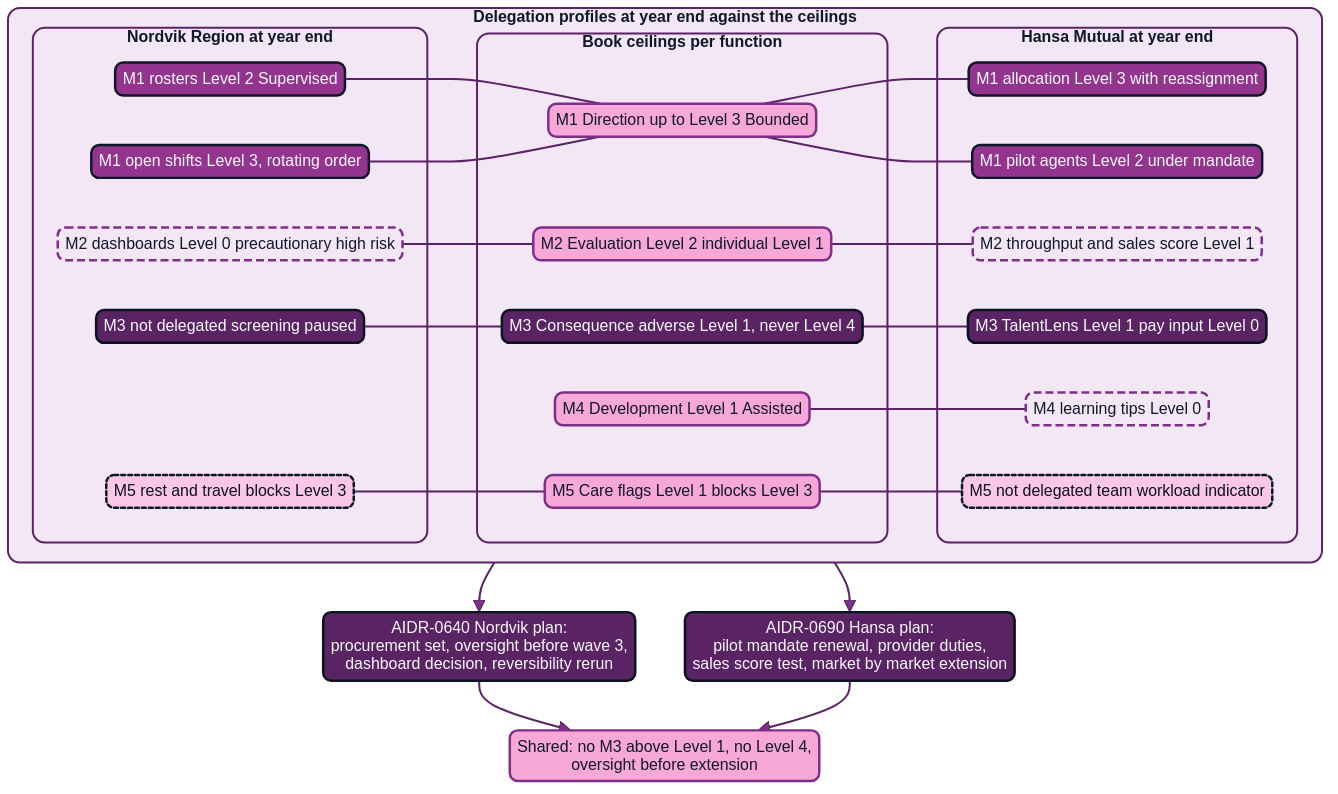
Figure 32.1: The two delegation profiles at the end of the year against the book's ceilings, and the two 24-month plans. Nordvik stays below every ceiling and keeps M3 Consequence empty; Hansa reaches the M1 Direction ceiling for allocation and holds its consequence systems at Level 1 Assisted or below. Nordvik's plan begins with procurement and oversight before the third home-care wave; Hansa's begins with the pilot's mandate and the provider duties for allocation, and extends anything beyond Germany only through each entity's gate.
One question, two answers
Both bodies asked who should hold management decisions when AI already takes part in them. They asked it from different places, and the difference shaped every answer.
The commission to Ingrid Halvorsen came after a pause. In September 2026 the Region had stopped its recruitment-screening pilot because the union for municipal and care workers asked how the ranking was made and the supplier could not show it (AIDR-0601). ShiftWise, procured under tender NR-2025-089 and already high-risk under AI Act Annex III, point 4(b), was about to draft routes in home care, and the time-per-visit dashboards had been built in house without anyone deciding what they were for. The commission asked for governance of something the Region had mostly bought, for a committee of elected members.
The request to Hansa came from an estate in which AI already directed people: the claims-triage agent allocated claims, TalentLens ranked applicants, the sales score fed variable pay, and the agent-boss pilot HM-AB-PILOT-01 was to start in January 2027. The board asked for one policy across seven markets, two of them outside the AI Act.
This book builds on the conclusion of AI Governance, Chapter 13, that governance as code does not remove forums but changes what they are for: pipelines enforce, observe and remember, while forums decide what pipelines cannot, such as appetite, policy, exceptions and residual risk (F18) (41, Nordqvist, 2026). In both answers the profiles and records became the pipeline, and the elected committee, the board, the unions and the Konzernbetriebsrat remained the forums that decide what may be delegated at all.
Nordvik Region: the answer to the regional executive committee
Function by function at the end of the year
M1 Direction. ShiftWise drafts four-week rosters for the wards and visit schedules and routes for home care at Level 2 Supervised under DLG-NR-ROS-01, negotiated with the union for nurses and midwives and the union for municipal and care workers on 20 January 2027 (AIDR-0602). Unit managers such as Mikael Strand approve every roster, and MDR-NR-0001, the Strandvik roster for the four weeks from 8 February 2027, records the three shifts he changed and the seventeen days' notice. One class runs at Level 3 Bounded: open shifts offered to staff who opted in, in a published rotating order and never ranked. The staff assistant and the embedded assistant pilot propose action lists at Level 0 Advisory under DLG-NR-SA-01, and after the December 2026 sample found nine of 48 action items with owners the chair had not confirmed, a summary with unconfirmed owners can no longer be distributed (Chapter 10). The oversight record for February to May 2027 showed seven approvers, 26 rosters, a median of 12 minutes from opening to approval and ten of fourteen seeded faults found, a catch rate of 0.71 against a floor of 0.85, and a screen on which eleven rest-rule flags could be closed with one click (Chapter 26).
M2 Evaluation. The home-care dashboards show planned against actual time per visit and route at Level 0 Advisory under DLG-NR-HCD-01, with individual figures to the unit manager only and barred from pay reviews and disciplinary matters. Location traces between visits were removed after the proportionality review (Chapter 13), and because individual monitoring is profiling, the Region treats the dashboards as high-risk under Annex III, point 4(b), as a precaution and accepts the provider's duties that follow from having built them (Chapter 21). No oversight figures exist for them, because no decision is taken on them.
M3 Consequence. Nothing in the register reaches it. The recruitment-screening module remains paused under AIDR-0601, pay is set by line managers in annual reviews under the collective agreements, and the decision-rights file DRF-NR-01 keeps hiring, pay and discipline without any delegation and sets the Region's own M3 ceiling at Level 1 Assisted, stricter than the book's. Open-shift offers touch access to work, which is why the Region keeps them in a published rotating order that uses nothing about the person, and tests them: the fairness review DIT-NR-ROS-01 found hourly staff receiving offers at a ratio of 0.66, traced it to a competence filter for delegated medication administration and agreed training places with the union, with a re-test in June 2027 (Chapter 12).
M4 Development. No system is delegated any part of it. Deputies in each home-care unit plan one week a month by hand, the unit manager's development conversation records the rosters changed and why, and Mikael Strand's competence record CMP-NR-MGR-01 is the first under the framework NR-MGR-CF (Chapter 19).
M5 Care. ShiftWise flags rest-rule breaches at Level 1 Assisted and, after CNT-NR-0001, blocks a roster that breaches minimum rest or the travel-time constraint at Level 3 Bounded: routed time plus five minutes and never under ten, with a 30-minute break after six hours, in the risk assessment WRA-NR-HC-01 revision 2 of 11 March 2027 (Chapter 14). That contest is the one used path so far. It was lodged on the second day of routes in Strandvik, corrected the next morning and closed when the rule fix was verified on 25 March 2027, and it led AIDR-0631 to send contests to someone other than the approver and to set one time limit: ten working days and never later than fourteen calendar days (Chapter 27).
Three decisions the Region got right
The first was to pause rather than defend. A public authority with a duty to give reasons could not deploy a ranking it could not explain, and Ingrid Halvorsen stopped the screening pilot before she had a commission to do so. The pause cost the Region a tool and gained it a requirement for every tender.
The second was to negotiate the delegation profile before go-live and to agree how it would change afterwards. Under the Region's co-determination act, which follows the Swedish MBL, the employer must negotiate on its own initiative before deciding on an important change in its activity or in the conditions of employment (MBL §11) (205, Sveriges riksdag, 1976). The Region went further: AIDR-0627 classes each supplier release by what it changes for the people managed, with release notes 30 days ahead (Chapter 23), so when CNT-NR-0001 showed a route that met every working-time rule and still could not be worked, the classes already said who had to agree the fix.
The third was to change the screen rather than the managers. When the oversight record showed fast approvals and bulk-closed flags, Ingrid Halvorsen asked why the design allowed it, not who had done it. AIDR-0630 blocks approval until every flag is resolved, plans two hours per roster, removes missed seeds at publication, requires AI literacy and oversight training before the second home-care wave and returns the roster class to Level 1 Assisted for any group whose seeded catch stays below 0.85 for two periods. The Region also replaced the supplier's proposed measure of success, visits per paid hour, with a staggered evaluation over at least two years that compares units not yet using the system (Chapter 15).
Two it got wrong or has still to make
What the Region got wrong was the order of go-live. The first wave started with rosters approved by managers who had not been trained in oversight, on a screen that allowed bulk closure, and with a fallback that had fallen behind the system it was meant to replace. The reversibility test RVT-NR-ROS-2027-01 in April 2027 found that the Strandvik deputy had never planned a route by hand, that the manual route template lacked the travel-time rule CNT-NR-0001 had added, and that the wards' competence rules existed only inside the supplier's product (Chapter 25). It passed with conditions and froze the supplier's shift-swap feature. AI Threat, Chapter 26, concluded that small delegations erode skill, process, capacity, interfaces and memory until the documented fallback no longer exists, and that further delegation is frozen where a reversibility test fails (F69) (44, Nordqvist, 2026). The Region found it within three months.
What the Region has still to decide is what to do with the dashboards' individual figures. Treating the dashboards as high-risk was the right precaution, but it makes a small digitalisation unit the provider of a high-risk system, with the obligations of Chapter III, Section 2 of the AI Act, from 2 December 2027, the date to which Regulation (EU) 2026/1744 deferred the high-risk obligations for Annex III systems (1, European Union, 2024) (2, European Union, 2026). Individual figures help Mikael Strand see when a person's routes are consistently overrun, which serves M5 Care, and are what a future cost programme could turn into M2 Evaluation of a person. Keeping them, with a provider's obligations, or reducing the dashboards to route and unit figures, which would also reduce the obligations, is a decision the Region has deferred into its plan.
The answer to the commission
The Region's answer to AIDR-0600, reported to the regional executive committee in June 2027 and completed with the plan in September, is that a public authority can govern an AI boss it mostly buys only to the extent that it holds the evidence itself: the delegation profile, the stop path outside the supplier's system, the records of every roster and change, the contest path and the oversight figures. ShiftWise stays at Level 2 Supervised for rosters, open-shift offers stay at Level 3 Bounded only while no personal aspect orders them, the dashboards are treated as high-risk, recruitment screening stays paused until a supplier can explain its ranking, and no line manager is asked to direct agents until the Region has the supervision capacity to oversee them (Chapter 16). Its first priority is procurement: the requirement set NR-PRQ-MGT-01 (AIDR-0628), which turns the questions tender NR-2025-089 did not ask into specifications, tested award criteria and contract conditions under Articles 42, 67 and 70 of Directive 2014/24/EU (8, European Union, 2014). This is its answer to Q10: never rely on a supplier's statement where a test can be required.
Hansa Mutual: the answer to the executive board
Function by function at the end of the year
M1 Direction. The claims-triage agent, a Mode 5 Autonomous production agents system, allocates claims to handlers at Level 3 Bounded under DLG-HM-CTA-01 version 1.2.0 (AIDR-0685), recorded for Germany only, with rules enforced outside the agent, a daily cap per handler that team leaders can adjust (Chapter 5), the bounded preference rule PREF-01 (Chapter 11), a team-level workload indicator with a cap on claims per handler-hour (Chapter 14) and a team leader's right to reassign any claim or switch the team to manual allocation. AIDR-0651 reopened the classification of the allocation function and treats it as high-risk under Annex III, point 4(b); release 7.0 removed a capacity factor based on each handler's last four weeks of throughput. MDR-HM-0001 records Jana Petersen's reassignment of five of nine motor claims sent to a handler on a reduced schedule, which led to a capacity field as the first Class 2 change under the change-class annex to KBV-IT-2024 (AIDR-0677). In the pilot, the document-intake and recovery agents act at Level 2 Supervised under MND-HM-CLM-01 and DLG-HM-AB-01, and a handler approves every subrogation letter. The chain record found one checkpoint, the routing of a claim into the recovery path, effectively at Level 3 Bounded until the routing reason was added to the handler's view in May 2027 (Chapters 17 and 30). The reversibility test RVT-HM-CTA-2027-01 showed that the deputy team leader took three times as long to allocate without the agent and that complex claims concentrated on four handlers; it froze new allocation classes and any extension beyond Germany (Chapter 25).
M2 Evaluation. Throughput figures per handler reach the handler and the team leader only, under KBV-IT-2024, at Level 1 Assisted, and cannot be exported as a ranking. The sales-performance score is an input to variable pay under DLG-HM-SPS-01 version 4. Its oversight figures were the year's clearest warning: in one Dutch sales unit 97 per cent of pay proposals matched the score band at a median of 48 seconds, so a score recorded as advisory was decisive in practice (Chapters 8 and 26). The disparate-impact test DIT-HM-CTA-01 found complex claims reaching part-time handlers at a ratio of 0.71 through rule CTA-R-14, which was corrected (Chapter 12).
M3 Consequence. TalentLens ranks applicants at Level 1 Assisted under DLG-HM-REC-01, with the affect and voice analysis switched off group-wide because emotion recognition at the workplace is prohibited by Article 5(1)(f) of the AI Act (1, European Union, 2024). The Polish recruiting oversight figures for the first quarter of 2027 showed Level 1 drifting under seasonal volume: rejections below the cut in a median of 38 seconds, a blind review that would have advanced 21 of 150 rejected applicants, and three of six seeded applications missed. AIDR-0678 wrote an equality test into the profile, and AIDR-0680 capped reviews per recruiter-hour and changed the case view. Sales managers decide variable pay with the score at Level 0 Advisory, and CNT-HM-0001, the Dutch field-sales employee's contest of a score compared with the group median and inflated by two misattributed complaints, was decided within the group's limit of 15 working days and led to per-market normalisation and AIDR-0681's quarterly contest report.
M4 Development. Learning-platform recommendations run at Level 0 Advisory. Team leaders are now selected on evidence of judgement under the team-leader charter template and the horizon register of AIDR-0683, and Jana Petersen's deputy allocates ten per cent of new claims without the agent's proposal (Chapter 19).
M5 Care. Nothing is delegated, and the wellbeing and collaboration analytics stay switched off. Because the agent's allocation sets the pace of the queue, Hansa added a team-level workload indicator, a cap on claims per handler-hour and an assessment of psychological stress under section 5 of the German Occupational Safety and Health Act (Chapter 14).
Three decisions the group got right
The first was to reopen its own classification. The claims-triage agent had been classified as not high-risk for its insurance function, and nobody had asked what its allocation of work to people was. AIDR-0651 asked, treated the allocation as high-risk, found a capacity factor that made recent throughput an allocation input and removed it. A builder can do what a deployer cannot: read its own rules and change them in one release.
The second was to agree how change is governed rather than to renegotiate every version. Co-determination over technical equipment designed to monitor behaviour or performance under BetrVG §87(1) no. 6 reaches almost every AI boss, and where the parties cannot agree the conciliation committee decides under §87(2) (9, Germany, 2001). The change-class annex lets the joint IT committee approve Class 2 changes within ten working days, sets up a standing conciliation committee and reviews itself each December. Monthly changes of allocation rules became routine, and the capacity field passed within weeks.
The third was the pilot's terms. People direct agents and agents direct no one; the mandate manifest is enforced outside the agents; the team charter TCH-HM-CLM-01 keeps complex claims and a share of routine claims for handlers and forbids comparing agents' throughput with handlers'; and the evaluation plan EVP-HM-AB-2027-01 returns the agents to Level 1 Assisted if reopened claims rise by more than 15 per cent against the comparison for two quarters (Chapters 15, 16 and 18). This applies the conclusion of The Transformed Security Architect, Chapter 13, that an agent team works under a written mandate at an autonomy level matched to reversibility, with the person who conducts it as the accountable verifier (F75) (46, Nordqvist, 2026).
Two it got wrong or has still to make
What the group got wrong was to let an advisory score become a decision. The sales score was recorded at Level 0 Advisory, but nobody measured whether sales managers departed from it until a Dutch employee, supported by the ondernemingsraad, contested her score. By then the score had been compared with the wrong baseline and fed variable pay in a unit where managers almost never departed from it. GDPR Article 22, as the Court of Justice read it in SCHUFA, reaches a score on which a decision draws strongly, so a recorded degree that differs from the practised one is a legal exposure as well as a fairness problem (5, European Union, 2016). The TalentLens drift in Poland was the same failure in hiring.
What the group has still to decide is whether, when and how its AI boss leaves Germany. The freeze after RVT-HM-CTA-2027-01 holds allocation in Germany until the deputy can allocate without the agent. The pilot's next phase would add a claims team at the Polish service centre, which brings in the company trade union organisation, the employee council and the work regulations the Polish Labour Code requires, and makes the pilot a matter for the European Works Council under Directive 2009/38/EC (52, European Union, 2009). The board has to decide whether the group's AI boss is one system with seven sets of conditions or seven systems.
The answer to the board
Hansa's answer to AIDR-0650 is that the group policy on AI in management is not one document but a set: the decision-rights file DRF-HM-01, which names the executive board as accountable for the allocation of management rights and the chief HR officer as the board member who answers for it; a baseline of AI Act controls for management systems applied in all seven markets as group policy, with each market overlay recording whether a control is law or policy (Chapter 21); the change-class annex to KBV-IT-2024; the transparency register under AIDR-0682, which marks an entry as not enabled in an entity until its body has agreed; and the delegation register, which shows that algorithmic management at Hansa is concentrated in Germany. The claims-triage allocation is high-risk and carries the provider's obligations; the sales score loses its role as a pay input in any market where managers rarely depart from it; the pilot extends to further teams only with a team charter and a mandate under MND-HM-CLM-*; and no system in any market raises an M3 Consequence use above Level 1 Assisted. The binding constraint is co-determination across seven markets, which the policy treats as the pace of change.
The two delegation registers at the end of the year
The registers show what each organisation raised, lowered and refused. The table reads each function against the book's default ceilings from Chapters 4 and 20.
| Function and ceiling | Nordvik Region | Hansa Mutual |
|---|---|---|
| M1 Direction, up to Level 3 Bounded | Rosters held at Level 2 Supervised; offers at Level 3 only while no personal aspect orders them; shift-swap feature and agent-to-agent negotiation refused | Allocation held at Level 3 Bounded with reassignment, cap and PREF-01; pilot agents raised to Level 2 Supervised for their own actions; extension beyond Germany frozen |
| M2 Evaluation, Level 2 for team measures, Level 1 for individuals | Dashboards at Level 0 Advisory, barred from pay and discipline; location traces removed | Throughput at Level 1 Assisted, no export; sales score under a practice test with per-market normalisation |
| M3 Consequence, Level 1 for adverse decisions, never Level 4 | Recruitment screening lowered from Level 1 Assisted to not delegated; Region ceiling at Level 1 | TalentLens held at Level 1 Assisted with a volume cap; sales score at Level 0 Advisory, to be removed where decisive in practice; throughput refused as an M3 input |
| M4 Development, Level 1 Assisted | Not delegated; hand-planned weeks reserved | Learning recommendations at Level 0 Advisory; deputy allocates without the agent |
| M5 Care, flags at Level 1, blocks at Level 3 | Rest flags at Level 1; rest and travel-time blocks raised to Level 3 Bounded | Not delegated; analytics refused; team-level workload indicator added |
Two patterns stand out. Every degree either organisation raised during the year was protective or confined to agents' own actions: Nordvik's blocks in M5 Care, which stop a roster that would harm someone, and Hansa's Level 2 Supervised for pilot agents that draft letters a handler approves. Every degree touching a person's evaluation or consequences was held, lowered or refused.
Two 24-month plans
Both plans run from October 2027 to September 2029 in four periods of six months, and both are recorded with their conclusions: Nordvik's as AIDR-0640, Hansa's as AIDR-0690. This book builds on the conclusion of AI Threat, Chapter 32, that a register reaches the board as one page with at most three decisions and is reviewed on change (F65) (44, Nordqvist, 2026); the plans follow the same discipline, and they follow the form of the plans in The Transformed Security Architect, Chapter 26, which put every increase in autonomy last and made it conditional (46, Nordqvist, 2026).
Practical guide: turning a year's records into a prioritised 24-month plan
Purpose. Turn the delegation register, the decision records, the Management Decision Records, the contestation records and the oversight records of a year into a plan that the management body can fund, the representatives can review and an auditor can check.
Roles. The HR director or chief HR officer drafts as function owner; the AI governance lead or chief risk officer co-owns; the workers' representatives, a union, a works council or a group works council, review before adoption; the safety representatives and the data protection officer are consulted; the regional executive committee or the executive board endorses at most three decisions.
Steps.
- List every decision record of the year and mark each as done, in progress or reopened. Settle conflicting numbers and dates by the later-dated record and note them.
- For each management function, read the register's end-of-year degree against the ceiling, and list every reversibility test that passed with conditions and every freeze still in force. A freeze is a measure in the plan, not a footnote.
- For each function, name the one constraint that most limits governance: supervision capacity, procurement windows, the number of representative bodies, the provider's evidence. Plan against constraints, not against the artefact list.
- Order measures by what they protect first. Default: oversight that the records show to be weak before new delegation; protective constraints before efficiency; anything that touches M3 Consequence before anything that touches only M1 Direction.
- Give each measure one owner by role, its dependencies, the representatives' part (negotiation, consent, information) and a verification that produces evidence: a seeded catch rate, a disparate-impact ratio, a reversibility test, an agreement and its date.
- Write the conditions under which a degree may rise as thresholds, and the signals that would revise the plan. Default: no raise without two consecutive periods of oversight figures above their floors and a reversibility test passed without conditions. Adapt the thresholds to the collective agreement, the works agreement and the organisation's risk appetite.
- Keep the plan as code beside the delegation register and review it each half-year, on every trigger it names and with the representatives.
Definition of done. Every measure has an owner, a period, a verification and the representatives' part; every freeze in the register appears as a measure; no measure raises M3 Consequence above Level 1 Assisted; and at most three decisions go to the management body.
Worked example: the two 24-month plans as code
Illustrative. Nordvik's plan, recorded as AIDR-0640, begins with procurement and with oversight before the third home-care wave in the first quarter of 2028. It contains no agent directed by a manager and no new consequence system.
# management/plans/ai-in-management-2027-2029.yaml (Nordvik Region, illustrative)
plan: PLAN-NR-MGT-2027
decision_record: AIDR-0640
owner: role:hr-director                  # Ingrid Halvorsen
co_owner: role:ai-governance-lead
endorsed_by: regional-executive-committee
period: {from: "2027-10-01", to: "2029-09-30"}
constraint: procured systems; supervision capacity in home care
measures:
  - id: N1
    what: Apply NR-PRQ-MGT-01 at acceptance of the next major ShiftWise release, then as annex to the follow-on tender
    period: months-0-24
    owner: role:hr-director
    representatives: negotiation under MBL 11 with both unions
    verify: seeded-breach suite passes; stop drill within 1 hour; export test passes
  - id: N2
    what: Oversight before wave 3; roster class returns to Level 1 Assisted where seeded catch stays below 0.85 for two periods
    period: months-0-6
    owner: role:head-of-home-care
    depends_on: [AIDR-0630]
    verify: OQM-NR-ROS-01 at or above 0.85 in every wave-2 unit
  - id: N3
    what: Decide whether dashboards keep individual figures; if kept, provider duties in place by 2027-12-02
    period: months-0-6
    owner: role:hr-director
    representatives: negotiation; safety representatives consulted
    verify: decision recorded; DLG-NR-HCD-01 revised either way
  - id: N4
    what: Open-shift offers stay at Level 3 Bounded in the published rotating order, with no ordering based on any personal aspect; DIT-NR-ROS-01 on every release
    period: months-0-24
    owner: role:hr-director
    verify: offer ratio by contract type at or above 0.8
  - id: N5
    what: Meet RVT-NR-ROS-2027-01 conditions; rerun the test; shift-swap stays frozen until it passes
    period: months-6-12
    owner: role:unit-manager
    verify: RVT in 2028-04 passes without conditions
  - id: N6
    what: Report the staggered evaluation at 24 months
    period: months-18-24
    owner: role:hr-director
    verify: outcomes in six categories, unit level only, stop rules applied
  - id: N7
    what: Reopen recruitment screening and agents directed by managers only against their conditions
    period: months-18-24
    condition: supplier explains its ranking; trained overseers and a Region-held stop path exist
    verify: decision recorded either way
excluded: [Level 4 Autonomous anywhere, any M3 Consequence above Level 1 Assisted, ranked open-shift offers, emotion inference]
decisions_for_committee: [fund oversight time of two hours per roster, adopt NR-PRQ-MGT-01 for the tender, decide on individual dashboard figures]
revise_on: [supplier change of control, contest showing a new harm, stop rule in EVP triggered]
Hansa's plan, recorded as AIDR-0690, begins with the pilot's mandate, which AIDR-0686 extended unchanged from 31 December 2027 to 30 June 2028 so that the evaluation can reach its twelve-month point, and with the provider's duties for allocation. Every extension beyond Germany passes the gate of the entity concerned.
# management/plans/ai-in-management-2027-2029.yaml (Hansa Mutual, illustrative)
plan: PLAN-HM-MGT-2027
decision_record: AIDR-0690
owner: role:chief-hr-officer
co_owner: role:chief-risk-officer
endorsed_by: executive-board
reviewed_by: Konzernbetriebsrat
period: {from: "2027-10-01", to: "2029-09-30"}
constraint: co-determination across seven markets
measures:
  - id: H1
    what: Renew or end MND-HM-CLM-01 by 2028-06-30, the date to which AIDR-0686 extended it, on the twelve-month evaluation; TCH-HM-CLM-01 attached
    period: months-0-12
    owner: role:claims-team-leader
    representatives: KBV-IT-2024 change classes
    verify: EVP-HM-AB-2027-01 twelve-month report; no stop rule triggered
  - id: H2
    what: Provider obligations for claims-triage allocation from 2027-12-02; routing reason in the handler view
    period: months-0-6
    owner: role:head-of-group-claims-operations
    depends_on: [AIDR-0651]
    verify: Annex IV file generated; chain checkpoint back at Level 2 Supervised
  - id: H3
    what: Departure-rate test for the sales score in every market; remove it as a pay input where departures stay below 0.05
    period: months-0-12
    owner: role:chief-hr-officer
    representatives: Konzernbetriebsrat; ondernemingsraad consent in NL
    verify: DLG-HM-SPS-01 revised per market; quarterly contest report
  - id: H4
    what: Hold TalentLens at Level 1 Assisted; seeded catch and blind review each quarter; equality test each release
    period: months-0-24
    owner: role:group-head-of-recruitment
    verify: seeded catch at or above 0.85 for two quarters
  - id: H5
    what: Extend the pilot to further Hamburg teams with a team charter and an MND-HM-CLM mandate each
    period: months-6-18
    owner: role:head-of-group-claims-operations
    condition: H1 verified; agents stay at Level 2 Supervised
    verify: mandate and charter merged per team
  - id: H6
    what: Lift the DE-only freeze market by market, starting with the Polish service centre
    period: months-12-24
    owner: role:chief-hr-officer
    condition: deputy allocates without the agent within service level; entity gate passed; European Works Council informed
    verify: RVT-HM-CTA rerun passes without conditions; register shows the gate and its date
excluded: [Level 4 Autonomous anywhere, any M3 Consequence above Level 1 Assisted, agents directing people, throughput as an M3 input, emotion inference]
decisions_for_executive_board: [accept loss of the sales score as a pay input where decisive, fund deputy allocation time, sequence the markets]
revise_on: [stop rule in EVP-HM-AB-2027-01, oversight figure below floor for two periods, change in UK or Swiss regime]
Neither plan raises a degree unconditionally. Both put the measures that make delegation safe before the measures that extend it.
Where they differ and why
The same five functions and the same rule for consequences produced different priorities because the two organisations hold different levers. Nordvik mostly procures, so its lever is the contract and the acceptance test; Hansa mostly builds, so its lever is the allocation rule and the release. Nordvik's duties fall mainly on what it buys, as a public deployer that must also register its use and assess fundamental rights under Article 27 of the AI Act; Hansa's fall on what it builds, as a provider (1, European Union, 2024). Nordvik's AI boss directs shift work in care, where M1 Direction becomes M5 Care within a single route; Hansa's directs office work in a queue that never empties, and reaches M2 Evaluation and M3 Consequence through pay and hiring.
The form of co-determination explains the rest. Under an MBL-style act, Nordvik's unions cannot veto a change, but the Region must negotiate before every important one and before work is given to someone who will not be its employee (MBL §§ 11 and 38) (205, Sveriges riksdag, 1976). That is why the supplier's agent-to-agent component, which could fill open shifts from an agency, stays disabled. Hansa's Konzernbetriebsrat can withhold consent over any system suited to monitor, a conciliation committee decides where the parties cannot agree, and the agreement binds only the German entities, so the group must express one principle in seven legal orders (9, Germany, 2001). The safety-and-health channel runs in parallel in both: the Framework Directive requires the planning and introduction of new technologies to be the subject of consultation with workers or their representatives as regards their consequences for safety and health, in Article 6(3)(c), and the employer's duty stays with the employer whoever it enlists, in Article 5 (49, Council of the European Communities, 1989).
What transfers and what does not
Much transfers. The delegation profile as the source of every notice and register entry; the Management Decision Record for every override and consequence decision; change classes that govern change rather than versions; a contest path with a reviewer who is not the approver and a written answer within a stated limit; seeded cases and an oversight-quality metric reported at team or unit level and never used to evaluate the overseers; reversibility tests that freeze further delegation; and the rule that no system holds M3 Consequence above Level 1 Assisted. Hansa could take Nordvik's habit of writing every record for a hostile reader, which public-access rules force on the Region; Nordvik could take Hansa's habit of measuring practice against the recorded degree.
Some things do not transfer. A public authority's leverage through procurement law has no equivalent in a private group, which must write its duties into its own profiles instead. A consent right cannot be imported into a negotiation regime, nor a negotiation duty into Switzerland or the United Kingdom, where the group applies its controls as policy. Hansa's ability to remove a factor from an allocation rule in one release has no equivalent for Nordvik, which must wait for a supplier's release or a tender.
Across the degrees of delegation
| Degree | Nordvik Region's plan | Hansa Mutual's plan |
|---|---|---|
| Level 0 Advisory | Assistants' action lists; dashboards if individual figures are kept | Sales score as pay input until removed where decisive; learning recommendations |
| Level 1 Assisted | Rest flags; fallback degree for rosters if oversight fails | TalentLens; throughput; fallback degree for pilot agents |
| Level 2 Supervised | ShiftWise rosters and routes; any agency booking if ever enabled |
Pilot agents directed by people, Mode 5, extended team by team |
| Level 3 Bounded | Unranked open-shift offers; protective blocks | Claims allocation with reassignment; no new class while frozen |
| Level 4 Autonomous | Not used | Not used |
Nordvik's plan stays with procured Mode 4 Built AI applications and Mode 2 Embedded workplace assistants, without agents directed by managers; Hansa's extends Mode 5 Autonomous production agents directed by people at Level 2 Supervised.
What remains unresolved
Three questions remain open at the end of the book, and the plans address them without settling them.
Oversight at volume. Nordvik's seeded catch of 0.71 and Hansa's 38-second rejections show that Level 2 Supervised and Level 1 Assisted are claims about practice that must be shown each period. That the redesigned screens and caps will hold the figures above their floors is expected; whether they will hold through a winter of sickness absence in home care or a storm season in claims is not yet observed.
Evidence over years. Both evaluation plans run for at least 24 months, and neither has reported. Whether ShiftWise routes reduce missed visits without raising sick leave, and whether the pilot's agents reduce handlers' routine work without raising reopened claims, is expected to be known by 2029 and is unknown now. Q4 remains open.
Change faster than agreement. Q8 asked how co-determination applies to a system that changes daily. The change-class annex and the negotiation protocol are the best answer either organisation found, and both depend on the provider's disclosure: 30 days' release notes from Nordvik's supplier, Hansa's own release discipline. A supplier that ships features which arrive enabled would defeat both; that suppliers will move to disabled-by-default management features because public buyers require it is speculation, and Nordvik's plan treats a supplier change of control as a trigger for revision.
What other organisations can take from the comparison
The lessons are the book's own conclusions from two illustrative cases.
- Write the delegation profile before go-live and agree with the representatives how it will change, not only what it says.
- Record exclusions as decisions. An empty list of M3 Consequence uses for a measure can be audited; an absence can be filled by the next cost programme.
- Measure practice against the recorded degree from the first month; an advisory score nobody departs from is not advisory.
- Test reversibility early and live; a freeze is cheaper than a recovery.
- If you procure, put tests rather than statements into the contract, and hold the stop path and the records on your side.
- If you build, read your own rules for proxies of individual behaviour before a works council or a contest finds them.
- Treat the number of representative bodies as the pace of change, and sequence extensions by entity rather than by technical readiness.
These follow the series' single argument, which AI Threat, Chapter 35, stated as keeping decisions as records that can be corrected, keeping the ability to stop outside the system being stopped, keeping people able to do the work and judge the output, keeping dependence reversible and matching autonomy to reversibility (F70) (44, Nordqvist, 2026).
Nordvik Region and Hansa Mutual
Nordvik's conclusion, recorded as AIDR-0640, is that ShiftWise stays at Level 2 Supervised for rosters, that open-shift offers stay at Level 3 Bounded only while no personal aspect orders them, that the home-care dashboards are treated as high-risk under Annex III, point 4(b), as a precaution, and that recruitment screening stays paused until a supplier can explain its ranking; its first priority is the procurement requirement set for management functions. Hansa's conclusion, recorded as AIDR-0690, is that the claims-triage agent's allocation is high-risk (AIDR-0651), that the sales score loses its role as a pay input in markets where managers rarely depart from it, and that the agent-boss pilot extends to further teams only with a team charter and an MND-HM-CLM-* mandate; its binding constraint is co-determination across seven markets. They differ in levers and law, and share the rule that no system holds a consequence decision about a person beyond Level 1 Assisted.
Summary
Two governing bodies asked in November 2026 who should hold management decisions when AI takes part in them, and two organisations answered. Nordvik Region answered the commission AIDR-0600 by holding the evidence of a system it bought: a negotiated delegation profile, a stop path outside the supplier's system, records of every roster, a contest path and oversight figures. Hansa Mutual answered the request AIDR-0650 with a group policy that is a set of artefacts: a decision-rights file, a baseline of AI Act controls in seven markets, a change-class annex, a transparency register and a delegation register that shows its AI boss concentrated in Germany.
Both delegated most in M1 Direction; M2 Evaluation stayed advisory or assisted, though Hansa's sales score showed an advisory measure becoming decisive in practice; M3 Consequence is empty at Nordvik and held at Level 1 Assisted or below at Hansa; M4 Development became the place where both protect the craft of managing; and M5 Care gained protective blocks at Nordvik and a team-level workload indicator at Hansa, while remaining a duty no system discharges.
Each organisation got three things right and two wrong or undecided. Nordvik paused what it could not explain, negotiated before go-live and changed the screen rather than the managers; it went live before its fallback and its overseers were ready and has still to decide on individual dashboard figures. Hansa reopened its own classification, agreed how change is governed and set terms under which people direct agents and agents direct no one; it let an advisory score decide pay in practice and has still to decide how its AI boss leaves Germany. The 24-month plans, AIDR-0640 and AIDR-0690, put oversight and protection before any extension, raise no consequence use above Level 1 Assisted, and are expected, not observed, to work.
Chapter 33 places both organisations in the book's general conclusions, tests the thesis against what all the chapters found and answers the question the book began with: who should be the boss.
Sources
- European Parliament and Council of the European Union (2024). Regulation (EU) 2024/1689 laying down harmonised rules on artificial intelligence (Artificial Intelligence Act). Official Journal of the European Union. (1, European Union, 2024)
- European Parliament and Council of the European Union (2026). Regulation (EU) 2026/1744 amending Regulations (EU) 2024/1689, (EU) 2018/1139 and (EU) 2023/1230 as regards the simplification of the implementation of harmonised rules on artificial intelligence (Digital Omnibus on AI). Official Journal of the European Union. (2, European Union, 2026)
- European Parliament and Council of the European Union (2016). Regulation (EU) 2016/679 on the protection of natural persons with regard to the processing of personal data (General Data Protection Regulation). Official Journal of the European Union. (5, European Union, 2016)
- European Parliament and Council of the European Union (2014). Directive 2014/24/EU on public procurement. Official Journal of the European Union. (8, European Union, 2014)
- Federal Republic of Germany (2001). Betriebsverfassungsgesetz (BetrVG). Gesetze im Internet. (9, Germany, 2001)
- Nordqvist, G. (2026). AI Governance: Governing Artificial Intelligence in European Enterprises and Public Authorities. The Architecture as Code Series, Book 2. (41, Nordqvist, 2026)
- Nordqvist, G. (2026). AI Threat: Are the Dystopias Coming True? Evidence, Risk and Response for European Enterprises and Public Authorities. The Architecture as Code Series, Book 5. (44, Nordqvist, 2026)
- Nordqvist, G. (2026). The Transformed Security Architect: Role, Craft and Career in the Age of AI in European Enterprises and Public Authorities. The Architecture as Code Series, Book 6. (46, Nordqvist, 2026)
- Council of the European Communities (1989). Council Directive 89/391/EEC of 12 June 1989 on the introduction of measures to encourage improvements in the safety and health of workers at work. Official Journal of the European Communities. (49, Council of the European Communities, 1989)
- European Parliament and Council of the European Union (2009). Directive 2009/38/EC on the establishment of a European Works Council or a procedure in Community-scale undertakings and Community-scale groups of undertakings for the purposes of informing and consulting employees (recast). Official Journal of the European Union. (52, European Union, 2009)
- Sveriges riksdag (1976). Lag (1976:580) om medbestämmande i arbetslivet (Co-determination in the Workplace Act, MBL). (205, Sveriges riksdag, 1976)