Skill, Judgement and Who Becomes a Manager When AI Does the Managing
Chapters 16 to 18 put a person in charge of agents and of mixed teams, and each assumed a manager who can judge what the systems propose. This chapter examines that assumption. Managers have traditionally learned the craft by doing the small, repetitive work of first-line management: drawing up rosters, allocating cases, covering absences, writing the first assessment of a colleague's work and having the difficult conversation that follows. That work is now the work that scheduling systems, allocation agents and performance dashboards do first. The chapter asks what happens to managerial skill and judgement when AI drafts the rosters, allocations and evaluations, who is promoted into management when the visible evidence of good work is produced by a system, and how an organisation keeps the craft and the route into it. It concerns two management functions: M2 Evaluation, because a manager who accepts an AI rating without the judgement to question it is no longer evaluating, and M4 Development, because the development of the next generation of managers is what is at stake. It touches M1 Direction, where most of the automated apprenticeship used to sit. It answers the open question Q5 of SERIES_FOUNDATIONS.md: what happens to the people who would have become managers when the junior management work through which managers used to learn is automated.
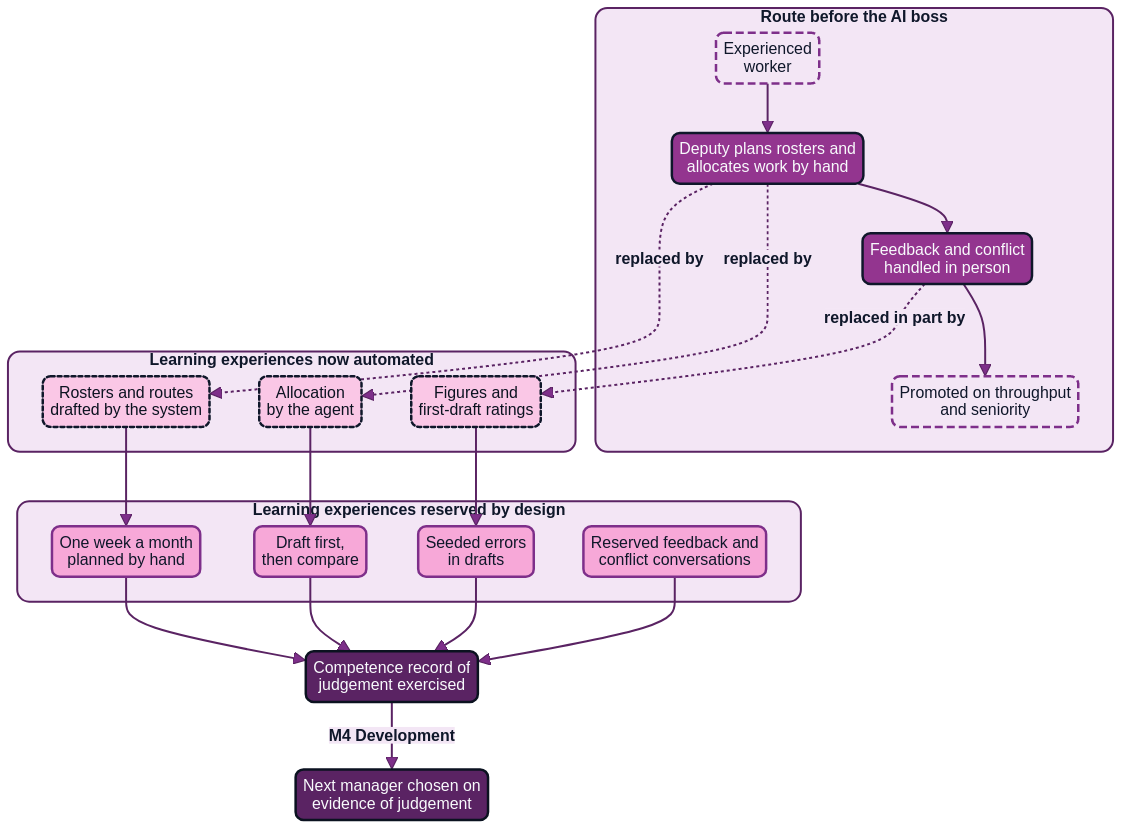
Figure 19.1: The route into management before and after the AI boss, with the learning experiences that are automated, those that are reserved by design and the competence record that evidences judgement.
The chapter builds on three conclusions of the earlier volumes. AI Threat, Chapters 6 and 14, concluded that relying on AI reduces effort, recall and, among those who trust the tool, checking; that automation erodes the skills of the people who must catch its errors; and that automating junior work removes the route by which experts are made, with drafting first, unassisted practice, seeded-error drills and an oversight-quality metric reported at team level as the response (F66) (44, Nordqvist, 2026). The Transformed Security Architect, Chapter 15, concluded that keeping the craft is a design decision, made of unassisted practice, apprenticeship routes that survive the automation of junior work and a record of what the practitioner can still do without AI (F77), and its Chapters 21 and 22 that competence is evidenced by records of judgement exercised, not by certificates alone (F79) (46, Nordqvist, 2026). AI Red Team, Chapters 6 and 15, added that autonomy should be paced to the skills available to supervise it (F53) (43, Nordqvist, 2026). This chapter draws those conclusions for the line manager.
Learning to manage
Linda Hill followed nineteen new managers through their first year in the role and found that becoming a manager is less a matter of acquiring techniques than a transformation of professional identity, learned mainly on the job (119, Hill, 2003). Her managers learned the role by doing the work, by making mistakes in front of the people affected and by being told about them.
Henry Mintzberg's observation of managers at work, half a century earlier, described the same work from outside: brief, varied and fragmented activities, a preference for live and verbal communication over documents, and a day shaped more by interruptions than by plans (103, Mintzberg, 1973). Both accounts describe a practice learned by deciding repeatedly and living with the result.
In most organisations that practice began well before the manager's title. The route in a hospital ward or a home-care unit ran from experienced assistant nurse to the senior who planned the routes, covered absences at six in the morning and settled who would work the Christmas shifts. In a claims department it ran from experienced handler to the deputy who allocated the difficult files, read the colleague's draft letter before it went out and noticed that a newer handler was taking home more than she could carry. None of these tasks was called management, and none was paid as such. Each taught four things that a new manager needs and that are hard to learn elsewhere.
The first is that every plan trades one person's interest against another's. A roster that honours one colleague's childcare arrangements gives another the late shift, and the deputy who draws it by hand sees the trade and has to stand behind it. The second is fast, clear feedback: a route plan that leaves no time between two visits fails on Monday morning. The third is the conversation, such as telling a colleague that the swap she asked for cannot be granted, a skill learned by doing it badly at first. The fourth is accountability to people rather than to a figure: the deputy answers to the colleagues in the room, not to a dashboard.
The second point matters more than it seems. Daniel Kahneman and Gary Klein, writing from opposite traditions of research on judgement, agreed that intuitive expertise can be trusted only where the environment is regular enough to be predictable and the person has had adequate opportunity to learn its regularities, and that subjective confidence is not a reliable indicator of whether a judgement is accurate (27, Kahneman & Klein, 2009). First-line scheduling and allocation are among the few parts of management that meet both conditions. The environment has regularities (sickness peaks, the clients who always need longer, the handler who is strong on motor claims and weak on liability), and the feedback arrives within days. The apprenticeship in rostering and allocation was where managerial intuition was calibrated.
The automated junior management work
The OECD defines algorithmic management as the use of software, which may include AI, to fully or partially automate tasks traditionally carried out by human managers. Its survey of more than 6,000 firms in France, Germany, Italy, Japan, Spain and the United States found such tools already in common use in most of the countries studied. Managers in the firms surveyed reported that the tools often improved the quality of their decisions and their own job satisfaction, and they also reported concerns about unclear accountability, about being unable to follow the tools' logic and about inadequate protection of workers' health (149, Milanez et al., 2025). Katherine Kellogg, Melissa Valentine and Angèle Christin's review of research on algorithms at work grouped the mechanisms of algorithmic control into six: employers direct workers by restricting and recommending, evaluate them by recording and rating, and discipline them by replacing and rewarding (137, Kellogg et al., 2020).
Read against the apprenticeship described above, the overlap is close. The tasks being automated first are the ones that taught. Table 19.1 sets them side by side.
| Junior management task | What it taught | What the system now does | Typical degree of delegation |
|---|---|---|---|
| Drawing up rosters and visit routes | Trade-offs between people; working-time rules; the regularities of demand | Drafts the four-week roster or the daily route from forecasts, preferences and rules | Level 2 Supervised: the manager approves |
| Allocating cases or tasks | Matching work to people's skill and load; noticing overload | Allocates within rules; the manager can reassign | Level 3 Bounded |
| Covering absences | Negotiation, fairness, knowing who can be asked | Offers open shifts to staff who opted in | Level 3 Bounded |
| Reporting team performance | Which figures mean something and which do not | Produces dashboards and figures per team and per person | Level 0 Advisory to Level 1 Assisted |
| First assessment of a colleague's work | Forming and stating a judgement; the feedback conversation | Drafts summaries, flags outliers, proposes ratings | Level 0 Advisory to Level 1 Assisted |
Table 19.1: First-line management tasks, what they taught and what AI systems now do with them. Degrees of delegation are the typical settings at the two example organisations.
That these tasks are being automated is observable: the survey evidence above documents it across six economies, and both example organisations in this book show it. Nordvik Region's ShiftWise drafts four-week rosters for hospital wards and visit schedules and routes for home care, and fills gaps by offering open shifts; unit managers approve every roster. Hansa Mutual's claims-triage agent allocates claims to individual handlers within allocation rules, and the team leader can reassign them. Neither system was introduced to change how managers are made. Both change it.
The change is not that the deputy has nothing left to do. It is that the deputy's task changes from authoring to approving. A deputy who approves a roster the system has drafted sees the result of trade-offs, not the trade-offs themselves, and the feedback that arrives on Monday morning is feedback on the system's draft, not on the deputy's own judgement. Calibration needs the person to have made the judgement the environment then corrects; approving someone else's provides a much weaker signal.
Judgement and its decay
Lisanne Bainbridge observed in 1983 that automation takes over the tasks that are easy to specify and leaves operators to monitor the system and to take over when it fails, and that both remaining tasks need skills that the automation itself erodes (24, Bainbridge, 1983). AI Threat, Chapter 14, set out her ironies in full for claims handling and casework (44, Nordqvist, 2026). For managers, the rosters and allocations left to handle by hand are the difficult ones, such as the week when three colleagues are ill, and the moment of full takeover comes when the system is unavailable, when the manager's unpractised skill is all there is.
Raja Parasuraman and Dietrich Manzey reviewed the empirical research on two related failures. Automation complacency, the failure to monitor automation adequately, occurs under multiple-task load, when manual tasks compete with the automated one for attention; it is found in naive and expert participants alike and cannot be overcome with simple practice. Automation bias, the tendency to follow automated advice in place of a vigilant search for information, produces errors of omission and of commission when decision aids are imperfect; it also occurs in naive and expert participants, cannot be prevented by training or instructions, and affects decisions in teams as well as by individuals (25, Parasuraman & Manzey, 2010). Linda Skitka, Kathleen Mosier and Mark Burdick had shown both kinds of error in a simulated flight task: participants with a highly but not perfectly reliable monitoring aid missed events it did not flag, followed its recommendations against other valid information, and did worse on those events than participants without it (155, Skitka et al., 1999).
None of these studies observed line managers, but the conditions they identify describe the first-line manager's day closely: Mintzberg's interrupted day is a multiple-task load, and the roster that ShiftWise drafts is a recommendation from a highly but not perfectly reliable aid. An error of omission, in management, is the roster problem the system did not flag: the newly employed care assistant scheduled alone with a client who needs two people, or a run of late-early shift changes that the working-time check does not count as a breach. An error of commission is accepting a figure or a rating that contradicts what the manager knows: the handler whose throughput fell because she took the complex claims nobody else could handle, rated lower because the figure cannot see why.
This is where M2 Evaluation is most exposed. When a dashboard, a scoring model or an assistant's summary offers a first view of a person's performance, the manager's evaluation can become a confirmation of the system's view. Hao-Ping Lee and colleagues surveyed 319 knowledge workers, who described 936 examples of using generative AI at work; higher confidence in the AI was associated with less critical thinking, higher confidence in one's own ability with more, and critical thinking shifted from producing work towards verifying, integrating and stewarding it (29, Lee et al., 2025). Evan Risko and Sam Gilbert's review adds that offloading is valuable only when people judge accurately what they can do without the aid (28, Risko & Gilbert, 2016); a manager who has never drawn a roster by hand has no basis for that judgement.
The evidence also shows that the design of the aid matters. In a field experiment with nearly a thousand secondary-school students, Hamsa Bastani and colleagues found that unrestricted access to a chatbot during practice improved grades on the practice problems but, once access was removed, left students performing worse than those who never had access, while a tutor version that gave hints rather than answers largely avoided the harm (30, Bastani et al., 2025). Erik Brynjolfsson, Danielle Li and Lindsey Raymond, studying 5,172 customer-support agents, found that an AI assistant raised productivity by 15 per cent on average, most for the less experienced, and reported evidence that the assistant helped workers learn (23, Brynjolfsson et al., 2025). The findings are compatible: an aid that shows what good work looks like can teach, and one that does the work in the novice's place can prevent learning.
The AI Act recognises the problem without solving it. Article 14(4)(b) requires that a high-risk AI system be provided to deployers in a way that enables the people assigned to oversight to remain aware of the possible tendency to rely or over-rely automatically on its output, which the Article names automation bias, and Article 26(2) requires deployers to assign human oversight to natural persons who have the necessary competence, training and authority (1, European Union, 2024). For ShiftWise, which Nordvik Region deploys as a high-risk system under Annex III, point 4, the unit managers are those persons. The implication is that the competence Article 26(2) demands is a skill the system's own use erodes, which the deployer has to keep in being.
What the evidence supports, then, must be labelled with care. Reduced checking among people who trust an automated aid is observable in laboratory and survey studies, and the automation of first-line management tasks is observable in practice. Erosion of managerial judgement in particular is expected, by analogy with the measured effects in other assisted work and the mechanism Bainbridge described, but no study has yet followed line managers who approve AI-drafted rosters or ratings over years. That gap is a reason to design against the risk now rather than to wait.
Who gets promoted
A second question concerns who becomes a manager in the first place. Alan Benson, Danielle Li and Kelly Shue studied microdata on the performance of sales workers at 131 firms and found evidence consistent with the Peter Principle: firms prioritise current job performance in promotion decisions at the expense of other observable characteristics that better predict managerial performance. They estimated the costs of promoting workers with lower managerial potential to be high, and found that firms place less weight on sales performance when managerial roles carry greater responsibility (124, Benson et al., 2019). The best salesperson is promoted because the evidence of good sales is visible and the evidence of managerial ability is not.
The evidence on what good managers do points away from individual output. Google's Project Oxygen analysed more than 10,000 data points about the company's managers from performance reviews and feedback surveys, together with interview notes, and found that teams with highly effective managers achieved better results, were happier and had lower turnover. It identified ten behaviours of highly effective managers: being a good coach; empowering the team without micromanaging; creating a team environment that values everyone; focusing on productivity and results; communicating effectively; supporting career development and discussing performance; implementing a clear vision and strategy; having key technical skills; collaborating across the company; and making strong decisions (95, Google re:Work, n.d.). Technical skill is on the list, but most of the behaviours are relational and developmental: coaching, empowering, including, communicating and developing careers.
Gallup's State of the Global Workplace report for 2025 found that the global share of engaged employees fell from 23 to 21 per cent in 2024 and that managers experienced the sharpest decline, from 30 to 27 per cent, while individual contributors remained at 18 per cent. It reported that managers who received best-practice training improved their own and their teams' engagement, with management performance metrics improving by 20 to 28 per cent (153, Gallup, 2025). These are a survey firm's own figures, but their direction agrees with Project Oxygen: management is a distinct skill that can be developed.
AI changes this picture in two ways. The first is that the visible evidence of good work increasingly comes from the systems. When the claims-triage agent allocates claims and produces throughput figures per handler, throughput is the most available measure of a handler, and a promotion process that leans on the most available measure leans further towards the Peter Principle. A handler who has spent two years being allocated work by an agent has a throughput record; she has no record of having allocated work herself, because the agent did it. The second is that the experiences that used to reveal managerial ability before promotion, the deputy who drew good rosters or settled a dispute about the Christmas shifts, are the ones being automated. An organisation that has automated junior management work has fewer of the other observable characteristics that Benson and colleagues found to predict managerial performance.
The response is not to stop measuring performance but to create and record evidence of managerial judgement before promotion, the purpose of the competence record described below.
The narrowing route
The answer to Q5 now takes shape. The people who would have become managers are still there. What narrows is the route by which they used to show and develop the ability: the deputy's work becomes approval, the evidence available for promotion becomes system-generated throughput, and the moments of hand-made judgement that once calibrated intuition become rare and arrive at the worst time, when the system is down.
The evidence for each step differs. That first-line management tasks are being automated is observable. That managerial judgement erodes where those tasks are no longer practised is expected, on the grounds set out above. That first-line management disappears as a career step, because organisations widen spans of control once systems carry the scheduling and allocation, is speculation: it is plausible, but no study known to this book has measured such a change in spans of control or in promotion paths as a result of algorithmic management.
The loss, if it comes, will be quiet: each delegation, from approving rosters instead of drawing them to letting the assistant draft the first assessment, is reasonable on its own. AI Threat, Chapter 26, concluded that small delegations of this kind erode skill, process and capacity until the documented fallback no longer exists, and that a delegation register is needed to show their sum (44, Nordqvist, 2026). The delegation register of management functions that Chapter 25 sets out serves that purpose for management; this chapter adds that each entry in it should state which learning experience the delegation removes and how it is replaced.
Freeing managers for relational work
There is a second reading, and it deserves to be stated at its strongest. At Nordvik Region, rostering a home-care unit took a senior about a day a week; at Hansa Mutual, allocation took a team leader part of every morning. If systems take over that work, managers gain time for the activities that Project Oxygen and Gallup associate with effective management: coaching, developing careers, discussing performance, building a team in which people feel valued. Amy Edmondson's study of work teams found that team psychological safety, the shared belief that the team is safe for interpersonal risk-taking, was associated with learning behaviour and through it with team performance (117, Edmondson, 1999). Building that climate is relational work. On this reading, the AI boss could make better managers by removing the work that kept them from managing.
The two readings meet on the conditions. Freed time becomes relational time only if three things hold. The time must actually be given back to the people in the team, not absorbed by a wider span of control or by more reporting. The manager must keep the authority to change what the system produces, and use it, so that approval remains a judgement rather than a formality. And the craft that the system now performs must be kept in reserve, because a manager who cannot draw a roster by hand cannot tell when the system's roster is wrong, and the relational work includes defending a colleague against a figure that misrepresents her. Where they do not, the time saved goes elsewhere and the skill goes with it.
Keeping the craft
K. Anders Ericsson, Ralf Krampe and Clemens Tesch-Römer explained expert performance as the result of prolonged deliberate practice: effortful activities designed to improve performance, distinct from ordinary work (26, Ericsson et al., 1993). A deputy who approves fifty AI-drafted rosters a year is working, not practising, and the system makes it possible to work for years without practising at all. The Transformed Security Architect, Chapter 15, drew the same conclusion for the architect who approves agent proposals (46, Nordqvist, 2026).
Keeping the managerial craft means reserving, on purpose, a share of the work that taught it, through five practices.
Unassisted planning. The deputy, and periodically the manager, draws a roster, a route plan or an allocation by hand for a defined period, using the same inputs the system uses, and the plan is used. The comparison with the system's draft is the feedback.
Drafting first in evaluation. Before opening the dashboard or the assistant's summary, the manager writes a short assessment of each person's work from his own knowledge, then compares it with what the system shows. He records disagreements and why. This is the drafting-first practice of AI Threat, Chapter 6 (44, Nordqvist, 2026), applied to M2 Evaluation, and it counters automation bias in rating people.
Seeded errors. A small number of drafts presented to the approver contain a known fault: a rest-period breach the working-time check does not catch, a newly employed colleague assigned alone to a two-person visit, a complex claim allocated to a handler in her first month. The rate at which approvers find them is reported at team level, as the oversight-quality metric of AI Threat, Chapter 14, and Chapter 26 of this book describe, never as an individual score.
Reserved conversations. Feedback conversations, the handling of conflict and the decision on a request that cannot be granted stay with a person, without an AI-written script. Deputies take part in some of them each year alongside an experienced manager.
Degraded-mode rehearsal. Once or twice a year the unit runs a period as if the system were unavailable, which tests both the skill and the documented fallback that AI Red Team, Chapter 6, required for any supervised automation (43, Nordqvist, 2026).
Each practice costs time and fails if left to goodwill, because the assisted path is always faster in the week it is chosen. They belong in the delegation profile and the working-time plan, not in a training catalogue.
Practical guide: A managerial craft programme
Purpose. Keep the judgement that first-line managers and their deputies need to oversee systems that draft rosters, allocations and evaluations, keep the route into management open, and produce evidence of managerial judgement for development and selection.
Roles. The line manager (programme owner for the unit); the deputy or deputies; HR (development and the competence framework); the workers' representatives (in a Nordic setting the unions under the co-determination act, in Germany the works council); the data protection officer; and the workers affected, whose rosters and allocations are produced by hand during the reserved periods.
Steps.
- List the learning experiences each team's systems have taken over, from Table 19.1 and the delegation register of management functions (Chapter 25), and record how each is replaced.
- Reserve unassisted planning: by default one week in four of rosters or routes drawn by the deputy by hand, and for case allocation 10 per cent of new work allocated by the deputy or team leader without the agent's proposal. Adapt the share to the collective agreement and the unit's size; do not let it fall below one period a quarter.
- Introduce drafting first for M2 Evaluation: before each development conversation, the manager writes a short assessment from his own knowledge before opening any dashboard or AI summary, and records disagreements with the system's figures and the reasons.
- Seed errors: by default two faults per approver per quarter in drafts, agreed in advance with the workers' representatives as to type and frequency, never in a roster or allocation that is actually issued without correction, and reported at team level only.
- Reserve conversations: deputies and new managers take part in at least four feedback or conflict conversations a year with an experienced manager present, with the colleague's consent.
- Rehearse degraded mode twice a year for a defined period, with the documented fallback.
- Record the judgement exercised in a competence record for each manager and deputy (see the worked example), with purposes, readers and retention agreed with the representatives before the first record is written.
- Negotiate or agree the programme before it starts. Under MBL §11 an employer bound by a collective agreement must negotiate with the union before deciding on an important change in its activity or in conditions of employment (205, Sveriges riksdag, 1976), and Nordvik Region's co-determination act follows the same pattern. In Germany, general assessment principles require the works council's consent under BetrVG §94(2), selection guidelines for transfers, which include a move to team leader, under §95(1), also where AI is used in drawing them up (§95(2a)), and any technical equipment suited to monitor behaviour or performance falls under §87(1) no. 6 (9, Germany, 2001).
- Review the programme yearly: the seeded-error find rate at team level, the share of reserved work actually done, and whether the competence records were used in the last selection of a deputy or manager.
Definition of done. Every team whose rosters, allocations or evaluations are drafted by a system has a recorded reserve share, a seeded-error schedule and a degraded-mode date; every manager and deputy has a competence record that the person has read; the representatives have agreed the record's terms; and the last appointment of a first-line manager cites evidence of judgement from the records.
Evidencing competence
Architecture as Code (Chapter 18) concluded that competence is managed as a skills matrix by level, from Foundation to Expert, and that practical demonstration on real delivery, not certification, shows capability (F11) (40, Nordqvist, 2025). AI Governance, Chapter 14, added that assessment results are personal data whose use is agreed with employee representatives (F26) (41, Nordqvist, 2026), and The Transformed Security Architect, Chapters 21 and 22, that competence is evidenced by records of judgement exercised (F79) (46, Nordqvist, 2026). Frameworks such as SFIA 9, which describes professional skills at seven levels of responsibility, make such records comparable across an organisation (11, SFIA Foundation, 2024).
For a first-line manager overseeing the AI boss, the evidence that matters is judgement exercised against the system's proposal: rosters changed and why, allocations overridden and why, ratings disagreed with and why, plans drawn by hand and how they compared, seeded errors found, conversations held. Two cautions shape what the record may contain.
The first is that an override count is not a measure of judgement. A manager who overrides often may be exercising judgement or may be fighting the system out of habit; one who never overrides may be complacent or may be working with a system that is right. The record therefore holds the reasons and, where known, the outcome of a sample of overrides and acceptances, not a rate to be maximised. Individual approval and override rates are not used to rank managers, for the same reason that The Transformed Security Architect, Chapter 14, reported approval quality only at team level.
The second is that the record is personal data about the manager, and its entries often refer to decisions about other workers. It should refer to the Management Decision Records (Chapter 25) in which those decisions are kept, under their own access rules, rather than copying their content. Its purposes should be closed and stated: development, the check that the holder of a decision right has the competence the delegation profile requires, and selection for a managerial post. GDPR Article 88 allows member states and collective agreements to lay down more specific rules for processing employees' data (5, European Union, 2016), and in Germany the record's assessment principles require the works council's consent under BetrVG §94(2), as the practical guide noted.
Worked example: A competence record for a first-line manager
Illustrative example. The record belongs to Mikael Strand, unit manager of the Strandvik home-care unit at Nordvik Region, at the end of his first half-year approving ShiftWise rosters, the period in which the Region agreed the managerial craft programme with the unions in AIDR-0608. It refers to the Management Decision Records in which the rosters he changed are kept, and to the delegation profile DLG-NR-ROS-01 under which ShiftWise drafts them.
# competence/records/CMP-NR-MGR-01.yaml (illustrative)
competence_record:
  id: CMP-NR-MGR-01
  person_ref: NR-EMP-20417
  role: unit_manager_home_care
  unit: strandvik_home_care
  framework: {id: NR-MGR-CF, version: "2027.1"}
  terms: AIDR-0608            # purposes, readers and retention negotiated with the unions
  purposes: [development_plan, oversight_competence_check, selection_for_managerial_post]
  not_used_for: [individual_performance_ranking, pay_setting]
  readers: [record_subject, own_manager, hr_business_partner_care]
  retention: current and previous record; working notes deleted on acceptance
  period: {from: 2027-02-01, to: 2027-07-31}
  delegation_profile: DLG-NR-ROS-01   # ShiftWise rosters at Level 2 Supervised
  judgement_exercised:
    - kind: roster_changed
      record: MDR-NR-0041
      reason: newly employed care assistant scheduled alone at a two-person visit
      outcome: changed before issue; supplier informed of the missing competence rule
    - kind: roster_changed
      record: MDR-NR-0044
      reason: three late-early changes in one week for the same assistant nurse
      outcome: changed; rest rule within limits, pattern not flagged by the system
    - kind: roster_changed
      record: MDR-NR-0001
      reason: first roster under DLG-NR-ROS-01; a flagged rest breach, an outweighed childcare preference and a premium-shift imbalance
      outcome: three shifts changed before publication, reasons recorded (Chapter 9)
    - kind: rating_disagreement
      source: home-care dashboard, time per visit
      reason: longer visits explained by clients with new care needs; figure not used
  unassisted_practice:
    - {kind: route_plan_by_hand, weeks: 2, compared_with_system: true}
  seeded_errors: {reported_at: team_level_only, team_find_rate: 4 of 5}
  conversations: {reserved_held: 6, of_which_with_deputy_present: 3}
  competences:
    - {id: MGR-PLN-01, name: planning and allocation, level: advanced}
    - {id: MGR-EVL-02, name: evaluation against system figures, level: practitioner}
    - {id: MGR-DEV-01, name: developing deputies, level: practitioner}
  subject_comment: agrees; asks that the deputy's hand-planned weeks count towards her record
  development_plan:
    - {competence: MGR-EVL-02, target: advanced, by: 2027-12-31}
    - {competence: MGR-DEV-01, action: deputy plans one week a month by hand}
  valid_until: 2029-07-31
The record names no figures about the staff whose rosters were changed and holds no override rate. The rating disagreement concerns the dashboard's figure, not a judgement of a colleague, and the record states that the figure was not used. Hansa Mutual's equivalent for a deputy team leader in the claims department has the same form, with allocation_overridden entries referring to Management Decision Records such as MDR-HM-0001, the delegation profile DLG-HM-CTA-01 of the claims-triage agent, and terms agreed with the Konzernbetriebsrat.
Across the degrees of delegation
The craft risk depends on what the manager still does. Table 19.2 shows it for M1 Direction and M2 Evaluation, the functions in which first-line managers have traditionally learned.
| Degree of delegation | What the manager does | Judgement exercised | Craft risk | Reserve needed |
|---|---|---|---|---|
| Level 0 Advisory | Draws the plan or assessment; the system comments | Full | Low | None beyond normal work |
| Level 1 Assisted | Draws the plan; the system proposes parts | Full, with prompts | Low to moderate | Drafting first in evaluation |
| Level 2 Supervised | Approves or edits a full draft | Only if edits are real | Moderate | Unassisted share, seeded errors |
| Level 3 Bounded | Sets rules; can reassign afterwards | Over the rules and exceptions | High | Larger unassisted share, degraded-mode rehearsal |
| Level 4 Autonomous | Not involved in the instance | None in the instance | Highest | Full unassisted fallback, delegation reviewed in the register |
Table 19.2: Craft risk across the degrees of delegation for M1 Direction and M2 Evaluation.
Managerial skill decays fastest where M1 Direction and M2 Evaluation are delegated at Level 3 Bounded or above, since the manager no longer drafts. At Level 2 Supervised the manager still edits, which keeps judgement only if the edits are real. The usage mode matters too: a Mode 2 embedded workplace assistant drafting an assessment for the manager to edit keeps the manager closest to authorship, a Mode 4 built application such as ShiftWise presents a finished draft, and a Mode 5 autonomous production agent such as Hansa's claims-triage agent acts first and leaves the manager to reassign. The further the mode and the degree move from authorship, the larger the reserve the craft programme must hold.
Nordvik Region and Hansa Mutual
Nordvik Region's home-care units have traditionally grown their unit managers from senior assistant nurses who planned routes and covered absences. With ShiftWise drafting routes and offering open shifts, that apprenticeship narrows. Ingrid Halvorsen, the HR director, and Mikael Strand agree a managerial craft programme in which the deputy of each home-care unit, usually a senior assistant nurse, plans the unit's routes by hand one week a month, and in which the unit manager's development conversation records the rosters he or she changed and why. The Region negotiates the programme with the union for municipal and care workers and the union for nurses and midwives before it starts, records it as AIDR-0608 in May 2027, after the reversibility test of April found that the Strandvik deputy had never planned a route by hand (Chapter 25), and starts with Strandvik. The competence record above is the first, and the deputies' hand-planned weeks double as the fallback if ShiftWise is unavailable.
Hansa Mutual's team leaders have come from experienced claims handlers, and the claims-triage agent now does the allocation on which they once learned, at Level 3 Bounded under DLG-HM-CTA-01. Jana Petersen, with twelve years in motor and property claims, can judge the agent's allocations, and her reassignments, beginning with MDR-HM-0001, show it. Her deputy has two years, almost all of them spent being allocated work by the agent. Hansa adds managerial judgement to its competence framework, with records of allocations overridden and the reasons, and agrees the record's assessment principles with the Konzernbetriebsrat under BetrVG §94(2) and the selection guideline for team-leader appointments under §95(1), recorded as AIDR-0656. Ten per cent of new claims in Jana's team are allocated by the deputy without the agent's proposal, which also feeds the team charter's reserved learning tasks of Chapter 18. The next team leader is chosen on evidence of judgement, not on throughput alone, and the throughput figures, which reach team leaders only under KBV-IT-2024, are not an input to that selection.
The difference between the two follows from their systems and their law. Nordvik's system drafts and the manager approves, so its programme reserves authorship; Hansa's agent acts and the team leader reassigns, so its programme reserves allocation itself and needs the larger share. Nordvik negotiates under one co-determination act; Hansa must agree the record with the Konzernbetriebsrat and then with the bodies of its other entities, beginning with the Polish service centre.
Summary
This chapter asked who becomes a manager when AI does much of the managing. Managers learned the craft through rostering, allocating, covering absences and first assessments, which offered the regular environment and fast feedback in which judgement is calibrated. Systems now do that work first, and the deputy moves from authoring to approving. The automation of these tasks is observable; the erosion of managerial judgement is expected, by analogy with measured automation bias and complacency in other assisted work; the disappearance of first-line management as a career step is speculation.
The chapter concerns M2 Evaluation and M4 Development. In M2 Evaluation the risk is that a manager's assessment becomes confirmation of a system's figure, through the errors of omission and commission that the research on automation bias documents. In M4 Development the risk is twofold: the route by which the next managers learned narrows, and promotion, already inclined to reward performance in the current job over managerial ability, leans further towards system-generated throughput. The opportunity is real: freed time can go to the coaching that the evidence associates with good managers, if it is given back to the team and the craft is kept in reserve.
The answer to Q5 is that the people who would have become managers remain, but the route must be rebuilt by design. Organisations reserve unassisted planning, draft first in evaluation, seed errors and report the find rate at team level, keep feedback and conflict conversations with people, rehearse degraded mode, and record judgement exercised in a competence record whose terms are agreed with the workers' representatives. The next manager is then chosen on evidence of judgement, not on throughput alone.
Chapter 20 turns from the manager's competence to the manager's authority: who in the management chain may direct, evaluate, reward and dismiss, what may be delegated to AI, and which of those decision rights depend on the competence this chapter has shown how to keep and evidence.
Sources
- Hill, L. A. (2003). Becoming a Manager: How New Managers Master the Challenges of Leadership. 2nd edition. Harvard Business School Press. (119, Hill, 2003)
- Mintzberg, H. (1973). The Nature of Managerial Work. Harper & Row. (103, Mintzberg, 1973)
- Kahneman, D. & Klein, G. (2009). Conditions for Intuitive Expertise: A Failure to Disagree. American Psychologist, 64(6). (27, Kahneman & Klein, 2009)
- Milanez, A., Lemmens, A. & Ruggiu, C. (2025). Algorithmic management in the workplace: New evidence from an OECD employer survey. OECD Publishing. (149, Milanez et al., 2025)
- Kellogg, K. C., Valentine, M. A. & Christin, A. (2020). Algorithms at Work: The New Contested Terrain of Control. Academy of Management Annals, 14(1). (137, Kellogg et al., 2020)
- Bainbridge, L. (1983). Ironies of automation. Automatica, 19(6). (24, Bainbridge, 1983)
- Parasuraman, R. & Manzey, D. H. (2010). Complacency and Bias in Human Use of Automation: An Attentional Integration. Human Factors, 52(3). (25, Parasuraman & Manzey, 2010)
- Skitka, L. J., Mosier, K. L. & Burdick, M. (1999). Does automation bias decision-making? International Journal of Human-Computer Studies, 51(5). (155, Skitka et al., 1999)
- Lee, H.-P., Sarkar, A., Tankelevitch, L., Drosos, I., Rintel, S., Banks, R. & Wilson, N. (2025). The Impact of Generative AI on Critical Thinking. Proceedings of CHI 2025. (29, Lee et al., 2025)
- Risko, E. F. & Gilbert, S. J. (2016). Cognitive Offloading. Trends in Cognitive Sciences, 20(9). (28, Risko & Gilbert, 2016)
- Bastani, H., Bastani, O., Sungu, A., Ge, H., Kabakcı, Ö. & Mariman, R. (2025). Generative AI without guardrails can harm learning: Evidence from high school mathematics. Proceedings of the National Academy of Sciences, 122(26). (30, Bastani et al., 2025)
- Brynjolfsson, E., Li, D. & Raymond, L. (2025). Generative AI at Work. The Quarterly Journal of Economics, 140(2). (23, Brynjolfsson et al., 2025)
- European Parliament and Council of the European Union (2024). Regulation (EU) 2024/1689 (Artificial Intelligence Act). Official Journal of the European Union. (1, European Union, 2024)
- Benson, A., Li, D. & Shue, K. (2019). Promotions and the Peter Principle. The Quarterly Journal of Economics, 134(4). (124, Benson et al., 2019)
- Google re:Work (n.d.). Following the data: The research behind great managers. Google re:Work guide. (95, Google re:Work, n.d.)
- Gallup (2025). Global Engagement Falls for the Second Time Since 2009 (State of the Global Workplace: 2025 Report). Gallup Workplace. (153, Gallup, 2025)
- Edmondson, A. (1999). Psychological Safety and Learning Behavior in Work Teams. Administrative Science Quarterly, 44(2). (117, Edmondson, 1999)
- Ericsson, K. A., Krampe, R. T. & Tesch-Römer, C. (1993). The Role of Deliberate Practice in the Acquisition of Expert Performance. Psychological Review, 100(3). (26, Ericsson et al., 1993)
- Sveriges riksdag (1976). Lag (1976:580) om medbestämmande i arbetslivet (MBL). (205, Sveriges riksdag, 1976)
- Federal Republic of Germany (2001). Betriebsverfassungsgesetz (BetrVG). Gesetze im Internet. (9, Germany, 2001)
- European Parliament and Council of the European Union (2016). Regulation (EU) 2016/679 (General Data Protection Regulation). Official Journal of the European Union. (5, European Union, 2016)
- SFIA Foundation (2024). SFIA 9: The global skills and competency framework for a digital world. SFIA Foundation. (11, SFIA Foundation, 2024)
- Nordqvist, G. (2025). Architecture as Code. The Architecture as Code Series, Book 1. (40, Nordqvist, 2025)
- Nordqvist, G. (2026). AI Governance: Governing Artificial Intelligence in European Enterprises and Public Authorities. The Architecture as Code Series, Book 2. (41, Nordqvist, 2026)
- Nordqvist, G. (2026). AI Red Team: AI as an Active Part of Cyber Defence in European Enterprises and Public Authorities. The Architecture as Code Series, Book 4. (43, Nordqvist, 2026)
- Nordqvist, G. (2026). AI Threat: Are the Dystopias Coming True? Evidence, Risk and Response for European Enterprises and Public Authorities. The Architecture as Code Series, Book 5. (44, Nordqvist, 2026)
- Nordqvist, G. (2026). The Transformed Security Architect: Role, Craft and Career in the Age of AI in European Enterprises and Public Authorities. The Architecture as Code Series, Book 6. (46, Nordqvist, 2026)