Decision Rights in the Management Chain: Who May Direct, Evaluate, Reward and Dismiss
Part IV has shown people managing agents, agents orchestrating agents, mixed teams and the narrowing route into management, and each chapter left open who holds which right. This chapter writes down that allocation per role, function and system, as an artefact that can be read, negotiated, tested and changed. It concerns all five functions: M1 Direction and M2 Evaluation, the rights that may be delegated to AI under conditions; M3 Consequence, where every decision about a person ends with a named human decider; and M4 Development and M5 Care, the rights that stay with the manager and the employer. It also assigns the right above all five, to stop or pause the management system itself, and states the book's answers to Q1 and Q2 as rules.
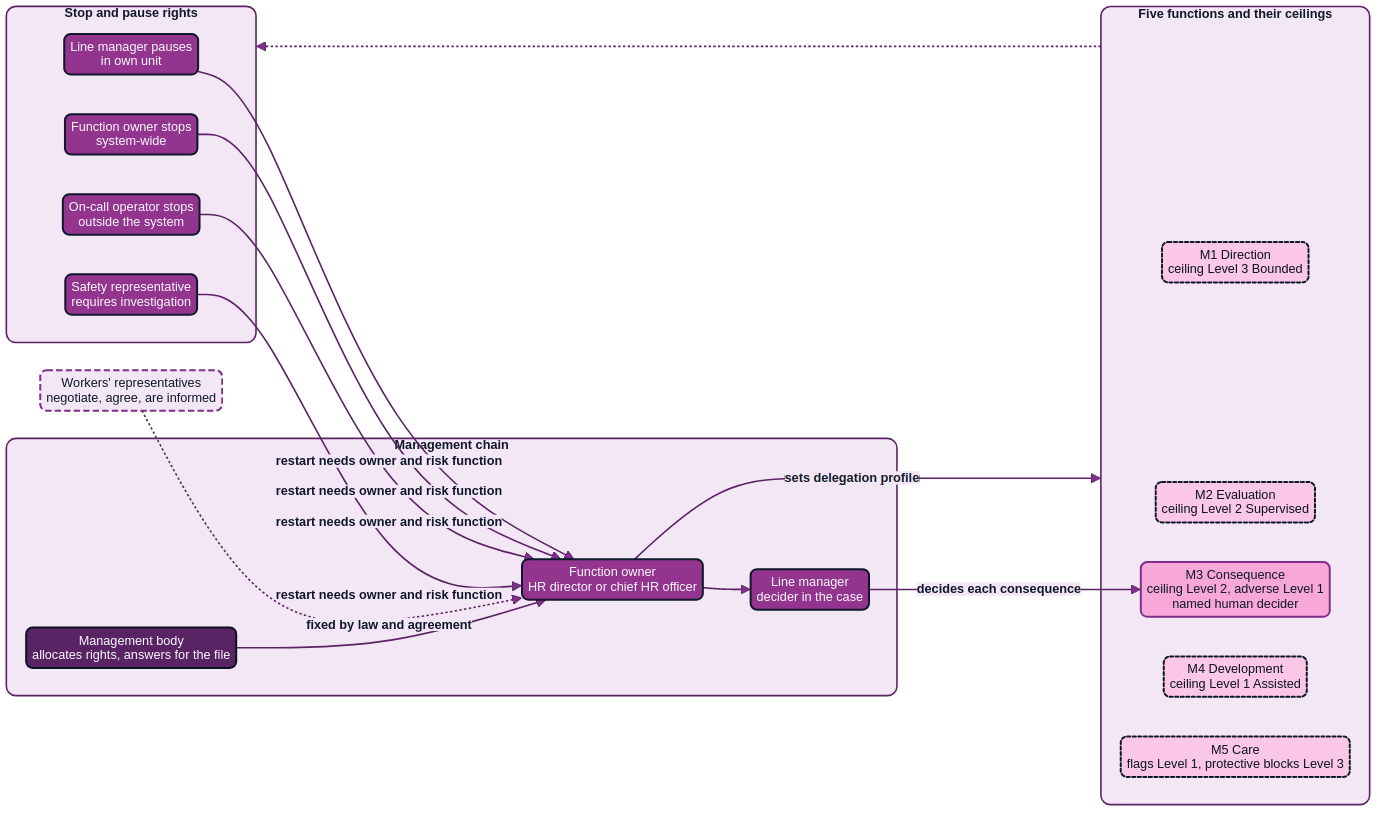
Figure 20.1: The management chain as a decision-rights matrix. Each function has a ceiling of delegation, M3 Consequence ends with a named human decider in every case, four stop and pause rights are assigned in advance, and the representatives' rights constrain what the function owner may reassign.
The chapter builds on four earlier conclusions: decision tiers, a tier policy kept as data and stop rights named in advance (F17 to F19; AI Governance, Chapter 13) (41, Nordqvist, 2026); named owners, operators and authorities for every machine identity, with Level 3 Bounded concentrating accountability in the playbook (F51; AI Red Team, Chapter 6) (43, Nordqvist, 2026); the right to stop assigned before the crisis and cheaper to exercise than the right to continue (F63; AI Threat, Chapter 30) (44, Nordqvist, 2026); and roles as versioned artefacts with written decision rights, gates instead of meetings, and accountability that cannot be delegated to a system (F73, F74, F78; The Transformed Security Architect, Chapters 4, 17 and 18) (46, Nordqvist, 2026).
Decision rights as an artefact
A decision right answers four questions about one class of decision: who may take it, who must be consulted or must agree first, who may stop or reverse it, and who answers for it afterwards. In most organisations the answers are spread across an HR policy, a delegation-of-authority schedule, collective agreements, works agreements, job descriptions and habit. That worked while every decision passed through a line manager who held the rights by default. It stops working when a system ranks applicants, allocates claims and drafts rosters in the gaps between the documents, and nobody can say whose right it is exercising.
The remedy this chapter proposes is a single file per organisation, management/decision-rights.yaml, that lists the classes of management decision, assigns each to a role, states the maximum degree of delegation to AI for that class, names the stop and pause rights and records the rights that law or agreement fixes. It sits beside the delegation register of Chapter 25, whose delegation profiles (DLG-*) record what has actually been delegated, at which level and under which agreement. A profile that exceeds a ceiling in the file is invalid, and a pipeline check can say so.
Three properties make the file useful rather than decorative. First, it is written per class of decision, not per decision: "approve a four-week roster", "reassign a claim", "reject an applicant at the screening stage", "set the variable-pay component". A class has a decider, a ceiling, a stop right and an owner. Second, it names roles and, through a role map, the people who hold them, because a right held by "management" is held by nobody. Third, it is versioned and changed only by a recorded decision. Nygard's argument for Architecture Decision Records, that context and consequences are lost unless written down where the work is done, applies with more force to decisions about people (16, Nygard, 2011).
The file is not a legal opinion. It records how the organisation allocates the rights it has, and, so that nobody forgets them, the rights that others hold by law.
Who may delegate
Delegating a management function to AI is itself a decision with three parts: who owns the function, at which tier a change is decided, and what part the workers' representatives play.
The function owner. Every management function needs one owner who proposes and maintains its delegation profiles and answers for the conditions under which delegated decisions are made. Across an organisation this is normally the HR director or chief HR officer, because the functions carry the employer's obligations. The owner is a person in a role, not a committee, because a committee cannot be asked by an employee or a court to explain why the profile was set where it was.
The tier. The asymmetry of AI Governance, Chapter 13, and of The Transformed Security Architect, Chapter 17, applies directly: a change that loosens a boundary is never delegated as far as a change that tightens one (41, Nordqvist, 2026) (46, Nordqvist, 2026). Lowering a degree or pausing a system protects people and is cheap to reverse, so any function owner may do it at once, and a line manager in the own unit. Raising a degree within the ceiling is a tier 2 decision for the function owner, after the representatives have exercised their rights, recorded as an AI Decision Record. Raising a ceiling is a tier 4 decision for the management body, because what the organisation lets a machine do to its staff is a question of appetite.
The representatives' part. Co-determination does not make the representatives owners of a function, nor can the employer reassign their rights. In Germany the works council co-determines the introduction and use of technical equipment designed to monitor employees' behaviour or performance under BetrVG §87(1) no. 6, must be informed in good time about the planning of work procedures including the use of AI under §90(1) no. 3, and may call on an expert, deemed necessary by statute, whenever it must assess the introduction or use of AI, under §80(3) (9, Germany, 2001). The 2021 reform introduced those references to AI into the Act (207, Germany, 2021). In Sweden an employer bound by a collective agreement must, on its own initiative, negotiate with the union before deciding on an important change in its activity or in the working or employment conditions of the union's members, under MBL §11 (205, Sveriges riksdag, 1976). The AI Act requires every employer deploying a high-risk system at the workplace to inform workers' representatives and the affected workers before putting it into service or using it, under Article 26(7) (1, European Union, 2024). As an organisational implication, the file must show for every class which body must agree, be negotiated with or be informed, and in what order.
Direction and evaluation
M1 Direction is the function AI may perform most widely, because most of its decisions can be reversed within a shift. The ceiling is Level 3 Bounded, provided four conditions hold. The rules within which the system acts are written down, agreed where co-determination applies, and enforced outside the model, so that the playbook of AI Red Team, Chapter 6, exists in the management domain (43, Nordqvist, 2026). The line manager can override any individual direction at once and without having to justify the override to the system's owner first. The direction has no effect on pay, working time beyond what the roster already fixes, or a person's health that the rules have not anticipated. And the system's output is recorded, so that a pattern of directions can be examined later. Where one of these conditions fails, the ceiling falls to Level 2 Supervised, with a person approving each direction. Level 4 Autonomous for M1 is a tier 4 decision, and neither organisation uses it.
A roster is a direction, but it also fixes when a person works and whether an hourly worker earns enough that month. Rostering sits at the boundary of M1 Direction and M3 Consequence, and the file must say on which side each class falls. The AI Act recognises the overlap: Annex III, point 4(b), lists systems intended to make decisions affecting terms of work-related relationships, to allocate tasks based on individual behaviour or personal traits or characteristics, and to monitor and evaluate the performance and behaviour of persons in such relationships (1, European Union, 2024). A system that allocates work on the basis of a person's past throughput is doing all three at once.
M2 Evaluation has a lower ceiling: Level 2 Supervised for measures that aggregate work at team or unit level, and Level 1 Assisted for anything that rates an individual. Measurement is how a manager learns that a route is impossible or a team overloaded, but an individual evaluation is also the raw material of a consequence decision: a throughput figure seen today becomes a pay input next year and evidence in a performance procedure after that. Together the steps turn an M2 measure into an M3 decision that nobody took. Thompson called this the problem of many hands: when many people contribute to an outcome, it becomes difficult to identify any one of them as responsible for it (111, Thompson, 1980). The file prevents the drift by stating, for every M2 class, which M3 decisions its output may feed, and by requiring a new decision, recorded and where required agreed, before it feeds another.
Consequence
For M3 Consequence the file states the book's central rule: every consequence decision about a person has a named human decider, and Level 4 Autonomous is never used. The ceiling is Level 2 Supervised, with a person approving case by case, and for adverse decisions (rejecting an applicant, refusing a promotion, reducing variable pay, starting a disciplinary procedure, dismissing, deactivating an account or withdrawing access to work) the ceiling is Level 1 Assisted: the system may rank, score or recommend, and the person decides and acts.
Naming a decider is necessary but not sufficient, because a named person easily becomes a formality. Skitka, Mosier and Burdick found in a simulated monitoring task that participants with an automated aid missed events it did not flag and followed its incorrect recommendations (155, Skitka et al., 1999). Alon-Barkat and Busuioc, in experiments with Dutch participants on public-sector decisions, did not find general over-reliance on algorithmic advice, but in one study found that people adhered to advice more readily when it matched stereotypes about the person concerned, whether it came from an algorithm or a human expert; a third study, with civil servants, did not find that pattern (179, Alon-Barkat & Busuioc, 2023). Green, reviewing policies that require human oversight of government algorithms, concluded that the evidence does not support their assumption that people can perform the oversight required, and that such policies can lend legitimacy to flawed systems (178, Green, 2022). Elish named the result: a moral crumple zone, in which responsibility for the failure of a complex system is attributed to the human operator who had little control over it (170, Elish, 2019).
The Post Office Horizon case shows how far this can go in a working relationship. Sub-postmasters, who worked under contract rather than as employees, were held liable for shortfalls that the accounting system displayed, and in the 2019 judgment in Bates v Post Office the High Court found that the system contained bugs, errors and defects capable of causing apparent shortfalls in branch accounts (72, High Court of Justice & Queen's Bench Division, 2019). Those who pursued the shortfalls had formal authority to decide otherwise but lacked the information and the institutional room to doubt the figures, as the inquiry's final report describes (203, Post Office Horizon IT Inquiry, 2025).
The decision-rights file therefore names, for every M3 class, not only the decider but the four conditions under which the decider's right is real.
- Authority. The decider may decide against the system's output without penalty and without having to win an argument with the system's owner first. For platform work, persons charged with oversight must have the authority necessary for overriding automated decisions and be protected from dismissal, disciplinary measures and other adverse treatment when they exercise it, under Article 10(2) of the Platform Work Directive (47, European Union, 2024). The AI Act requires deployers to assign oversight to persons with the necessary competence, training, authority and support, under Article 26(2), and providers to enable them to disregard, override or reverse the output, under Article 14(4)(d) (1, European Union, 2024).
- Information. The decider sees the grounds of the recommendation, the data it used and the facts the system could not see, not only a score. Article 14(4)(b) of the AI Act requires that overseers be enabled to remain aware of automation bias.
- Time. The volume of decisions per decider allows each to be read. Chapter 26 sets out how to measure whether it does; the decision-rights file states the volume above which a class must be split or its degree lowered.
- Record. Each decision produces a Management Decision Record naming the decider, the system's part and the reasons, which the person concerned can see and contest (Chapter 25).
Where the law requires a human decision, the file cites it. Directive (EU) 2024/2831 requires that any decision to restrict, suspend or terminate the contractual relationship or the account of a person performing platform work, or any other decision of equivalent detriment, be taken by a human being, under Article 10(5) (47, European Union, 2024). Where the GDPR permits a decision based solely on automated processing, the data subject keeps at least the right to obtain human intervention, to express a point of view and to contest the decision, under Article 22(3) (5, European Union, 2016). In German undertakings with, as a rule, more than twenty employees entitled to vote, hiring requires the works council's consent under BetrVG §99(1), and wherever a works council exists every dismissal requires its prior hearing, without which the dismissal is invalid, under §102(1) (9, Germany, 2001). These rights apply whether or not AI was involved, and the file must show where the chain of decision passes through these bodies.
Development and care
For M4 Development and M5 Care the file mostly protects rights from being delegated by default. For M4, the ceiling is Level 1 Assisted. A platform may recommend courses and an assistant may draft a conversation agenda; the conversation itself, the agreement on what a person will learn and the judgement of what they are ready for stay with the manager. Development is where the manager learns what the figures do not show, and a manager who has delegated M1, much of M2 and then M4 has little left from which to form the judgement that M3 requires (Chapter 19). Career decisions such as nomination for a leadership programme are M3 Consequence decisions.
For M5, the decision-rights file starts from a duty that cannot be delegated at all. Under the Framework Directive the employer has a duty to ensure the safety and health of workers in every aspect related to the work, enlisting external services or persons does not discharge the employer from that responsibility, and the workers' own obligations do not affect the principle of the employer's responsibility, under Article 5(1) to (3) (49, Council of the European Communities, 1989). As an organisational implication, neither a procured scheduling system nor its supplier takes over any part of the duty. The Directive also requires the employer to ensure that the planning and introduction of new technologies are the subject of consultation with the workers or their representatives as regards their consequences for safety and health, under Article 6(3)(c). The Charter of Fundamental Rights gives every worker the right to working conditions which respect their health, safety and dignity, under Article 31(1) (48, European Union, 2012).
Within that duty, the file separates two kinds of M5 action. A system may flag a risk at Level 1 Assisted, such as a breached rest rule or a route with no travel time, to a named person who must resolve it within a stated time. A system may also block, at Level 3 Bounded, an action that would breach a protective rule, such as publishing a roster that violates minimum rest. Protective blocks apply F63: they stop something, a named person can override them with a recorded reason, and they never reduce a protection. The file never delegates the judgement that a person is in difficulty, the heart of Q11 and of Chapter 14.
Stop and pause
The rights over a management system itself are needed only when something has gone wrong, which is why they are forgotten. F19 and F63 apply directly: stop rights are named in advance, held by people who can act in the time the harm allows, and exercised through a path outside the system they stop. The AI Act requires providers of high-risk systems to enable overseers to intervene in the operation of the system or interrupt it through a "stop" button or a similar procedure that allows the system to come to a halt in a safe state, under Article 14(4)(e), and requires deployers who have reason to consider that use in accordance with the instructions may result in a risk within the meaning of Article 79(1) to suspend its use, under Article 26(5) (1, European Union, 2024).
For a management system the decision-rights file assigns four rights.
- Pause in the unit. The line manager may pause the system's direction of the own team, at once, and fall back to manual direction. The pause covers only the management function, not the business process.
- Stop system-wide. The function owner may stop the system's management function across the organisation, including at the representatives' request.
- Technical stop outside the system. The on-call operator of the platform, or for a procured system the stop path written into the supplier contract, halts it without its cooperation or the supplier's.
- Require an investigation. Safety representatives may require the employer to investigate a risk the system creates and answer within a stated time.
The file states, for each right, the maximum time from decision to effect, the fallback that takes over and the test that shows the stop works. A pause that takes effect at the next planning cycle is no pause for a system that offers open shifts hourly, and a fallback that depends on unpractised rostering skills is no fallback, which is why Chapter 18 asked teams to keep the ability to plan by hand. Restart is deliberately more expensive than stop: it needs the function owner and the risk function, the representatives are informed beforehand, and the evidence that the reasons for the stop have been addressed is recorded. A stop in good faith is never treated as a failure, and the file says so.
Rights fixed by law and agreement
Some rights cannot be reassigned by the file at all; its task is to make them visible to the people who design and run management systems.
Co-determination rights. In Germany, beyond §87(1) no. 6, the works council co-determines questions of pay structure in the establishment, including the introduction and application of new remuneration methods, under §87(1) no. 10, and selection guidelines for hiring, transfers, regrading and dismissals need its consent under §95(1), which applies also where AI is used in drawing up the guidelines, under §95(2a) (9, Germany, 2001). Where a matter concerns the group or several group companies and cannot be regulated by the individual works councils, the group works council is competent, under §58(1). In Sweden, besides the duty to negotiate under MBL §11, the employer must keep the union continuously informed about the guidelines for personnel policy under §19 (205, Sveriges riksdag, 1976). In the Netherlands the works council's consent right under the Works Councils Act extends to arrangements for facilities aimed at or suitable for observing or monitoring the attendance, behaviour or performance of the people working in the undertaking, under Article 27(1)(l) (206, Kingdom of the Netherlands, 1971). Chapter 23 treats these rights in detail. For the file they mean that agreement or negotiation is a gate before the delegation decision, not a step after it.
Work-environment rights. Under the Swedish Work Environment Act a safety representative may request measures and a particular investigation, which the employer must confirm in writing at once and answer without delay, under chapter 6, section 6 a, and may suspend work that involves immediate and serious danger to life or health pending the Work Environment Authority's position, under chapter 6, section 7 (75, Sveriges riksdag, 1977). The file records these rights so that the people who run a scheduling system know that a request to investigate it is a legal act with a time limit, not a complaint to be triaged.
Public-law duties. A public employer also carries the duties of public law, including equal treatment and the duty to give reasons (Chapter 24), and so cannot let an M3 decision rest on a ranking it cannot explain, which is why Nordvik paused its recruitment-screening pilot (AIDR-0601).
The accountability of management bodies. European law increasingly places duties for the systems an organisation relies on directly on its management body. NIS 2 requires that the management bodies of essential and important entities approve the cybersecurity risk-management measures, oversee their implementation and can be held liable for infringements, under Article 20(1) (6, European Union, 2022). DORA requires the management body of a financial entity to define, approve, oversee and be responsible for the ICT risk-management framework and to bear the ultimate responsibility for managing the entity's ICT risk, under Article 5(2) (7, European Union, 2022). Neither instrument concerns the management of people, but both show a pattern that the employer's duty under the Framework Directive shares: a duty placed on the organisation and its leadership is not discharged by delegating the work to a system or a supplier. Bovens defines accountability as a relationship in which an actor is obliged to explain and justify conduct to a forum, the forum can pose questions and pass judgement, and the actor may face consequences (121, Bovens, 2007). A system can be the subject of that relationship's questions; it cannot be the actor. The file therefore names the management body as accountable for the allocation as a whole, and the board member who answers for it.
Practical guide: Writing a decision-rights file for management functions and reviewing it with the representatives
Purpose. Produce management/decision-rights.yaml, agreed where required, so that every class of management decision has a decider, a ceiling, a stop right and a record of the representatives' rights.
Roles. The function owner leads; line managers from two units test the classes; the data protection officer checks classes that touch GDPR Article 22; the AI governance lead checks the ceilings against the delegation register; the workers' representatives review, negotiate or agree as law and agreements require; an affected worker reads the draft for clarity.
Steps.
- List the classes. Start from the delegation register and the HR policy. For each of the five functions list the decisions managers take more than once a month, and every M3 decision regardless of frequency. Expect 25 to 40 classes in a large organisation.
- Assign each class to a function and a decider. Assign a boundary class, such as a roster, to the stricter function or split it. Name the decider by role.
- Set the ceiling. Use the defaults of this chapter: M1 up to Level 3 Bounded under the four conditions, M2 up to Level 2 Supervised for team measures and Level 1 Assisted for individual ones, M3 up to Level 2 Supervised and Level 1 Assisted for adverse decisions, M4 up to Level 1 Assisted, M5 flags at Level 1 Assisted and protective blocks at Level 3 Bounded. Lower a default where the collective agreement, the works agreement or the organisation's appetite requires it; never raise one without a tier 4 decision.
- Write the four conditions for every M3 class. Authority, information, time (a maximum number of decisions per decider per hour or day) and record.
- Assign the stop rights. For every system that appears in the register, name the four holders, the maximum time from decision to effect (default 15 minutes for systems that direct work in real time, one working day for systems that plan weeks ahead), the fallback and the date of the last stop test.
- Record the fixed rights. For each class, cite the statutory or agreed right of the representatives (co-determine, negotiate, be informed, require investigation) and mark it as a gate that must be passed before the delegation changes.
- Review with the representatives. Send the draft, the register and a plain-language explanation at least four weeks before the decision, go through every M3 class and stop right together, and record agreements, disagreements and the employer's response.
- Adopt and publish. The function owner adopts the file as an AI Decision Record; the management body adopts the ceilings and the accountability section. Publish it to staff and link it from the worker information notices of Chapter 28.
- Test it. Within three months, take ten real decisions from the past year, including at least three M3 decisions and one stop, and check that the file would have named the decider, the ceiling and the stop right.
Definition of done. Every system in the delegation register maps to classes in the file; no delegation profile exceeds a ceiling; every M3 class names a decider and the four conditions; every system has four named stop rights with a tested time to effect; every fixed right is shown as a gate; the representatives' review is recorded; the file has a version, an owner and a review date no more than twelve months ahead.
Worked example: management/decision-rights.yaml for Nordvik Region and Hansa Mutual
The following files are illustrative. They agree with the delegation profiles of Chapter 4 and the people-management profiles of the two organisations. Nordvik's file comes first.
# management/decision-rights.yaml  (Nordvik Region, illustrative)
id: DRF-NR-01
version: 1.0.0
adopted_by: AIDR-0607            # HR director, after negotiation; endorsed by the regional director
effective: 2027-04-01
review_by: 2028-03-31
owner: role:hr-director           # Ingrid Halvorsen
accountable_body: regional-executive-committee
ceilings:                          # maximum degree of delegation per function
  M1_Direction: L3_Bounded
  M2_Evaluation: {team: L2_Supervised, individual: L1_Assisted}
  M3_Consequence: {any: L1_Assisted, adverse: L1_Assisted}   # stricter than the book default
  M4_Development: L1_Assisted
  M5_Care: {flag: L1_Assisted, protective_block: L3_Bounded}
classes:
  - id: NR-M1-ROSTER-APPROVE
    function: M1_Direction
    decider: role:unit-manager
    system: ShiftWise
    profile: DLG-NR-ROS-01
    degree: L2_Supervised
    record: MDR-NR
  - id: NR-M1-OPEN-SHIFT-OFFER
    function: M1_Direction
    decider: role:unit-manager      # owns the rules; offers go to staff who opted in
    system: ShiftWise
    profile: DLG-NR-ROS-01
    degree: L3_Bounded
    condition: offers to all opted-in staff; any ranking of staff is a new decision
  - id: NR-M3-HIRE
    function: M3_Consequence
    decider: role:recruiting-manager
    system: none                    # screening paused, AIDR-0601
    degree: L0_Advisory
    conditions: {authority: true, information: full-application, record: MDR-NR}
  - id: NR-M3-PAY-REVIEW
    function: M3_Consequence
    decider: role:line-manager
    system: none
    fixed_by: collective-agreement
stop_rights:
  - {right: pause-in-unit, holder: role:unit-manager, system: ShiftWise, scope: open-shift-offers, time_to_effect: PT15M, fallback: manual-offers}
  - {right: stop-system-wide, holder: role:hr-director, system: ShiftWise, time_to_effect: PT1H, fallback: last-approved-rosters}
  - {right: technical-stop, holder: role:platform-on-call, path: supplier-contract-stop-path, tender: NR-2025-089, time_to_effect: PT1H, last_test: 2027-03-12}
  - {right: require-investigation, holder: role:safety-representative, basis: work-environment-act ch6 s6a, answer_within: P10D}
restart: [role:hr-director, role:ai-governance-lead, inform: unions-before-restart]
fixed_rights:
  - {body: public-sector-unions, right: negotiate-before-decision, basis: co-determination-act s11 pattern, gate_for: [ceilings, profiles]}
  - {body: workers-and-representatives, right: be-informed, basis: AI Act Art 26(7), gate_for: [ShiftWise]}
  - {body: safety-representatives, right: suspend-work-immediate-danger, basis: work-environment-act ch6 s7}
Hansa Mutual's file has more classes, because AI already reaches M3 Consequence there, and an accountability section that names the executive board.
# management/decision-rights.yaml  (Hansa Mutual, illustrative excerpt)
id: DRF-HM-01
version: 1.0.0
adopted_by: AIDR-0655             # chief HR officer; ceilings and accountability by the executive board
effective: 2027-04-15
review_by: 2028-04-14
owner: role:chief-hr-officer
accountability:
  management_body: executive-board
  answers_for: allocation of management decision rights and their ceilings
  board_member: role:chief-hr-officer
  reported: annually, with the delegation register, to the executive board and the Konzernbetriebsrat
applies_in: [DE, NL, SE, PL, NO, UK, CH]   # local gates below decide rollout per entity
classes:
  - id: HM-M1-CLAIM-ALLOCATE
    function: M1_Direction
    system: claims-triage-agent
    profile: DLG-HM-CTA-01
    degree: L3_Bounded
    override: {holder: role:claims-team-leader, scope: any-allocated-claim, record: MDR-HM}
  - id: HM-M2-THROUGHPUT
    function: M2_Evaluation
    degree: L1_Assisted
    visible_to: role:claims-team-leader
    may_feed: []                      # feeds no M3 decision without a new agreed decision
  - id: HM-M3-HIRE-SCREEN
    function: M3_Consequence
    system: TalentLens
    profile: DLG-HM-REC-01
    degree: L1_Assisted
    decider: role:recruiter
    conditions: {authority: true, information: ranking-reasons-and-full-application, max_reviews_per_hour: 12, record: MDR-HM}
  - id: HM-M3-VARIABLE-PAY
    function: M3_Consequence
    system: sales-performance-score
    profile: DLG-HM-SPS-01
    degree: L0_Advisory
    decider: role:sales-manager
stop_rights:
  - {right: reassign, holder: role:claims-team-leader, time_to_effect: immediate}
  - {right: stop-system-wide, holder: role:chief-hr-officer, systems: all-management-systems, time_to_effect: PT30M}
  - {right: technical-stop, holder: role:agent-operator-on-call, system: claims-triage-agent, scope: allocation-to-people, time_to_effect: PT15M, fallback: team-leader-queue}
restart: [role:chief-hr-officer, role:chief-risk-officer, inform: competent-works-council-before-restart]
fixed_rights:
  - {body: Konzernbetriebsrat, right: co-determine, basis: BetrVG s87(1) no. 6, scope: group-wide systems, agreement: KBV-IT-2024}
  - {body: local-Betriebsrat, right: co-determine, basis: BetrVG s87(1) no. 6, scope: establishment-only systems}
  - {body: competent-works-council, right: consent-to-hiring, basis: BetrVG s99, applies_in: [DE]}
  - {body: competent-works-council, right: hearing-before-dismissal, basis: BetrVG s102, applies_in: [DE]}
  - {body: ondernemingsraad, right: consent, basis: WOR, applies_in: [NL]}
  - {body: unions, right: negotiate-before-decision, basis: MBL s11, applies_in: [SE]}
Three features carry the argument. Nordvik's M3 ceiling is stricter than the book's default, because a public employer that has paused its one consequence system keeps consequences out of AI's reach for now. Hansa's throughput class lists the M3 decisions it may feed, and the list is empty. Both files separate the management function from the business function in the stop rights, so that pausing allocation to people does not stop claims from being routed.
Q1 and Q2 as rules
The book's own conclusion from this chapter and Part IV answers the first two open questions.
Q1: which management functions may be delegated to AI, to what degree, and who decides?
- M1 Direction may be delegated up to Level 3 Bounded under the four conditions of this chapter; Level 4 Autonomous for M1 is a tier 4 decision.
- M2 Evaluation may be delegated up to Level 2 Supervised for team measures and Level 1 Assisted for individual ones, each with a written list of the M3 decisions it may feed.
- M3 Consequence goes no further than Level 2 Supervised, adverse decisions no further than Level 1 Assisted, and never to Level 4 Autonomous; every decision has a named human decider with authority, information, time and a record.
- M4 Development goes no further than Level 1 Assisted; M5 Care allows flags and protective blocks, and the duty of care is never delegated.
- The function owner decides the degree within the ceiling, after the representatives have exercised their rights; the management body decides the ceilings; lowering a degree or pausing a system is open to any function owner and, in the own unit, to any line manager, without prior approval.
Q2: who is accountable for a consequence decision an AI recommended and a manager accepted without reading it?
- The named decider answers to the person concerned for the decision. The decision is reopened at the person's request, whatever the explanation for how it was made.
- The function owner answers for the conditions under which it was made. If the Management Decision Record and the oversight record show that the decider lacked authority, information or time, for example approvals faster than the class's floor or a volume above its maximum, the defect is recorded as a finding against the delegation profile, the owner must correct it, and the decider is not made the moral crumple zone for a design they did not choose.
- The management body answers for the allocation of rights as a whole, through the board member the decision-rights file names, and receives the findings of the second rule at least annually.
- The person concerned is shown, in the Management Decision Record and the explanation of Chapter 27, the decider's role, the system's part and the path of appeal, so that accountability is not only allocated but visible.
In Bovens' terms, the decider explains and justifies, the person, the representatives and in the end a court or supervisor are the forums, and the consequences fall on whoever held the right that failed, not on whoever stood nearest to the system (121, Bovens, 2007).
What is observable and what is expected
Decision tiers, stop rights and co-determination rights are observable practice, and the co-determination rights cited here are law in force. The written allocation of decision rights per management function, with ceilings of delegation, is this book's proposal. Its uptake by organisations is expected, on the basis of a decided instrument: the obligations for high-risk systems listed in Annex III, including Article 26 on deployers, apply from 2 December 2027 under Article 113 as amended by the Digital Omnibus (2, European Union, 2026), and the Platform Work Directive must be transposed by 2 December 2026. Whether courts and supervisors will treat such a file as evidence that oversight was real is speculation until the first cases are decided.
Across the usage modes
Decision rights are written per function, but the usage mode determines where they are enforced and who can bypass them.
| Usage mode | How the decision rights reach the system | Where the stop right acts | Typical gap |
|---|---|---|---|
| Mode 0 Ambient AI | Through licence configuration of the suite feature | Feature switch held by the function owner | Feature enabled by a vendor update nobody mapped to a class |
| Mode 1 Conversational assistants | Inherited from the manager who uses the tool | The manager stops using it | A manager pastes a ranking into an M3 decision without recording it |
| Mode 2 Embedded workplace assistants | Inherited from the user; action lists only proposed | Feature switch per tenant | Proposed owners accepted as assignments |
| Mode 3 Agentic work tools | Inherited from the user's identity and permissions | Revoking the user's delegation | Agent acts on a person's behalf in an M1 class nobody listed |
| Mode 4 Built AI applications | Enforced in configuration and workflow, read from the file | Application switch and contractual stop path | Configuration drifts from the delegation profile |
| Mode 5 Autonomous production agents | Enforced through the mandate manifest and permissions | Agent operator on call, outside the agent | Business and management functions share one stop |
Modes 1 to 3 inherit the manager's rights and limits, so a manager may not use an assistant for a decision the manager may not delegate. Mode 4 applications enforce the rights in configuration, which the deployment pipeline checks against the file. Mode 5 agents enforce them through the mandate manifest of Chapter 16, which cites the classes the agent may act in.
Nordvik Region and Hansa Mutual
Nordvik's file DRF-NR-01, adopted by Ingrid Halvorsen as AIDR-0607 after negotiation with the public-sector unions, gives unit managers such as Mikael Strand the right to approve every ShiftWise roster and to pause open-shift offers in their unit within fifteen minutes. The HR director may set or change any delegation profile after negotiation under the co-determination act, and the file records the safety representatives' right to require an investigation of a work-environment risk, with an answer within ten days. No consequence right is delegated: hiring, pay and discipline stay at Level 0 Advisory while the screening pilot remains paused. The Region's technical stop path runs outside the supplier's system under tender NR-2025-089, and its first test, on 12 March 2027 before the file was adopted, took effect within the hour the file allows. The regional executive committee, as accountable body, receives it with the report under AIDR-0600.
Hansa's file DRF-HM-01, recorded as AIDR-0655, gives team leaders such as Jana Petersen the right to reassign any claim the claims-triage agent allocated, recruiters the hiring decision on TalentLens rankings, sales managers the variable-pay decision, and the chief HR officer the right to stop any management system group-wide within thirty minutes. It records that a change to a system suited to monitor employees needs the agreement of the Konzernbetriebsrat for group-wide systems, under KBV-IT-2024, or of the competent local body, under BetrVG §87(1) no. 6, with gates for each other entity. When the draft reached the executive board, the chief HR officer asked how the board's own accountability would be shown; the file now names the executive board as accountable for the allocation of management rights and the chief HR officer as the board member who answers for it. Thomas Brandt asked for, and obtained, the empty list of M3 decisions that throughput figures may feed.
Nordvik's file protects a boundary it has not yet crossed; Hansa's governs a boundary its agent and its scoring already touch.
Summary
This chapter turned the five management functions and the degrees of delegation into a decision-rights file, management/decision-rights.yaml, that assigns each class of management decision to a decider, sets a ceiling of delegation per function, names the stop and pause rights and records the rights that law and agreement fix. The file says what may be delegated and by whom; the delegation register of Chapter 25 says what has been.
M1 Direction may be delegated up to Level 3 Bounded under written conditions and M2 Evaluation up to Level 2 Supervised, with individual ratings at Level 1 Assisted. M3 Consequence goes no further than Level 2 Supervised, adverse decisions no further than Level 1 Assisted, and every decision has a named human decider with authority, information, time and a record. M4 Development stays at Level 1 Assisted, and in M5 Care the employer's duty, which the Framework Directive does not let it discharge to others, is never delegated.
The rights over the system itself are assigned before they are needed: a line manager may pause in the own unit, the function owner may stop system-wide, an operator may stop the system from outside it, and safety representatives may require an investigation. Stopping is cheap and restarting is deliberate. Co-determination rights, work-environment rights, public-law duties and the accountability of the management body are recorded as gates and duties that the file cannot reassign. As rules for Q1 and Q2: the function owner decides the degree within ceilings the management body sets, after the representatives have exercised their rights; for a consequence decision accepted without reading, the decider answers to the person, the function owner for the conditions and the management body for the allocation.
Part V turns from the organisation's own allocation of rights to the law that constrains it. Chapter 21 begins with the AI Act at work: Annex III, point 4, the prohibition of emotion recognition at the workplace and the deployer's duties on which several of this chapter's rules rest.
Sources
- European Parliament and Council of the European Union (2024). Regulation (EU) 2024/1689 laying down harmonised rules on artificial intelligence (Artificial Intelligence Act). Official Journal of the European Union. (1, European Union, 2024)
- European Parliament and Council of the European Union (2026). Regulation (EU) 2026/1744 amending Regulations (EU) 2024/1689, (EU) 2018/1139 and (EU) 2023/1230 (Digital Omnibus on AI). Official Journal of the European Union. (2, European Union, 2026)
- European Parliament and Council of the European Union (2016). Regulation (EU) 2016/679 (General Data Protection Regulation). Official Journal of the European Union. (5, European Union, 2016)
- European Parliament and Council of the European Union (2022). Directive (EU) 2022/2555 (NIS 2 Directive). Official Journal of the European Union. (6, European Union, 2022)
- European Parliament and Council of the European Union (2022). Regulation (EU) 2022/2554 on digital operational resilience for the financial sector (DORA). Official Journal of the European Union. (7, European Union, 2022)
- Federal Republic of Germany (2001). Betriebsverfassungsgesetz (BetrVG). Gesetze im Internet. (9, Germany, 2001)
- Nygard, M. (2011). Documenting Architecture Decisions. Cognitect blog. (16, Nygard, 2011)
- Nordqvist, G. (2026). AI Governance: Governing Artificial Intelligence in European Enterprises and Public Authorities. The Architecture as Code Series, Book 2. (41, Nordqvist, 2026)
- Nordqvist, G. (2026). AI Red Team: AI as an Active Part of Cyber Defence in European Enterprises and Public Authorities. The Architecture as Code Series, Book 4. (43, Nordqvist, 2026)
- Nordqvist, G. (2026). AI Threat: Are the Dystopias Coming True? Evidence, Risk and Response for European Enterprises and Public Authorities. The Architecture as Code Series, Book 5. (44, Nordqvist, 2026)
- Nordqvist, G. (2026). The Transformed Security Architect: Role, Craft and Career in the Age of AI in European Enterprises and Public Authorities. The Architecture as Code Series, Book 6. (46, Nordqvist, 2026)
- European Parliament and Council of the European Union (2024). Directive (EU) 2024/2831 on improving working conditions in platform work. Official Journal of the European Union. (47, European Union, 2024)
- European Union (2012). Charter of Fundamental Rights of the European Union. Official Journal of the European Union. (48, European Union, 2012)
- Council of the European Communities (1989). Council Directive 89/391/EEC on the introduction of measures to encourage improvements in the safety and health of workers at work. Official Journal of the European Communities. (49, Council of the European Communities, 1989)
- High Court of Justice, Queen's Bench Division (2019). Bates and others v Post Office Ltd (No 6) "Horizon Issues", [2019] EWHC 3408 (QB). Judiciary of England and Wales. (72, High Court of Justice & Queen's Bench Division, 2019)
- Sveriges riksdag (1977). Arbetsmiljölag (1977:1160) (Work Environment Act). (75, Sveriges riksdag, 1977)
- Thompson, D. F. (1980). Moral Responsibility of Public Officials: The Problem of Many Hands. American Political Science Review. (111, Thompson, 1980)
- Bovens, M. (2007). Analysing and Assessing Accountability: A Conceptual Framework. European Law Journal. (121, Bovens, 2007)
- Skitka, L. J., Mosier, K. L. & Burdick, M. (1999). Does automation bias decision-making? International Journal of Human-Computer Studies. (155, Skitka et al., 1999)
- Elish, M. C. (2019). Moral Crumple Zones: Cautionary Tales in Human-Robot Interaction. Engaging Science, Technology, and Society. (170, Elish, 2019)
- Green, B. (2022). The flaws of policies requiring human oversight of government algorithms. Computer Law & Security Review. (178, Green, 2022)
- Alon-Barkat, S. & Busuioc, M. (2023). Human–AI Interactions in Public Sector Decision Making: "Automation Bias" and "Selective Adherence" to Algorithmic Advice. Journal of Public Administration Research and Theory. (179, Alon-Barkat & Busuioc, 2023)
- Post Office Horizon IT Inquiry (2025). Volume 1 of the Post Office Horizon IT Inquiry's final report. (203, Post Office Horizon IT Inquiry, 2025)
- Sveriges riksdag (1976). Lag (1976:580) om medbestämmande i arbetslivet (Co-determination in the Workplace Act, MBL). (205, Sveriges riksdag, 1976)
- Kingdom of the Netherlands (1971). Wet op de ondernemingsraden (Works Councils Act, WOR). (206, Kingdom of the Netherlands, 1971)
- Federal Republic of Germany (2021). Gesetz zur Förderung der Betriebsratswahlen und der Betriebsratsarbeit in einer digitalen Arbeitswelt (Betriebsrätemodernisierungsgesetz). Bundesgesetzblatt I 2021. (207, Germany, 2021)