The AI Boss Defined: Management Functions, Degrees of Delegation and Accountability
Chapters 2 and 3 described what a manager does and how a century of managing by measurement led to the algorithm. This chapter turns that description into the book's instruments. It defines the AI boss and algorithmic management, applies the series' five autonomy levels to each management function as degrees of delegation with a default ceiling per function, and states the rule for consequences: Level 4 Autonomous is never used for M3 Consequence, and every consequence decision about a person has a named human decider. It sets out the accountability problem the rule answers, introduces the delegation profile (DLG-*) with an example for each organisation, places profiles in a delegation register, previews the records of Part VI and states the thesis in a form evidence could refute. The chapter concerns all five management functions: M1 Direction, M2 Evaluation, M3 Consequence, M4 Development and M5 Care.
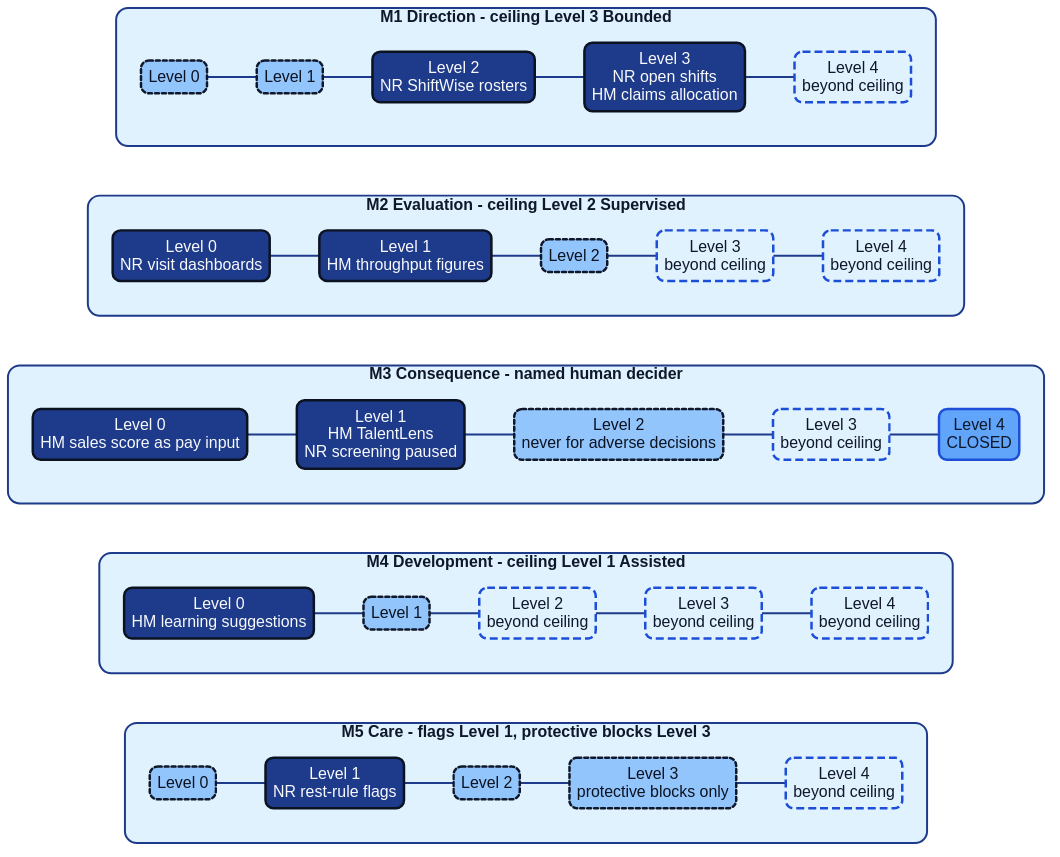
Figure 4.1: The delegation matrix: five management functions against five degrees of delegation, with the default ceilings, the closed cell for Level 4 in M3 Consequence, and the current profiles of Nordvik Region and Hansa Mutual plotted on it.
A definition
The term "algorithmic management" entered the research literature through a study of ride-hailing drivers. Lee and colleagues described software that assigns, optimises and evaluates human jobs through tracked data, and how drivers responded (127, Lee et al., 2015). Mateescu and Nguyen widened the frame beyond platforms and defined algorithmic management as "a diverse set of technology tools and techniques that structure the conditions of work and remotely manage workforces" (133, Mateescu & Nguyen, 2019). The OECD's survey of more than 6,000 firms in six countries defines it as the use of software, which may include AI, to fully or partially automate tasks traditionally carried out by human managers; it found such tools in common use in most countries studied, and managers citing unclear accountability, hard-to-follow logic and inadequate protection of workers' health among their concerns (149, Milanez et al., 2025).
Kellogg, Valentine and Christin found that algorithmic control works through six mechanisms: employers direct workers by restricting and recommending, evaluate them by recording and rating, and discipline them by replacing and rewarding (137, Kellogg et al., 2020). Their three verbs map onto M1 Direction, M2 Evaluation and M3 Consequence. The two functions they do not name, M4 Development and M5 Care, are the ones the control literature leaves out, and a definition built on control alone would miss the AI that recommends a course or flags fatigue, where delegation is quietest.
This book uses two terms.
- Algorithmic management is the practice of performing management functions wholly or partly by automated means, whether the software uses AI or fixed rules.
- An AI boss is any AI system or agent that performs part of a management function for or over a person. It does so for a person when it assists a manager who remains the one acting, as when an assistant proposes owners for the actions from a meeting. It does so over a person when its output reaches the worker directly or takes effect without a manager acting on it, as when an agent allocates a claim to a handler.
Three tests decide whether a system is an AI boss. Its output concerns a person as a worker: an applicant, an employee, an agency worker or a person performing platform work. The output is used, by the system or by someone else, to direct, evaluate, decide a consequence for, develop or care for that person. And the system contains AI in the AI Act's sense or is an agent. The third test separates the AI boss from rule-based algorithmic management, but this book's instruments apply to both, because the person managed rarely knows which is at work.
What falls outside is the AI that assists the worker rather than manages the worker. Hansa Mutual's claims assistant, which retrieves policy wordings for the handler who asked (AIDR-0021), is a tool of the handler's own work. It becomes part of an AI boss on the day its usage logs become a figure per handler that a team leader reads. The boundary is crossed by a decision about data, not by a change in the model. The same holds for Mode 0 features: Hansa switched off the collaboration and wellbeing analytics in its office suite pending works-council agreement because they would have made an office product an instrument of M2 Evaluation and M5 Care that nobody had decided to deploy.
The definition is wider than the law's categories on purpose. The AI Act lists as high-risk, in Annex III, point 4, AI systems used for recruitment or selection, and AI systems "intended to be used to make decisions affecting terms of work-related relationships, the promotion or termination of work-related contractual relationships, to allocate tasks based on individual behaviour or personal traits or characteristics or to monitor and evaluate the performance and behaviour of persons in such relationships" (1, European Union, 2024). The Platform Work Directive distinguishes automated monitoring systems, which monitor, supervise or evaluate work performance, from automated decision-making systems, which take or support decisions that significantly affect persons performing platform work, including access to and organisation of assignments, earnings, safety and health, working time, training, promotion and the termination of an account (Article 2(1)(h) and (i)) (47, European Union, 2024). Every system that meets either legal definition is an AI boss in this book's sense, but not every AI boss meets a legal definition: an office assistant that proposes who should own each task is not high-risk, yet it performs part of M1 Direction (Chapter 10).
Degrees of delegation
AI Red Team, Chapter 6, defined five autonomy levels for AI in cyber defence and set them per action, from reversibility, blast radius, confidence and the decision tier; it concluded that the line between Level 2 and Level 3 is the most important, that Level 3 is defined by a codified playbook enforced by a policy decision point outside the model, that Level 4 is never used for offensive or irreversible actions, and that the level is decided and recorded rather than discovered (43, Nordqvist, 2026). This book builds on that conclusion (F50) and applies the same five levels to each management function. Applied to the management of people, they become degrees of delegation.
| Degree | What the AI boss does | Who decides each action | Example in a care unit or claims team |
|---|---|---|---|
| Level 0 Advisory | Shows information or a suggestion | A person, who also acts | A dashboard shows planned against actual time per visit |
| Level 1 Assisted | Drafts the action; a person reviews and carries it out | A person, with their own authority | A screening module ranks applications; a recruiter reads them and decides whom to invite |
| Level 2 Supervised | Carries out the action after explicit human approval of each one | A person approves; the system executes | A rostering system publishes a four-week roster after the unit manager approves it |
| Level 3 Bounded | Carries out pre-approved, reversible actions within a codified playbook; a person is informed and can stop it | The playbook, approved in advance by a named authority | An agent allocates claims to handlers within published allocation rules; the team leader can reassign |
| Level 4 Autonomous | Selects and carries out actions without per-action approval | The system, within bounds set in advance | Never for M3 Consequence |
Three properties carry over unchanged. The level is set per action class, not per system: one rostering system can draft rosters at Level 2 Supervised and offer open shifts at Level 3 Bounded. The line between Level 2 and Level 3 is where per-decision human approval stops, and so where the most consequential choice about delegation is made. And Level 3 without a written playbook enforced outside the model is Level 4 under another name.
One property changes. In cyber defence the object of an action is a host or a session; in management it is a person, who can be harmed by an action that is technically reversible. A shift can be reversed in the roster, but the evening a nurse arranged childcare for cannot be given back. Reversibility is therefore judged from the position of the person affected.
Matching degree to function
The five management functions differ in what a person loses when they go wrong, in how far a single error spreads and in the law that governs them. Four criteria set the degree of delegation for each action class:
- Reversibility for the person. Can the effect on the person be undone fully and quickly, including the time, money and opportunity it cost them?
- Breadth. How many people does one action, or one error repeated by the system, affect? This is the blast radius of AI Red Team, Chapter 6, measured in people.
- The person's stake. Does the action touch income, employment, health, reputation or the record that later decisions will read?
- The law and the agreements. Which instrument fixes who must decide, and which collective agreement or works agreement fixes the procedure?
Applied to the five functions, the criteria give default ceilings: the highest degree of delegation an organisation should allow for a function unless a recorded decision justifies a lower or, for M1 Direction only, a narrowly bounded exception. Chapter 20 turns these defaults into decision rights per role.
| Function | Default ceiling | Reasoning |
|---|---|---|
| M1 Direction | Level 3 Bounded | Assigning and sequencing work is high-volume and mostly reversible; a playbook can bound it, and the worker or manager can correct a poor allocation within hours |
| M2 Evaluation | Level 2 Supervised | An evaluation becomes part of the record that later decisions read; a person approves any individual rating before it is stored or shown to anyone but the worker |
| M3 Consequence | Level 2 Supervised; Level 1 Assisted for adverse decisions; never Level 4 | Consequences are often irreversible for the person and are governed by labour, data-protection and platform law; a named person decides each one |
| M4 Development | Level 1 Assisted | Feedback and career advice depend on a relationship and on context the system lacks; a system may draft, a person gives |
| M5 Care | Level 1 Assisted for flags; Level 3 Bounded only for protective blocks | A system may flag a risk to health or safety for a person to act on, and may block an action that would breach a protective rule, but never relaxes one |
Two rows need explanation. M2 Evaluation has a lower ceiling than M1 Direction because of persistence: an assignment is used once, while a rating is stored and read again by whoever later decides pay, promotion or dismissal. An unchecked rating is a deferred consequence. M5 Care is asymmetric on purpose. A rostering system that refuses to publish a roster breaching the minimum daily rest of Article 3 of the Working Time Directive acts protectively (50, European Union, 2003), and its error, an unnecessary refusal, is caught by the manager who must find another way. A system that relaxes a rest rule, or treats a worker's report of fatigue as needing no response, acts against the purpose of the function, and that is never delegated.
The function an action belongs to is set by its effect on the person, not by its label. Offering open shifts looks like M1 Direction. For a part-time care assistant whose income depends on extra shifts, the order in which offers go out is also access to work, which belongs to M3 Consequence. If the system ranks staff by their history of accepting offers, it is evaluating them, which belongs to M2 Evaluation. Platform work shows the same drift from dispatch into rating and from rating into the removal of access (Chapter 5). An action that touches several functions takes the lowest of their ceilings, unless the profile records conditions that keep it within the higher one, as Nordvik's profile for open shifts below does.
The rule for consequences
The series concluded in AI Red Team, Chapter 6, that Level 4 Autonomous is never used for irreversible actions (43, Nordqvist, 2026). In this book the rule becomes: Level 4 Autonomous is never used for M3 Consequence, and every consequence decision about a person has a named human decider who can be identified, contested and held to account. For adverse consequences, such as rejecting an applicant, a disciplinary step, refusing pay, dismissal or removing access to work, the ceiling is Level 1 Assisted: the system may draft, but the decider acts with their own authority. For favourable or neutral consequences applying a rule people have already decided, such as paying a night-shift supplement fixed by a collective agreement, the ceiling is Level 2 Supervised, and the decision belongs to the person who approves the batch.
Three reasons support the rule, each sufficient alone.
The first is irreversibility. A court can order reinstatement after a dismissal, but the months between, the lost income and the damage to the person's standing cannot be undone.
The second is the law. Article 22(1) of the GDPR gives the data subject the right not to be subject to a decision based solely on automated processing, including profiling, which produces legal effects or similarly significantly affects them; where the contract or explicit-consent exceptions apply, Article 22(3) requires at least the right to obtain human intervention, to express a point of view and to contest the decision (5, European Union, 2016). The Platform Work Directive is more direct: any decision to restrict, suspend or terminate the contractual relationship or the account of a person performing platform work, or any other decision of equivalent detriment, "shall be taken by a human being" (Article 10(5)), and the persons charged with oversight must have the competence, training and authority to override automated decisions and enjoy protection from dismissal and other adverse treatment when they do so (Article 10(2)) (47, European Union, 2024). Member States must transpose the Directive by 2 December 2026 (Article 29(1)); its effect on employers outside the platform economy, through national transposition and through courts reasoning by analogy, is expected rather than observable. The AI Act requires deployers of high-risk systems to assign human oversight to natural persons with the necessary competence, training and authority (Article 26(2)), and requires providers to enable those persons to disregard, override or reverse the system's output and to remain aware of automation bias (Article 14(4)(b) and (d)) (1, European Union, 2024). Following the Digital Omnibus on AI, the obligations of Chapter III, Sections 1 to 3, apply to Annex III systems from 2 December 2027 (2, European Union, 2026). None of these provisions is phrased as an autonomy level, but read together their organisational implication is consistent: for a consequence about a person, the employer must be able to point to a person who decided.
The third is accountability, which the next section treats: a system cannot explain itself to a forum and face consequences for its conduct.
A named human decider is not a signature. The decider must be able to do six things:
- Be identified by the person affected, by role and, on request, by name, from the record of the decision.
- Decide otherwise with real authority, without justifying a departure more heavily than an acceptance.
- See the information the recommendation rested on, what it did not use, and what the person affected has said.
- Have the time the decision deserves, measured rather than assumed (Chapter 26).
- Be protected when deciding against the recommendation, as Article 10(2) of the Platform Work Directive requires for platform work and this book recommends for every employer.
- Answer for the decision to the person, the representatives, a court and a supervisory authority, through the records of Chapters 25 and 27.
A decider who lacks any of the six is a name attached to a system's output, and the next section explains why that is worse than having no name at all.
The accountability problem
Bovens defined accountability in a deliberately narrow sense: "a relationship between an actor and a forum, in which the actor has an obligation to explain and to justify his or her conduct, the forum can pose questions and pass judgement, and the actor may face consequences" (121, Bovens, 2007). For a management decision, the forums are the worker affected, the workers' representatives, the labour court and the supervisory authority. The system that ranked, scored or allocated can neither justify its conduct to them nor face consequences. Unless a person stands in the actor's position, the relationship has a forum but no actor.
Two failure modes follow, and they pull in opposite directions.
The first is the problem of many hands. Thompson observed that when many officials contribute in many ways to a decision, it becomes difficult to ascribe responsibility to any one of them, and argued that the usual responses, holding the hierarchy responsible or the collective, distort the notion of responsibility; he proposed personal responsibility based on causal and volitional criteria (111, Thompson, 1980). Algorithmic management multiplies the hands: a dismissal recommended by a performance score passes through the provider, the procurement team, the HR function that set the thresholds, the line manager who read the result and the executive who approved the programme, and each can say truthfully that the decision was not theirs alone. Adams-Prassl concluded that some legal challenges of algorithmic management can be met by adapting existing standards, but that management accountability for key workplace decisions may require a fundamental rethink of existing norms (135, Adams-Prassl, 2019). Aloisi and De Stefano's account of AI, platform work and labour law, published under the title Your Boss Is an Algorithm, examines the same displacement of managerial authority into software (141, Aloisi & De Stefano, 2022).
The second is the moral crumple zone. Elish analysed accidents involving automated systems and introduced the term to describe how responsibility for an action may be misattributed to a human actor who had limited control over the behaviour of an automated system: like the crumple zone of a car, the nearest human absorbs the moral and legal impact, protecting the integrity of the technological system (170, Elish, 2019). In management, the crumple zone is the line manager who signs the roster the system produced, approves the rating the system computed or confirms the dismissal the score recommended, without the information, time or authority to have decided otherwise. When the decision is challenged, the manager is named and the system is not examined.
The answer to many hands is a name; the answer to the crumple zone is that the name carries the means of deciding. Green surveyed 41 policies that prescribe human oversight of government algorithms and found two flaws: the evidence suggests that people are often unable to perform the oversight the policies assume, and the policies therefore legitimise the use of flawed algorithms while giving a false sense of security; he proposed institutional oversight, in which the organisation must justify the use of an algorithm and the form of human oversight with evidence and submit that justification to democratic review before adoption (178, Green, 2022). A named decider for each consequence answers Thompson; the six capabilities above, with the oversight record of Chapter 26, answer Elish; and the delegation profile, negotiated with workers' representatives before a system goes live and reviewed on evidence, is the institutional oversight Green asks for, in the form that co-determination already gives European workplaces.
Open question Q2 asks who is accountable when an AI recommended a consequence and a manager accepted it without reading it. The book's answer, developed in Chapters 20 and 26, has three parts. The manager who decided is accountable, because the profile gave the manager the authority and information to decide otherwise. The function owner who set the profile is accountable for providing those means and a volume that made reading possible. Where the oversight record shows that reading was not possible, accountability moves to whoever set the volume, and the profile, not the manager, must change. This follows the series' conclusion from AI Red Team, Chapter 6, that at higher degrees human approval moves from the action to the playbook and the decision record, which concentrates accountability rather than diluting it (F51) (43, Nordqvist, 2026).
The thesis in testable form
With the instruments defined, the working thesis of Chapter 1 can be stated as four claims, each with the evidence that would weaken it. The claims are the book's own and are judged in Chapters 29 and 33.
- Direction can be delegated; consequences cannot. Organisations that delegate M1 Direction up to Level 3 Bounded within written playbooks, while keeping M3 Consequence at or below Level 2 Supervised with a named decider, gain the coordination benefits of algorithmic management without the harms recorded in Part II. Weakened by: evidence that fully automated consequence decisions produce fairer and safer outcomes than human decisions with records and appeal.
- Every management decision AI makes or shapes is a record. Where workers can read and contest Management Decision Records, errors are corrected sooner and contests resolved faster than where they cannot. Weakened by: records that nobody reads, or contests with records faring no better than those without.
- The manager's role is transformed, not abolished. Teams directed partly by AI sustain performance, health and retention over years only where a human manager still performs M4 Development and M5 Care. Weakened by: evidence that algorithmic direction without human leadership sustains performance and wellbeing over years, not quarters.
- The quiet harms come first. Losses to autonomy, dignity, pace, health, managers' judgement and people's willingness to speak appear earlier and more widely than dramatic failures, and the book's instruments detect them. Weakened by: measured effects in Part III confined to visible, dramatic cases.
The outlooks behind the claims carry the labels of AI Governance, Chapter 22 (41, Nordqvist, 2026). That algorithmic management is in common use is observable (149, Milanez et al., 2025). That the spread of agents in office work will put more of M1 Direction under AI is expected: Microsoft's Work Trend Index for 2025 announced that "as agents increasingly join the workforce, we'll see the rise of the agent boss", meaning employees who manage agents (151, Microsoft, 2025). Whether long-run evidence will support the third claim is speculation in either direction (Chapter 15).
Delegation profiles
A delegation profile states, for one system or team, the degree of delegation per function and action class, the named decider, the representatives' agreement, the stop path and the next review. It is the management form of the mandate manifest that The Transformed Security Architect, Chapter 13, wrote for an architect's agent team, in which the person who conducts the team remains the accountable verifier of everything it proposes (F75) (46, Nordqvist, 2026). It is short, versioned and stored beside the organisation's AI Decision Records, which keep the discipline of numbered, immutable records that AI Platform and Security, Chapter 5, took from the Architecture Decision Records of Architecture as Code (Chapter 4) (F38, F8) (42, Nordqvist, 2026) (40, Nordqvist, 2025) (16, Nygard, 2011). Adopting or changing a profile is itself an AI Decision Record.
A profile records five things a policy document usually leaves implicit: the degree per action class rather than per system; the functions the system does not perform, so that a later extension shows as a change; the conditions that keep an action within its function, such as the inputs it may not use; the people who can stop the system and how, in line with the conclusions of AI Governance, Chapter 13, and AI Threat, Chapter 30, that stop rights are named in advance, held outside the system they stop and cheaper to exercise than the right to continue (F19, F63) (41, Nordqvist, 2026) (44, Nordqvist, 2026); and the Management Decision Records the system must produce, so that the record is a by-product of operation.
Practical guide: Writing a first delegation profile for an AI system that touches management functions
Purpose. Produce a first, honest profile for one system that already takes part in managing people, so that the organisation, the workers' representatives and the people managed can see what has been delegated.
Roles. The function owner (HR director, chief HR officer or head of the operational function), who signs; the line managers who will decide; the system owner; the data protection officer; the workers' representatives with rights over the system; and at least two workers managed by it.
Steps.
- List the action classes: everything the system does that reaches a worker or manager (drafts, ranks, scores, assigns, offers, flags, blocks), including outputs that are only stored. Default: at most fifteen classes in a first profile.
- Assign each class to a function by its effect on the person (Chapter 2). Where a class touches two functions, record both and apply the lower ceiling.
- Record the degree as observed, not as intended. Sample fifty recent actions per class. If managers approve rosters in seconds without opening them, the observed degree is nearer Level 3 Bounded than the Level 2 Supervised the contract describes; record that for Chapter 26's oversight record.
- Compare with the default ceilings. Lower any class above its ceiling or justify it in an AI Decision Record. Nothing justifies Level 4 Autonomous for M3 Consequence, and adverse decisions above Level 1 Assisted need a justification.
- Name the deciders and the stop path: the role that decides or approves for every class at Level 1 or above; who pauses locally and who stops system-wide, by a path that works when the system is down, for every class at Level 2 or above.
- Write the playbook and exclusions for each Level 3 class, enforced in a component the model cannot change.
- Agree the profile with the representatives before go-live or, for a system already in use, within three months. In Germany, a system suited to monitor behaviour or performance requires the works council's agreement under BetrVG §87(1) no. 6 (9, Germany, 2001); in Sweden, the employer must negotiate before deciding on an important change in working or employment conditions under MBL §11 (205, Sveriges riksdag, 1976); for a high-risk system, inform workers' representatives and affected workers before use under AI Act Article 26(7) (1, European Union, 2024). Adapt the procedure to the collective agreement or works agreement.
- Set the review date and triggers. Default: review six months after first approval and annually thereafter, and at once on a new model version, a new action class, a new unit or entity, a change in thresholds, a pattern of contests or an incident.
Definition of done. The profile parses against the schema, names a decider for every class at Level 1 or above and a stop path for every class at Level 2 or above, places no M3 Consequence class above its ceiling, records the representatives' position, and has been read by two workers who say they understand what it delegates.
Worked example: delegation profiles DLG-NR-ROS-01 and DLG-HM-CTA-01
The two profiles below are illustrative. The first is Nordvik Region's profile for the procured rostering system ShiftWise, version 1.0.0, negotiated with the unions before the system's routes go live in home care and recorded as AIDR-0602.
profile: DLG-NR-ROS-01
version: 1.0.0
organisation: Nordvik Region
system:
  name: ShiftWise
  usage_mode: Mode 4 Built AI applications
  role_under_ai_act: deployer
  classification: high-risk, AI Act Annex III point 4(b)
  tender: NR-2025-089
  fria: FRIA-2026-007
scope: [hospital wards, home care]
owner: HR director, Ingrid Halvorsen
decision_record: AIDR-0602
representatives:
  procedure: negotiation under the co-determination act before the decision
  parties: [union for nurses and midwives, union for municipal and care workers]
  agreed: 2027-01-20
functions:
  M1_Direction:
    - action: draft_roster_and_visit_routes
      level: Level 2 Supervised
      decider: unit manager approves every roster before publication
    - action: offer_open_shift
      level: Level 3 Bounded
      playbook: offers only to staff who opted in, within working-time
        rules and competence, in the published rotating order
      excluded_inputs: [acceptance_history, sick_leave_history]
      local_pause: unit manager, for own unit
  M2_Evaluation: not_delegated
  M3_Consequence: not_delegated
  M4_Development: not_delegated
  M5_Care:
    - action: flag_rest_rule_breach
      level: Level 1 Assisted
      decider: unit manager resolves every flag before approval
    - action: block_roster_breaching_minimum_rest
      level: Level 3 Bounded
      direction: protective only; never relaxes a rule
stop:
  system_wide: HR director or on-call HR duty manager
  fallback: manual rostering from the last approved roster
records:
  mdr: every approved roster and every change by a manager
  first: MDR-NR-0001
open_questions:
  - retention of offer acceptance data by the provider (Chapter 5)
review:
  next: 2027-08-01
  triggers: [new model version, new unit, change to offer order, contest pattern]
The second is Hansa Mutual's profile for the work-allocation function of the claims-triage agent. It records what the agent already does, so that the Konzernbetriebsrat, the team leaders and the handlers can read it, and it documents the reassessment of that function under Annex III, point 4(b), that AIDR-0651 opens.
profile: DLG-HM-CTA-01
version: 1.0.0
organisation: Hansa Mutual
system:
  name: claims-triage agent, work-allocation function
  usage_mode: Mode 5 Autonomous production agents
  identity: own workload identity on the core claims system
  classification: not high-risk for its insurance function (AIDR-0024);
    work allocation under reassessment (AIDR-0651)
scope: [claims teams in Germany]
other_entities: own profile version after each entity's consultation gate
owner: group head of claims operations
co_approver: chief HR officer
representatives:
  body: Konzernbetriebsrat
  basis: BetrVG 87(1) no. 6; group works agreement KBV-IT-2024
  recorded: 2026-12-14
functions:
  M1_Direction:
    - action: allocate_claim_to_handler
      level: Level 3 Bounded
      playbook: allocation rules v2026.4, enforced by the core claims
        system rule engine outside the agent
      inputs: [claim type, complexity class, handler authority limit,
        open workload, absence status]
      under_review: individual throughput as an allocation input (AIDR-0651)
      override: team leader may reassign any claim
  M2_Evaluation:
    - action: compute_throughput_per_handler
      level: Level 1 Assisted
      visible_to: team leader only, per KBV-IT-2024
      team_metric: OQM-HM-CLM-01, team level only
  M3_Consequence:
    status: not_delegated
    rule: throughput figures are no input to any M3 decision without a
      new profile version agreed with the Konzernbetriebsrat
  M4_Development: not_delegated
  M5_Care: not_delegated
stop:
  team: team leader switches own team to manual allocation
  group: group head of claims operations; agent operator revokes credentials
records:
  mdr: every reassignment that overrides the agent; not every allocation
  first: MDR-HM-0001
review:
  next: 2027-04-30
  triggers: [AIDR-0651 outcome, change to allocation rules, new entity]
Three choices deserve comment. Nordvik's open-shift offers sit at Level 3 Bounded only because acceptance and sick-leave history are excluded from the offer order; without that exclusion the action would rank people and exceed the ceilings of M2 Evaluation and M3 Consequence. The provider's retention of acceptance data is recorded as an open question rather than assumed away. Hansa's profile names an input under review, individual throughput, because allocating tasks "based on individual behaviour" is a use Annex III, point 4(b), names. And both profiles record M3 Consequence as not delegated in a testable form: Nordvik's because ShiftWise produces no consequence, Hansa's because it forbids the path by which figures could become one.
The delegation register
A profile shows one system. The delegation register of management functions, management/delegation-register.yaml, shows all of them. AI Threat, Chapter 26, concluded that small delegations erode skill, process, capacity, interfaces and memory until the documented fallback no longer exists, that a delegation register shows the sum of what has been delegated, and that reversibility tests check that each delegation can be undone, with further delegation frozen where a test fails (F69) (44, Nordqvist, 2026). That register listed functions rather than systems, because what matters is which human capacity is no longer exercised. This book extends it to the management of people.
Each entry points to a delegation profile and adds four things the profile alone does not show. It shows, per function and team, how many systems touch that function, which is how an organisation discovers that three separately reasonable profiles leave a team leader little of M1 Direction to exercise. It records the last reversibility test: whether the unit could run its rosters, or the team its allocation, without the system for a defined period, and whether its managers still can. It records the oversight-quality metric of Chapter 26 against each Level 2 class, so that upward drift in practice is visible. And it records the representatives' position per function, which a works council or union needs in order to co-determine a system whose thresholds change faster than agreements are renegotiated (open question Q8).
The register also records Mode 0 features once discovered. AI Red Team concluded that vendor AI may already act at an autonomy nobody decided (F57) (43, Nordqvist, 2026); in management, a scoring feature arriving in an HR suite update is the equivalent, and an entry marked "discovered, not decided" is more useful than none. Chapter 25 sets out the register's schema and readers.
The artefact set
The delegation profile is the first of the artefacts that Part VI develops. Parts II to V use them as a lens before they are described in full, so the set is previewed here.
| Artefact | Identifier | What it records | Chapter |
|---|---|---|---|
| Delegation profile | DLG-NR-*, DLG-HM-* |
Degree of delegation per function and action class for a system or team, deciders, agreement, stop path, review | 4, 25 |
| Delegation register | management/delegation-register.yaml |
All profiles, the sum per function and team, reversibility tests, oversight metrics | 25 |
| Management Decision Record | MDR-NR-NNNN, MDR-HM-NNNN |
One management decision AI made or shaped about a person: proposal, decider, reasons, information given, route to contest | 25 |
| Oversight record and oversight-quality metric | per profile | Whether human review of AI recommendations was real | 26 |
| Contestation record | CNT-NR-*, CNT-HM-* |
A worker's challenge to a management decision and its outcome | 27 |
| Worker information notice | per system | What workers and representatives are told, when and by whom | 28 |
| Mandate manifest | MND-HM-CLM-* |
Tasks, degree, tools, data and approvals of agents a manager directs | 16 |
| AI Decision Record | AIDR-0600 to AIDR-0699 |
Decisions about systems and profiles, such as adopting a profile | 1 onwards |
The artefacts answer different readers: the profile and register tell the management body and the representatives what has been delegated; the Management Decision Record and contestation record tell the worker, a court and a supervisor what was decided about this person and how to challenge it (open question Q3); the oversight record tells the function owner whether the human decision was real; and the worker information notice tells everyone managed before any decision is taken.
Reading Parts II to V through the instruments
The instruments give every later chapter three questions to ask of any AI boss: which functions it performs, judged by effect; at what degree each action class actually runs, against the ceiling; and, for every M3 Consequence it touches, who the named decider is, whether that person can do the six things above, and what record the decision leaves.
Part II applies the questions to the AI boss as practised today, from platform dispatch (Chapter 5) to the AI manager in the office (Chapter 10); the recurring question there is whether the degree of delegation for a consequence was ever decided and recorded. Part III asks what being managed at those degrees does to people. Part IV reverses the direction, to people managing agents and agents managing agents, where the mandate manifest takes the place of the profile. Part V reads the European instruments, of which this chapter has used only the provisions that fix who must decide.
Across the usage modes
The degree of delegation is set per function and action class, not per mode, but the mode constrains it, because the mode determines whose identity the AI boss acts with and where its limits can be enforced (AI Governance, Chapter 2; AI Platform and Security, Chapter 2) (41, Nordqvist, 2026) (42, Nordqvist, 2026).
| Usage mode | Whose identity it acts with | Typical degree in management | Where the profile is enforced | What to watch |
|---|---|---|---|---|
| Mode 0 Ambient AI | The vendor's feature, inside licensed software | Undecided until discovered | Contract and configuration | Scoring or analytics switched on by an update |
| Mode 1 Conversational assistants | The manager's own | Level 0 Advisory | The manager's judgement and training | A manager pasting worker data in to draft a rating |
| Mode 2 Embedded workplace assistants | The manager's, delegated | Level 0 to Level 1 | Tenant settings and the manager's authority | Action lists that quietly allocate work |
| Mode 3 Agentic work tools | The manager's, within a sandbox | Level 1 to Level 2 | The tool's approval settings | Agents sending instructions to staff in the manager's name |
| Mode 4 Built AI applications | The application's service identity | Level 0 to Level 3, per action class | Configuration and the policy component | Thresholds changed without a new profile version |
| Mode 5 Autonomous production agents | Their own workload identity and permissions | Level 2 to Level 3; never Level 4 for M3 | Mandate, permissions and an external rule engine | An agent's permissions reaching consequence actions |
Mode 1 to Mode 3 tools act with the manager's identity and cannot exceed the manager's own authority, which makes the manager the decider by construction. Mode 4 applications act within their configuration, so a change of threshold is a change of profile. Mode 5 agents act with identities of their own, which is where the rule against Level 4 for M3 Consequence carries most weight: an agent whose permissions reach an action that ends someone's access to work has already been delegated a consequence, whatever the policy says.
Nordvik Region and Hansa Mutual
At Nordvik Region, Ingrid Halvorsen's commission (AIDR-0600) makes the delegation register one of its first products, and DLG-NR-ROS-01 is its first test. The profile keeps ShiftWise at Level 2 Supervised for M1 Direction, with unit managers such as Mikael Strand approving every roster and visit route, allows one Level 3 Bounded class for offering open shifts to staff who opted in, and keeps the rest-rule flags for M5 Care at Level 1 Assisted. The unions negotiate it under the co-determination act before the routes go live in home care, and the result is recorded as AIDR-0602. DLG-NR-HCD-01 records the home-care dashboards at Level 0 Advisory for M2 Evaluation (Chapter 8). Writing the profiles shows the Region that nothing in its estate reaches M3 Consequence while the screening pilot remains paused (AIDR-0601), and that resuming it needs a profile that names its decider.
At Hansa Mutual, the executive board's request for a group policy (AIDR-0650) meets an estate in which AI already directs people. DLG-HM-CTA-01 records the claims-triage agent's allocation of claims at Level 3 Bounded within rules enforced outside the agent, with Jana Petersen and the other team leaders able to reassign any claim, and the throughput figures at Level 1 Assisted for M2 Evaluation, visible to team leaders only under KBV-IT-2024. Thomas Brandt asks for individual throughput as an allocation input to be written into the profile rather than left to AIDR-0651, and it is. The group's other profiles show what Nordvik's did not: TalentLens (DLG-HM-REC-01) reaches M3 Consequence at Level 1 Assisted in hiring, and the sales-performance score (DLG-HM-SPS-01) at Level 0 Advisory as an input to variable pay, which Chapters 7 and 8 take up. The agent-boss pilot (DLG-HM-AB-01) follows in Chapter 16.
Figure 4.1 shows the difference: Nordvik's AI boss works in M1 Direction and M5 Care under one jurisdiction, while Hansa's reaches into M2 Evaluation and M3 Consequence and must be agreed with a Konzernbetriebsrat and six other national arrangements before a profile extends beyond Germany.
Summary
The AI boss is any AI system or agent that performs part of a management function for or over a person; algorithmic management is the wider practice, with or without AI. A worker's own tool most often becomes an AI boss through a decision to use its data about the worker. The definition includes, and is wider than, the categories of AI Act Annex III, point 4, and the Platform Work Directive.
The series' autonomy levels, applied per management function and action class, are the book's degrees of delegation. Reversibility for the person, breadth, the person's stake and the law set default ceilings: Level 3 Bounded for M1 Direction, Level 2 Supervised for M2 Evaluation, Level 2 Supervised and Level 1 Assisted for adverse decisions in M3 Consequence, Level 1 Assisted for M4 Development, and Level 1 Assisted for flags with Level 3 Bounded only for protective blocks in M5 Care. Level 4 Autonomous is never used for M3 Consequence, and every consequence decision has a named human decider who can be identified, decide otherwise, see the information, take the time, be protected and answer for it.
The rule answers the accountability problem in both its forms, the many hands and the moral crumple zone. The delegation profile records degree, deciders, agreement, stop path and review; the delegation register shows the sum of what has been delegated and whether it can be undone. Nordvik's DLG-NR-ROS-01 and Hansa's DLG-HM-CTA-01 show both in use, and the thesis now stands as four claims that evidence could weaken, to be judged in Chapters 29 and 33.
Chapter 5 begins Part II where algorithmic management is most fully developed and best documented: platform work, in which the algorithm dispatches, rates and deactivates, and in which European courts and the Platform Work Directive first answered the question of who must decide.
Sources
- European Parliament and Council of the European Union (2024). Regulation (EU) 2024/1689 laying down harmonised rules on artificial intelligence (Artificial Intelligence Act). Official Journal of the European Union. (1, European Union, 2024)
- European Parliament and Council of the European Union (2026). Regulation (EU) 2026/1744 amending Regulations (EU) 2024/1689, (EU) 2018/1139 and (EU) 2023/1230 as regards the simplification of the implementation of harmonised rules on artificial intelligence (Digital Omnibus on AI). Official Journal of the European Union. (2, European Union, 2026)
- European Parliament and Council of the European Union (2016). Regulation (EU) 2016/679 on the protection of natural persons with regard to the processing of personal data (General Data Protection Regulation). Official Journal of the European Union. (5, European Union, 2016)
- Federal Republic of Germany (2001). Betriebsverfassungsgesetz (BetrVG) (Works Constitution Act), as amended. Gesetze im Internet. (9, Germany, 2001)
- Nygard, M. (2011). Documenting Architecture Decisions. Cognitect blog. (16, Nygard, 2011)
- Nordqvist, G. (2025). Architecture as Code. The Architecture as Code Series, Book 1. (40, Nordqvist, 2025)
- Nordqvist, G. (2026). AI Governance: Governing Artificial Intelligence in European Enterprises and Public Authorities. The Architecture as Code Series, Book 2. (41, Nordqvist, 2026)
- Nordqvist, G. (2026). AI Platform and Security: Building and Securing AI Platforms in European Enterprises and Public Authorities. The Architecture as Code Series, Book 3. (42, Nordqvist, 2026)
- Nordqvist, G. (2026). AI Red Team: AI as an Active Part of Cyber Defence in European Enterprises and Public Authorities. The Architecture as Code Series, Book 4. (43, Nordqvist, 2026)
- Nordqvist, G. (2026). AI Threat: Are the Dystopias Coming True? Evidence, Risk and Response for European Enterprises and Public Authorities. The Architecture as Code Series, Book 5. (44, Nordqvist, 2026)
- Nordqvist, G. (2026). The Transformed Security Architect: Role, Craft and Career in the Age of AI in European Enterprises and Public Authorities. The Architecture as Code Series, Book 6. (46, Nordqvist, 2026)
- European Parliament and Council of the European Union (2024). Directive (EU) 2024/2831 of 23 October 2024 on improving working conditions in platform work. Official Journal of the European Union. (47, European Union, 2024)
- European Parliament and Council of the European Union (2003). Directive 2003/88/EC of 4 November 2003 concerning certain aspects of the organisation of working time. Official Journal of the European Union. (50, European Union, 2003)
- Thompson, D. F. (1980). Moral Responsibility of Public Officials: The Problem of Many Hands. American Political Science Review, 74(4), 905–916. (111, Thompson, 1980)
- Bovens, M. (2007). Analysing and Assessing Accountability: A Conceptual Framework. European Law Journal, 13(4), 447–468. (121, Bovens, 2007)
- Lee, M. K., Kusbit, D., Metsky, E. & Dabbish, L. (2015). Working with Machines: The Impact of Algorithmic and Data-Driven Management on Human Workers. Proceedings of CHI 2015, 1603–1612. (127, Lee et al., 2015)
- Mateescu, A. & Nguyen, A. (2019). Explainer: Algorithmic Management in the Workplace. Data & Society. (133, Mateescu & Nguyen, 2019)
- Adams-Prassl, J. (2019). What if your boss was an algorithm? Economic incentives, legal challenges, and the rise of artificial intelligence at work. Comparative Labor Law & Policy Journal, 41(1). (135, Adams-Prassl, 2019)
- Kellogg, K. C., Valentine, M. A. & Christin, A. (2020). Algorithms at Work: The New Contested Terrain of Control. Academy of Management Annals, 14(1), 366–410. (137, Kellogg et al., 2020)
- Aloisi, A. & De Stefano, V. (2022). Your Boss Is an Algorithm: Artificial Intelligence, Platform Work and Labour. Hart Publishing. (141, Aloisi & De Stefano, 2022)
- Milanez, A., Lemmens, A. & Ruggiu, C. (2025). Algorithmic management in the workplace: New evidence from an OECD employer survey. OECD Artificial Intelligence Papers. (149, Milanez et al., 2025)
- Microsoft (2025). 2025: The Year the Frontier Firm Is Born. Work Trend Index Annual Report. (151, Microsoft, 2025)
- Elish, M. C. (2019). Moral Crumple Zones: Cautionary Tales in Human-Robot Interaction. Engaging Science, Technology, and Society, 5, 40–60. (170, Elish, 2019)
- Green, B. (2022). The flaws of policies requiring human oversight of government algorithms. Computer Law & Security Review, 45, 105681. (178, Green, 2022)
- Sveriges riksdag (1976). Lag (1976:580) om medbestämmande i arbetslivet (Co-determination in the Workplace Act, MBL). (205, Sveriges riksdag, 1976)