What a Manager Does: Five Management Functions and Who Performs Them
Before anyone can say what an AI boss does, or should be allowed to do, the book needs a precise account of what a manager does. This chapter provides it. It reads the classical and the empirical literature of management, from Fayol and Drucker to Mintzberg's observation studies, and the research on job design, stress and psychological safety that explains why the manager matters to the people managed. From that literature and from the legal duties of an employer it derives five management functions that the rest of the book uses as its unit of analysis: M1 Direction, M2 Evaluation, M3 Consequence, M4 Development and M5 Care. It defines each function with its boundaries, shows who performs each one today in a hospital ward, a home-care unit and a claims team, explains why the split follows differences in reversibility, law and the person's stake rather than convenience, and introduces the idea, formalised in Chapter 4, that each function can be delegated to a system at a degree from Level 0 Advisory to Level 4 Autonomous. It ends with the book's first artefact: a function map that records, for a team, who performs each function and which systems already touch it.
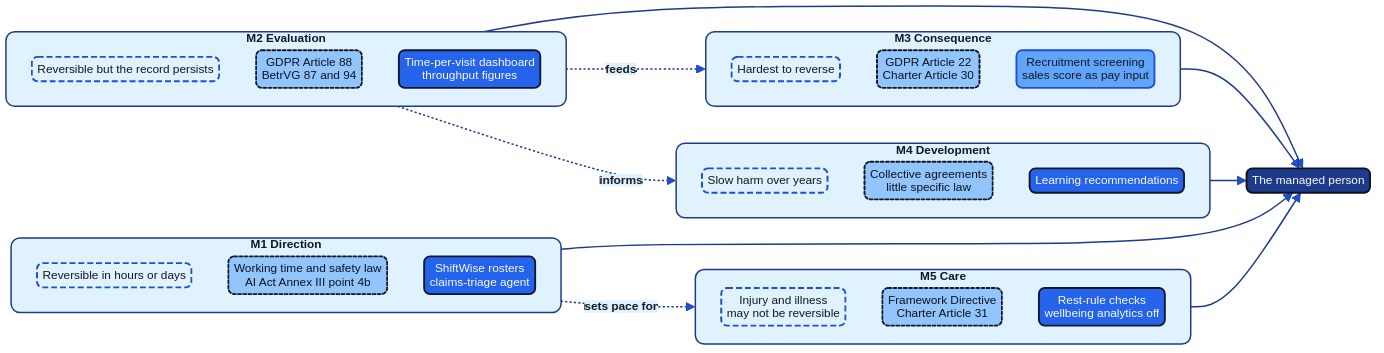
Figure 2.1: The five management functions around the managed person, with the reversibility, governing law and current systems of each, and the overlaps that join them.
What managers were said to do
The first systematic answer came from a mining engineer. Henri Fayol, writing in 1916 from his experience running a French coal and steel company, separated management from the technical, commercial, financial, security and accounting activities of a firm and divided it into five elements: to plan, to organise, to command, to co-ordinate and to control (97, Fayol, 1949). His principles of administration, which accompany the elements, already contain most of the subjects of this book: division of work, authority and responsibility, discipline, remuneration, equity and the stability of tenure of personnel. Fayol's contribution was the claim that management is a function that can be described, taught and separated from the work it manages. Without that claim there would be nothing to delegate to a machine.
Peter Drucker moved the account from the firm to the person who manages. In The Practice of Management he described the manager's work as five basic operations: setting objectives, organising, motivating and communicating, establishing yardsticks of measurement, and developing people, the manager included (100, Drucker, 1954). Two of his operations have no counterpart in Fayol. Measurement becomes a task of its own, and Drucker's management by objectives proposed that people should use the measurements to control their own performance rather than be controlled by them. Development becomes a duty of the manager rather than a by-product of experience.
The plan, organise, command and control tradition that followed them into management textbooks is prescriptive, written from the perspective of the employing organisation. It established that management is a set of separable functions, but its categories describe what the organisation gets from management, not what the person managed receives or risks. Neither the duty of care for health nor the person's voice appears among Fayol's elements. The book's split must cover both perspectives.
What managers were observed to do
Henry Mintzberg tested the classical account by watching managers work. In his structured observation of five chief executives, each followed for a week, he found work that was brief, varied and fragmented, carried out mostly by talking rather than reading or writing, and driven by interruptions rather than plans (103, Mintzberg, 1973). He grouped what he saw into ten roles in three families. The interpersonal roles are figurehead, leader and liaison. The informational roles are monitor, disseminator and spokesperson. The decisional roles are entrepreneur, disturbance handler, resource allocator and negotiator. Planning and controlling, the centre of the classical account, were hard to find as separate activities; they were spread across hundreds of short exchanges.
Three of Mintzberg's findings matter for the AI boss. First, much of management is informational: the manager is the point where information about the work and the people converges and from which it is passed on. A system that collects activity data, ranks cases and produces dashboards takes over part of the monitor and disseminator roles, often without anyone deciding that it should. Second, the leader role, which includes staffing, motivating and attending to the people in the unit, is woven through everything else rather than performed at scheduled times. It is the part least visible in a job description and least likely to be specified when a system is procured. Third, a system that promises to remove the fragmentation may also remove the moments in which a manager notices that someone is in difficulty.
Linda Hill followed new managers through their first year and found that most began by seeing the role as authority over tasks and learned that it was about relationships, interdependence and responsibility for other people's work and wellbeing, with formal authority the least effective tool they had (119, Hill, 2003). The parts new managers underestimate are the parts hardest to express in rules, and therefore hardest to hand to a system.
Large organisations have measured whether managers make a difference. Google's Project Oxygen analysed more than 10,000 data points from performance reviews and feedback surveys together with interviews, and found that teams with highly effective managers were more likely to achieve better results, to be happier and to have lower turnover; it identified ten behaviours of effective managers, of which coaching, empowering the team without micromanaging and supporting career development are three (95, Google re:Work, n.d.). Benson, Li and Shue, using performance data on sales workers at 131 firms, found evidence consistent with the Peter Principle: firms promoted their best salespeople to manager even when other observable characteristics better predicted managerial performance, at measurable cost (124, Benson et al., 2019). Who becomes a manager is itself a consequential decision, a point Chapter 19 takes up.
The research on algorithmic management gives the third reading. Kellogg, Valentine and Christin, using Edwards's account of the workplace as a contested terrain of control (108, Edwards, 1979), synthesised the interdisciplinary research on algorithms at work and found that algorithmic control operates through six mechanisms: employers use algorithms to direct workers by restricting and recommending, to evaluate them by recording and rating, and to discipline them by replacing and rewarding (137, Kellogg et al., 2020). Direction, evaluation and discipline are Edwards's three elements of a system of control. The OECD defines algorithmic management as the use of software, which may include AI, to fully or partially automate tasks traditionally carried out by human managers, and its survey of more than 6,000 firms in France, Germany, Italy, Japan, Spain and the United States found such tools already commonly used in most of those countries; the managers surveyed cited unclear accountability, difficulty following the tools' logic and inadequate protection of workers' health as concerns (149, Milanez et al., 2025). The joint ILO and European Commission study of logistics and healthcare found hospital information systems and digital platforms already used to allocate tasks and coordinate work (147, International Labour Organization, 2024). These findings are observable, not projections.
Five management functions
The control literature names three functions because it studies control. The classical literature adds development, and the observation studies, the job-design research and the law of the employer's duty of care add a fifth. The book uses five functions because each of the five has its own decisions, its own law, its own failure and its own way of being delegated. The table gives the definitions that every later chapter uses.
| Function | Definition | Includes | Boundary |
|---|---|---|---|
| M1 Direction | Assigning, sequencing, pacing and instructing work | Rosters and visit routes, allocation of cases, priorities, target times, work instructions, reassignment during the day | Ends where a decision determines whether a person has work or income at all; that is M3 |
| M2 Evaluation | Measuring, rating and judging performance and conduct | Activity and output measures, dashboards, quality sampling, ratings, conduct investigations | Ends at a judgement about the person; what follows from the judgement is M3 or M4 |
| M3 Consequence | Hiring, pay, promotion, discipline, dismissal, deactivation and access to work | Selection, pay setting and variable pay, promotion, warnings, dismissal, account suspension, allocation of hours that determines income | Begins wherever the person's legal or economic position changes |
| M4 Development | Feedback, learning, coaching and career | Development conversations, feedback on work, training plans, mentoring, career paths, learning recommendations | Feedback meant to improve the person is M4; a rating used to compare people is M2 |
| M5 Care | Safety, health, wellbeing, voice and the duty of care | Workload and pace limits, rest, risk assessment, adaptation of work, noticing and acting on ill health, the person's ability to raise concerns | Overlaps all other functions because each can create a risk to health that M5 must answer for |
M1 Direction is the function the classical writers called command and organisation, and the one Kellogg and colleagues call restricting and recommending. It is the most visible part of algorithmic management: the rostering system that drafts a four-week schedule, the dispatch algorithm that offers a delivery, the triage agent that places a claim in a handler's queue. Direction includes pace. A target time per visit or a queue that refills as fast as it empties is a decision about how fast someone works, even where nobody states it as one. Direction ends where the decision changes whether a person has work or income at all. For an hourly care assistant whose pay depends on the shifts offered, the allocation of open shifts is partly an M3 decision, and the function map must say so.
M2 Evaluation is measurement, rating and judgement. It includes measures of output and activity, the dashboards that display them, the sampling of work for quality, formal ratings and the investigation of conduct. It is Mintzberg's monitor role turned into a system and Kellogg's recording and rating. The boundary that matters most is between measuring the work and judging the person. A figure for average visit time across a route is information for planning; the same figure per person, visible to the manager, is evaluation, whether or not anyone calls it that. Evaluation ends at a judgement; the pay rise, the warning or the development plan that follows from it belongs to another function.
M3 Consequence is where a person's legal or economic position changes: who is hired, what they are paid, who is promoted, who is warned, dismissed or, on a platform, deactivated, and who gets access to work. It is Kellogg's replacing and rewarding and the part of Fayol's principles that concerns remuneration, discipline and tenure. The function is defined by its effect on the person, not by the formal label of the decision. An allocation rule that systematically gives one group fewer hours is a consequence decision, even if the system that applies it is classed as scheduling.
M4 Development is feedback, learning, coaching and career. Drucker made it a duty of the manager, and Project Oxygen found coaching and support for career development among the behaviours that distinguish effective managers (95, Google re:Work, n.d.). Development is not the same as evaluation, and the difference is measurable. Kluger and DeNisi's meta-analysis of 607 effect sizes found that feedback interventions improved performance on average, but that more than a third of them reduced it, and that feedback was less effective the more it drew attention away from the task and towards the self (116, Kluger & DeNisi, 1996). Feedback that compares a person with others or with a score can work against the development it is meant to serve, which is why the boundary between M2 and M4 is drawn by purpose.
M5 Care is safety, health, wellbeing, voice and the duty of care. It is the function most often left out of management models and the one most firmly grounded in law. The Framework Directive on safety and health at work gives the employer a duty to ensure the safety and health of workers in every aspect related to the work; it requires the employer to adapt work to the individual, with a view in particular to alleviating monotonous work and work at a predetermined work-rate; and it requires that the planning and introduction of new technologies be the subject of consultation with workers or their representatives as regards their consequences for safety and health (Council Directive 89/391/EEC, Articles 5(1), 6(2)(d) and 6(3)(c)) (49, Council of the European Communities, 1989). The Charter of Fundamental Rights gives every worker the right to working conditions which respect his or her health, safety and dignity (Article 31(1)) (48, European Union, 2012). Voice belongs here because a person who cannot raise a concern cannot report a risk: Hirschman's distinction between exit and voice (102, Hirschman, 1970) and Edmondson's finding that team psychological safety is associated with learning behaviour (117, Edmondson, 1999) both describe the conditions under which people speak rather than leave or stay silent.
The five functions are the book's own construction, built from these sources. Fayol and Drucker are not wrong; their categories describe the organisation's need. The five functions describe what reaches the person managed. That makes them the right unit for asking what may be delegated to a system, and the claim that they are the right unit is tested in Chapters 4 and 20.
Why the split matters
A split is useful only if the parts differ in ways that change what should be done with them. The five functions differ in four ways: how reversible their decisions are, what the person has at stake, which law governs them and what can be measured about them.
| Function | Reversibility | The person's stake | Governing law (examples) | What can be measured |
|---|---|---|---|---|
| M1 Direction | High for each decision, within hours or days; the cumulative effect of pace is not | Time, effort and pace, day by day | Working Time Directive Article 3; Framework Directive Article 6(2)(d); BetrVG §87(1) no. 2; AI Act Annex III, point 4(b) | Throughput, waiting time, schedule changes, rest breaches |
| M2 Evaluation | The judgement can be corrected, but the record persists and travels to other functions | Reputation and the inputs to every later decision | GDPR Article 88; BetrVG §87(1) no. 6 and §94(2); AI Act Annex III, point 4(b) | Accuracy, consistency between raters, error rates by group |
| M3 Consequence | Lowest; a dismissal or a lost job offer is seldom fully undone | Livelihood, career and legal status | Charter Article 30; GDPR Article 22; AI Act Annex III, point 4; Platform Work Directive Article 10(5); BetrVG §95 | Outcomes by group, appeal and reversal rates |
| M4 Development | Slow in both directions; harm shows over years | Skill, employability and growth | Collective agreements and practice; little specific law | Learning completed, internal mobility, retention |
| M5 Care | Injury and illness may be permanent | Health, safety, dignity and the ability to speak | Framework Directive Articles 5, 6 and 11; Charter Article 31; national work-environment law | Sickness absence, incidents, workload indicators, concerns raised |
Reversibility is the property the series has used throughout to set the autonomy of a system. AI Red Team, Chapter 6, defined five autonomy levels per action and concluded that Level 4 Autonomous is never used for irreversible actions (43, Nordqvist, 2026). Applied to management, the rule picks out M3 Consequence, whose decisions are the hardest to undo and the most consequential for a person. M1 Direction is the reverse case: each individual allocation can be undone in hours, which is why direction is where delegation to a system is most defensible. Pace is the exception within M1. A single fast day is reversible; a year of work at a predetermined rate is a health risk, and that is why the Framework Directive names work at a predetermined work-rate among the things to alleviate.
The law follows the same lines, with a gap. Direction is governed mostly through working time and safety law. In Germany, the start and end of daily working time, including breaks, is subject to the works council's co-determination (BetrVG §87(1) no. 2), and the Working Time Directive entitles every worker to a minimum daily rest of 11 consecutive hours (Directive 2003/88/EC, Article 3) (9, Germany, 2001) (50, European Union, 2003). Evaluation is governed by data protection and co-determination: the GDPR allows member states, by law or collective agreement, to provide more specific rules for processing employees' data, including for the management, planning and organisation of work (Article 88) (5, European Union, 2016), and in Germany the introduction and use of technical devices designed to monitor employees' behaviour or performance, and the setting of general appraisal principles, require the works council's agreement (BetrVG §87(1) no. 6 and §94(2)) (9, Germany, 2001). Consequence is governed most densely: by the Charter's protection against unjustified dismissal (Article 30), by the GDPR's right not to be subject to a decision based solely on automated processing that produces legal or similarly significant effects (Article 22), by equality law, and in Germany by the works council's consent to selection guidelines for hiring, transfers and dismissals, which since 2021 applies expressly where AI is used to draw them up (BetrVG §95(1) and (2a)) (207, Germany, 2021). For platform work, the Platform Work Directive requires that any decision to restrict, suspend or terminate the contractual relationship or the account of a person performing platform work, or any other decision of equivalent detriment, be taken by a human being (Directive (EU) 2024/2831, Article 10(5)) (47, European Union, 2024).
The AI Act draws its line around the functions rather than across them. Annex III, point 4, classes as high-risk AI systems intended for recruitment or selection, in particular to place targeted job advertisements, analyse and filter applications and evaluate candidates (point 4(a)), and systems intended to make decisions affecting terms of work-related relationships, promotion or termination, to allocate tasks based on individual behaviour or personal traits or characteristics, or to monitor and evaluate the performance and behaviour of persons in such relationships (point 4(b)) (1, European Union, 2024). Point 4(b) reaches into M1 Direction where allocation depends on individual behaviour or traits, into M2 Evaluation and into M3 Consequence. It does not mention development or care. Deployers who are employers must inform workers' representatives and the affected workers before putting a high-risk system into service or use at the workplace (Article 26(7)). Following the Digital Omnibus, the obligations for high-risk systems classified under Annex III apply from 2 December 2027 (Regulation (EU) 2026/1744, amending Article 113) (2, European Union, 2026), which is expected: decided, but not yet in application.
M4 Development is the gap: it is governed mostly by collective agreements, practice and the manager's judgement. That is a reason for care, not for freedom. A function whose harm appears slowly, as a skill not learned or a career that stalls, is easy to delegate without anyone noticing what was lost, which is the pattern AI Threat, Chapter 26, described as gradual disempowerment (44, Nordqvist, 2026).
M5 Care is governed by the most general law and the most specific duties. In the Swedish example the book uses for Nordvik Region, the employer must take all measures necessary to prevent the employee from being exposed to ill health or accidents, and must systematically plan, lead and control the activity so that the work environment meets the requirements (Arbetsmiljölag (1977:1160), chapter 3, sections 2 and 2a) (75, Sveriges riksdag, 1977). The Swedish Work Environment Authority's regulations go further and place a duty on the employer to ensure that managers and supervisors know how to prevent and handle unhealthy workload and victimisation, and that they have the conditions to put that knowledge into practice (AFS 2023:2, chapter 2, section 4) (84, Arbetsmiljöverket, 2023). The duty is addressed to the employer, but it assumes a manager who can see the workload. A system that directs the work and a manager who no longer sees it is the configuration Q11 of this book asks about.
Where the functions overlap
The functions are separable for analysis and joined in practice. Five overlaps recur through the book.
Evaluation feeds consequence. A throughput figure or a sales score becomes an input to pay, promotion or dismissal, sometimes years after it was introduced for planning, a drift that is easy to miss because the system has not changed, only the decision it feeds. The protection is to map a system to every function its output reaches, not only to the function it was bought for, and to treat a new use of an existing figure as a change that needs its own decision.
Direction sets pace, and pace is a matter of care. A rostering system that minimises gaps between home-care visits or a triage agent that keeps every queue full sets the intensity of the work. Karasek's job strain model holds that high demands combined with low decision latitude produce mental strain (107, Karasek, 1979), and the Job Demands-Resources model extends the account to the resources, among them support and feedback, that buffer demands (120, Bakker & Demerouti, 2007). An M1 system that raises demands and lowers latitude acts on M5 whatever its label says.
Development depends on evaluation. Feedback needs information about the work, and a system that records the work produces that information. Whether it serves development or only ranking depends on who sees it, in what form and for what purpose, which is why the boundary between M2 and M4 is drawn by purpose rather than by data.
Consequence shapes direction. Who is hired determines who can be assigned what, and selection rules carry assumptions about the work into the team for years. Benson, Li and Shue's finding on promotion shows the same loop inside management itself (124, Benson et al., 2019).
Evaluation can silence care. Bernstein's field experiment in a large mobile-phone factory found that a modest increase in group-level privacy improved line performance, and that observed workers concealed improvements and deviations from the observers (122, Bernstein, 2012). Measurement that people experience as surveillance can reduce the voice that M5 depends on. Chapter 13 treats the chilling effect at length.
Who performs each function today
A function is not the same as a job. In every workplace the five functions are shared between the line manager, HR, systems, colleagues and the person themselves. Mapping the AI boss starts with seeing that distribution clearly, because a system that takes over part of a function takes it from someone, and that someone may not be the line manager.
The table shows the present distribution in three workplaces. The ward is a medical ward in one of Nordvik Region's two local hospitals; the home-care unit is Nordvik's Strandvik unit; the claims team is Jana Petersen's team of about 20 claims handlers in Hamburg at Hansa Mutual. The facts come from the people-management profiles of the two organisations.
| Function | Hospital ward, Nordvik Region | Strandvik home-care unit, Nordvik Region | Claims team in Hamburg, Hansa Mutual |
|---|---|---|---|
| M1 Direction | Ward manager approves ShiftWise four-week rosters; the nurse in charge allocates patients each shift; staff state preferences |
Unit manager approves ShiftWise visit schedules and routes; staff who opted in are offered open shifts by the system |
Claims-triage agent allocates claims to handlers within allocation rules; the team leader can reassign |
| M2 Evaluation | Ward manager and senior colleagues, by observation and incident review; clinical audit | Unit manager, by informal observation and the time-per-visit dashboard | Team leader, with individual throughput figures under the group works agreement KBV-IT-2024; mid-year reviews in the HRIS |
| M3 Consequence | Ward manager recruits; HR administers; pay set in annual review under the collective agreement | Unit manager recruits and sets pay in the annual review under the collective agreement; screening pilot paused | Team leader and HR; annual objectives cycle in Hansa People; HR lead for Germany on discipline and dismissal |
| M4 Development | Ward manager in development conversations recorded without ratings; clinical educators; colleagues | Unit manager in development conversations recorded without ratings; learning-management system | Team leader; group learning platform recommends courses; experienced handlers mentor new ones |
| M5 Care | Ward manager, safety representative and occupational health service; ShiftWise flags rest-rule breaches |
Unit manager with the safety representative; ShiftWise flags rest-rule breaches |
Team leader, the Betriebsrat and occupational health; wellbeing analytics switched off pending agreement |
Three things stand out. First, systems already carry part of M1 Direction in all three workplaces, and part of M2 Evaluation in two. In Hamburg a Mode 5 agent performs much of M1 Direction at Level 3 Bounded, within allocation rules, today. Second, the line manager remains the main performer of M3, M4 and M5 everywhere, but never alone: HR, collective agreements and the works agreement constrain each decision, and the safety representative shares M5. Third, colleagues and the person themselves perform parts of the functions that no organisation chart records. The nurse in charge directs, the experienced handler develops the new one, and the worker who states shift preferences or raises a concern performs part of M1 and M5 for themselves. A system that takes over a function can displace these informal performers as easily as the formal one.
The distribution differs between the two organisations for reasons the book returns to. Nordvik's AI boss directs shift work in care through a procured system; its manager approves every roster, at Level 2 Supervised. Hansa's directs office work through an agent it built, at a higher degree, under a works agreement that limits who sees individual figures. Neither organisation has delegated any part of M3 Consequence beyond Level 1 Assisted, and Nordvik has paused its one system that came close.
The manager as a person in the system
The functions describe what is done. The research on job design describes why it matters who does it.
Hackman and Oldham's job characteristics model names five core dimensions of a job, skill variety, task identity, task significance, autonomy and feedback from the job itself, and links them through psychological states to motivation, satisfaction and performance (106, Hackman & Oldham, 1976). Two of the five, autonomy and feedback, are set largely by how M1 Direction and M2 Evaluation are done. A system that specifies the sequence and pace of every task reduces autonomy by design; a system that returns a score instead of information about the work changes the kind of feedback a person receives. Ryan and Deci's self-determination theory makes the same point at a more general level: competence, autonomy and relatedness are basic psychological needs, and social conditions that thwart them diminish motivation and well-being (118, Ryan & Deci, 2000).
Karasek's demand-control model and its successor, the Job Demands-Resources model, add the manager as a resource. Social support from managers and colleagues is one of the resources that buffers high demands (120, Bakker & Demerouti, 2007), and the Swedish regulations list it among the resources the employer must consider when assessing workload (84, Arbetsmiljöverket, 2023). Edmondson's study of 51 work teams in a manufacturing company found that team psychological safety, a shared belief that the team is safe for interpersonal risk-taking, was associated with learning behaviour, and that team structures such as context support and team leader coaching shaped it (117, Edmondson, 1999).
The common thread is that part of management is a relationship rather than a task. Noticing that a colleague who used to finish her round early now finishes late every day, asking why, and adjusting the route before she goes on sick leave is M5 Care performed through attention. It is not written in any procedure, and no dashboard records it. When a system takes over the routes, the opportunity to notice moves with it unless someone designs it back in. This is the question Q11 records: what replaces the manager's judgement in the duty of care when direction and evaluation are done by a system that does not notice a person in difficulty.
The series has already concluded that a role can be written down. The Transformed Security Architect, Chapter 4, treated a role as a versioned artefact with a mandate, accountabilities and decision rights (F73) (46, Nordqvist, 2026), and Architecture as Code (Chapter 17) concluded that change succeeds only with equal investment in people, process and technology (F9) (40, Nordqvist, 2025). The function map below applies the first conclusion to management: before deciding what a system may do, write down what the role does and who does it.
Mapping an AI system onto the functions
A function map records, for a team or a unit, who performs each management function today, which parts sit in systems and which AI systems touch which functions, at which degree. It is the starting point for everything the book proposes: the delegation profile of Chapter 4 states the intended degree per function for a system, and the delegation register of Chapter 25 sums the profiles across the organisation. Without a map, those later artefacts describe what a system was bought to do, not what it does.
The degree of delegation is introduced here and formalised in Chapter 4. It reuses the five autonomy levels of AI Red Team, Chapter 6, applied per management function rather than per security action (43, Nordqvist, 2026). At Level 0 Advisory a system offers information and a person decides and acts. At Level 1 Assisted the system drafts or recommends and a person reviews and decides each case. At Level 2 Supervised the system acts after a person approves each action. At Level 3 Bounded the system acts within rules approved in advance, and a person is informed and can stop it. At Level 4 Autonomous the system acts without per-action approval. Level 4 Autonomous is never used for M3 Consequence: every consequence decision about a person has a named human decider who can be identified, contested and held to account. The rule is the book's form of the series' rule that Level 4 is never used for irreversible actions.
The mode and the degree are different things. The usage mode says how AI is deployed and whose identity it uses; the degree says who decides each action within a function. A Mode 5 agent can work at Level 2 Supervised, and a Mode 0 feature can act at what amounts to Level 4 because a vendor configured it that way, a pattern AI Red Team, Chapter 6, observed in security products. The function map records both.
The map follows the series' practice of routing decisions to the lowest tier that can take them with evidence (F17; AI Governance, Chapter 13) and of working through records rather than meetings (F22; AI Governance, Chapter 12) (41, Nordqvist, 2026): it is a file in version control, changed by review and readable by the people it concerns.
Practical guide: Mapping a team's management functions
Purpose. Produce a reviewed function map for one team or unit that shows who performs each management function today, which parts sit in systems and which AI systems now touch which functions, at which mode and degree.
Roles. The line manager of the team (owner of the map); an HR business partner; a workers' representative or safety representative chosen by the representatives (reviewer); the system owner of each AI system listed; the data protection officer for any system that processes personal data about the team; two or three members of the team, who are asked what they experience.
Steps.
- Fix the scope: one team or unit, its line manager and the period the map describes. A map of a whole organisation is the delegation register's job, not this one.
- For each of the five functions, list the decisions taken in the team in a normal month, using the definitions in this chapter. Include informal decisions, such as who covers an absence or who mentors a new starter.
- For each decision, record who performs it today: line manager, HR, a system, a peer or the person themselves. Where more than one performs it, record each and say who has the last word.
- List every system that produces an output used in any of those decisions, including Mode 0 features in licensed software and Mode 2 assistants that summarise meetings or propose task owners. Ask the team which systems they experience as directing or evaluating them; the answer often adds systems IT did not list.
- For each system, record every function its output reaches, not only the one it was procured for, its usage mode, the degree at which it works per function, and who decided that degree. If nobody decided, write "not decided": that is a finding.
- Mark each overlap from this chapter that applies: evaluation that feeds pay, direction that sets pace, development that depends on evaluation, selection that shapes the team, measurement that may chill voice.
- Record the law and agreements that govern each function in this team, naming the instrument and article or the clause of the collective or works agreement.
- Review the map with the workers' representative within 20 working days of the draft, adapting the period to the co-determination procedure that applies, and record open questions rather than resolving them silently.
- Commit the map, link it to the decision record that commissioned it, and set a review date no more than 12 months away, or earlier when a system is introduced, changed or switched on.
Definition of done. Every function has at least one named performer; every system that touches a function appears with its mode, its degree per function and the person who decided the degree, or the finding that nobody did; every M3 Consequence entry names a human decider; the representatives' review is recorded; the map parses and is in version control with a review date.
Worked example: A function map as code
The following map is illustrative. It records the Strandvik home-care unit at Nordvik Region, prepared by Mikael Strand under the commission AIDR-0600 and reviewed with the safety representative.
# management/function-map.yaml (illustrative excerpt)
function_map:
  id: FMAP-NR-STR-01
  organisation: Nordvik Region
  unit: Strandvik home-care unit
  line_manager: Mikael Strand
  staff: 35            # assistant nurses and care assistants, a third part-time or hourly
  commissioned_by: AIDR-0600
  reviewed_by: [safety representative, HR business partner, data protection officer]
  prepared: 2026-12-01
  next_review: 2027-12-01
  functions:
    M1_direction:
      performers: [line_manager, system, self]
      last_word: line_manager
      systems:
        - name: ShiftWise visit schedules and routes
          mode: Mode 4 Built AI applications
          degree: Level 2 Supervised
          decided_by: AIDR-0602
        - name: ShiftWise open-shift offers to staff who opted in
          mode: Mode 4 Built AI applications
          degree: Level 3 Bounded
          decided_by: AIDR-0602
          also_reaches: [M3_consequence]   # offered hours determine pay for hourly staff
    M2_evaluation:
      performers: [line_manager, system]
      systems:
        - name: Home-care performance dashboard, time per visit
          mode: Mode 4 Built AI applications
          degree: Level 0 Advisory
          decided_by: not yet decided    # delegation profile DLG-NR-HCD-01 to follow
          finding: individual figures visible to the unit manager; use not agreed
          also_reaches: [M4_development, M5_care]
    M3_consequence:
      performers: [line_manager, hr]
      human_decider: Mikael Strand   # recruitment and annual pay review under the collective agreement
      systems:
        - name: Recruitment screening module
          degree: Level 1 Assisted
          status: paused (AIDR-0601)
    M4_development:
      performers: [line_manager, peer]
      note: development conversations recorded in the HRIS without ratings
      systems: []
    M5_care:
      performers: [line_manager, safety_representative, self]
      systems:
        - name: ShiftWise working-time and rest checks
          mode: Mode 4 Built AI applications
          degree: Level 1 Assisted
          decided_by: AIDR-0602
  overlaps: [M1_sets_pace_for_M5, M2_feeds_M3_if_dashboard_used_in_pay_review]
  open_questions:
    - Does the dashboard fall under AI Act Annex III point 4(b)?
The map for Jana Petersen's claims team at Hansa Mutual has the same shape and a different distribution.
# management/function-map.yaml (illustrative excerpt, Hansa Mutual)
function_map:
  id: FMAP-HM-CLM-HH-01
  organisation: Hansa Mutual
  unit: Claims team, Hamburg
  line_manager: Jana Petersen
  staff: 20
  commissioned_by: AIDR-0650
  reviewed_by: [Betriebsrat Hamburg, HR lead Germany]
  prepared: 2026-12-07
  next_review: 2027-06-30          # before and after the agent-boss pilot under AIDR-0652
  agreements: [KBV-IT-2024]
  functions:
    M1_direction:
      performers: [system, line_manager]
      last_word: line_manager      # can reassign; each override is MDR-HM-*
      systems:
        - name: Claims-triage agent, allocation to handlers
          mode: Mode 5 Autonomous production agents
          degree: Level 3 Bounded
          decided_by: AIDR-0034          # go-live decided for the insurance function
          open_question: Annex III point 4(b) reassessment of allocation (AIDR-0651)
    M2_evaluation:
      performers: [line_manager, system]
      systems:
        - name: Throughput figures per handler
          degree: Level 1 Assisted
          decided_by: KBV-IT-2024   # individual figures to the team leader only
          also_reaches: [M3_consequence, M4_development]
    M3_consequence:
      performers: [line_manager, hr]
      human_decider: Jana Petersen with the HR lead for Germany
      systems: []                   # no AI in discipline or dismissal
    M4_development:
      performers: [line_manager, peer, system]
      systems:
        - name: Group learning platform recommendations
          mode: Mode 4 Built AI applications
          degree: Level 0 Advisory
          decided_by: not decided
    M5_care:
      performers: [line_manager, works_council, self]
      systems: []                   # wellbeing analytics in the office suite switched off
  overlaps: [M1_sets_pace_for_M5, M2_feeds_M3_through_annual_objectives]
Two findings are visible in the files before anyone reads a policy. At Strandvik, the dashboard reaches M2, M4 and M5 at a degree nobody has yet decided; its delegation profile, DLG-NR-HCD-01, has still to be written. In Hamburg, the agent performs most of M1 at Level 3 Bounded, which makes the team leader's reassignment the main human control over direction, and the throughput figures reach M3 through the annual objectives cycle. Chapter 4 turns findings like these into delegation profiles.
Across the usage modes
The function map records the mode of every system it lists, because the mode determines how a system came to touch a function and who decided that it should.
| Usage mode | How it reaches the functions | Example in the two organisations | Who decided that it touches a function |
|---|---|---|---|
| Mode 0 Ambient AI | Features in licensed HR and office software that score, summarise or recommend | Wellbeing and collaboration analytics in Hansa's office suite, switched off pending agreement | Often the vendor, unless the organisation decides to switch the feature off or on |
| Mode 1 Conversational assistants | A manager uses an assistant to draft feedback or a warning letter | Approved enterprise tools in both organisations | The individual manager, usually unrecorded |
| Mode 2 Embedded workplace assistants | Meeting summaries and task lists that propose owners | Nordvik's pilot assistant; Hansa's office assistants | Nobody explicitly: M1 Direction at Level 0 Advisory arrives with the rollout |
| Mode 3 Agentic work tools | Agents act with an employee's identity; little reach into management today | Limited to Nordvik's platform team and Hansa's engineering teams | The engineer who runs the tool |
| Mode 4 Built AI applications | Procured or built for a named function | ShiftWise for M1 Direction; TalentLens for M3 Consequence in hiring |
A procurement or build decision with an AIDR |
| Mode 5 Autonomous production agents | Agents with their own identities perform a function | Hansa's claims-triage agent allocates claims to people | A decision record, though it may have been made for another purpose |
Modes 0 and 2 touch the functions without anyone deciding it, so the map is often the first place the touch is written down. Modes 4 and 5 are decided, but for one function: the claims-triage agent, classified for its insurance function, also directs the work of 20 people.
Nordvik Region and Hansa Mutual
At Nordvik Region, Mikael Strand performs most of M1 Direction in the Strandvik home-care unit by approving the routes ShiftWise drafts, M2 Evaluation through observation and the time-per-visit dashboard, M3 Consequence through recruitment and the annual pay review, M4 Development through development conversations without ratings, and M5 Care with the safety representative. The map shows a public employer whose systems have entered direction and evaluation, whose one consequence system is paused, and whose largest finding is a dashboard used at a degree not yet decided.
At Hansa Mutual, in Jana Petersen's Hamburg claims team, the claims-triage agent performs much of M1 Direction within allocation rules, the throughput figures carry part of M2 Evaluation under KBV-IT-2024, and HR and the annual objectives cycle carry M3 Consequence. M5 Care sits with the team leader, the works council and occupational health. The map shows an employer that has delegated more of direction, to an agent with its own identity, and has bound evaluation more tightly through co-determination.
Nordvik's question is how to keep the manager's sight of the work when a system drafts it; Hansa's is how to keep the team leader's override real when the agent directs most of the day. Both start from the map.
Summary
Management can be divided, and the division matters. Fayol and Drucker described separable functions; Mintzberg and Hill observed work that is informational, interpersonal and fragmented; the research on algorithmic management identifies direction, evaluation and discipline as the mechanisms of algorithmic control, and the OECD and ILO evidence shows such tools already in common use. All of this is observable.
From these sources and from the employer's legal duties the chapter derived five management functions, M1 Direction, M2 Evaluation, M3 Consequence, M4 Development and M5 Care, each defined with its boundaries. They differ in reversibility, in the person's stake, in the law that governs them and in what can be measured: M1 decisions are individually reversible, M3 decisions the hardest to undo, M4 harms appear over years in the least regulated function, and M5 rests on the Framework Directive, the Charter and national work-environment law. They overlap: evaluation feeds consequence, direction sets the pace that care must answer for, and measurement can silence the voice care needs.
Today the functions are shared between line managers, HR, systems, colleagues and the person managed. In a Nordvik ward and home-care unit, systems already carry part of direction at Level 2 Supervised; in Hansa's Hamburg claims team an agent carries most of it at Level 3 Bounded. The line manager remains the main performer of consequence, development and care, and part of care is a relationship no system records.
The chapter introduced the idea that each function can be delegated to a system at a degree from Level 0 Advisory to Level 4 Autonomous, with Level 4 never used for M3 Consequence, and the first artefact of the book: a function map that records who performs each function, which systems touch it, at which mode and degree, and who decided. The claim that the five functions are the right unit for delegation is the book's own and is tested in Chapters 4 and 20.
Chapter 3 places the five functions in a century of managing by measurement, from Taylor to the algorithm, to show which parts of the AI boss are new and which are old.
Sources
- Fayol, H. (1949). General and Industrial Management. Translated by C. Storrs. London: Pitman. (97, Fayol, 1949)
- Drucker, P. F. (1954). The Practice of Management. New York: Harper & Brothers. (100, Drucker, 1954)
- Mintzberg, H. (1973). The Nature of Managerial Work. New York: Harper & Row. (103, Mintzberg, 1973)
- Hill, L. A. (2003). Becoming a Manager: How New Managers Master the Challenges of Leadership. Boston, MA: Harvard Business School Press. (119, Hill, 2003)
- Google re:Work. Following the data: The research behind great managers (Project Oxygen). (95, Google re:Work, n.d.)
- Benson, A., Li, D. & Shue, K. (2019). Promotions and the Peter Principle. The Quarterly Journal of Economics. (124, Benson et al., 2019)
- Edwards, R. (1979). Contested Terrain: The Transformation of the Workplace in the Twentieth Century. New York: Basic Books. (108, Edwards, 1979)
- Kellogg, K. C., Valentine, M. A. & Christin, A. (2020). Algorithms at Work: The New Contested Terrain of Control. Academy of Management Annals. (137, Kellogg et al., 2020)
- Milanez, A., Lemmens, A. & Ruggiu, C. (2025). Algorithmic management in the workplace: New evidence from an OECD employer survey. OECD Publishing. (149, Milanez et al., 2025)
- International Labour Organization (2024). Algorithmic management practices in regular workplaces are already a reality. ILO. (147, International Labour Organization, 2024)
- Kluger, A. N. & DeNisi, A. (1996). The effects of feedback interventions on performance: A historical review, a meta-analysis, and a preliminary feedback intervention theory. Psychological Bulletin. (116, Kluger & DeNisi, 1996)
- Council of the European Communities (1989). Council Directive 89/391/EEC of 12 June 1989 on the introduction of measures to encourage improvements in the safety and health of workers at work. Official Journal of the European Communities. (49, Council of the European Communities, 1989)
- European Union (2012). Charter of Fundamental Rights of the European Union. Official Journal of the European Union. (48, European Union, 2012)
- Hirschman, A. O. (1970). Exit, Voice, and Loyalty: Responses to Decline in Firms, Organizations, and States. Cambridge, MA: Harvard University Press. (102, Hirschman, 1970)
- Edmondson, A. (1999). Psychological Safety and Learning Behavior in Work Teams. Administrative Science Quarterly. (117, Edmondson, 1999)
- Nordqvist, G. (2026). AI Red Team: AI as an Active Part of Cyber Defence in European Enterprises and Public Authorities. (43, Nordqvist, 2026)
- Federal Republic of Germany (2001). Betriebsverfassungsgesetz (BetrVG) (Works Constitution Act). (9, Germany, 2001)
- European Parliament and Council of the European Union (2003). Directive 2003/88/EC of 4 November 2003 concerning certain aspects of the organisation of working time. (50, European Union, 2003)
- European Parliament and Council of the European Union (2016). Regulation (EU) 2016/679 (General Data Protection Regulation). (5, European Union, 2016)
- European Parliament and Council of the European Union (2024). Directive (EU) 2024/2831 of 23 October 2024 on improving working conditions in platform work. (47, European Union, 2024)
- European Parliament and Council of the European Union (2024). Regulation (EU) 2024/1689 laying down harmonised rules on artificial intelligence (Artificial Intelligence Act). (1, European Union, 2024)
- European Parliament and Council of the European Union (2026). Regulation (EU) 2026/1744 (Digital Omnibus on AI). (2, European Union, 2026)
- Nordqvist, G. (2026). AI Threat: Are the Dystopias Coming True? Evidence, Risk and Response for European Enterprises and Public Authorities. (44, Nordqvist, 2026)
- Sveriges riksdag (1977). Arbetsmiljölag (1977:1160) (Work Environment Act). (75, Sveriges riksdag, 1977)
- Arbetsmiljöverket (2023). AFS 2023:2 Planering och organisering av arbetsmiljöarbete. Swedish Work Environment Authority. (84, Arbetsmiljöverket, 2023)
- Karasek, R. A. (1979). Job Demands, Job Decision Latitude, and Mental Strain: Implications for Job Redesign. Administrative Science Quarterly. (107, Karasek, 1979)
- Bakker, A. B. & Demerouti, E. (2007). The Job Demands-Resources model: state of the art. Journal of Managerial Psychology. (120, Bakker & Demerouti, 2007)
- Bernstein, E. S. (2012). The Transparency Paradox: A Role for Privacy in Organizational Learning and Operational Control. Administrative Science Quarterly. (122, Bernstein, 2012)
- Hackman, J. R. & Oldham, G. R. (1976). Motivation through the design of work: Test of a theory. Organizational Behavior and Human Performance. (106, Hackman & Oldham, 1976)
- Ryan, R. M. & Deci, E. L. (2000). Self-determination theory and the facilitation of intrinsic motivation, social development, and well-being. American Psychologist. (118, Ryan & Deci, 2000)
- Nordqvist, G. (2026). The Transformed Security Architect: Role, Craft and Career in the Age of AI in European Enterprises and Public Authorities. (46, Nordqvist, 2026)
- Nordqvist, G. (2025). Architecture as Code. (40, Nordqvist, 2025)
- Federal Republic of Germany (2021). Gesetz zur Förderung der Betriebsratswahlen und der Betriebsratsarbeit in einer digitalen Arbeitswelt (Betriebsrätemodernisierungsgesetz). Bundesgesetzblatt I 2021, p. 1762. (207, Germany, 2021)
- Nordqvist, G. (2026). AI Governance: Governing Artificial Intelligence in European Enterprises and Public Authorities. (41, Nordqvist, 2026)