The Mixed Team: People and Agents Under the Same Manager
Chapters 16 and 17 looked at the manager who directs agents and at the chains that form when agents direct other agents. This chapter looks at the team in which people and AI agents take work from the same queue under one manager. Such a team is not just a team with better tools: some of its members can be measured continuously at almost no cost and need no development or care, and their figures can easily become the yardstick for the others. The chapter shows how to divide the work, keep agents' figures apart from people's, design handovers, keep recognition and psychological safety, and apply co-determination. It concerns four management functions: M1 Direction, because work is split between people and agents and allocated among them; M2 Evaluation, because agents' throughput must not become the measure of people; M4 Development, because the tasks people learn on are the ones agents take first; and M5 Care, because no agent notices a colleague in difficulty. The worked example is the team charter for Jana Petersen's claims team at Hansa Mutual.
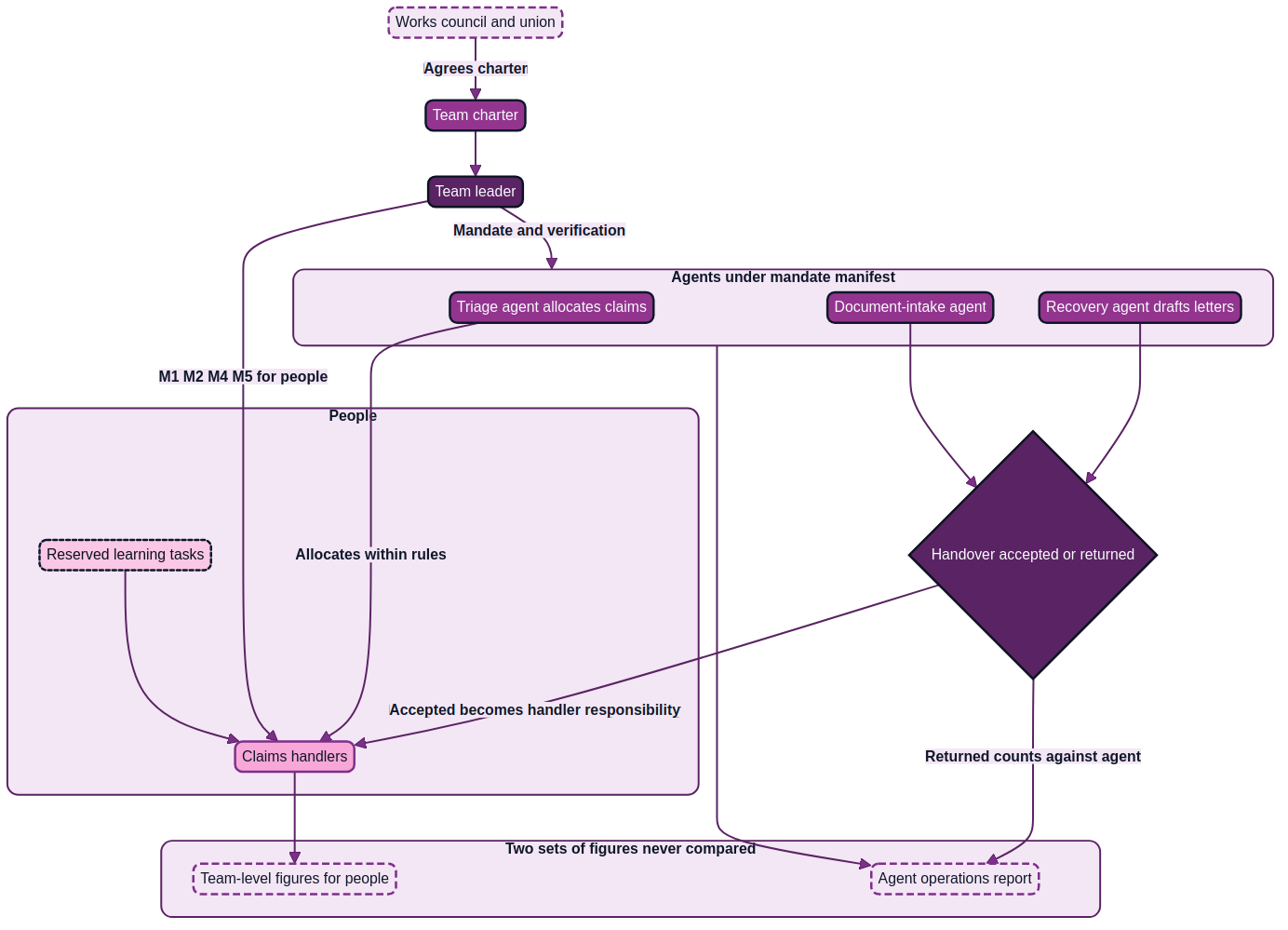
Figure 18.1: A mixed team under one manager, with people and agents, the separated figures, the recorded handovers and the reserved learning tasks, all set by a team charter agreed with the works council.
One manager, two kinds of worker
The phrase that made the mixed team a management topic came from a vendor. Microsoft's Work Trend Index for 2025, based on a survey of 31,000 knowledge workers in 31 markets, describes an "agent boss" as someone who builds, delegates to and manages agents. It reports that 36 per cent of leaders and 21 per cent of employees expect to manage agents in their jobs, and it proposes that leaders track a "human-agent ratio" for each role and task (151, Microsoft, 2025). The survey measures expectations, not outcomes, but the design problem is real: every management routine built for a team of people has to be checked once agents join it.
The research on teams of humans and autonomous systems is older than the term and more cautious. Thomas O'Neill and colleagues reviewed the empirical literature on human–autonomy teaming. They defined it as humans and autonomous agents working interdependently towards a common goal, with each agent taking a distinct role or set of tasks (177, O'Neill et al., 2022). Seventy-six articles met their criteria. All were simulations; no field study qualified. Fifty-seven were military or emergency simulations, largely of command-and-control tasks, and in most a single agent worked with a single human. Where human–human teams were compared with human–autonomy teams, the human–human teams generally did better. Training people to work with the agent consistently helped. Making the agent's reasoning visible had mixed effects: it improved performance and perceptions of the agent but could also produce complacency, conflict and extra workload. To counter complacency, the authors suggest occasionally having people perform the agent's typical tasks themselves. They also found that the literature had almost nothing to say about the learning, development and need satisfaction of the individual team members, a gap they list as a research priority.
Two conclusions follow for a line manager. The evidence for mixed teams in ordinary office and care work is thin, so practice should be treated as an experiment and recorded as one. And the gap the review found is where the manager's duties lie: research measured whether teams hit their targets, not whether their people learned and stayed well, which is what M4 Development and M5 Care name.
Architecture as Code (Chapters 17 and 18) concluded, following Melvin Conway, that a system's design mirrors the communication paths of the organisation that builds it (40, Nordqvist, 2025) (17, Conway, 1968), and AI Governance, Chapter 12, that organisational design is architecture by other means (41, Nordqvist, 2026). In a mixed team the relation also runs in reverse: how work flows between agents and people sets who sees whose output and who gets credit. Matthew Skelton and Manuel Pais made cognitive load the main constraint on team design (19, Skelton & Pais, 2019), and agents add to the team leader's load even when they reduce the handlers'. Chapter 16 drew the boundary that this chapter assumes: people manage agents, and agents do not manage people. The team leader is the accountable verifier of everything the agents produce, as The Transformed Security Architect, Chapter 13, concluded for an architect's agent team (46, Nordqvist, 2026).
Dividing the work
Dividing work between people and agents is an M1 Direction decision, usually made in the wrong place: a vendor's configuration, a business case or the agent's success rate assigns tasks to the agent, and the people get what is left. Lisanne Bainbridge showed for process control that automation leaves the operator the tasks the designer could not automate, plus monitoring and taking over when it fails, which needs skills the operator no longer practises (24, Bainbridge, 1983). A team that hands its routine cases to agents gives its people the hardest cases without the routine practice that made them competent to handle them.
The split cannot be left to throughput. In a field experiment at a large consultancy, consultants using a language model did better on tasks inside the frontier of what the model could do and were 19 percentage points less likely to reach a correct answer on a task chosen to lie outside it (22, Dell'Acqua et al., 2023). A division drawn from the agent's average success rate will place some tasks on the wrong side of that frontier, and only people with practice in them will notice. In customer support, Erik Brynjolfsson, Danielle Li and Lindsey Raymond found that an AI assistant raised issues resolved per hour by 15 per cent on average, with the largest improvements for less experienced and lower-skilled workers and only small gains in speed, with small declines in quality, for the most experienced. Their evidence suggests that the tool spread the practices of the more able workers (23, Brynjolfsson et al., 2025). The agent draws on the experience of the team's best people, and that experience is renewed only by people doing the work.
The series has already reached the rule this implies. AI Red Team, Chapters 6 and 15, concluded that skills erode when AI does most of the work, that supervision and the degraded mode after a stop still need them, and that people keep them by working a share of cases without assistance, with autonomy paced to the skills available to supervise it (43, Nordqvist, 2026). AI Threat, Chapter 14, added that automating junior work removes the route by which experts are made (44, Nordqvist, 2026). In a mixed team the rule becomes a division of work in three parts:
- Work that stays with people: cases in which the judgement is the job, such as disputed liability, injury, complaints and vulnerable customers, and cases outside the frontier the team has measured.
- Work that agents may do under supervision: preparation, drafting and allocation that a person checks or can reverse, within the agent's mandate manifest and delegation profile.
- Reserved learning work: a share of the cases that agents could do, kept for people on purpose, so that they keep the skill to check the agents and to carry the work when the agents are stopped.
The third category is the one most often dropped, because on any single day it looks like waste. It is what keeps the second category safe, and its size belongs in the team's charter with a stated reason.
Dividing work also decides who gets the interesting work. J. Richard Hackman and Greg Oldham identified five core characteristics that make work motivating: skill variety, task identity, task significance, autonomy and feedback from the job itself (106, Hackman & Oldham, 1976). Agents take the parts of a case that are easiest to specify, such as intake and standard letters, and a handler who once took a claim from first notice to settlement and now sees only the disputed middle has lost task identity. In four online experiments with 3,562 participants, Suqing Wu and colleagues found that working with a generative AI system improved immediate performance, but when participants moved to a task done alone the gain did not carry over, intrinsic motivation fell and boredom rose (231, Wu et al., 2025). These were short online tasks, so the finding is a signal, not a measured long-term effect, but it supports judging the split by what is left for each person as well as by throughput.
Two sets of figures
An agent's work is logged as it happens, so throughput per agent costs nothing to produce, and neither does throughput per handler once the same system allocates work to people. Putting the two side by side in one dashboard is trivial. It is the most important thing a mixed team must not do.
The comparison measures unlike work, because people get the harder cases and the reserved learning cases, and it creates a benchmark that pulls people's pace towards a figure set by software. Donald Campbell stated the general mechanism: the more a quantitative indicator is used for social decision-making, the more it is subject to corruption pressures and the more it distorts the processes it was meant to monitor (110, Campbell, 1979). Katherine Kellogg, Melissa Valentine and Angèle Christin showed how algorithmic systems extend control at work through recording and rating (137, Kellogg et al., 2020). Once an agent's figure appears next to a person's, the agent's becomes the norm and the person's the gap: M2 Evaluation by a dashboard design nobody decided on.
There is a quieter comparison too. In four preregistered experiments with 4,439 participants, Jessica Reif, Richard Larrick and Jack Soll found that people who use AI at work expect to be judged less competent and less motivated, that observers do judge them so, and that this affected assessments of job candidates (230, Reif et al., 2025). In a mixed team a handler who leans on the agent may be seen as doing less, and one who checks slowly as slower than the agent. Research on reactions to algorithms is itself mixed, with aversion after seeing an algorithm err (157, Dietvorst et al., 2015) and appreciation of algorithmic advice in other tasks (168, Logg et al., 2019), which is one more reason not to let informal impressions turn into evaluation.
Separation has four parts.
- Two reports with two audiences. Agents' figures go into an agent operations report for the team leader, the pilot or system owner and the agent operator. It asks whether the agent works within its mandate, how often its output is returned and what it costs. People's figures are reported at team level and, where a works agreement allows it, individually to the team leader only.
- No shared unit. The reports do not use a common unit such as "claims per hour" that invites comparison. Agents are measured by acceptance and return rates and mandate breaches; people, where measured at all, by outcomes the team agreed, such as quality reviews and backlog.
- No benchmark. The charter forbids using an agent's throughput as a target, a norm or a reference for people, and forbids a "human-agent ratio" as a staffing target for the team without negotiation with the workers' representatives.
- Returns count against the agent. A return of wrong or incomplete output counts against the agent's quality, never the handler's throughput, and checking time counts as work.
The oversight-quality metric of AI Threat, Chapter 14, which Chapter 26 develops, fits this design. It measures whether people actually check what agents produce and reports at team level only (44, Nordqvist, 2026), which shows whether oversight works without ranking individuals.
Handovers
Every mixed team has points where agent output becomes a person's responsibility: the prepared file, the draft letter, the allocation. Undesigned, they default to the worst arrangement: the output arrives looking finished, the person signs it off under time pressure, and the record shows only that a person approved it. Madeleine Clare Elish called the place where responsibility lands on the nearest human operator for the failure of a larger system a moral crumple zone (170, Elish, 2019). Chapter 17 applied the idea to chains of agents, and the mixed team is where such crumple zones form daily.
A designed handover has five properties.
- A defined moment of transfer. Agent output is a draft until a named person accepts it, and from that moment it is that person's work. The moment is recorded with the person, the time, the version of the agent's output and the person's changes.
- A right to return without cost. The person can return the output to the agent or to the queue with a reason. Returns are expected, not exceptional, and they are not counted against the person.
- Time to check. The allocation rules give each handover a standard allowance of time to review it. A handover that the allocation treats as zero minutes is an instruction to rubber-stamp.
- Visible provenance. The person can see what the agent did, which sources it used and what it was uncertain about. The human–autonomy teaming review found that this kind of transparency helps performance but can also breed complacency (177, O'Neill et al., 2022). Provenance therefore goes together with the seeded cases and unassisted work that keep checking honest.
- A record the person can see. The handover record belongs to the case file, and the handler can see their own records. Where a handover leads to a management decision about a person, such as a reassignment, a Management Decision Record is written (Chapter 25).
Raja Parasuraman and Dietrich Manzey found that complacency and automation bias occur in experts as well as novices and are not overcome by instruction alone (25, Parasuraman & Manzey, 2010). A handover with a moment of transfer, a time allowance and a right to return builds the countermeasure into the work.
Handovers from people to agents fall under the mandate manifest of Chapter 16; the charter need only say who may hand work to which agent and that the handover is logged.
Recognition and competence
When software does the visible part of the work, the human contribution becomes less visible. A handler's catch of a wrong subrogation claim or call to a customer confused by an agent's letter leaves little trace in throughput figures; it shows only as the absence of an error. A team leader who manages by the figures will see the agents' work and miss the people's.
Recognition matters because it is part of how people stay competent and motivated. Richard Ryan and Edward Deci's self-determination theory identifies autonomy, competence and relatedness as the basic psychological needs whose satisfaction supports intrinsic motivation and wellbeing (118, Ryan & Deci, 2000). A mixed team puts all three under pressure: autonomy when an agent sequences work, competence when output is shown next to a faster system's, relatedness when interaction shifts from colleagues to software.
The evidence is not all negative. In a preregistered field experiment with 776 professionals at Procter & Gamble, Fabrizio Dell'Acqua and colleagues found that individuals with AI matched two-person teams without it, reported more positive emotions, and were less inclined as R&D or commercial specialists to propose only solutions from their own discipline (229, Dell'Acqua et al., 2025). Read with the study by Wu and colleagues, it suggests the effect depends on how the work is divided and what is left for the person when the AI is absent; neither study measured years in a team.
Psychological safety links recognition to performance. Amy Edmondson's study of 51 work teams in a manufacturing company found that team psychological safety, a shared belief that the team is safe for interpersonal risk-taking, was associated with learning behaviour, and that learning behaviour mediated between psychological safety and team performance (117, Edmondson, 1999). In a mixed team, learning behaviour includes saying the agent got something wrong and asking for a case back, both risky when the organisation has invested in the agent and the figures favour it. Ron Westrum's generative culture, in which messengers are not punished and failure leads to inquiry, is the climate such reports need (18, Westrum, 2004).
Three practices make the human contribution visible without another metric: a regular team review of agent errors and catches, held as learning and recorded by case, not as a score for the person; complete cases from first notice to settlement for a share of claims, so that competence shows in finished work; and development conversations in which the team leader names each person's judgement, with examples the person agrees to record. Chapter 19 develops the competence record for this purpose.
Development and care
The Transformed Security Architect, Chapter 13, and Chapter 16 of this book concluded that instruction, scope and verification transfer from managing people to managing agents. Motivation, development, care and the duty owed to a person do not (46, Nordqvist, 2026). To open question Q6, what a manager of agents still owes the people in the same team, this chapter answers: everything owed before, plus protection from the agents' side effects.
Under M4 Development, the manager owes each person three things. The first is a route to greater skill that does not depend on cases the agents have absorbed: reserved learning work, rotation through complex claims and complete cases. The second is feedback on their own work, not on their speed relative to a system. Avraham Kluger and Angelo DeNisi's meta-analysis found that more than a third of feedback interventions reduced performance, and that feedback which drew attention to the self, away from the task, was the least effective (116, Kluger & DeNisi, 1996). A comparison with an agent is feedback about the self, of the least useful kind. The third is a development conversation that records what the person can still do without the agents, the counterpart for line staff of the record of craft that The Transformed Security Architect, Chapter 15, proposed for architects.
Under M5 Care, the manager owes a duty that the employer carries in law and that no agent can perform. The Framework Directive requires employers to adapt work to the individual, "with a view, in particular, to alleviating monotonous work and work at a predetermined work-rate and to reducing their effect on health" (Article 6(2)(d)), and to ensure that the planning and introduction of new technologies are the subject of consultation with workers or their representatives as regards their consequences for safety and health (Article 6(3)(c)) (49, Council of the European Communities, 1989). An agent that allocates claims sets a predetermined work rate unless its rules say otherwise, and people who keep only the exceptions face high demands with little latitude, the combination Robert Karasek's model associates with strain (107, Karasek, 1979). Care therefore has concrete content: allocation capped at planned capacity, handover checks counted as work, and workload reviewed with the team at fixed intervals.
Open question Q11 asks what replaces the manager's judgement in care when direction and evaluation are done by a system that does not notice a person in difficulty. For the mixed team nothing replaces it, and the design must leave the manager time to exercise it: the number of agents a team leader directs is limited by the attention the people still need, not by how many agents the platform can run.
Co-determination in a mixed team
Co-determination law was written for systems that act on people; a mixed team also contains systems that people direct.
In Germany, the works council co-determines on the introduction and use of technical equipment designed to monitor the behaviour or performance of employees (BetrVG §87(1) no. 6) (9, Germany, 2001). The Federal Labour Court has read the provision broadly, so that equipment objectively suitable for such monitoring falls within it whatever the employer intends (71, Bundesarbeitsgericht, 2016). The claims-triage agent, which produces figures per handler, falls within it, and so does any agent whose handover logs record who accepted or returned what. Since the amendments of 2021 (207, Germany, 2021), BetrVG §90(1) no. 3 requires the employer to inform the works council in good time about the planning of work procedures and workflows, "including the use of artificial intelligence", and §90(2) to consult it on the effects on the nature of employees' work in time for its proposals to count. Under §80(3) a works council assessing artificial intelligence may call in an expert, who is deemed necessary, and §91 lets it demand measures where changes to workflows place a particular burden on employees contrary to established findings on the humane design of work.
Co-determination does not cover the agent as such: a works council has no right over the agent's model or prompts for their own sake. Its rights attach to the agent's effects on employees, which in a mixed team covers the figures, the logs, the allocation rules and the division of work. Its questions are predictable:
- Which data about individual employees do the agents and their logs produce, who sees them, and for what purpose?
- Are agents' figures ever compared with employees', and what prevents it?
- How is work divided, and what is reserved for employees and why?
- How much time do employees have to check agent output, and are returns held against them?
- What happens to the employees' work, and to their skills, if the agents are stopped?
In Sweden the form differs but the result is similar. Under MBL §11 the employer must negotiate on its own initiative with the union bound by its collective agreement before deciding on an important change in its activity or in its members' working or employment conditions, and under §19 keep the union informed of the activity's development and its personnel policy (205, Sveriges riksdag, 1976). Introducing agents that alter the content of people's jobs is such a change. Under the AI Act, where an agent's allocation of work to individuals makes it a high-risk system under Annex III, point 4(b), which covers AI systems intended "to allocate tasks based on individual behaviour or personal traits or characteristics or to monitor and evaluate the performance and behaviour of persons", Article 26(7) requires the deployer that is an employer to inform workers' representatives and affected workers before the system is put into service or used at the workplace. Article 26(2) requires the deployer to assign human oversight to natural persons with the necessary competence, training, authority and support (1, European Union, 2024). Whether Hansa's claims-triage agent falls under point 4(b) is the question AIDR-0651 reopens (Chapter 21); the team charter treats the allocation as if the duties applied.
These are organisational implications, not legal advice, and they point the same way in every regime: the charter of a mixed team is negotiated or consulted on before the agents start, and so are changes to it (Chapter 23).
Team design patterns
Pilots are recent, so these patterns come from the evidence above and the earlier volumes' conclusions, and are hypotheses to test.
Patterns that work:
- The written division. The three-part split is written down with reasons, not inherited from a vendor's default.
- Two reports, no comparison. Agents' and people's figures go to different audiences in different units.
- Handover as a moment. Every transfer is a recorded acceptance with a time allowance and a right to return.
- The complete case. People handle a share of cases from start to finish.
- Blameless catches. Agent errors that people catch are reviewed as learning and counted in aggregate.
- Attention budget. The number of agents a team leader directs is set against the time the people need.
Patterns to avoid:
- The leftover job. People get whatever the agents cannot do, and the reserved learning share disappears in the first busy month.
- The shared dashboard. Agent and handler throughput appear on one screen, and the agent's figure quietly becomes the team norm.
- The silent signature. People approve agent output with no time allowance and no right to return, and the approval record becomes the place where blame lands.
- The agent as colleague. The agent is given a name and a seat in team rituals, and the team stops treating its output as a draft. Studies in the review found that people may prefer an agent that matches their work style to a human colleague (177, O'Neill et al., 2022), a preference to design around.
- The invisible manager. The team leader spends the day verifying agents and has no time left for development conversations and care.
Practical guide: A team charter for a mixed team
Purpose. Set down, before agents join a team, how work is divided, figures kept apart, handovers made and learning tasks reserved, so that the rules bind the manager and the configuration and can be shown to the workers' representatives.
Roles. The team leader drafts and owns the charter. The system owner of each agent confirms that the configuration can enforce it. HR checks it against the performance-management cycle. The works council or union representative negotiates or is consulted under the applicable regime. The data protection officer reviews the figures and logs. The people in the team review the draft before it is agreed.
Steps.
- List every AI system in the team, with its usage mode, its delegation profile (
DLG-*), its mandate manifest (MND-*) where it is an agent the team leader directs, and the management function it touches. - Divide the work into people's work, agents' supervised work and reserved learning work, with a reason for each line. Set the reserved share as a percentage of the cases agents could do; 10 to 20 per cent, reviewed after six months, is a reasonable default, adjusted to the team's skill profile and turnover.
- Define the two reports: who sees each, in which units, and which comparisons are forbidden. Record where individual figures for people are allowed under the works agreement or collective agreement, and to whom.
- Define each handover: the moment of transfer, the record written, the time allowance (start with the median time a careful reviewer needs, measured during the shadow period), the right to return and how returns are counted.
- Set the care rules: the cap on allocated work per person, the inclusion of checking time in planned capacity, the interval of workload reviews (monthly at team level for the first six months) and the route by which a person asks for a case to be reassigned.
- Set the voice rules: a monthly team review of agent errors without individual scores, and a channel for concerns outside the line.
- Negotiate or consult with the workers' representatives before the agents start, and attach the agreed charter to the decision record that authorises the agents.
- Review the charter at a fixed date and whenever an agent's mandate, mode or delegation profile changes.
Definition of done. The charter is a versioned file attached to the decision record that authorises the agents, agreed with or consulted on by the representatives, enforced by the configuration and reporting tools (confirmed by a dashboard test), and seen by everyone in the team.
Worked example: The team charter for Jana Petersen's claims team
Illustrative. Jana Petersen leads about 20 claims handlers in motor and property claims at Hansa Mutual in Hamburg. The claims-triage agent allocates claims to them within allocation rules at Level 3 Bounded under DLG-HM-CTA-01. From January 2027, under the agent-boss pilot HM-AB-PILOT-01, she also directs a document-intake agent and a recovery agent that drafts subrogation letters, at Level 2 Supervised under MND-HM-CLM-01 and DLG-HM-AB-01. Every subrogation letter is approved by a handler before it is sent. Thomas Brandt, chair of the Konzernbetriebsrat, asked for the charter to be attached to the pilot's terms in AIDR-0652, so that its separation of figures binds the pilot and not only the team leader's good intentions. The charter below is version 1.0.0, agreed with the Hamburg works council and the Konzernbetriebsrat before the pilot starts.
# management/teams/TCH-HM-CLM-01.yaml (illustrative)
id: TCH-HM-CLM-01
version: 1.0.0
team: Claims Hamburg, motor and property
team_leader: Jana Petersen
attached_to: AIDR-0652          # terms of HM-AB-PILOT-01
agreements: [KBV-IT-2024]
agreed_with: [Betriebsrat Hamburg headquarters, Konzernbetriebsrat]
effective: 2027-01-01
review_by: 2027-06-30
members:
  people: {claims_handlers: 20}
  systems:
    - {name: claims-triage agent, mode: 5, profile: DLG-HM-CTA-01, function: M1 Direction, level: Level 3 Bounded}
    - {name: document-intake agent, mode: 5, mandate: MND-HM-CLM-01, profile: DLG-HM-AB-01, level: Level 2 Supervised}
    - {name: recovery agent, mode: 5, mandate: MND-HM-CLM-01, profile: DLG-HM-AB-01, level: Level 2 Supervised}
division_of_work:
  people_only:
    - claims above EUR 25000 or with personal injury
    - disputed liability and customer complaints
    - claims flagged as vulnerable customer
  agents_supervised: [document intake, subrogation letter drafts]
  reserved_learning:
    routine_share_unassisted: 0.15     # routine claims handled without agent drafts
    complete_cases_per_handler_per_month: 4
    rotation_into_complex_claims: quarterly
figures:
  agent_operations_report:
    audience: [team leader, pilot owner, agent operator]
    measures: [acceptance rate, return rate by reason, mandate breaches, cost]
  people:
    published: team level only
    individual: team leader only, under KBV-IT-2024
  forbidden:
    - comparison of handler output with agent output in any report
    - agent throughput as target, norm or reference for handlers
    - human-agent ratio as staffing target without works council agreement
handovers:
  transfer: handler acceptance recorded as AgentOutputAccepted in the claim file
  record_fields: [handler, time, agent output version, changes]
  review_allowance_minutes: {intake_file: 4, subrogation_letter: 6}
  return: allowed with reason; counted against agent quality only
care:
  allocation_cap: planned capacity including review allowances
  workload_review: monthly at team level; in each development conversation
  reassignment_request: any handler may ask; team leader decides within 1 working day
voice:
  team_review: monthly, agent errors and catches in aggregate, no individual scores
  concern_channel: works council or pilot owner, outside the line
management_decisions:
  allocation_override: recorded as a Management Decision Record
  first_record: MDR-HM-0001
The reserved learning work is defined twice: unassisted routine claims keep the skill to check the recovery agent's letters, and complete cases keep task identity. The forbidden comparisons are rules the reporting tools must enforce, and the pilot's acceptance test checks that no report shows handler and agent figures in one view. The review allowances are in minutes because the allocation rules work in minutes; a check not budgeted in that unit does not exist for the allocation.
Across the usage modes
A mixed team usually combines several usage modes, and the charter states which mode and degree of delegation applies to each kind of work.
| Usage mode | Role in a mixed team | Typical degree of delegation | What the charter must settle |
|---|---|---|---|
| Mode 0 Ambient AI | Features in licensed suites, such as collaboration analytics | Not delegated where they can monitor people without agreement | Whether they are switched on at all |
| Mode 1 Conversational assistants | Used by people for their own drafting | Level 0 Advisory or Level 1 Assisted, the person's own work | That their use is not held against the person |
| Mode 2 Embedded workplace assistants | Summarise meetings, propose action lists with owners | Level 0 Advisory for task assignment | Who assigns: the person chairing, not the assistant |
| Mode 3 Agentic work tools | Act with a person's identity on that person's tasks | Level 1 Assisted to Level 2 Supervised | That the output is the person's and checked as such |
| Mode 4 Built AI applications | Systems that direct people, such as rostering or allocation | Level 2 Supervised to Level 3 Bounded for M1 Direction | Caps, review allowances, the right to reassign |
| Mode 5 Autonomous production agents | Agents that a manager directs as team members, and agents that allocate work | Level 2 Supervised for the agents' own actions; Level 3 Bounded for allocation within rules | Two reports, handovers, reserved learning work; no M3 Consequence for a person |
The distinction between Mode 4 and Mode 5 matters less here than the direction of management. Systems that direct people bring the duties of Chapters 8 and 9 and, where they allocate tasks on individual behaviour, of Annex III, point 4(b). Agents that people direct bring the mandate manifest of Chapter 16. At Hansa the claims-triage agent crosses the line: a Mode 5 agent that directs people, which is why its allocation function has its own delegation profile and is being reassessed.
The outlook can be stated with the series' labels. Mixed teams of people and agents are observable in pilots, including Hansa's from January 2027 in this book's narrative. Their spread in claims, customer service and back-office work is expected, on the trend reported in vendors' own surveys (151, Microsoft, 2025). Effects on team cohesion, learning and wellbeing over years are speculation until they are measured. The human–autonomy teaming literature has measured almost none of them outside simulation (177, O'Neill et al., 2022), which is a reason for every pilot to measure them.
Nordvik Region and Hansa Mutual
At Hansa Mutual, Jana Petersen's claims team is the book's mixed team: about 20 handlers, the claims-triage agent that allocates their work, and the pilot's document-intake and recovery agents. Her charter keeps complex claims and a share of routine claims for handlers, never compares the agents' throughput with the handlers', and records each handover; her overrides of the triage agent are Management Decision Records, the first being MDR-HM-0001. Thomas Brandt's request to attach the charter to AIDR-0652 makes the separation binding, and it cost the pilot nothing it needed, since its purpose is to learn whether people can direct agents well, not to set a pace for people. His remaining concern, raised in Chapter 17, is that figures along the chain could be combined into an evaluation of a handler that nobody decided on; the forbidden-comparison rule and the test of the reporting tools are Hansa's answer.
Nordvik Region's contrast is a team with assistants and a directing system but no agents. In the Strandvik home-care unit, ShiftWise drafts visit schedules and routes at Level 2 Supervised under DLG-NR-ROS-01, and Mikael Strand approves every roster. The staff assistants draft action lists at Level 0 Advisory, and the meeting chair assigns. No agent is a team member, and as Chapter 16 records, the Region will not ask line managers to direct agents until it can supervise them. The charter's questions still apply, because a system that drafts routes divides work as surely as an agent does, and Mikael uses them to decide which planning tasks his senior assistant nurses keep. Same-day replanning after absences stays with them, and under the Region's managerial craft programme (Chapter 19, AIDR-0608) the unit's deputy, a senior assistant nurse, plans the unit's routes by hand one week a month, so that the unit can still plan routes when ShiftWise is down. The time-per-visit dashboard (DLG-NR-HCD-01, Level 0 Advisory) is kept apart from any figure ShiftWise produces about its own planning, so that the system's planned visit times do not become the norm against which staff are judged. Under the Region's co-determination act, on the pattern of MBL §11, these choices are negotiated with the union for municipal and care workers.
The organisations differ in what the mixed team contains and in the channel through which its rules are agreed, a works council at Hansa and union negotiation at Nordvik. They share the rule that matters most: people's figures are never measured against a system's.
Summary
A mixed team puts people and AI agents under one manager. The evidence on human–autonomy teaming comes from simulations and has hardly studied the learning and wellbeing of team members, which is exactly where the manager's duties lie.
The chapter concerned four management functions. Under M1 Direction, it divided work into people's work, agents' supervised work and reserved learning work, which keeps people able to check the agents and carry the work when they stop. Under M2 Evaluation, it set the rule that agents' and people's figures are reported separately and never compared, that returns count against the agent and that checking is work. Handovers are recorded moments of transfer with a time allowance and a right to return.
Under M4 Development and M5 Care, it set out what the manager owes people that no agent needs: a route to greater skill, feedback on their own work, recognition of judgement, workload capped at planned capacity, and attention that verifying agents must not consume. The Framework Directive, BetrVG §§ 87(1) no. 6, 90 and 80(3), MBL §§ 11 and 19 and AI Act Article 26 give representatives rights over almost every part of a mixed team, and the team charter, attached to the decision record that authorises the agents, brings the rules together.
Chapter 19 turns to the managers themselves: who becomes a manager when AI does much of the managing, and how the judgement that a team leader such as Jana Petersen brings to her agents is kept and passed on when the junior management work it grew from is automated.
Sources
- European Parliament and Council of the European Union (2024). Regulation (EU) 2024/1689 laying down harmonised rules on artificial intelligence (Artificial Intelligence Act). Official Journal of the European Union. (1, European Union, 2024)
- Federal Republic of Germany (2001). Betriebsverfassungsgesetz (BetrVG), as last amended on 19 July 2024. Gesetze im Internet. (9, Germany, 2001)
- Conway, M. E. (1968). How Do Committees Invent? Datamation, 14(4). (17, Conway, 1968)
- Westrum, R. (2004). A typology of organisational cultures. Quality and Safety in Health Care, 13(suppl 2). (18, Westrum, 2004)
- Skelton, M. & Pais, M. (2019). Team Topologies: Organizing Business and Technology Teams for Fast Flow. IT Revolution Press. (19, Skelton & Pais, 2019)
- Dell'Acqua, F. et al. (2023). Navigating the Jagged Technological Frontier: Field Experimental Evidence of the Effects of AI on Knowledge Worker Productivity and Quality. Harvard Business School Working Paper 24-013. (22, Dell'Acqua et al., 2023)
- Brynjolfsson, E., Li, D. & Raymond, L. (2025). Generative AI at Work. The Quarterly Journal of Economics, 140(2). (23, Brynjolfsson et al., 2025)
- Bainbridge, L. (1983). Ironies of automation. Automatica, 19(6). (24, Bainbridge, 1983)
- Parasuraman, R. & Manzey, D. H. (2010). Complacency and Bias in Human Use of Automation: An Attentional Integration. Human Factors, 52(3). (25, Parasuraman & Manzey, 2010)
- Nordqvist, G. (2025). Architecture as Code. The Architecture as Code Series, Book 1. (40, Nordqvist, 2025)
- Nordqvist, G. (2026). AI Governance: Governing Artificial Intelligence in European Enterprises and Public Authorities. The Architecture as Code Series, Book 2. (41, Nordqvist, 2026)
- Nordqvist, G. (2026). AI Red Team: AI as an Active Part of Cyber Defence in European Enterprises and Public Authorities. The Architecture as Code Series, Book 4. (43, Nordqvist, 2026)
- Nordqvist, G. (2026). AI Threat: Are the Dystopias Coming True? Evidence, Risk and Response for European Enterprises and Public Authorities. The Architecture as Code Series, Book 5. (44, Nordqvist, 2026)
- Nordqvist, G. (2026). The Transformed Security Architect: Role, Craft and Career in the Age of AI in European Enterprises and Public Authorities. The Architecture as Code Series, Book 6. (46, Nordqvist, 2026)
- Council of the European Communities (1989). Council Directive 89/391/EEC on the introduction of measures to encourage improvements in the safety and health of workers at work. Official Journal of the European Communities, L 183. (49, Council of the European Communities, 1989)
- Bundesarbeitsgericht (2016). Beschluss vom 13. Dezember 2016, 1 ABR 7/15. (71, Bundesarbeitsgericht, 2016)
- Hackman, J. R. & Oldham, G. R. (1976). Motivation through the design of work: Test of a theory. Organizational Behavior and Human Performance, 16(2). (106, Hackman & Oldham, 1976)
- Karasek, R. A. (1979). Job Demands, Job Decision Latitude, and Mental Strain: Implications for Job Redesign. Administrative Science Quarterly, 24(2). (107, Karasek, 1979)
- Campbell, D. T. (1979). Assessing the impact of planned social change. Evaluation and Program Planning, 2(1). (110, Campbell, 1979)
- Kluger, A. N. & DeNisi, A. (1996). The effects of feedback interventions on performance: A historical review, a meta-analysis, and a preliminary feedback intervention theory. Psychological Bulletin, 119(2). (116, Kluger & DeNisi, 1996)
- Edmondson, A. (1999). Psychological Safety and Learning Behavior in Work Teams. Administrative Science Quarterly, 44(2). (117, Edmondson, 1999)
- Ryan, R. M. & Deci, E. L. (2000). Self-determination theory and the facilitation of intrinsic motivation, social development, and well-being. American Psychologist, 55(1). (118, Ryan & Deci, 2000)
- Kellogg, K. C., Valentine, M. A. & Christin, A. (2020). Algorithms at Work: The New Contested Terrain of Control. Academy of Management Annals, 14(1). (137, Kellogg et al., 2020)
- Microsoft (2025). 2025: The Year the Frontier Firm Is Born. Work Trend Index Annual Report. (151, Microsoft, 2025)
- Dietvorst, B. J., Simmons, J. P. & Massey, C. (2015). Algorithm aversion: People erroneously avoid algorithms after seeing them err. Journal of Experimental Psychology: General, 144(1). (157, Dietvorst et al., 2015)
- Logg, J. M., Minson, J. A. & Moore, D. A. (2019). Algorithm appreciation: People prefer algorithmic to human judgment. Organizational Behavior and Human Decision Processes, 151. (168, Logg et al., 2019)
- Elish, M. C. (2019). Moral Crumple Zones: Cautionary Tales in Human-Robot Interaction. Engaging Science, Technology, and Society, 5. (170, Elish, 2019)
- O'Neill, T., McNeese, N., Barron, A. & Schelble, B. (2022). Human–Autonomy Teaming: A Review and Analysis of the Empirical Literature. Human Factors, 64(5). (177, O'Neill et al., 2022)
- Sveriges riksdag (1976). Lag (1976:580) om medbestämmande i arbetslivet (MBL). (205, Sveriges riksdag, 1976)
- Federal Republic of Germany (2021). Gesetz zur Förderung der Betriebsratswahlen und der Betriebsratsarbeit in einer digitalen Arbeitswelt (Betriebsrätemodernisierungsgesetz). Bundesgesetzblatt I 2021. (207, Germany, 2021)
- Dell'Acqua, F. et al. (2025). The Cybernetic Teammate: A Field Experiment on Generative AI Reshaping Teamwork and Expertise. NBER Working Paper 33641. (229, Dell'Acqua et al., 2025)
- Reif, J. A., Larrick, R. P. & Soll, J. B. (2025). Evidence of a social evaluation penalty for using AI. Proceedings of the National Academy of Sciences, 122(19). (230, Reif et al., 2025)
- Wu, S., Liu, Y., Ruan, M., Chen, S. & Xie, X.-Y. (2025). Human-generative AI collaboration enhances task performance but undermines human's intrinsic motivation. Scientific Reports, 15. (231, Wu et al., 2025)