The Transformed Manager: Leading People When AI Directs the Work
Chapters 25 to 28 designed the records, the oversight, the appeal path and the notices that make an AI boss accountable. Each of them assumed a person: the named decider in the Management Decision Record, the overseer whose review is measured, the manager who explains a decision to the worker it concerns. This chapter describes that person. Its thesis is that the line manager's role is transformed, not abolished: from supervisor of tasks to accountable leader of people and conductor of agents. It concerns all five management functions. M1 Direction and much of M2 Evaluation are shared with systems under written delegation; M3 Consequence keeps a named human decider; the human parts of M4 Development and the whole of M5 Care remain with the manager and grow. The chapter sets out what AI takes from each function and what it cannot take, the manager's artefacts, the role charter and time budget, the competences, the question of span of control, what HR becomes, the evidence on good managers against which the AI boss must be measured, and what would show the thesis wrong. It closes with the author's own projections for the role, labelled as such and kept apart from the findings.
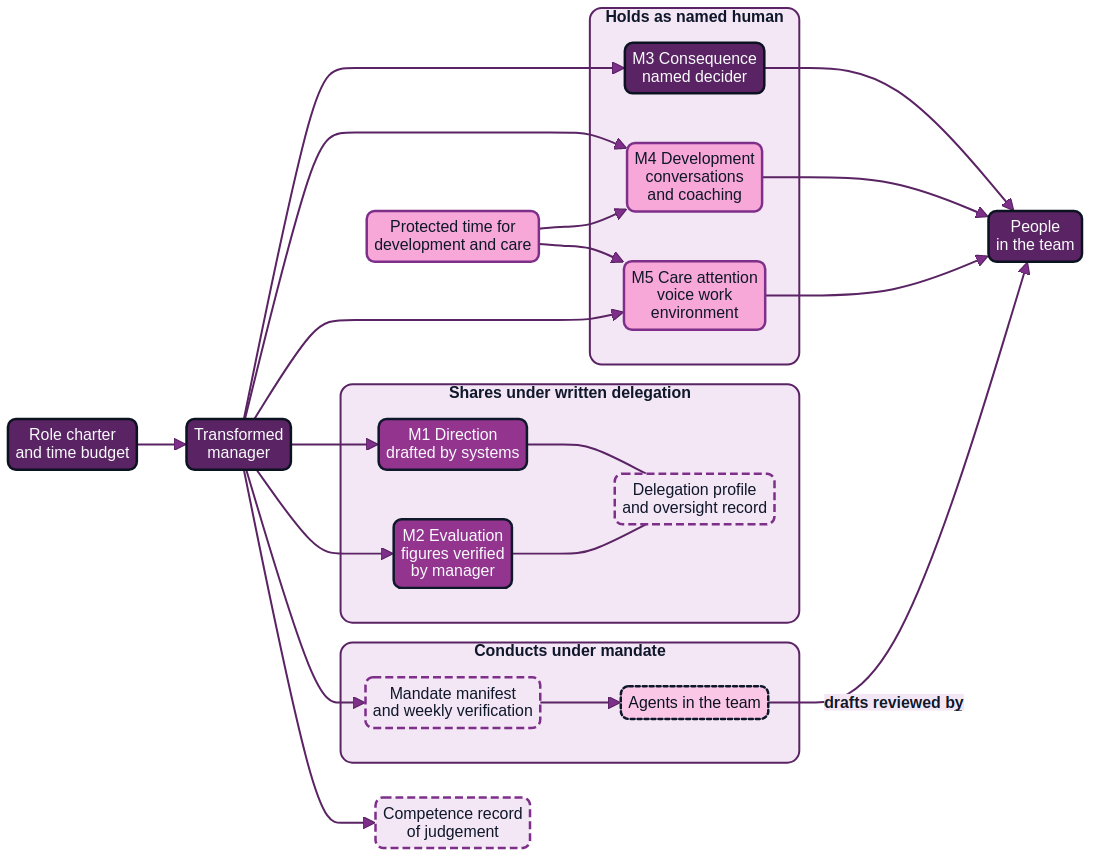
Figure 29.1: The transformed manager holds, shares and conducts: a named decider for consequences, a leader for development and care, an overseer of systems that direct the work and a conductor of agents, all bound by a role charter with protected time.
Transformed, not abolished
Three accounts of the manager's future compete, and each deserves to be stated at its strongest.
The first holds that the role is being abolished. Its evidence is real. The OECD's survey of more than 6,000 firms in six countries found algorithmic management tools already in common use for tasks traditionally carried out by managers (149, Milanez et al., 2025). Microsoft's Work Trend Index proposes a "human-agent ratio" for every role and describes organisations that are "human-led, agent-run", in which "even entry-level employees are managers from day one" (151, Microsoft, 2025). Anthropic, after an experiment in which a model ran a small office shop with mixed results, concluded that "AI middle-managers are plausibly on the horizon" (185, Anthropic, 2025). If scheduling, allocation, measurement and first-line review are done by systems, the argument runs, the layer of people who did them is no longer needed. The automation of these tasks is observable. The disappearance of the line manager as a consequence is speculation: no study known to this book has measured it, and the forecasts above come from organisations that sell the systems.
The second holds that nothing essential changes: AI is a tool, and the role absorbs it as it absorbed the spreadsheet. This account is right that accountability for people stays with people, but it misses what Chapters 5 to 10 documented: systems now perform parts of management functions, at degrees of delegation someone decided or failed to decide.
The third is this book's thesis. The manager's role is transformed along a single axis. Work that concerns the work, such as assigning, sequencing and measuring, moves towards systems under written delegation. Work that concerns the person, such as deciding a consequence, developing a skill and noticing ill health, stays with the manager and gains weight, because the systems add pace, figures and agents that the manager must answer for. The supervisor of tasks becomes an accountable leader of people and a conductor of agents. This chapter builds on the series' conclusion that a role persists wherever accountability for a boundary must be human (F80) and on the book's own rule that Level 4 Autonomous is never used for M3 Consequence (46, Nordqvist, 2026).
The parallel with the security architect
The Transformed Security Architect reached the same conclusion for a single profession. It described the security architect's transformation as four shifts, the fourth of which, Shift 4, from sole author to conductor of an AI team, moved authorship of drafts to agents while leaving the architect the accountable verifier of everything they propose (Chapters 3 and 13; F72, F75) (46, Nordqvist, 2026). Its central finding was that what remains scarce, and defines the role, is accountable human judgement: the ability to verify what AI produces and to answer for the decision (F71).
Three parts of that finding transfer to every line manager: the mandate manifest at a level matched to reversibility, which Chapter 16 applied to Jana Petersen's team; verification that is more than approval, with seeded errors and an oversight-quality metric (F76), which Chapters 16 and 26 turned into a routine; and the role itself as an artefact, with a charter, decision rights and a competence record (F73).
The parallel breaks at one point, and the break defines this chapter. The architect's AI team drafts policies and threat models; nothing it produces has feelings, a career or a body. The line manager's systems direct and measure people, and the manager's agents work beside them. For the architect, Shift 4 is mostly about the work. For the manager, conducting agents is the smaller half of the transformation. The larger half is leading the people whom the systems now direct, and that half has no counterpart in the security architect's role.
What AI takes and what it cannot
Chapter 2 defined the five functions by their decisions, their reversibility and their law; Chapter 4 and Chapter 20 set the default ceiling of delegation for each. Read together, they show what AI takes from the manager and what it cannot take.
| Function | What systems take | What stays with the manager | The manager's position |
|---|---|---|---|
| M1 Direction | Drafting rosters, routes and allocations; offering open shifts; sequencing agent work | Approving or overriding; setting the rules and caps; answering for pace | Shares, up to Level 3 Bounded under conditions |
| M2 Evaluation | Recording activity, producing figures, flagging outliers, drafting summaries | Judging what a figure means for a person; drafting first; refusing a figure that misrepresents | Shares and verifies; Level 1 Assisted for individual measures |
| M3 Consequence | Ranking applications, preparing inputs | The decision, the reasons and the answer to a contest | Holds as named decider; never above Level 2 Supervised, and at Nordvik Level 1 Assisted |
| M4 Development | Recommending courses, drafting feedback, reporting completion | The development conversation, coaching, recognition, the route to greater skill | Holds the human parts; Level 1 Assisted at most |
| M5 Care | Flagging rest breaches, blocking rosters that breach rules | Noticing a person in difficulty, adapting the work, hearing a concern | Holds; systems may block at Level 3 Bounded but not care |
M1 Direction is where the transfer is greatest and most defensible, because each allocation is reversible within hours. The manager's task moves from drawing the roster to setting the rules within which a system draws it, approving the draft and answering for the pace it sets. Pace is the part that does not transfer: the Framework Directive requires the employer to adapt work to the individual with a view to alleviating work at a predetermined work-rate (Council Directive 89/391/EEC, Article 6(2)(d)) (49, Council of the European Communities, 1989), and a system that fills every gap sets such a rate unless its rules forbid it.
M2 Evaluation is shared, but the judgement remains. Kellogg, Valentine and Christin found that algorithms extend control through recording and rating (137, Kellogg et al., 2020), and Chapter 19 showed how automation bias turns a manager's assessment into confirmation of a figure (25, Parasuraman & Manzey, 2010). The transformed manager drafts first, reads the figure second and records disagreement. The figure is evidence; the evaluation is the manager's.
M3 Consequence keeps a named decider. This is the book's first rule, and the transformed manager is the person in whom it becomes concrete: the unit manager who sets pay in the annual review, the team leader who decides with HR on discipline. The Platform Work Directive gives the clearest statutory form for platform work: a decision to restrict, suspend or terminate the account of a person performing platform work, or any other decision of equivalent detriment, "shall be taken by a human being" (Directive (EU) 2024/2831, Article 10(5)) (47, European Union, 2024). The transformed manager is that human being for ordinary employment, by the organisation's choice where no statute requires it.
M4 Development loses its administrative parts and keeps its human ones. A learning platform can recommend a course and an assistant can draft feedback, but Kluger and DeNisi's meta-analysis found that more than a third of feedback interventions reduced performance, especially where feedback drew attention to the self rather than the task (116, Kluger & DeNisi, 1996). Whether feedback helps lies in the conversation, which a system can prepare but not hold, and the route to greater skill that agents erode (Chapters 18 and 19) becomes the manager's design task.
M5 Care stays whole. Systems can flag a breach of rest rules and block a roster that breaches them; they cannot notice that a colleague who used to finish her round early now finishes late every day. The Swedish Work Environment Authority's regulations place a duty on the employer to ensure that managers know how to prevent and handle unhealthy workload and have the conditions to put that knowledge into practice (AFS 2023:2, chapter 2, section 4) (84, Arbetsmiljöverket, 2023). The duty assumes a manager with time to see the work. Q11 asks what replaces the manager's judgement in care when systems direct and evaluate; this chapter's answer, with Chapter 18's, is that nothing does, and that the organisation must therefore protect the time in which it is exercised.
The standard the AI boss must meet
An AI boss is often compared with a poor manager: the arbitrary roster, the favoured colleague, the review written in ten minutes. The comparison flatters the system. The right standard is what good managers do, and the evidence on that is better than the comparison suggests.
Google's Project Oxygen analysed more than 10,000 data points from performance reviews and feedback surveys together with interviews, and found that teams with highly effective managers achieved better results, were happier and had lower turnover. Of the ten behaviours it identified, most are relational: being a good coach, empowering the team without micromanaging, creating an inclusive team environment, communicating, and supporting career development (95, Google re:Work, n.d.). Its companion study, Project Aristotle, examined 180 teams, 115 engineering project teams and 65 sales pods, and found that what mattered was "less about who is on the team, and more about how the team worked together"; of the five dynamics it named, psychological safety came first, ahead of dependability, structure and clarity, meaning and impact (250, Google re:Work, 2015). Amy Edmondson, whose construct Google adopted, found in 51 work teams in a manufacturing company that team psychological safety was associated with learning behaviour and through it with team performance, and that team leader coaching shaped it (117, Edmondson, 1999).
Gallup's figures point the same way. Beck and Harter reported Gallup's estimate that managers account for at least 70 per cent of the variance in employee engagement scores across business units (249, Beck & Harter, 2015). Gallup's 2025 report found that engagement among managers fell from 30 to 27 per cent in 2024, the sharpest decline of any group, and that managers who received best-practice training improved their own and their teams' engagement (153, Gallup, 2025). These are a survey firm's estimates from its own instruments, and they measure engagement rather than health or fairness. Their direction agrees with the independent findings: the manager is one of the strongest levers on how people experience work.
Self-determination theory explains why. Ryan and Deci identify autonomy, competence and relatedness as basic psychological needs whose satisfaction supports motivation and wellbeing (118, Ryan & Deci, 2000). Coaching serves competence, empowering serves autonomy, and an inclusive, psychologically safe team serves relatedness. Linda Hill's new managers learned that the job was about relationships and responsibility for other people's work and wellbeing, with formal authority the least effective tool they had (119, Hill, 2003).
Measured against this standard, the AI boss performs the parts of management that the evidence ranks lowest and none of those it ranks highest: it cannot coach, include or make a team safe for raising a concern. The implication is the chapter's central design rule: the AI boss is acceptable only where it frees a manager to do what the evidence on good managers describes, and it must be evaluated on whether it does. An evaluation of ShiftWise that measures roster quality and planning time but not whether unit managers spend the saved time with their staff measures the wrong thing.
Leading people
The relational work has three parts that grow when systems direct the work.
Recognition. When systems do the visible part of the work, the human contribution becomes an absence of error: the claim a handler caught, the client a care assistant stayed with longer. Chapter 18 showed that a manager who manages by the figures sees the agents' work and misses the people's. Recognising judgement by name is work only a manager can do.
Voice. A team in which a system sets the pace needs a way to say that the pace is wrong. Psychological safety is that way, and it is built by the manager's response to the first person who uses it. In a team with agents, voice also protects the agents: the handler who reports that an agent misread a policy is the team's best detector.
Explanation. Chapter 28 showed that the worker information notice is necessary and insufficient: a person learns what a system does from the manager who explains it in a conversation. The AI Act gives a person affected by a decision taken on the basis of a high-risk system's output the right to obtain from the deployer clear and meaningful explanations of the role of the system in the decision-making procedure and the main elements of the decision (Article 86) (1, European Union, 2024). The manager is the first explainer and often the first reviewer.
Conducting agents
Conducting agents is the part of the transformation that mirrors Shift 4 most closely, and Chapter 16 described it in full: a mandate manifest enforced outside the agents, actions at Level 2 Supervised in a first pilot, a never list that forbids any management function over people, containment, a stop path the manager holds, and a weekly verification routine of about two hours. Two points belong in a description of the role.
The first is that conducting agents is line management, not a technical side task. The agents set pace for the people who approve their drafts, take over the work juniors learned on and produce logs about each approver; the manager answers for all three effects, which is why Jana Petersen's team charter (Chapter 18) forbids comparing agent and handler figures.
The second is that the conducting must stay smaller than the leading. Chapter 16 listed the signs that a manager is being managed by the agent team: the agents' output sets the pace, approvals take seconds, and the manager's time goes to exceptions and queues instead of people. The role charter below makes the protection explicit by budgeting agent work as a fixed allocation and protecting time for M4 Development and M5 Care as a floor.
The manager's artefacts
The series treats a role as a versioned artefact (F73). For the transformed manager, the artefacts already exist in this book; the role charter is what binds them to a person.
| Artefact | What it records for the manager | Introduced in |
|---|---|---|
Delegation profile DLG-* |
The degree at which each system performs each function in the manager's team, and who decided it | Chapter 4, Chapter 25 |
| Oversight record | The manager's review of a system's output, with what was checked and what was changed | Chapter 26 |
Mandate manifest MND-* |
The scope, levels, never list, budgets and stop path of agents the manager directs | Chapter 16 |
Team charter TCH-* |
The division of work between people and agents, separated figures, handovers and reserved learning work | Chapter 18 |
Competence record CMP-* |
Judgement exercised against systems' proposals, assessed against the framework NR-MGR-CF |
Chapter 19 |
Role charter ROLE-* |
The manager's decision rights per function, the systems overseen, the agents directed and the time budget | This chapter |
Management Decision Records and contestation records are not the manager's artefacts in the same sense; they belong to the decision and to the person affected. The charter refers to them, as the competence record does, without copying their content.
The charter and the time budget
A role charter for a line manager states, for each of the five functions, what the manager decides, what systems do and under which delegation profile, what the manager oversees, what the manager may not delegate, and to whom the manager escalates. It adds what no earlier artefact contains: a time budget, the share of working time the role assigns to each function and to conducting agents, with a floor for development and care.
The time budget answers the condition Chapter 19 set: freed time becomes relational time only if it is given back to the people, not absorbed by a wider span or more reporting. It is a planning instrument for the role, not a measurement of the person: the manager reports against it in the development conversation, and no system records it.
Practical guide: Writing a role charter and time budget for a line manager whose team includes an AI boss and agents
Purpose. Give a line manager written decision rights per management function, a list of the systems and agents the manager oversees or directs, and a time budget that protects M4 Development and M5 Care, so that the role can be reviewed, staffed and defended.
Roles. The line manager drafts the charter with the manager's own manager, who approves it. An HR business partner checks it against the decision-rights file (Chapter 20) and the competence framework. The workers' representatives review the parts that act as selection guidelines or appraisal principles, and the safety representative reviews the care section. The team sees the final charter.
Steps.
- Start from the function map and the decision-rights file. Copy, for the manager's team, each decision class from the decision-rights file (
DRF-*) and the delegation profile of each system that touches it. Default: no decision right in the charter that the file does not grant. - Write the decision rights per function. For each function, list what the manager decides, approves, overrides and escalates. Default: every M3 Consequence class names the manager or another named role as decider; none names a system.
- List the systems overseen and the agents directed. Give each its usage mode, delegation profile or mandate manifest, the manager's oversight duty and the manager's stop right with its time to effect.
- Write the never list. Default: the manager does not delegate development conversations, decisions on contested routes or allocations, the response to a concern about health or safety, or any adverse consequence decision to a system or an agent.
- Build the time budget from a two-week diary. Record two ordinary weeks by function, then set target shares. Default floor: at least 35 per cent of working time on M4 Development and M5 Care together; at most 10 per cent on conducting agents in a first pilot; a reserved share for unassisted practice from Chapter 19.
- Decide what happens to time saved. Where a system saves measurable time, record in a decision record whether the saving goes to the team, to a wider span or elsewhere. Default: to the team, until a review shows the floor is met without it.
- Link the competence record. Name the framework and the competences the role requires, with the target level for each.
- Agree the parts that touch representatives' rights. In Germany, selection guidelines for appointments to the role require the works council's consent (BetrVG §95(1), also where AI is used in drawing them up, §95(2a)), and general appraisal principles its consent under §94(2) (9, Germany, 2001); in Sweden, a change in managers' conditions or in a unit's staffing is negotiated before the decision under MBL §11 (205, Sveriges riksdag, 1976).
- Set review dates. Default: yearly, and whenever a system's degree of delegation changes, an agent is added or the span changes.
Definition of done. The charter parses and is in version control; every decision right traces to the decision-rights file; every system and agent appears with its profile or manifest and a stop right; the time budget has a floor for development and care and a recorded decision on time saved; the representatives' review is recorded; and the manager and the team have seen it. Adapt the shares to the collective agreement, the works agreement and the size of the team.
Worked example: The role charters of Mikael Strand and Jana Petersen
Illustrative. After ShiftWise routes went live in the Strandvik home-care unit, Mikael Strand's two-week diaries showed that the system saved him about a day a fortnight in route planning. In AIDR-0633, dated 2027-08-25, Ingrid Halvorsen, the HR director, decided that the saving goes to the staff, and that the Region will not widen unit managers' span of control on the strength of it before the review of the commission AIDR-0600. The charter below records the result.
# roles/line-managers/ROLE-NR-MGR-01.yaml (illustrative)
id: ROLE-NR-MGR-01
title: Unit manager, home care
holder: Mikael Strand          # Strandvik home-care unit, about 35 staff
version: 1.0.0
effective: 2027-09-01
approved_by: role:head-of-home-care
decision_record: AIDR-0633      # time saved goes to staff; span not widened
decision_rights_file: DRF-NR-01
competence_record: CMP-NR-MGR-01
framework: {id: NR-MGR-CF, version: "2027.2"}
functions:
  M1_Direction:
    system: {name: ShiftWise, profile: DLG-NR-ROS-01, degree: L2_Supervised}
    decides: [approve each roster and route plan, override contested routes]
    stop_right: {scope: open-shift-offers, time_to_effect: PT15M}
  M2_Evaluation:
    system: {name: time-per-visit dashboard, profile: DLG-NR-HCD-01, degree: L0_Advisory}
    rule: draft own assessment before opening the dashboard
  M3_Consequence:
    decides: [recruitment in the unit, annual pay review under the collective agreement]
    systems: none                # screening paused, AIDR-0601
  M4_Development:
    decides: [development conversations, deputy's hand-planned week each month]
    delegated_to_systems: none
  M5_Care:
    decides: [workload adjustments, response to concerns, work-environment plan]
    with: safety representative
    system_flags: {name: ShiftWise rest checks, degree: L1_Assisted}
agents_directed: none            # no agents until the Region can supervise them
never_delegated:
  - development conversations
  - decisions on contested routes (CNT-NR-*)
  - response to a concern about health or safety
time_budget_per_fortnight:       # shares of working time
  M1_roster_and_route_oversight: 0.12
  M2_evaluation_and_dashboard_review: 0.05
  M3_recruitment_and_pay: 0.06
  M4_development_conversations_and_coaching: 0.15
  M5_home_visits_with_staff_and_work_environment: 0.25
  unassisted_practice_and_seeded_errors: 0.05
  administration_budget_and_municipal_liaison: 0.32
protected_floor: {M4_plus_M5: 0.35, reviewed_in: development conversation}
time_saved_by_systems: {estimate: one day per fortnight, goes_to: M5 home visits and M4}
review: {cadence_months: 12, triggers: [degree change, new system, span change]}
The charter shows the saving where it went: home visits with staff rose from about 15 to 25 per cent of Mikael's time and development conversations to 15 per cent. Jana Petersen's charter has the same form and adds the agents.
# roles/line-managers/ROLE-HM-MGR-01.yaml (illustrative excerpt)
id: ROLE-HM-MGR-01
title: Claims team leader, motor and property, Hamburg
holder: Jana Petersen            # about 20 handlers plus pilot agents
version: 1.0.0
effective: 2027-07-01
decision_record: AIDR-0683
decision_rights_file: DRF-HM-01
team_charter: TCH-HM-CLM-01
functions:
  M1_Direction:
    system: {name: claims-triage agent, profile: DLG-HM-CTA-01, degree: L3_Bounded}
    decides: [reassign any allocated claim, record MDR-HM-*]
  M3_Consequence:
    decides_with: HR lead Germany
    systems: none
agents_directed:
  mandate: MND-HM-CLM-01
  profile: DLG-HM-AB-01
  verification: weekly routine, about 2 hours
  stop_right: {mechanism: revoke workload identities, time_to_effect: PT5M}
time_budget_per_week:
  conducting_agents: 0.08
  M4_coaching_handlers_on_complex_claims: 0.18
  M5_workload_reviews_and_one_to_ones: 0.17
protected_floor: {M4_plus_M5: 0.35}
Jana's charter protects time for coaching handlers whose routine work the agents now do, and caps the share of her week that the agents may take. The selection-relevant parts of the charter template were agreed with the Konzernbetriebsrat under BetrVG §§ 94(2) and 95(1).
Competences
Chapter 19 introduced Nordvik Region's competence framework for managers, NR-MGR-CF version 2027.1, with competences for planning and allocation, evaluation against system figures and developing deputies, and a competence record that evidences judgement exercised. The transformed role needs five competence areas, each evidenced by records rather than certificates, as The Transformed Security Architect, Chapters 21 and 22, concluded (F79) (46, Nordqvist, 2026) and as frameworks such as SFIA 9 make comparable across an organisation (11, SFIA Foundation, 2024).
| Competence area | What it means | Evidence in the record |
|---|---|---|
| Judgement | Deciding against a system's proposal when the situation calls for it, and accepting it when it does not | Rosters changed and allocations overridden, with reasons and sampled outcomes |
| Explanation | Explaining to a worker what a system did and why a decision was made | Contestations answered, worker questions recorded in the team review |
| Oversight | Reviewing system output without automation bias | Drafting-first notes, seeded errors found at team level, degraded-mode periods run |
| Agent direction | Writing and maintaining a mandate, verifying output, using the stop path | Manifest changes authored, verification records, timed stops |
| Care | Noticing and acting on workload, ill health and concerns | Work-environment actions, workload reviews, concerns raised and answered |
Nordvik's version 2027.2 of the framework adds two competences to those of Chapter 19: MGR-EXP-01 explanation of system-supported decisions and MGR-CAR-01 care under algorithmic direction. Hansa adds MGR-AGT-01 agent direction to its own framework for team leaders in the pilot. The AI Act gives the competence areas a legal anchor for high-risk systems: deployers must assign human oversight to natural persons who have "the necessary competence, training and authority, as well as the necessary support" (Article 26(2)), applying to Annex III systems from 2 December 2027 under the Digital Omnibus (1, European Union, 2024) (2, European Union, 2026). Article 4, as amended by the Omnibus, requires providers and deployers to take measures to support the AI literacy of their staff (2, European Union, 2026). Neither article names the manager, but in both organisations the manager is the person to whom oversight is assigned.
Span of control and the manager of one human and twenty agents
If systems take the planning and agents the routine work, the obvious economic move is to widen spans of control. The vendors' "human-agent ratio" points further (151, Microsoft, 2025), to a manager of one human and twenty agents.
That image is speculation. No study known to this book has measured how well one person can direct twenty agents in ordinary line management, how the one human in such a team fares, or how widening spans after algorithmic management affects people's health, development or performance over years. What is observable points the other way. The human-autonomy teaming research reviewed in Chapter 18 found almost no field studies and little attention to the learning and wellbeing of team members. The verification evidence of Chapter 16 sets the number of agents by the human attention available to verify them, not by how many can run. And automation bias rises under multiple-task load (25, Parasuraman & Manzey, 2010), which is what a wide span produces.
The evidence that would settle the question can be named, and an organisation that widens spans should collect it before and after the change:
- the oversight-quality metric of Chapter 26, by team, as the number of agents per manager rises;
- seeded-error catch rates and approval times at each span;
- the share of the manager's time on M4 Development and M5 Care, against the floor in the charter;
- sickness absence, turnover and the results of the work-environment survey, by team, over at least two years;
- contestations raised and reversed, as a measure of whether consequence decisions remain sound.
Widening a span is therefore a decision with a record, a baseline and a review date, not a saving booked when a system goes live. Both organisations in this book have written that rule into their decisions, as the worked examples show.
What HR becomes
When management functions are delegated function by function, HR becomes the owner of the delegation. The book's artefacts give HR five tasks that most HR functions do not yet perform.
HR keeps the decision-rights file and the delegation register of management functions (Chapters 20 and 25), so that every degree of delegation has an owner, a ceiling and a review date. It designs role charters for line managers from the decision-rights file, so that every manager knows what is theirs to decide. It owns the competence framework and its records, with purposes and readers agreed with the representatives. It runs the selection of managers on evidence of judgement and care, not throughput, correcting the tendency Benson, Li and Shue found for firms to promote their best performers at measurable cost to managerial quality (124, Benson et al., 2019). And it is the counterpart of the workers' representatives for the systems themselves: the HR director who negotiates the delegation profile with the unions, the chief HR officer who agrees the works agreement with the Konzernbetriebsrat.
HR becomes a design function for management. Ingrid Halvorsen's commission AIDR-0600 and Hansa's board request AIDR-0650 already place these duties there, and the transformed manager depends on them, because a line manager cannot protect time that the staffing model has already spent.
What organisations must change
The role cannot transform by itself. Four changes fall to the employer.
Selection. Choose managers for judgement and care, evidenced in competence records, as Chapter 19 proposed. Throughput figures produced by the systems a candidate was managed by are not evidence of managerial ability.
Training. Train for the five competence areas above, with unassisted practice and seeded errors rather than tool training alone, and with the relational competences given the weight the evidence gives them.
Span of control and the route in. Treat widening as a recorded decision with a baseline and a review, and reserve the learning experiences systems have taken, as Chapter 19 described, so that there are people who can become managers.
One further change is protection. The Platform Work Directive requires that persons charged with overseeing automated decisions have "the competence, training and authority necessary to exercise that function, including for overriding automated decisions", and that they "enjoy protection from dismissal or its equivalent, disciplinary measures and other adverse treatment where they exercise their functions" (Directive (EU) 2024/2831, Article 10(2)) (47, European Union, 2024). The provision applies to digital labour platforms only. Its principle is sound for every employer: a manager who overrides a system must not be measured against the system's throughput for having done so. Both organisations write that principle into the role charter template.
What would show the thesis wrong
The thesis is the book's own conclusion and must be falsifiable. Four findings would weaken or refute it.
First, evidence that teams directed by systems without a line manager, over several years, sustain performance, health and development as well as teams with one. Such teams would show that the leadership half of the role is not needed where direction is automated.
Second, evidence that fully automated consequence decisions, with records and appeal, produce fairer and more accurate outcomes than human ones. This is the book's general falsifier, and it would remove the named decider from the role.
Third, evidence that the time saved by systems does not go to people even where it is protected: that managers with a charter floor still spend the saving on reporting and exceptions. The transformation would then be a description of what should happen, not of what does.
Fourth, evidence that the relational work can be done as well by peers, HR or coaches outside the line, so that the role divides into a technical overseer and a separate people function. This is the most plausible alternative.
None of these findings exists today. Each can be sought, and the horizon register below names the signals.
The author's projections
This section was drafted on the author's behalf from the book's content and must be reviewed and personalised by the author before publication. It is a projection, labelled as the author's judgement, and is not one of the book's findings. The verdict on Q12 is reserved for Chapter 33.
I expect there to be line managers in 2036, and I expect most of them to direct systems and some to direct agents. That much is expected: the systems are in use, the vendors are building agents into the office software every manager already has, and the European instruments in force place oversight on natural persons.
I am less confident about what the role will contain. My judgement is that large employers will divide into two kinds. In the first, which I hope will include public authorities like Nordvik Region, the time freed by systems is given back to people, spans stay roughly where they are, and the manager becomes more of a coach and a carer than today. In the second, the saving is booked as a wider span, the manager becomes an overseer of figures and queues for more people than anyone can know, and the relational work moves to nobody. The second is cheaper in the first year and more expensive later, in sickness absence, turnover and errors that no one catches, but I do not expect the evidence for that to arrive before many organisations have made the choice. This is speculation, and it is mine.
I do not expect the manager of one human and twenty agents to become common in ordinary line management within ten years. Directing agents well takes more attention than the vendors' ratios assume, and the agents' effects on the people beside them add work rather than remove it. I hold this judgement moderately: if the oversight-quality metrics of the pilots hold steady as agents per manager rise, I would have to revise it.
The judgement I hold most firmly is that the named decider will not disappear from consequence decisions in Europe, because the law, the works councils and the courts will keep asking who decided. What I cannot predict is whether that person will have the time, the competence and the protection to decide well. That depends on choices organisations make now, in charters, budgets and spans, and it is why this chapter ends with a register rather than a forecast.
The author's judgement ends here.
A horizon register for the role
A projection is useful only if the organisation can see whether it is coming true. The series keeps outlooks in a horizon register, versioned and reviewed like any other artefact, with each trend labelled observable, expected or speculation and each scenario tied to signals with owners and thresholds.
Worked example: A horizon register for the transformed manager
Illustrative. Hansa Mutual's chief HR officer keeps a horizon register for the team-leader role, following the method of AI Governance, Chapter 22, and The Transformed Security Architect, Chapter 23 (41, Nordqvist, 2026) (46, Nordqvist, 2026). It was adopted with AIDR-0683 and is reviewed each June with the Konzernbetriebsrat.
# horizon/manager-role-register.yaml (illustrative excerpt)
id: HZN-HM-MGR-01
owner: role:chief-hr-officer
decision_record: AIDR-0683
reviewed: "2027-06-28"
next_review: "2028-06-27"
charter_template: roles/line-managers/ROLE-HM-MGR-template.yaml
trends:
  - id: systems-draft-direction-and-evaluation
    label: observable
    evidence: [source-287, source-271, DLG-HM-CTA-01]
    decision: Charters state the degree per function for every system
  - id: people-direct-agents-in-line-management
    label: observable            # pilot HM-AB-PILOT-01
    evidence: [MND-HM-CLM-01, TCH-HM-CLM-01]
    decision: Agent direction capped in the time budget during the pilot
  - id: freed-time-goes-to-people
    label: expected              # only where protected
    evidence: [ROLE-HM-MGR-01 time budget, team survey]
    decision: Protected floor for M4 plus M5 in every charter
  - id: one-manager-many-agents
    label: speculation
    evidence: []
    decision: No span widened without baseline and review
signals:
  - metric: oversight_quality_by_team   # OQM-HM-CLM-01
    threshold_below: 0.85
    owner: role:pilot-owner
  - metric: share_of_team_leaders_meeting_M4_M5_floor
    threshold_below: 0.80
    owner: role:hr-lead-germany
  - metric: agents_per_team_leader
    current: 2
    threshold: 5                 # above this, a new decision record
    owner: role:chief-hr-officer
no_regret:
  - {id: selection-on-judgement-evidence, status: in-place}
  - {id: override-protection-in-charter, status: in-place}
The register makes the author's projections testable inside one organisation. If the share of team leaders meeting the floor falls while agents per team leader rise, the second kind of employer described above is forming, and the register forces a decision before it is complete.
Across the degrees of delegation
The transformed manager's position in each function follows from the degree at which systems perform it.
| Degree of delegation | What the manager does | Functions where it applies in the two organisations | What the charter protects |
|---|---|---|---|
| Level 0 Advisory | Decides and acts; the system informs | M2 dashboards at Nordvik; M3 pay input at Hansa; M4 course recommendations | Drafting first, so that the information does not become the judgement |
| Level 1 Assisted | Decides each case on the system's draft or ranking | M3 screening at Hansa; M5 rest flags; individual M2 measures | The reasons in the record, and the right to set the draft aside |
| Level 2 Supervised | Approves each action before it takes effect | M1 rosters at Nordvik; agent actions in Hansa's pilot | Time to review, seeded errors, the override without penalty |
| Level 3 Bounded | Sets the rules and can stop or reassign | M1 claims allocation at Hansa; open-shift offers at Nordvik; protective blocks in M5 | The stop right, the reassignment record, unassisted practice |
| Level 4 Autonomous | Not involved in the instance | Not used for any management function over people in either organisation; never for M3 Consequence | Nothing to protect, which is why it is not used |
Usage modes matter for whose identity the system uses. The manager uses Mode 1 conversational assistants and Mode 2 embedded workplace assistants with their own identity and remains the author of what they draft; oversees Mode 4 built AI applications such as ShiftWise that direct the team; and directs Mode 5 autonomous production agents under a mandate manifest, as Jana Petersen does. In every mode the charter keeps M3 Consequence and M5 Care with the manager.
Nordvik Region and Hansa Mutual
At Nordvik Region, Mikael Strand's charter keeps roster approval, contested routes, development conversations and the work environment with him, and records that ShiftWise saves him about a day a fortnight, which he spends on home visits with staff and on development conversations. Ingrid Halvorsen's AIDR-0633 decides that the Region will not widen unit managers' span of control on the strength of the saving before the commission's review, and the decision is negotiated with the unions under the Region's co-determination act. The Region still asks no line manager to direct agents.
At Hansa Mutual, Jana Petersen's charter adds the direction of the pilot's agents under MND-HM-CLM-01, the reassignment of claims and the weekly verification routine, and protects time for coaching handlers whose routine work the agents now do. The chief HR officer's AIDR-0683 adopts the team-leader charter template, the horizon register and selection on evidence of judgement, with the selection-relevant parts agreed with the Konzernbetriebsrat.
Ingrid Halvorsen and Hansa's chief HR officer reach the same conclusion by different routes. Nordvik starts from the duty of care of a public employer and a span question that the unions raised; Hansa starts from a pilot in which a team leader directs agents and a works council that insisted the agents never become a yardstick for people. Both conclude that the transformed manager is chosen and trained for judgement and care, not for throughput.
Summary
The manager's role is transformed, not abolished. Systems now draft rosters, allocate work and produce figures, which is observable; the disappearance of the line manager as a result is speculation and rests on vendors' forecasts. The book's thesis, mirroring Shift 4 of The Transformed Security Architect, is that the supervisor of tasks becomes an accountable leader of people and a conductor of agents.
The chapter concerned all five management functions. M1 Direction and much of M2 Evaluation are shared with systems under delegation profiles, with the manager setting rules, approving, drafting first and answering for pace. M3 Consequence keeps a named human decider. The human parts of M4 Development and the whole of M5 Care stay with the manager and grow, because the systems add pace, figures and agents. The evidence on good managers, from Project Oxygen, Project Aristotle, Gallup and Edmondson, ranks coaching, psychological safety and development highest, and the AI boss must be judged by whether it frees managers to do them.
The manager's artefacts are bound to the person by a role charter with a time budget and a protected floor for development and care; the competences are judgement, explanation, oversight, agent direction and care; HR becomes the owner of delegation, charters, competence and selection. The manager of one human and twenty agents is speculation until the evidence named here has been collected, and the author's projections are kept to their own section and a horizon register.
Chapter 30 follows Ingrid Halvorsen, Mikael Strand, Jana Petersen and Thomas Brandt through a year with the AI boss and shows how these roles changed in practice.
Sources
- Milanez, A., Lemmens, A. & Ruggiu, C. (2025). Algorithmic management in the workplace: New evidence from an OECD employer survey. OECD Publishing. (149, Milanez et al., 2025)
- Microsoft (2025). 2025: The Year the Frontier Firm Is Born. Work Trend Index Annual Report. (151, Microsoft, 2025)
- Anthropic (2025). Project Vend: Can Claude run a small shop? (And why does that matter?) Anthropic. (185, Anthropic, 2025)
- Nordqvist, G. (2026). The Transformed Security Architect: Role, Craft and Career in the Age of AI in European Enterprises and Public Authorities. The Architecture as Code Series, Book 6. (46, Nordqvist, 2026)
- Council of the European Communities (1989). Council Directive 89/391/EEC on the introduction of measures to encourage improvements in the safety and health of workers at work. Official Journal of the European Communities, L 183. (49, Council of the European Communities, 1989)
- Kellogg, K. C., Valentine, M. A. & Christin, A. (2020). Algorithms at Work: The New Contested Terrain of Control. Academy of Management Annals, 14(1). (137, Kellogg et al., 2020)
- Parasuraman, R. & Manzey, D. H. (2010). Complacency and Bias in Human Use of Automation: An Attentional Integration. Human Factors, 52(3). (25, Parasuraman & Manzey, 2010)
- European Parliament and Council of the European Union (2024). Directive (EU) 2024/2831 of 23 October 2024 on improving working conditions in platform work. Official Journal of the European Union. (47, European Union, 2024)
- Kluger, A. N. & DeNisi, A. (1996). The effects of feedback interventions on performance: A historical review, a meta-analysis, and a preliminary feedback intervention theory. Psychological Bulletin, 119(2). (116, Kluger & DeNisi, 1996)
- Arbetsmiljöverket (2023). AFS 2023:2 Planering och organisering av arbetsmiljöarbete. Swedish Work Environment Authority. (84, Arbetsmiljöverket, 2023)
- Google re:Work (n.d.). Following the data: The research behind great managers (Project Oxygen). Google re:Work guide. (95, Google re:Work, n.d.)
- Google re:Work (2015). Understand team effectiveness (Project Aristotle). Google re:Work guide. (250, Google re:Work, 2015)
- Edmondson, A. (1999). Psychological Safety and Learning Behavior in Work Teams. Administrative Science Quarterly, 44(2). (117, Edmondson, 1999)
- Beck, R. & Harter, J. (2015). Managers Account for 70% of Variance in Employee Engagement. Gallup Business Journal. (249, Beck & Harter, 2015)
- Gallup (2025). Global Engagement Falls for the Second Time Since 2009 (State of the Global Workplace: 2025 Report). Gallup Workplace. (153, Gallup, 2025)
- Ryan, R. M. & Deci, E. L. (2000). Self-determination theory and the facilitation of intrinsic motivation, social development, and well-being. American Psychologist, 55(1). (118, Ryan & Deci, 2000)
- Hill, L. A. (2003). Becoming a Manager: How New Managers Master the Challenges of Leadership. 2nd edition. Harvard Business School Press. (119, Hill, 2003)
- European Parliament and Council of the European Union (2024). Regulation (EU) 2024/1689 laying down harmonised rules on artificial intelligence (Artificial Intelligence Act). Official Journal of the European Union. (1, European Union, 2024)
- Federal Republic of Germany (2001). Betriebsverfassungsgesetz (BetrVG) (Works Constitution Act), as last amended. Gesetze im Internet. (9, Germany, 2001)
- Sveriges riksdag (1976). Lag (1976:580) om medbestämmande i arbetslivet (MBL). (205, Sveriges riksdag, 1976)
- SFIA Foundation (2024). SFIA 9: The global skills and competency framework for a digital world. SFIA Foundation. (11, SFIA Foundation, 2024)
- European Parliament and Council of the European Union (2026). Regulation (EU) 2026/1744 (Digital Omnibus on AI). Official Journal of the European Union. (2, European Union, 2026)
- Benson, A., Li, D. & Shue, K. (2019). Promotions and the Peter Principle. The Quarterly Journal of Economics, 134(4). (124, Benson et al., 2019)
- Nordqvist, G. (2026). AI Governance: Governing Artificial Intelligence in European Enterprises and Public Authorities. The Architecture as Code Series, Book 2. (41, Nordqvist, 2026)