A Year With the AI Boss: Nordvik Region and Hansa Mutual
This chapter follows four people through one year with the AI boss, from December 2026 to November 2027: Ingrid Halvorsen, Nordvik Region's HR director; Mikael Strand, who manages the Strandvik home-care unit; Jana Petersen, a claims team leader in Hansa Mutual's Hamburg office; and Thomas Brandt, who chairs Hansa's Konzernbetriebsrat. Parts IV to VI took one instrument at a time; here they run together in the order the year needed them. The year touches all five management functions: M1 Direction, through rosters, routes and the allocation of claims; M2 Evaluation, through dashboards, throughput figures and scores; M3 Consequence, through hiring and pay inputs; M4 Development, through the craft that deputies and new handlers must keep; and M5 Care, through travel time, rest, workload and voice. The narrative is illustrative. The instruments are the book's, the external events and law it draws on are observable, and the organisations' outcomes are expected consequences of the decisions recorded, not predictions. Where earlier chapters gave conflicting dates for the same event, this chapter states the sequence that the book follows.
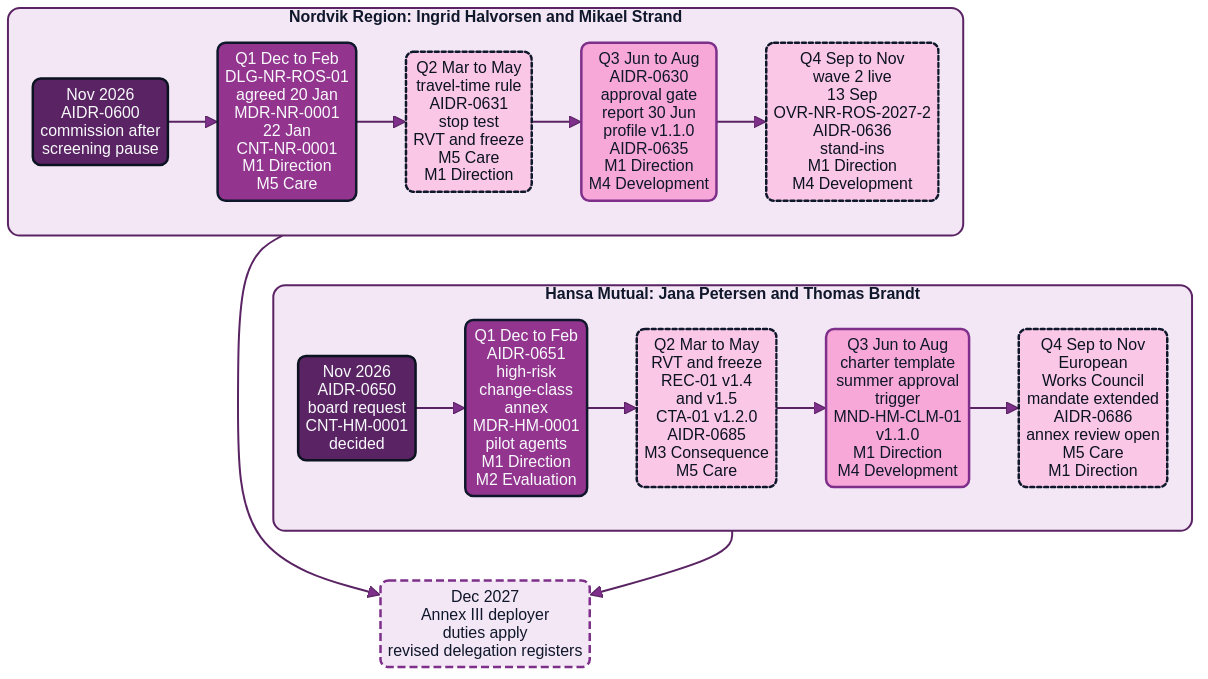
Figure 30.1: The year in two timelines, with the main records of each quarter and the management functions they concern.
Quarter one runs from December 2026 to February 2027, quarter two from March to May, quarter three from June to August and quarter four from September to November 2027.
Four people, two organisations
In November 2026 neither organisation had a word for what it was governing. Nordvik Region had a procured rostering system, ShiftWise, about to draft home-care routes, a time-per-visit dashboard, assistants that put names against action items, and a recruitment-screening pilot it had stopped. On 18 September 2026 Ingrid Halvorsen had paused the screening module (AIDR-0601) after the union for municipal and care workers asked how its ranking was made and the supplier could not show it (Chapter 7). The pause was the reason for what followed. On 16 November the regional director endorsed her commission to govern algorithmic management across the Region's about 6,000 staff, with the AI governance lead, the data protection officer and the chair of the central work-environment committee as reviewers and a report to the regional executive committee due by 30 June 2027. The commission carries the first number of the range, AIDR-0600, because every other record in it, the earlier pause included, is filed under it.
Mikael Strand had about 35 assistant nurses and care assistants in Strandvik, a third of them part-time or hourly. He planned routes by hand and had never been asked to approve anything a system had drafted. His unit was to be the first in home care to use ShiftWise routes.
At Hansa Mutual the AI boss was older and less visible. The claims-triage agent, a Mode 5 system, had allocated claims to individual handlers for years under allocation rules, and its throughput figures per handler reached team leaders under the group works agreement KBV-IT-2024. Jana Petersen, twelve years in motor and property claims, led about 20 handlers in Hamburg and could reassign any claim the agent allocated. From January 2027 she would also direct two pilot agents under HM-AB-PILOT-01. Thomas Brandt, a former underwriter and chair of the Konzernbetriebsrat since 2022, had negotiated KBV-IT-2024 and sat on the European Works Council. In October he had asked for TalentLens's selection criteria as a guideline under BetrVG §95, and the Dutch contestation CNT-HM-0001, decided on 2 November, had shown him a sales score that was advisory on paper and decisive in one unit (Chapters 8 and 27). On 23 November the executive board asked the chief HR officer and the chief risk officer for a group policy on AI in management, with the Konzernbetriebsrat invited to the review and a first report due on 30 April 2027 (AIDR-0650).
Quarter one: commissions and agreements
December: inventories before instruments
Both organisations began by finding out what they already had. On 1 December Mikael Strand and an HR business partner drew the unit's function map, FMAP-NR-STR-01 (Chapter 2). It showed what he had not noticed: the time-per-visit dashboard already gave him individual figures, at a degree nobody had decided. The same week, Ingrid's team sampled the minutes that the assistants had drafted for 12 meetings: 9 of 48 action items carried owners the chair had not confirmed, and 3 of the 9 people had treated them as instructions (Chapter 10). The recruiters' review of the paused pilot, reported on 15 December, could not reconstruct why the module had ranked anyone below the shortlist, so the Region invited the applicants who met the published requirements to be assessed afresh. On 18 December AIDR-0634 adopted a notice standard and change classes for every management system and added management systems to the Region's public algorithm register (Chapter 28). Mikael then tested the draft worker information notice with six of his staff, and rewrote it around their questions: how long a visit gets, whether declining an extra shift counts against them and whom to call when a route does not work.
The transposition deadline of the Platform Work Directive, 2 December 2026, passed in the same month (47, European Union, 2024). Neither organisation runs a digital labour platform, and both decided to read its Chapter III as a benchmark rather than wait for a law that would not reach them.
Hansa's inventory was longer. On 7 December Jana Petersen's function map, FMAP-HM-CLM-HH-01, recorded that the agent performed most of M1 Direction in her team, and the group kept the office suite's wellbeing and collaboration analytics switched off until the representatives agreed otherwise (Chapter 10). On 8 December the disparate-impact test DIT-HM-CTA-01 went to the Konzernbetriebsrat: rule CTA-R-14 offered complex claims only to handlers with two consecutive working days left in the week, which put part-time handlers, most of them women, at a disadvantage in access to the work that leads to promotion (Chapter 12). On 14 December the group reopened the classification of the agent's allocation function, treated it as high-risk under AI Act Annex III, point 4(b) (AIDR-0651), and removed in release 7.0 a capacity factor that had weighted allocation by each handler's last four weeks of throughput. The same day it recorded DLG-HM-CTA-01 version 1.0.0 for Germany only, and Thomas Brandt signed the change-class annex to KBV-IT-2024 (AIDR-0677), under which a joint IT committee approves Class 2 changes within ten working days (Chapter 23). On 21 December AIDR-0682 set up the group's transparency register.
January: profiles agreed, routes live
January at Nordvik ran on the duty to negotiate. Under the co-determination act on the pattern of MBL §11, the employer negotiates before it decides on an important change in working conditions (205, Sveriges riksdag, 1976), so nothing could run under DLG-NR-ROS-01 until the negotiation closed. Notice version 1.0 was issued on 11 January and explained by Mikael at a workplace meeting the next day. On 14 January the data protection officer gave her advice on DPIA-2026-031: open-shift offers sent to all opted-in staff at the same time, first acceptance winning, were solely automated but evaluated no personal aspect (Chapter 22).
The negotiation closed on 20 January. The unions agreed DLG-NR-ROS-01 version 1.0.0 (AIDR-0602) and the protocol for later changes (AIDR-0627), and the Region recorded its Platform Work Directive benchmark (AIDR-0625). The union for municipal and care workers changed one thing at the table. First acceptance rewarded whoever could answer a phone fastest, which favoured staff without children at home, so offers now go to every opted-in person in a published rotating order that advances one place with each offer. Because the DPIA named any ordering of recipients as a reason to reopen it, the officer reassessed the condition in AIDR-0626 before the profile was signed: a fixed rotation that draws on nothing about the person is not a ranking and evaluates no personal aspect, so the award stays outside Article 22 of the GDPR (5, European Union, 2016) for as long as no personal aspect enters the order. Notice version 1.1 followed on 21 January.
The first roster under the agreed profile, MDR-NR-0001, was approved and published on 22 January for the four weeks from 8 February to 7 March, with seventeen days' notice. Mikael changed three shifts of the draft and recorded why (Chapters 9 and 25). The daily routes went live in Strandvik on 25 January within the roster already in force.
On the second day, 26 January, an assistant nurse contested a route that left no time between two visits. CNT-NR-0001 was the year's most instructive record. Mikael corrected the route the next morning; the review, answered on 5 February, found an address geocoded to a postcode centroid and no rule setting a minimum travel time. The data was fixed on 12 February; the rule waited for the work-environment process (Chapter 27).
At Hansa the team charter TCH-HM-CLM-01 took effect on 1 January, under which agents' and handlers' figures are never compared (Chapter 18). The claims handlers' notice WIN-HM-CTA-DE followed on 8 January. On 12 January Jana noticed that the agent had sent nine motor claims to a handler on an agreed reduced schedule, because it read only her open workload. She reassigned five and recorded the override as MDR-HM-0001, and a capacity field that team leaders fill in without giving reasons became the first Class 2 change under the new annex. The pilot agents, wl-hm-clm-intake and wl-hm-clm-recovery, started work in her team in the second half of January under MND-HM-CLM-01 at Level 2 Supervised, every subrogation letter approved by a handler before it is sent (Chapter 16). CNT-HM-0001 closed on 15 January with the sales indicator normalised per market, and on 25 January AIDR-0681 made contest patterns a quarterly report and a review trigger in version 4 of DLG-HM-SPS-01, as Thomas had asked.
February: the first figures
Nordvik's first oversight period for roster approval began on 1 February. On 24 February Mikael and the safety representative assessed planned visit times as a work-environment risk in revision 1 of WRA-NR-HC-01 (AIDR-0632, Chapter 6). At Hansa, AIDR-0676 of 22 February tested TalentLens and the allocation agent against GDPR Article 22 and the SCHUFA reading (Chapter 22), and the team agreed the bounded preference rule PREF-01, published as version 1.1.0 of DLG-HM-CTA-01, capped at 30 per cent of a week's allocation and protecting complex claims for handlers in their first two years (Chapter 11).
Quarter two: corrections, stops and the first reports
March: the contest closes the loop
The contest of January turned into a rule in March. On 11 March the central work-environment committee approved WRA-NR-HC-01 revision 2: travel time between visits is the routed time plus five minutes and never under ten, enforced in ShiftWise as a feasibility condition written as a test (Chapter 14). On 12 March the Region tested its technical stop path under tender NR-2025-089 for the first time and stopped ShiftWise region-wide within the hour the decision-rights file would allow (Chapter 20). On 15 March Ingrid settled the appeal path in AIDR-0631. Two limits had been in circulation, 14 days in the dashboard review and 10 working days in FRIA-2026-007; CNT-NR-0001 had been answered within both, but it had gone to the manager who approved the route. The rule now sends review to the HR business partner, never to the decider, and sets 10 working days and never later than 14 calendar days, whichever comes first, which keeps the Region within the two weeks that Article 11 of the Platform Work Directive sets for platforms. Notice version 1.2 carried the travel-time rule to every member of the unit the same day. The rule fix was verified in production on 25 March, and CNT-NR-0001 closed only then.
Hansa ran its reversibility test of the allocation agent from 15 to 19 March: one Hamburg team on the team-leader queue for a week. Jana allocated within the service level. Her deputy, two years into the job and almost all of them spent being allocated work by the agent, needed three times as long, and complex claims gathered on the four most experienced handlers. RVT-HM-CTA-2027-01 passed with conditions and froze any new allocation class and any extension beyond Germany until the deputy could allocate without the agent (Chapter 25). From April, the deputy allocated ten per cent of new claims without the agent's proposal (Chapter 19). On 31 March AIDR-0678 added the equality-test block to DLG-HM-REC-01 as version 1.4 (Chapter 24).
April: decision rights and the recruiting drift
The decision-rights files came into force in April, Nordvik's DRF-NR-01 on 1 April and Hansa's DRF-HM-01 on 15 April (Chapter 20). From 5 to 16 April Nordvik ran RVT-NR-ROS-2027-01: Strandvik planned its routes by hand for two weeks. His deputy had never planned a route by hand, the manual template lacked the travel-time rule the contest had produced, and the wards' competence rules could not be exported from the supplier's product. The test passed with conditions due by 30 June, and the freeze it imposed kept the supplier's shift-swap feature, which would let staff exchange shifts without the unit manager's approval, switched off (Chapter 25). The first survey of SVY-NR-STV-01, three months after go-live, found staff rating the routes as fairer than the hand-planned ones and missing the informal swaps they used to arrange with each other (Chapter 11).
Hansa's first oversight record for recruitment showed the drift Chapter 7 had feared. In the Polish service centre in the first quarter, recruiters rejected applications below the cut in a median of 38 seconds and missed 3 of 6 seeded applications, at nineteen reviews per recruiter-hour against a cap of twelve (Chapter 26). The chief HR officer answered with AIDR-0680, which published version 1.5 of DLG-HM-REC-01: every application meeting the mandatory requirements is opened before rejection, the case view shows the application before the rank, and postings close at the volume the team can read. The same record extended OQM-HM-CLM-01 from handlers' review of agent output to team leaders' oversight of allocation, reported across the Hamburg claims department because Jana is her team's only team leader.
On 30 April the chief HR officer and the chief risk officer delivered the first report under AIDR-0650, with the group's decision-rights file, a baseline of AI Act controls applied in all seven markets as law or policy (Chapter 21) and the first quarterly contest report. The same day Thomas and the group head of claims operations reviewed DLG-HM-CTA-01. The review adopted the team-level workload indicator that Jana had proposed, claims per handler-hour against the agreed norm, the age of the oldest unworked claim and overtime, with a cap on claims allocated per handler-hour, and confirmed that rule CTA-R-14 now lets complex claims span shifts with a recorded handover (Chapters 12 and 14). AIDR-0685 records the result as version 1.2.0. Thomas's empty list of M3 Consequence decisions that throughput may feed went into the decision-rights file, where no future profile can quietly fill it.
May: chains and contracts
In May Hansa adopted the chain record CHN-HM-CLM-01 (Chapter 17). Its weak link was a checkpoint: handlers approving recovery letters could not see why the triage agent had sent a claim into the recovery path, so that step ran in practice at Level 3 Bounded. The routing reason was added to the handler's view in the May release, and the step returned to Level 2 Supervised. The first quarterly chain drill, SPT-HM-CHN-01, stopped the chain within its ten-minute target. At Nordvik, AIDR-0628 of 20 May set the procurement requirements NR-PRQ-MGT-01 for the follow-on tender, because the Region could hold ShiftWise to its stop path, logs, explanations and equality evidence only through a contract (Chapter 24).
Quarter three: oversight under pressure
June: a report and a redesign
The first oversight record, OVR-NR-ROS-2027-1, reached Ingrid in early June: seven approvers in home-care wave 1, 26 rosters, a median of 12 minutes, 5 approvals in under two minutes, 11 rest-rule flags closed with one click and 10 of 14 seeded faults found against an agreed threshold of 0.85 (Chapter 26). Four of the seven approvers had not finished the oversight module, because the wave had gone live before it was ready. She asked why the design allowed it, not who had done it. AIDR-0630 blocked approval until every flag has its own resolution, put two hours per roster into unit managers' schedules, removed missed seeds at publication and required AI literacy and oversight training before any unit of the second wave went live. It added a trigger: if the catch rate stays below 0.85 for two periods, the roster class returns to Level 1 Assisted, in which the manager draws the roster and ShiftWise checks it.
The June re-test of open-shift offers, after the training places agreed in Chapter 12, found hourly staff receiving offers at 0.84 of the rate of permanent staff, against 0.66 before, and the remaining gap traced to the course places still being completed. The conditions of the reversibility test were met by 30 June: the competence rules were exported to PeopleCore monthly and Strandvik's deputy had planned a week of routes by hand. The freeze on new action classes was lifted, and the shift-swap feature stayed off, because switching it on would now be a new action class needing negotiation.
Ingrid delivered her report to the regional executive committee on 30 June. It contained the delegation register, the negotiation protocol, the appeal path, the first oversight record, the reversibility test, the precautionary high-risk treatment of the dashboards, which makes the Region their provider as well as their deployer (Chapter 21), and the decision that no line manager would direct agents until the Region could supervise them. The committee accepted the report and asked for a plan for the next two years, which Chapter 32 sets out.
At Hansa the deputy's ten per cent of unassisted allocation met the condition of RVT-HM-CTA-2027-01 at the end of June, which lifted the freeze on paper. Extension beyond Germany stayed on hold, because each further entity needs its own gate. On 28 June AIDR-0683 adopted a team-leader charter template and selection on evidence of judgement (Chapter 29). Pay-transparency reporting under the national acts transposing Directive (EU) 2023/970 began to bind the EU entities in June, and the sales score's complaints indicator was restated as a criterion staff could read (Chapter 24).
July: summer at machine speed
July tested both organisations through absence. In Strandvik, holiday stand-ins approved rosters, and some had not taken the oversight module. In Hamburg the agents did not take holidays. With four handlers away, the recovery agent's 40 draft letters a day reached fewer people, and the median approval time for letters fell below 30 seconds for three consecutive weeks. That was a trigger of Jana's weekly routine (Chapter 16). She did not wait for the evaluation plan's stop rule to return the agents to Level 1 Assisted. She lowered the recovery agent's budget to 25 draft letters a day until September, moved the two handlers' unassisted samples to the mornings, when approvals were slowest, and recorded both changes in the manifest's history as version 1.1.0 of MND-HM-CLM-01. The median recovered within a fortnight.
August: the profile review
Nordvik reviewed DLG-NR-ROS-01 on 1 August, the date set in version 1.0.0, so that the second wave would go live under a revised profile. AIDR-0635 recorded version 1.1.0: the travel-time constraint of WRA-NR-HC-01 and the approval gate of AIDR-0630 written into the profile, the rotating order and its reopen condition kept, scope extended to the wave 2 units once their managers are trained, the shift-swap feature listed as excluded, and the next review on 1 February 2028, before the third wave. On 25 August Ingrid decided in AIDR-0633 that the day a fortnight ShiftWise saves unit managers goes to their staff, and that spans of control would not widen on the strength of it before the commission's review was complete (Chapter 29). Mikael's role charter, ROLE-NR-MGR-01, took effect on 1 September.
Quarter four: review and renegotiation
September: the second wave and the second record
Two of the wave 2 unit managers had not completed the oversight module by the planned date at the end of August. The wave went live on 13 September, two weeks late, rather than without them. The second oversight record for wave 1 covered the summer.
Worked example: The oversight record OVR-NR-ROS-2027-2
Illustrative. Chapter 26 showed the first oversight record for roster approval and named its successor. The second covers June to September 2027, the first period after AIDR-0630 and the first with holiday stand-ins. The figures are reported for all approvers and for stand-ins as a group, each group having at least five members, and never per person.
# oversight/OVR-NR-ROS-2027-2.yaml (illustrative)
id: OVR-NR-ROS-2027-2
previous_record: OVR-NR-ROS-2027-1
profile: DLG-NR-ROS-01            # v1.0.0 to 2027-08-31, v1.1.0 from 2027-09-01
class: NR-M1-ROSTER-APPROVE       # DRF-NR-01
recorded_degree: Level 2 Supervised
period: {from: 2027-06-01, to: 2027-09-30}
scope: home-care wave 1, seven units
owner: role:hr-director           # Ingrid Halvorsen
metric: OQM-NR-ROS-01
reported_to: [central work-environment committee, union for municipal and care workers, union for nurses and midwives]
aggregation: {groups: [all approvers, stand-in approvers], minimum: 5, per_person: none}
figures:
  approvers: {unit_managers: 7, stand_ins: 6}
  rosters_approved: 28
  median_minutes_open_to_approve: 47
  approvals_under_2_minutes: 0
  rosters_changed_before_approval: 19
  rest_rule_flags_raised: 24
  flags_closed_by_bulk_acknowledgement: 0     # blocked by design since AIDR-0630
  seeded_faults: {placed: 14, found: 12, rate: 0.86}
  seeded_faults_stand_ins: {placed: 4, found: 2, rate: 0.5}
  contestations: {received: 2, decision_changed: 1, records: [CNT-NR-0004, CNT-NR-0005]}
thresholds: {seeded_catch_min: 0.85, median_minutes_min: 10, approvals_under_2_minutes_max: 0, bulk_flag_closure_max: 0}
trigger_status: catch above 0.85 overall; return to Level 1 Assisted not triggered
findings:
  - Approval gate held; no flag closed in bulk
  - Stand-ins found half the seeds; three of six had not taken the oversight module
  - AIDR-0630 tied training to units going live, not to the approver role
actions:
  decision_record: AIDR-0636
  measures:
    - Oversight module required before anyone approves a roster, stand-ins included
    - Stand-in approvers named per unit in DRF-NR-01 before each holiday period
    - Deputies who plan a week by hand each month are first choice as stand-ins
next_record: OVR-NR-ROS-2027-3
The record does what Chapter 26 asked of it. It finds the weakness in the design, a training rule attached to the wrong object, rather than in the people, and its answer, AIDR-0636, is a change to the decision-rights file. It also links two chapters: the deputies who plan one week a month by hand are the stand-ins best able to check a draft, so M4 Development became a condition of oversight in M1 Direction.
October: the second survey and the European Works Council
The survey nine months after go-live found the gain in perceived fairness of routes holding and the loss of informal swaps still the most frequent complaint. The union for municipal and care workers asked for a swap function that keeps the unit manager's approval, a new action class that needs negotiation under the protocol of AIDR-0627 and is the first item for 2028. The evaluation plan's interim reading at the end of October showed neither of its stop rules firing: missed visits and short-term sick leave in wave 1 stayed within ten per cent of the units not yet using the system. Nine months of one wave cannot show whether the system works (Chapter 15).
At Hansa, the European Works Council was informed at its October meeting of the pilot's proposed next phase, which would add a claims team at the Polish service centre. A matter concerning establishments in two member states is transnational under Article 1(4) of Directive 2009/38/EC (52, European Union, 2009), and Thomas asked that the information follow the structure of the change-class annex, so that the members from Poland, the Netherlands and Sweden read the same classes the Konzernbetriebsrat reads.
November: the pilot's evaluation and the agreement under review
The evaluation of HM-AB-PILOT-01 against matched Hamburg teams under EVP-HM-AB-2027-01 was due at twelve months, and in November it had ten. Reopened claims and complaint rates in Jana's team were no worse than in the comparison teams, seeded-case catch in the weekly routine stayed above 0.85 except in July, and handler turnover could not yet be read. With MND-HM-CLM-01 expiring on 31 December 2027, the chief HR officer and the group head of claims operations decided in AIDR-0686 to extend the mandate unchanged to 30 June 2028, so that the evaluation can reach its twelve-month point, and to leave any change of scope, the Polish team included, to the two-year plan of Chapter 32.
Thomas spent November on the annual review of the change-class annex to KBV-IT-2024, due on 1 December. He proposed naming the pilot agents' approval logs in the annex, writing in the contest-report triggers of AIDR-0681 and placing the workload indicator beyond the joint IT committee's power to relax. The negotiation was open when the year ended.
Both organisations spent the last weeks of the year on the date that had shaped it. From 2 December 2027 the deployer obligations of Article 26 of the AI Act, including oversight by competent and authorised persons under Article 26(2) and prior information to workers' representatives under Article 26(7), apply to Annex III systems, after the Digital Omnibus deferred them (1, European Union, 2024) (2, European Union, 2026). Both checked their controls against the AI Act control set of Chapter 21. Neither found an obligation its records did not already address.
What went wrong
Most of the year's failures were found by a mechanism someone had designed: a contest, a seed, a test, a timed drill or a trigger. None was found by a system's own account of what it did.
| What went wrong | How it was found | What answered it |
|---|---|---|
| Unconfirmed owners in assistant minutes treated as instructions | Sample of 12 meetings | Configuration blocks distribution of unconfirmed owners |
| Capacity factor weighting allocation by four weeks of throughput | Classification review AIDR-0651 | Removed in release 7.0; change-class annex |
| Complex claims withheld from part-time handlers by CTA-R-14 | Disparate-impact test | Rule changed; promotion files flagged for review |
| Claims sent to a handler on a reduced schedule | Team leader's override, MDR-HM-0001 | capacity field as a Class 2 change |
| Impossible travel time from a postcode centroid | Contestation CNT-NR-0001 | Data fix; minimum travel time; appeal path AIDR-0631 |
| Deputies unable to plan or allocate without the system | Reversibility tests in both organisations | Hand-planned weeks; ten per cent unassisted allocation; freezes |
| Rosters approved in minutes, flags closed in bulk | Oversight record and seeds | Approval gate and training, AIDR-0630 |
| Recruiters rejecting below the cut in 38 seconds | Oversight record, blind review and seeds | Reading rule, case view and volume cap, AIDR-0680 |
| Fast letter approvals in the holiday weeks | Weekly routine trigger | Lower agent budget, MND-HM-CLM-01 v1.1.0 |
| Untrained holiday stand-ins | Second oversight record | Training tied to the approver role, AIDR-0636 |
Two failures were found late: the fallback route template had fallen behind the system it replaces, and the checkpoint in Hansa's chain had run at a higher degree than its profile said. Both are failures of the kind AI Threat, Chapter 26, warned of, in which the way back erodes while the delegation appears unchanged (F69) (44, Nordqvist, 2026).
Practical guide: A quarterly review with the representatives
Purpose. Give the employer and the workers' representatives one shared view, each quarter, of what has been delegated, what was decided, what was contested and whether oversight held, so that changes are agreed on evidence rather than on impressions.
Roles. The function owner (the HR director or chief HR officer) chairs and answers for the conditions; line managers such as Mikael Strand and Jana Petersen bring their teams' experience; union or works-council representatives such as Thomas Brandt and the safety representatives review the aggregates; the data protection officer checks the aggregation; the system owner answers technical questions.
- Generate the pack from the records. The delegation register with every profile version changed in the quarter, MDR counts by decision class, contestation records with times to answer, oversight records and the last reversibility test. Default: sent ten working days before the meeting.
- Check the aggregation. No figure about a person; minimum cell of five; overseers never assessed through oversight figures.
- Read failures first. Every trigger fired, test failed or seed missed, each with its answering decision or an open status.
- Compare the profile with practice. For each action class, compare the observed degree with the recorded one: a class approved in seconds or a checkpoint without information runs higher than its profile says.
- Classify pending changes under the agreed change classes, and let the representatives move a change up a class.
- Record the outcome as a short decision record with the representatives' position, and update the notices where a Class 1 or 2 change follows.
Definition of done. The pack was sent on time and contained no individual figures; every failure has an answer or an open status; every pending change has a class agreed by both sides; and the record of the meeting is in the repository. Adapt the cadence and the minimum cell size to the collective agreement or works agreement.
How the roles changed
Ingrid Halvorsen began the year as the owner of a commission and ended it as the owner of a register. Her work moved from approving systems to deciding degrees, setting the conditions under which others decide, and answering for them to the unions, the work-environment committee and the elected committee.
Mikael Strand stopped planning routes and started approving them. The day a fortnight ShiftWise saved him went, by decision rather than drift, to home visits with his staff and development conversations, which rose to a quarter and to about a sixth of his time. He designed two of the seeds that test him and his peers, and his deputy now plans a week of routes a month by hand. His authority over the roster is greater than it was, because every change he makes carries a reason his staff can read.
Jana Petersen became the book's mixed-team leader in practice: directed by one agent through allocation, directing two others through a mandate, and accountable for both to her handlers. She reassigns the agent that allocates to her team and verifies the agents she directs, and in July she used her own judgement, not the evaluation's stop rule, to slow them down. Her role charter ROLE-HM-MGR-01, in force from 1 July, protects 35 per cent of her time for M4 Development and M5 Care. Her deputy is now learning allocation by doing it.
Thomas Brandt's work moved from negotiating agreements to negotiating classes of change. By November 2027 he was reading contest reports, workload indicators and oversight aggregates every quarter and carrying the same structure to the European Works Council. He co-determines a system that changes monthly by agreeing in advance how it may change, which is the answer to Q8 that Chapter 23 proposed.
What the year shows
The order of the instruments mattered: commission, inventory, profiles, records, and only then measured oversight and reversibility tests. Where the order was reversed, as when a wave went live before its managers were trained, the cost appeared in the next record.
Co-determination shaped every outcome that lasted: the rotating order, the cap on preferred claims, the training places, the workload indicator and the empty list of consequences all came from the representatives, and none reduced what the systems were for. Both organisations kept M3 Consequence below Level 2 Supervised throughout, Nordvik with no AI in any consequence decision while the screening pilot stayed paused, Hansa with named recruiters and sales managers deciding at Level 1 Assisted and Level 0 Advisory. No action of any system ran at Level 4 Autonomous over a person.
Across the degrees of delegation
Table 30.1 shows how each organisation's delegation profiles moved between December 2026 and November 2027.
| Profile and action class | Function | December 2026 | November 2027 | What moved it |
|---|---|---|---|---|
DLG-NR-ROS-01 rosters and routes |
M1 Direction | Level 2 Supervised on wards; home care not live | Level 2 Supervised in wards and two home-care waves, approval gated on every flag; v1.1.0 | AIDR-0602, AIDR-0630, AIDR-0635 |
DLG-NR-ROS-01 open-shift offers |
M1 Direction | Level 3 Bounded, first acceptance in draft | Level 3 Bounded, published rotating order, no personal aspect | Negotiation; AIDR-0626 |
DLG-NR-ROS-01 rest and travel time |
M5 Care | Level 1 Assisted flags | Flags Level 1 Assisted; Level 3 Bounded protective blocks for rest and travel time | WRA-NR-HC-01 rev 2 |
DLG-NR-HCD-01 time-per-visit dashboards |
M2 Evaluation | Level 0 Advisory, status undecided | Level 0 Advisory, precautionary high-risk, no location traces, barred from pay and discipline | Chapters 8, 13 and 21 decisions |
| Recruitment screening | M3 Consequence | Paused | Paused; procurement requirements before any resumption | AIDR-0601, AIDR-0628 |
| Agents directed by managers | M1 Direction | None | None until supervision capacity exists | Commission AIDR-0600; AIDR-0610 |
DLG-HM-CTA-01 allocation |
M1 Direction | Level 3 Bounded, v1.0.0, Germany | Level 3 Bounded, v1.2.0, capacity field, PREF-01, workload cap, CTA-R-14 corrected; Germany only | AIDR-0651, AIDR-0677, AIDR-0685 |
DLG-HM-CTA-01 throughput figures |
M2 Evaluation | Level 1 Assisted, team leaders only | Level 1 Assisted; no M3 decision may use them | DRF-HM-01 |
DLG-HM-REC-01 TalentLens |
M3 Consequence | Level 1 Assisted, v1.3, drifting at volume | Level 1 Assisted, v1.5, equality block, reading rule, volume cap | AIDR-0678, AIDR-0680 |
DLG-HM-SPS-01 sales score |
M3 Consequence | Level 0 Advisory, v3, decisive in one unit | Level 0 Advisory, v4, per-market normalisation, contest triggers | CNT-HM-0001, AIDR-0681 |
DLG-HM-AB-01 pilot agents |
Agents' own actions | Level 2 Supervised from January | Level 2 Supervised, recovery checkpoint restored, budget lowered in summer, mandate extended to 2028-06-30 | CHN-HM-CLM-01, MND-HM-CLM-01 v1.1.0, AIDR-0686 |
Nordvik's profiles moved sideways: more units, more constraints, no higher degree. Hansa's moved inward: the same degrees, with more of the conditions that make them true written into the profile. Across the usage modes the year left the picture of Chapter 4 intact. Nordvik used a Mode 4 rostering system, Mode 4 dashboards and Mode 2 and Mode 4 assistants, and directed no agents. Hansa ran a Mode 5 allocation agent over people at Level 3 Bounded, Mode 5 pilot agents directed by a person at Level 2 Supervised, and Mode 2 office assistants, with the Mode 0 analytics feature still off.
What neither organisation has yet solved
Nordvik has not solved its dependence on the supplier. It can hold ShiftWise to its duties only through a contract that predates them, and the follow-on tender is still ahead. The supplier's agent-to-agent component for filling roster gaps stays disabled, but staff want swaps that the current product cannot offer with the manager's approval. Screening is paused without a route back. Unit managers' time is protected by a decision, AIDR-0633, whose review is still to come, and the evaluation will not speak for another fifteen months.
Hansa has not solved plurality. One agent, one works agreement and seven arrangements for representation mean that every extension of a profile beyond Germany is a new negotiation, and the Polish phase of the pilot waits on all of them. The team leader's oversight of allocation is reported only across a department, so its quality in any one team is still inferred. And the question of who becomes a team leader when allocation is learned through ten per cent of the work is open until the deputy is assessed. Chapter 32 takes up both lists.
Observable, expected and speculation
Algorithmic rostering, allocation agents, automated screening and their documented failures are observable in the cases of Parts II and III; the deadlines of the AI Act as amended and of the Platform Work Directive are decided law. That records, tests and negotiated classes find failures earlier than complaints do is expected from the evidence of Chapters 26 and 27 and from the year shown here. Whether the two organisations' measures improve health, retention and fairness over two years is speculation until the evaluations report.
Nordvik Region and Hansa Mutual
Nordvik's year was negotiation-first: every instrument passed through the unions before it ran, and its failures were found by a contest, a live test and the oversight records rather than by incidents. Its largest risk ended where it began: in a product it buys and can change only by contract.
Hansa's year was correction-first: its agent was already directing people, so the year consisted of finding what it did without anyone deciding it and writing down the conditions that made its degrees true, with a Konzernbetriebsrat that asked for one line at a time.
Both reached the same point by different routes: what made delegation safe was the human capacity to check it, the unit manager with two hours per roster, the deputy who can plan without the system, the team leader who slows her agents down when approvals become too fast.
Summary
The year followed Ingrid Halvorsen, Mikael Strand, Jana Petersen and Thomas Brandt from the commission and the board request to revised delegation registers. It showed the five management functions in use together: M1 Direction in rosters, routes, open shifts and allocation; M2 Evaluation in dashboards, throughput and scores; M3 Consequence in hiring and pay inputs, always with a named human decider; M4 Development in the craft deputies keep and the complex claims new handlers receive; and M5 Care in travel time, rest, workload and the time managers spend with their staff.
What went wrong was found by contests, seeds, tests, drills and triggers, and each finding led to a recorded decision. The representatives' contributions were among the most durable results of the year. Both organisations kept consequences with people and moved their profiles sideways or inward, never upward.
The year leaves open the supplier dependence and the paused screening at Nordvik, and plurality, team-level oversight and the next team leader at Hansa. Chapter 31 sets the two organisations' experience beside case studies and anti-patterns from elsewhere, and Chapter 32 draws the conclusions and plans for each organisation.
Sources
- European Parliament and Council of the European Union (2024). Regulation (EU) 2024/1689 laying down harmonised rules on artificial intelligence (Artificial Intelligence Act). Official Journal of the European Union. (1, European Union, 2024)
- European Parliament and Council of the European Union (2026). Regulation (EU) 2026/1744 amending Regulation (EU) 2024/1689 as regards the simplification of the implementation of harmonised rules on artificial intelligence (Digital Omnibus on AI). Official Journal of the European Union. (2, European Union, 2026)
- European Parliament and Council of the European Union (2016). Regulation (EU) 2016/679 on the protection of natural persons with regard to the processing of personal data (General Data Protection Regulation). Official Journal of the European Union. (5, European Union, 2016)
- European Parliament and Council of the European Union (2024). Directive (EU) 2024/2831 of 23 October 2024 on improving working conditions in platform work. Official Journal of the European Union. (47, European Union, 2024)
- European Parliament and Council of the European Union (2009). Directive 2009/38/EC on the establishment of a European Works Council or a procedure in Community-scale undertakings and Community-scale groups of undertakings for the purposes of informing and consulting employees (recast). Official Journal of the European Union. (52, European Union, 2009)
- Sveriges riksdag (1976). Lag (1976:580) om medbestämmande i arbetslivet. SFS 1976:580, as amended. (205, Sveriges riksdag, 1976)
- Nordqvist, G. (2026). AI Threat: Are the Dystopias Coming True? Evidence, Risk and Response for European Enterprises and Public Authorities. The Architecture as Code Series, Book 5. (44, Nordqvist, 2026)