Health, Pace and Burnout: Occupational Safety Under Algorithmic Direction
A manager who sets the pace of work has always also been the person placed to notice when the pace harms someone: the shift leader who adds a visit to a route sees the assistant nurse come back late and exhausted. Algorithmic management separates the two. The system that sequences visits, allocates claims or offers open shifts performs M1 Direction at machine speed, while the duty of care, M5 Care, stays with an employer whose line managers may no longer see the work as it is done. This chapter asks what that separation does to health. It presents what research measured about strain, pace, schedules and injury, sets out what occupational safety and health law requires of an employer whose system sets the pace, and stages the debate between those who see algorithmic direction as a machine for externalising strain and those who see in it the first manager that never forgets a rest rule.
The chapter builds on four conclusions of the earlier volumes: human command is built, with an interruption path outside the system and approval quality reported in aggregate where works councils have rights (F52), and autonomy is paced to the skills available to supervise it (F53) (AI Red Team, Chapters 6 and 15) (43, Nordqvist, 2026); oversight quality is measured at team level because reliance on automation reduces checking (F66; AI Threat, Chapters 6 and 14) (44, Nordqvist, 2026); and stop decisions are named in advance, on a path outside the system they stop (F19; AI Governance, Chapter 13) (41, Nordqvist, 2026). It addresses Q11, what replaces the manager's judgement in care for health when the system that directs work does not notice a person in difficulty, and contributes to Q4, whether algorithmic management works when measured in health as well as output.
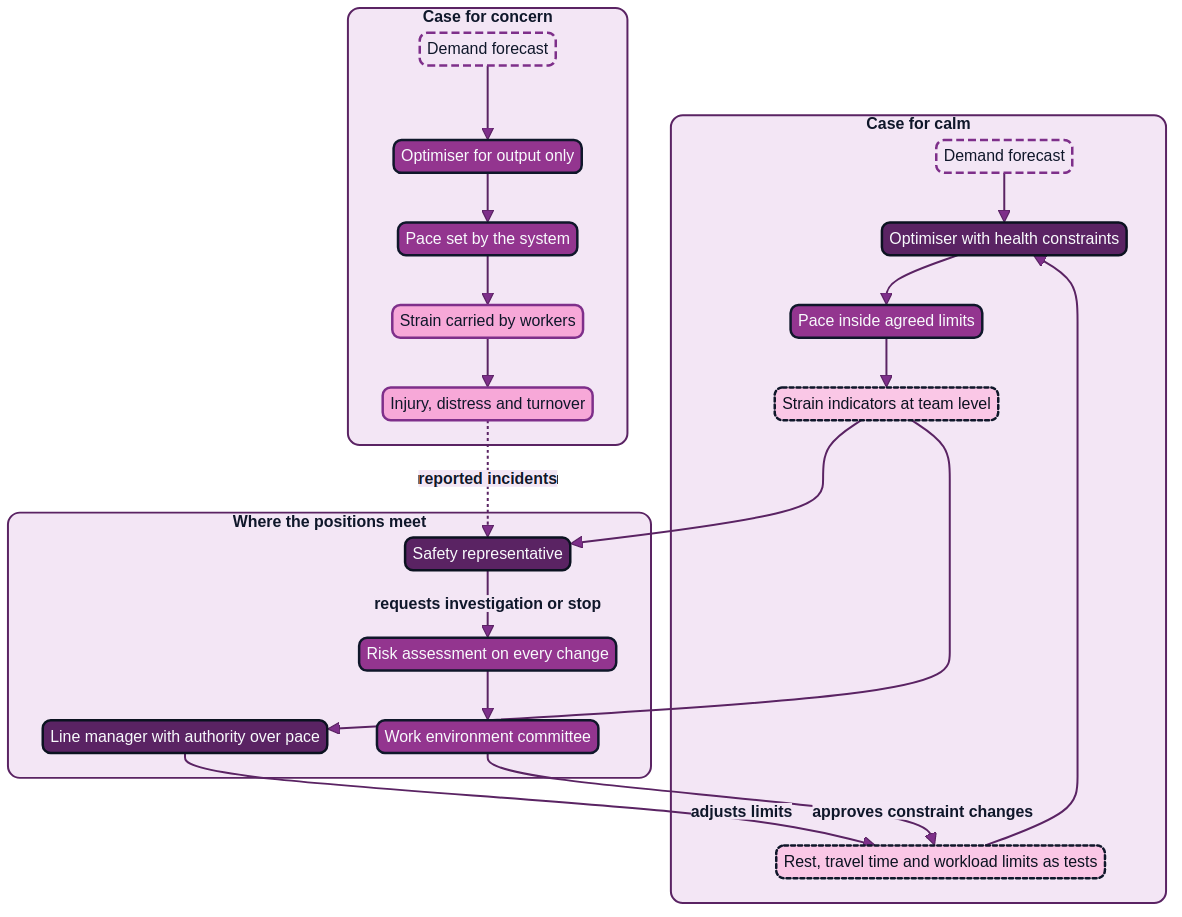
Figure 14.1: The debate on health and pace, with the optimiser shown without and with health constraints, and the safety representative and the line manager in the loop that changes them.
Pace, strain and recovery
The research that matters most here was written about control, effort and reward, not about algorithms, and it applies because algorithmic management changes exactly those variables.
Robert Karasek's demand-control model, published in 1979 from national survey data on workers in the United States and Sweden, separated two features of a job that earlier stress research had run together: the psychological demands placed on the worker and the worker's decision latitude, the authority to decide how and when to meet those demands (107, Karasek, 1979). Mental strain concentrates where high demands meet low latitude; demanding jobs with wide latitude were associated with learning and activity rather than exhaustion. Strain can therefore be reduced without reducing output, by returning decisions about the pace and order of work to the people who do it.
Johannes Siegrist's effort-reward imbalance model added a second axis. Its focus is reciprocity: high effort that is not matched by reward, in pay, esteem, promotion prospects or job security, is treated as particularly stressful. In prospective data on blue-collar men, low reward combined with high effort independently predicted new cardiovascular events, and the same variables partly explained the prevalence of hypertension and adverse lipid profiles in two further studies (225, Siegrist, 1996). Arnold Bakker and Evangelia Demerouti later reviewed both models and proposed the more flexible job demands-resources model, in which any feature of work that requires sustained effort counts as a demand and any feature that helps achieve goals or reduce demands counts as a resource, so that the model can be applied across occupations and used as a tool of human resource management (120, Bakker & Demerouti, 2007). In its two processes, chronic demands drain energy towards exhaustion, while resources such as autonomy, feedback and social support sustain engagement and buffer demands.
Read together, the models predict where algorithmic direction harms health. A system that shortens the planned time per task or fills the gaps between tasks raises demands; one that also fixes the order of visits or the next claim removes latitude and moves the job into Karasek's high-strain quadrant; one that removes the colleague or manager who noticed the late return removes a resource. Each effect is a design choice. The same system could let staff swap visits within limits and flag overload to someone with authority to act.
Recovery ties these models to the law. The Swedish Work Environment Authority defines unhealthy workload in exactly those terms: demands that more than temporarily exceed resources, an imbalance that becomes unhealthy when it is long-lasting and the opportunities for recovery are insufficient (84, Arbetsmiljöverket, 2023). An optimiser that removes slack removes the small recoveries inside a shift; one that fragments shifts removes the larger ones between them.
Monitored pace and injury
The strongest evidence that algorithmically set pace harms bodies comes from warehouses, whose rates and warnings Chapter 6 describes, and it comes with limits that deserve stating as clearly as its findings.
The Strategic Organizing Center, a coalition of trade unions, analysed the injury data that Amazon submitted to the United States Occupational Safety and Health Administration for 2017 to 2020. It reported more than 24,000 serious injuries at Amazon facilities in 2020, injuries that required time off work or light duty, and a serious injury rate of 5.9 per 100 Amazon warehouse workers against 3.3 for all other employers in the warehousing industry, nearly 80 per cent higher (197, Strategic Organizing Center, 2021). In December 2024 the majority staff of the United States Senate Committee on Health, Education, Labor and Pensions published the findings of an 18-month investigation, drawing on Amazon's own documents and on worker accounts. The committee's analysis found that Amazon warehouses recorded over 30 per cent more injuries than the warehousing industry average in 2023, that more than two-thirds of Amazon's warehouses had injury rates above the industry average, and that the company had studied the connection between its speed requirements and injuries and had declined to implement proposals to lower injury rates because of concerns about productivity (202, U.S. Senate Committee on Health et al., 2024).
Both are comparisons of recorded injury rates between one employer and an industry, not controlled studies of pace. Differences in workforce, task mix and turnover are not controlled for, recording practices matter (the committee alleged under-recording, which would make the gap a lower bound), the union coalition and the committee majority are parties with a view, and Amazon publicly disputed the committee's conclusions. What lifts the evidence above an adversarial claim is convergence: two analyses of regulatory data, internal documents examining the same link, and the long-understood ergonomic mechanism by which repetitive work at a predetermined pace with too little recovery causes musculoskeletal disorders.
The European Agency for Safety and Health at Work (EU-OSHA) reviewed the wider literature in its 2022 report on artificial intelligence for worker management. It found two faces: systems that gather data on work can give early warnings of hazardous situations, stress and fatigue and support risk assessment, while real-time direction can push workers to work faster, with more stress, physical harm and accidents, and scheduling tools that allocate work too aggressively can produce overwork and fatigue (86, European Agency for Safety and Health at Work, 2022). A 2024 EU-OSHA analysis of patents for AI-based worker management found only a marginal fraction aimed at improving workers' wellbeing (87, European Agency for Safety and Health at Work, 2024).
The fourth European Survey of Enterprises on New and Emerging Risks, ESENER 2024, asked more than 41,000 establishments in 30 countries about their risks (88, European Agency for Safety and Health at Work, 2025). Time pressure was reported by 43 per cent of establishments in the EU-27 and was the most frequently reported risk factor in Sweden, at 64 per cent. Seven per cent reported machines, systems or computers that monitor workers' performance or behaviour, rising to 15 per cent in transportation and storage. Among establishments using at least one digital technology, increased work intensity was reported as a related risk factor by 34 per cent, after prolonged sitting and repetitive movements, and loss of worker influence over pace was among the factors asked about. Only 35 per cent of those establishments had consulted employees about the effect of digital technologies on safety and health, up from 24 per cent in 2019. These are employers' reports, not measurements of health, but they show that the employers who introduce the technology recognise intensity as its risk.
Schedules and health
The shape of the schedule is the second channel. Daniel Schneider and Kristen Harknett surveyed 27,792 hourly retail and food-service workers employed at 80 large companies in the United States, recruited through targeted advertisements on social media, about their schedules and their wellbeing (125, Schneider & Harknett, 2019). Exposure to routine instability, such as short notice of schedules, on-call shifts, cancelled shifts and "clopening" shifts that close late and reopen early, was associated with psychological distress, poor sleep quality and unhappiness. Low wages were associated with the same outcomes, but unstable and unpredictable schedules were much more strongly associated, and a larger share of the association ran through work-life conflict than through household economic insecurity. The data are cross-sectional and self-reported, so causation is inferred, not demonstrated. Many of the practices measured are what demand-driven scheduling software (Chapter 9) produces when told to match staff to forecast demand at minimum cost.
At the other end of the scale of evidence, the World Health Organization and the International Labour Organization estimated the global burden of long working hours. Frank Pega and colleagues modelled exposure from more than 2,300 surveys and applied relative risks from systematic reviews: in 2016, 488 million people, 8.9 per cent of the global population, worked 55 hours a week or more, and an estimated 745,194 deaths from ischaemic heart disease and stroke were attributable to that exposure (176, Pega et al., 2021). The estimate concerns long hours in general, not algorithmic scheduling, but it shows that the organisation of working time causes serious disease at population scale, which is the reason for the limits European law places on it: a minimum daily rest of 11 consecutive hours in every 24-hour period, a break where the working day is longer than six hours, a weekly uninterrupted rest of 24 hours plus the 11 hours of daily rest, and an average working week, including overtime, of no more than 48 hours (50, European Union, 2003).
For a system designer these limits are constraints: precise, testable and exactly the kind of rule a scheduling system enforces more reliably than a busy manager. They are only the floor. A schedule can comply with every working-time rule and still carry unhealthy workload, because the rules limit hours, not what is packed into them.
The employer's duty
The legal frame is older than the algorithms and fits them closely. Council Directive 89/391/EEC, the Framework Directive on safety and health at work, places on the employer "a duty to ensure the safety and health of workers in every aspect related to the work" (Article 5(1)), and enlisting external services or persons does not discharge the employer from that responsibility (Article 5(2)) (49, Council of the European Communities, 1989). For an employer that procures a scheduling system, the supplier's design choices become the employer's working methods.
Among the principles of prevention, Article 6(2)(d) requires the employer to adapt the work to the individual, especially in the choice of working and production methods, "with a view, in particular, to alleviating monotonous work and work at a predetermined work-rate and to reducing their effect on health". Article 6(3)(a) requires the employer to evaluate the risks, and Article 6(3)(c) requires that "the planning and introduction of new technologies are the subject of consultation with the workers and/or their representatives, as regards the consequences of the choice of equipment, the working conditions and the working environment for the safety and health of workers". Article 9(1)(a) requires a risk assessment; Article 11 requires consultation, gives safety representatives the right to ask for measures (Article 11(3)) and lets workers appeal to the competent authority (Article 11(6)); and Article 8(4) protects workers who leave their workstation in serious, imminent and unavoidable danger.
Three implications follow. An algorithm that sets the rate of work is a working method chosen by the employer, within Article 6(2)(d). Introducing it, and every material change to it, requires risk assessment and consultation beforehand, not configuration by the supplier. And the safety representative's rights extend to the parameters that set the pace, because they determine the risk.
The Charter of Fundamental Rights gives every worker the right to "working conditions which respect his or her health, safety and dignity" (Article 31(1)) (48, European Union, 2012), and the AI Act adds its own frame. It classifies as high-risk AI systems intended to be used to allocate tasks based on individual behaviour or personal traits or characteristics, or to monitor and evaluate the performance and behaviour of persons in work-related relationships (Annex III, point 4(b)), and Article 26(7) requires deployers who are employers to inform workers' representatives and the affected workers before such a system is put into service (1, European Union, 2024). Chapter 21 treats these provisions. The AI Act's duties come on top of the Framework Directive's: a system that is not high-risk still sets a work-rate the employer must assess.
The Platform Work Directive writes these duties out for algorithmic management. Article 12 requires digital labour platforms, without prejudice to the Framework Directive, to evaluate the risks of automated monitoring and decision-making systems to the safety and health of platform workers, "in particular as regards possible risks of work-related accidents, psychosocial and ergonomic risks", to assess whether the systems' safeguards are appropriate, and to introduce preventive and protective measures (Article 12(1)); to inform, consult and involve platform workers or their representatives under Articles 10 and 11 of the Framework Directive (Article 12(2)); and not to use such systems "in a manner that puts undue pressure on platform workers or otherwise puts at risk the safety and physical and mental health of platform workers" (Article 12(3)) (47, European Union, 2024). Article 10(2) requires that those who oversee the systems have the authority to override automated decisions, and transposition is due by 2 December 2026 (Article 29). Its scope is platform work, but it is expected to shape how labour inspectorates read the general duties elsewhere.
National rules and standards
The examples are Swedish law, the model for Nordvik Region's work-environment legislation, and German law for Hansa Mutual's headquarters.
The Swedish Work Environment Act (arbetsmiljölagen, SFS 1977:1160) requires that technology, work organisation and job content be designed so that the worker is not exposed to physical or mental loads that can cause ill health or accidents, that forms of pay and the scheduling of working hours be taken into account, and that "strongly controlled or restricted work shall be avoided or limited" (Chapter 2, section 1) (75, Sveriges riksdag, 1977). Few sentences in European law describe the risk of algorithmic pace as directly. Chapter 3, section 2a requires continuous investigation of risks; Chapter 3, section 4 protects a worker who refrains from work in immediate and serious danger while awaiting instructions; Chapter 6, section 6a lets the safety representative (skyddsombud) request measures or an investigation, with an answer without delay and recourse to the Swedish Work Environment Authority; and Chapter 6, section 7 lets the representative stop work involving immediate and serious danger pending the Authority's decision.
AFS 2023:1 on systematic work environment management requires the employer, when changes to the activity are planned, to examine whether they bring risks of ill health or accidents and to assess them, and requires risk assessments to be documented in writing (section 11) (226, Arbetsmiljöverket, 2023). Chapter 2 of AFS 2023:2, on the organisational and social work environment, carries the provisions formerly in AFS 2015:4 (84, Arbetsmiljöverket, 2023). It requires managers to know how to prevent unhealthy workload and to have the means to act (section 4); requires the employer to ensure that the tasks and authority given to workers do not give rise to unhealthy workload, which means that resources must be adapted to demands (section 6); requires that workers know which tasks to perform, what result is expected, which tasks to prioritise when time does not suffice for all of them and whom to turn to for help (section 7); and requires measures to prevent the scheduling of working time from causing ill health (section 9). The general advice to section 6 asks the employer to make sure that the technology used is adapted to the work. Section 7 reads like a specification for a dispatch system: a route without priorities, or a queue without a named person to call, falls short of it.
In Germany, section 5 of the Occupational Safety and Health Act (Arbeitsschutzgesetz) requires the employer to assess the hazards connected with work, and names among the sources of hazard the design of work processes, workflows and working time and their interaction (section 5(3) no. 4) and psychological stress at work (section 5(3) no. 6) (227, Germany, 1996). BetrVG §87(1) no. 7 gives the works council a right of co-determination on rules for the prevention of occupational accidents and diseases and on health protection within the framework of statutory provisions, alongside the better-known right under §87(1) no. 6 on technical equipment suited to monitor behaviour or performance (9, Germany, 2001). A change to the allocation rules of a system that paces work therefore raises two co-determination questions, and the one about health is often overlooked.
ISO 45003:2021 gives guidelines for managing psychosocial risk within an occupational health and safety management system, and treats workload, work pace, working hours and job control among the psychosocial hazards an organisation should identify and control (83, ISO/IEC, 2021). It is voluntary but gives HR, safety and AI governance a shared vocabulary. The International Labour Organization's 2025 report on AI and occupational safety and health covers algorithmic management and stresses risk assessment and worker participation at the workplace (148, International Labour Organization, 2025).
Practical guide: Writing health and rest constraints into an optimiser, and testing that they hold
Purpose. Make health limits constraints that a system performing M1 Direction cannot trade for output, and prove by tests that they hold.
Roles. The system owner (for a procured system, the deployer's owner, not the supplier); the line manager who approves plans; the safety representative for the workplace; the occupational health service; HR for working-time rules and collective agreements; the supplier, who configures the system; and the work-environment committee, which approves changes to the constraints.
Steps.
- List the constraints with their sources. Working-time rules from law and the collective agreement; workload rules from the risk assessment (tasks per shift, minimum time per task type, travel time, lone work); rules agreed with representatives. A constraint without a source is negotiated away by the first person who finds it inconvenient.
- Classify each as hard or soft. Hard constraints are never breached by a proposed plan; soft ones only with a recorded reason. Default: everything with a legal or agreed source is hard; preferences are soft.
- Put hard constraints where the optimiser cannot weigh them. Require in the contract that they are feasibility conditions, not penalty terms in the objective function, because enough output always outweighs a penalty.
- Write each constraint as a test on the output. The deployer needs no access to the supplier's code: export every draft plan and run the tests before it reaches the approving manager. A failing test blocks approval.
- Seed known breaches. On every change, feed the tests plans that breach each constraint and confirm they are caught (the seeded-error principle of F66).
- Measure strain, not only compliance. Report overtime, missed breaks, late finishes, sick leave, turnover and contested plans monthly to the line manager and the safety representative, at team level unless representatives agree otherwise.
- Assess every change. A change to a constraint, the objective, the demand forecast or a duration model is a change to the work: assess it under the Framework Directive, Article 6(3), or its national equivalent, and consult the safety representative before it takes effect.
- Keep a stop path outside the system. The line manager and the safety representative may each revert a unit to manual planning without asking the supplier; test the fallback twice a year (F19).
Definition of done. Every constraint has a source, class, owner and test; tests block approval on failure and catch the seeded breaches; strain is reported monthly; changes carry a recorded risk assessment; the fallback was tested in the last six months. Adapt the defaults to the collective agreement, works agreement and national law.
Worked example: A work-environment risk assessment for ShiftWise routes in home care
Illustrative. After the contestation CNT-NR-0001, in which an assistant nurse in the Strandvik home-care unit showed that a ShiftWise route left no time to travel between two visits, Mikael Strand and the unit's safety representative revised the risk assessment for routes in home care. The central work-environment committee reviewed the revision, and the Region recorded the decision to treat the resulting constraints as hard constraints in AIDR-0605.
risk_assessment:
  id: WRA-NR-HC-01
  revision: 2
  date: 2027-03-11
  previous_revision: {revision: 1, date: 2027-02-24, covered: visit-time targets and the dashboard, shown in Chapter 6}
  system: ShiftWise
  scope: Home-care visit schedules and routes, Strandvik unit
  delegation_profile: DLG-NR-ROS-01
  legal_basis:
    - "Directive 89/391/EEC Art. 6(2)(d), 6(3)(a), 6(3)(c), 9(1)(a)"
    - "Work Environment Act ch. 2 s. 1; ch. 3 s. 2a"
    - "AFS 2023:1 s. 11; AFS 2023:2 ch. 2 ss. 6, 7, 9"
  trigger: CNT-NR-0001
  assessed_by: [unit manager Mikael Strand, safety representative, occupational health service]
  reviewed_by: central work-environment committee
  decision_record: AIDR-0605
  hazards:
    - id: H1
      description: Route plans no travel or transition time between visits
      severity: high
      control: C2
    - id: H2
      description: Visit durations forecast below time needed for care tasks
      severity: high
      control: C3
    - id: H3
      description: Late finish erodes daily rest before next shift
      severity: medium
      control: C1
  constraints:
    - id: C1
      rule: Daily rest at least 11 consecutive hours between shifts
      source: "Directive 2003/88/EC Art. 3 and collective agreement"
      class: hard
      test: tests/test_daily_rest.py
    - id: C2
      rule: Travel time between visits at least routed time plus 5 minutes, minimum 10 minutes
      source: WRA-NR-HC-01 after CNT-NR-0001
      class: hard
      test: tests/test_travel_time.py
    - id: C3
      rule: Planned visit time not below care-plan minimum for the visit type
      source: WRA-NR-HC-01
      class: hard
      test: tests/test_visit_minimum.py
    - id: C4
      rule: Break of at least 30 minutes in any shift longer than 6 hours
      source: "Directive 2003/88/EC Art. 4 and collective agreement"
      class: hard
      test: tests/test_breaks.py
  seeded_breaches_per_release: 12
  strain_indicators: [overtime_hours, missed_breaks, late_finishes, contested_routes, sick_leave_days]
  reporting: monthly, unit level, to unit manager and safety representative
  stop_path: unit manager or safety representative may revert the unit to manual planning
  next_review: 2027-09-30
The assessment is short because its work is done in the tests that keep any route breaching C1 to C4 from reaching Mikael Strand for approval, and in the monthly indicators that show whether compliant routes are still too tight. The ten-minute minimum and the 30-minute break are illustrative; the collective agreement and rural distances may require more.
The debate
The disagreement about health under algorithmic direction is not about whether pace can hurt people; both sides accept that. It is about whether the harm belongs to the technology or to the way it is configured and governed, and therefore whether the right response is restraint or design.
The case for concern
The case for concern begins with the objective function. A system that sets pace optimises output per unit of labour: visits per shift, claims per hour. Strain does not appear in the objective unless someone puts it there, and the EU-OSHA patent analysis suggests developers rarely do (87, European Agency for Safety and Health at Work, 2024). An optimiser without health constraints will find every minute of slack in a schedule and remove it, because slack looks like waste. The minutes it removes are the ones in which a person recovers.
The second strand is the evidence: injury rates far above industry averages at the employer best known for algorithmic pace, which had studied the link and declined proposals that might have reduced output (202, U.S. Senate Committee on Health et al., 2024) (197, Strategic Organizing Center, 2021). Unstable schedules are more strongly associated with distress and poor sleep than low pay is (125, Schneider & Harknett, 2019). The strain models explain why: algorithmic direction tends to raise demands and lower control at the same time, which is Karasek's high-strain job (107, Karasek, 1979), and it individualises rewards and sanctions while removing the esteem and discretion that Siegrist identified as rewards (225, Siegrist, 1996).
The third strand concerns care itself. A manager who directed work also saw its effects: the late return, the silence in a meeting. When direction moves into a system, that perception does not move with it. The system sees timestamps; the line manager, now responsible for more people, sees dashboards; nobody is placed to notice a person in difficulty, the gap Q11 names. The duty of care is discharged on paper by a risk assessment correct at go-live and never revisited as the model is retrained and the minutes are taken out. No one need intend harm; it is enough that health is nobody's variable in a system that optimises everything else.
The case for calm
The case for calm begins with what human managers have done with pace. Overwork, unsafe rosters and favouritism in allocating hard shifts long predate software; the WHO and ILO estimate describes a world in which most schedules are still made by people (176, Pega et al., 2021). A busy manager drafting a four-week roster for 35 staff by hand overlooks a rest rule more easily than a system that checks every pair of shifts, and a manager under pressure to cover a gap calls the reliable colleague again rather than spreading the load. A system can balance work across a team and refuse any plan that breaches a limit.
The second strand is detection: systems that gather data on work can give early warnings of hazards, stress and fatigue (86, European Agency for Safety and Health at Work, 2022). The timestamps a warehouse uses to discipline can show a unit manager that one route runs late every day or that overtime falls on two people. A manager sees what is in front of them; a system can show the whole team over months, and so be an ally of care rather than its replacement.
The third strand is that nothing in the evidence shows harm inherent in the software. The warehouse findings concern targets one employer set; the scheduling findings concern practices employers chose to cut labour costs. The same tools, with health limits in the optimiser, negotiated pace and strain indicators acted upon, could produce safer work than manual planning, and European law already requires that combination (49, Council of the European Communities, 1989) (47, European Union, 2024). Restricting the technology would preserve the overwork of human planning and forgo the protection of enforced rules.
Where the positions meet
Both positions accept the strain models, accept that a system enforces working-time limits more consistently than a person, and accept that the documented harms concern how pace was set and governed. Both agree that three conditions decide the outcome. The first is whether health constraints are inside the optimiser as limits it cannot trade, or outside it as policies the objective quietly overrides. The second is whether pace is negotiated: assessed before each change and reviewed with the people who bear it and their safety representatives. The third is whether someone with authority watches strain: a line manager with the time and power to change the plan, and a safety representative who can require an investigation or stop the work. Where all three hold, the case for calm describes what happens; where any is missing, the case for concern does.
What can be done
Workers can report strain early and in writing, through the safety representative if they prefer, and contest a plan that leaves no time for the work, as the assistant nurse in Strandvik did. The right to stop work in immediate and serious danger (Framework Directive, Article 8; national law) applies to danger created by a plan a system produced.
Line managers can treat every plan they approve as their own decision about pace and change one that complies with every rule but is still too tight; where they lack the authority or time, they can say so in writing.
Employers can write health limits into every system that performs M1 Direction as hard constraints with tests, assess every change, report strain at team level, keep a manual fallback and put these requirements into procurement.
Workers' representatives can review the parameters that set pace, not only the monitoring that measures it: time per task, the travel-time model, the allocation rules and the objective, under BetrVG §87(1) no. 7 in Germany and Chapter 6, section 6a of the Work Environment Act in Sweden.
Labour inspectorates can inspect algorithmic pace as a work-environment risk, ask for the risk assessment of each change, and use Article 12 of the Platform Work Directive as a reference outside platforms.
Verdict
That high demands with low control and low reward harm health, and that unstable schedules and long hours are associated with distress, poor sleep and serious disease, is observable.
That algorithmically set pace raises injury and strain is observable in warehouse work, where analyses of regulatory data and internal documents converge despite their limits, and expected in other sectors where systems set the rate, route or sequence of work without health constraints, such as delivery, home care and claims queues; the mechanism is the same, but measurement is scarce. That AI agents assigning office work raise burnout is speculation until measured; theory predicts it where they raise demands and remove control, and the opposite where they remove drudgery.
On M5 Care, care cannot be delegated to the system that directs the work, but it must be designed into it. The duty stays with people: the line manager who approves the plan, the safety representative who can stop it and the committee that approves its limits. A system contributes enforcement and detection at Level 1 Assisted: it flags, and a person acts. People and organisations can influence what decides the outcome: what the optimiser optimises, which limits it cannot cross, who sees the strain and who may change the plan.
Across the degrees of delegation
| Degree for M1 Direction | Effect on pace | Health safeguard required | M5 Care default |
|---|---|---|---|
| Level 0 Advisory | System suggests plans; manager sets pace | Manager trained in unhealthy workload (AFS 2023:2, s. 4) | Not delegated |
| Level 1 Assisted | System drafts; manager edits every plan | Hard constraints flagged before approval | Level 1 Assisted: system flags breaches |
| Level 2 Supervised | System plans; manager approves | Constraint tests block approval; monthly strain indicators | Level 1 Assisted |
| Level 3 Bounded | System allocates within rules without approval | Hard constraints in the rules; representatives review rules; manual fallback | Level 1 Assisted |
| Level 4 Autonomous | System sets pace without human approval | Not recommended where pace affects health | Never beyond Level 1 Assisted |
Mode 4 Built AI applications and Mode 5 Autonomous production agents, such as rostering systems and allocation agents, set pace directly. Mode 2 Embedded workplace assistants and Mode 3 Agentic work tools set it indirectly through what they assign. Mode 0 Ambient AI, such as wellbeing analytics, offers detection without direction and raises the monitoring questions of Chapter 13 first.
Nordvik Region and Hansa Mutual
At Nordvik Region, ShiftWise drafts home-care routes at Level 2 Supervised under DLG-NR-ROS-01 and flags breaches of rest rules at Level 1 Assisted for Mikael Strand to resolve. Home care, with the Region's highest share of part-time and hourly staff and its highest turnover, is where the Region watches strain most closely. CNT-NR-0001 showed that a flag was not enough: the route complied with every working-time rule and still could not be worked. The revised assessment WRA-NR-HC-01 made travel time a hard constraint written as a test, approved by the central work-environment committee, whose chair also reviews Ingrid Halvorsen's commission AIDR-0600. AIDR-0605 records that such constraints change only after risk assessment and the committee's review, and that the supplier must show they are enforced as feasibility conditions, a question tender NR-2025-089 had not asked.
Hansa Mutual delegates nothing in M5 Care to AI and keeps the wellbeing analytics switched off. Whether that is caution or neglect depends on what replaces them, because the claims-triage agent allocates claims at Level 3 Bounded under DLG-HM-CTA-01 and so sets the pace of the queue in Hamburg and the other German claims teams, the only ones its profile covers. Declining to delegate care does not remove the health risk of delegated direction; it removes the instrument that would show it. Jana Petersen proposes a team-level workload indicator from the agent's allocation data: claims per handler-hour against the team's agreed norm, the age of the oldest unworked claim, and overtime. Thomas Brandt accepts it only at team level, consistent with KBV-IT-2024 and the team-level oversight-quality metric OQM-HM-CLM-01 (AI Threat, Chapter 14) (44, Nordqvist, 2026), and asks for the allocation rules to be reviewed under BetrVG §87(1) no. 7 as well as no. 6, with an Arbeitsschutzgesetz section 5 assessment that includes psychological stress. AIDR-0685 records the indicator and a cap on claims allocated per handler-hour in version 1.2.0 of DLG-HM-CTA-01, adopted at the profile review of 30 April 2027 (Chapter 30). The difference is telling: Nordvik's strain shows in late finishes that can be counted under one regime, while Hansa's is less visible and must pass several national arrangements.
Summary
This chapter concerned M1 Direction and M5 Care, and the gap between them when a system sets the pace and people remain responsible for its effects. The strain models predict harm where demands rise while control and reward fall, and algorithmic direction moves all three that way unless designed not to.
The evidence is strongest in warehouses, where injury analyses and the Senate committee majority's investigation converge on an injury-productivity trade-off, and in scheduling, where unstable schedules are more strongly associated with distress and poor sleep than low pay. European employers recognise work intensity as a risk of digital technology, but most have not consulted their staff about it.
The law already places the duty with the employer: the Framework Directive names work at a predetermined rate as something to alleviate and requires assessment and consultation when technology is introduced; Swedish law requires strongly controlled work to be limited and resources to match demands; German law requires assessment of psychological stress; and Article 12 of the Platform Work Directive writes the duty out for algorithmic management.
Both sides of the debate accept three conditions: health constraints inside the optimiser, pace negotiated and assessed on every change, and someone with authority who watches strain. The harm of algorithmic pace is observable in warehouses, expected elsewhere and speculation for office agents. M5 Care should rarely be delegated beyond Level 1 Assisted, while health constraints belong inside every system that performs M1 Direction. Chapter 15 asks whether algorithmic management works at all when measured over years and in health, quality and retention as well as output.
Sources
- Nordqvist, G. (2026). AI Red Team: AI as an Active Part of Cyber Defence in European Enterprises and Public Authorities. The Architecture as Code Series, Book 4. (43, Nordqvist, 2026)
- Nordqvist, G. (2026). AI Threat: Are the Dystopias Coming True? Evidence, Risk and Response for European Enterprises and Public Authorities. The Architecture as Code Series, Book 5. (44, Nordqvist, 2026)
- Nordqvist, G. (2026). AI Governance: Governing Artificial Intelligence in European Enterprises and Public Authorities. The Architecture as Code Series, Book 2. (41, Nordqvist, 2026)
- Karasek, R. A. (1979). Job Demands, Job Decision Latitude, and Mental Strain: Implications for Job Redesign. Administrative Science Quarterly, 24(2), 285–308. (107, Karasek, 1979)
- Siegrist, J. (1996). Adverse health effects of high-effort/low-reward conditions. Journal of Occupational Health Psychology, 1(1), 27–41. (225, Siegrist, 1996)
- Bakker, A. B. & Demerouti, E. (2007). The Job Demands-Resources model: state of the art. Journal of Managerial Psychology, 22(3), 309–328. (120, Bakker & Demerouti, 2007)
- Arbetsmiljöverket (2023). AFS 2023:2 Planering och organisering av arbetsmiljöarbete – grundläggande skyldigheter för dig med arbetsgivaransvar. Swedish Work Environment Authority. (84, Arbetsmiljöverket, 2023)
- Strategic Organizing Center (2021). Primed for Pain: Amazon's Epidemic of Workplace Injuries. SOC. (197, Strategic Organizing Center, 2021)
- U.S. Senate Committee on Health, Education, Labor and Pensions, Majority Staff (2024). The "Injury-Productivity Trade-off": How Amazon's Obsession with Speed Creates Uniquely Dangerous Warehouses. United States Senate. (202, U.S. Senate Committee on Health et al., 2024)
- European Agency for Safety and Health at Work (2022). Artificial intelligence for worker management: an overview. EU-OSHA. (86, European Agency for Safety and Health at Work, 2022)
- European Agency for Safety and Health at Work (2024). Worker management through AI – From technology development to the impacts on workers and their safety and health. EU-OSHA. (87, European Agency for Safety and Health at Work, 2024)
- European Agency for Safety and Health at Work (2025). First findings of the Fourth European Survey of Enterprises on New and Emerging Risks (ESENER 2024). EU-OSHA. (88, European Agency for Safety and Health at Work, 2025)
- Schneider, D. & Harknett, K. (2019). Consequences of Routine Work-Schedule Instability for Worker Health and Well-Being. American Sociological Review, 84(1), 82–114. (125, Schneider & Harknett, 2019)
- Pega, F., Náfrádi, B., Momen, N. C., Ujita, Y., Streicher, K. N., Prüss-Üstün, A. M., Descatha, A., Driscoll, T. et al. (2021). Global, regional, and national burdens of ischemic heart disease and stroke attributable to exposure to long working hours for 194 countries, 2000–2016. Environment International, 154, 106595. (176, Pega et al., 2021)
- European Parliament and Council of the European Union (2003). Directive 2003/88/EC concerning certain aspects of the organisation of working time. Official Journal of the European Union. (50, European Union, 2003)
- Council of the European Communities (1989). Council Directive 89/391/EEC on the introduction of measures to encourage improvements in the safety and health of workers at work. Official Journal of the European Communities. (49, Council of the European Communities, 1989)
- European Union (2012). Charter of Fundamental Rights of the European Union. Official Journal of the European Union. (48, European Union, 2012)
- European Parliament and Council of the European Union (2024). Regulation (EU) 2024/1689 laying down harmonised rules on artificial intelligence (Artificial Intelligence Act). Official Journal of the European Union. (1, European Union, 2024)
- European Parliament and Council of the European Union (2024). Directive (EU) 2024/2831 on improving working conditions in platform work. Official Journal of the European Union. (47, European Union, 2024)
- Sveriges riksdag (1977). Arbetsmiljölag (1977:1160) (Work Environment Act). (75, Sveriges riksdag, 1977)
- Arbetsmiljöverket (2023). AFS 2023:1 Systematiskt arbetsmiljöarbete – grundläggande skyldigheter för dig med arbetsgivaransvar. Swedish Work Environment Authority. (226, Arbetsmiljöverket, 2023)
- Federal Republic of Germany (1996). Arbeitsschutzgesetz (ArbSchG) (Occupational Safety and Health Act), § 5. Gesetze im Internet. (227, Germany, 1996)
- Federal Republic of Germany (2001). Betriebsverfassungsgesetz (BetrVG) (Works Constitution Act). Gesetze im Internet. (9, Germany, 2001)
- International Organization for Standardization (2021). ISO 45003:2021 Occupational health and safety management – Psychological health and safety at work – Guidelines for managing psychosocial risks. ISO. (83, ISO/IEC, 2021)
- International Labour Organization (2025). Revolutionizing health and safety: The role of AI and digitalization at work. ILO. (148, International Labour Organization, 2025)