Conclusions: Who Should Be the Boss?
This book began with a question that the six earlier volumes of the series had not asked: what happens when artificial intelligence takes the manager's chair, directing, pacing, scoring, rewarding, disciplining and dismissing people, and when people in turn become the managers of AI agents. Thirty-two chapters later this chapter answers it. It restates the thesis and judges it claim by claim against what the chapters found, settles the open questions Q1 to Q12 or says why they remain open, sets out the five management functions as the book's lasting frame, shows what the book adds to the argument the series has made since Architecture as Code, and gathers the verdicts of the constructive debates of Part III. As the conclusion of the book it concerns all five management functions: M1 Direction, M2 Evaluation, M3 Consequence, M4 Development and M5 Care. The author's own verdict on who should be the boss in 2036 is kept to labelled sections, apart from the findings, as AI Governance, Chapter 24, established for the series (F33) (41, Nordqvist, 2026), and every outlook carries the label observable, expected or speculation.
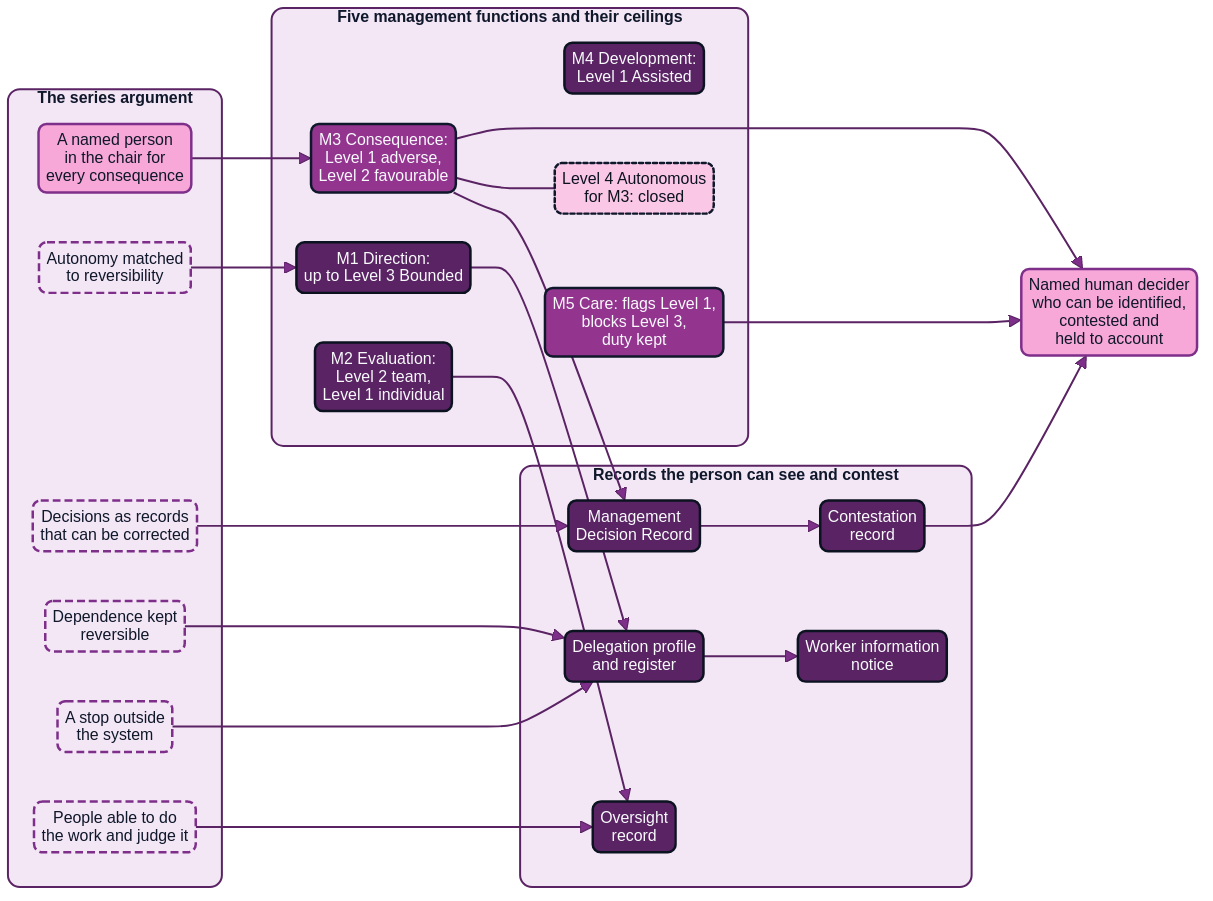
Figure 33.1: The book's argument in one figure: five functions with ceilings, one closed cell, the records that make each decision visible, and the named person in the chair, set within the argument of the seven volumes.
The thesis restated
The working thesis, stated in Chapter 1 and put into testable form in Chapter 4, was that AI may direct work but may not, on its own, decide about people. Management splits into five functions. The functions that assign and pace work can be delegated at a degree matched to reversibility. The functions that carry consequences for a person, hiring, pay, promotion, discipline, dismissal and access to work, always have a named human decider who can be identified, contested and held to account. Every management decision that AI makes or shapes about a person is a record the person can see, contest and have corrected. The sum of delegations is itself recorded, so that it is visible and reversible before the fallback has gone. And the manager's role is transformed, not abolished: from supervisor of tasks to accountable leader of people and conductor of agents.
The starting point was not speculative. Algorithmic management is in common use among the employers the OECD surveyed (149, Milanez et al., 2025); Kellogg, Valentine and Christin described algorithms as a new contested terrain of control through which employers direct, evaluate and discipline workers (137, Kellogg et al., 2020); and the vendor of the most widely used office software announced "the rise of the agent boss" (151, Microsoft, 2025). Taylor's separation of planning from doing was handed to software long before generative AI (96, Taylor, 1911), while the relational, fragmented work that Mintzberg observed in managers (103, Mintzberg, 1973) is the part no system has taken over. The book's question was therefore not whether AI would manage people, which is observable, but which parts of management it should perform, to what degree, and who answers for the result.
The thesis judged, claim by claim
Each claim below is the book's own conclusion, drawn from the chapters named. Where the two organisations are cited they illustrate the claim; as fictional cases they cannot test it.
AI may direct work, but not on its own decide about people
The evidence supports the claim and qualifies its first half. Direction can be delegated: rosters, open-shift offers and claims allocation ran at Level 2 Supervised and Level 3 Bounded in Part II without the harms recorded on the platforms and in the warehouses, where they were bounded, declinable and reassignable (Chapters 5, 9 and 10). But direction is not neutral. Chapter 9 showed that M1 Direction carries M3 Consequence and M5 Care inside it, because hours set pay and pace sets health; Chapter 5 showed that acceptance history in open-shift offers can become a hidden rating; and Chapters 6 and 14 showed that when a system sets the pace, the duty of care has to be exercised over parameters. The injury evidence assembled by the United States Senate committee majority (202, U.S. Senate Committee on Health et al., 2024) and the association between unstable schedules and distress among 27,792 service workers (125, Schneider & Harknett, 2019) show what happens when direction is delegated without those parameters.
The qualified claim is therefore narrower than the slogan: direction may be delegated up to Level 3 Bounded only where health and working-time constraints sit inside the optimiser as feasibility conditions, where the figures it produces are fenced off from consequence decisions unless that use has been agreed, and where allocation that uses individual behaviour is treated as the high-risk use it is under AI Act Annex III, point 4(b) (1, European Union, 2024). The second half of the claim, that no system decides on its own about a person, held without qualification. No chapter found a case in which removing the person from a consequence decision improved the outcome for the people affected; the cases of Part II found the opposite (Chapters 5, 7 and 8).
Every consequence decision has a named human decider
This is the firmest claim, and also the one most easily emptied. The law converges on it: GDPR Article 22 limits decisions based solely on automated processing that produce legal or similarly significant effects (5, European Union, 2016); the Platform Work Directive requires that decisions to restrict, suspend or terminate a platform worker's account or contract be taken by a human being (Article 10(5)) (47, European Union, 2024); and the AI Act requires deployers to assign oversight to natural persons with competence, training and authority (Article 26(2)) (1, European Union, 2024). The accountability literature explains why: without a person, Bovens's relationship between an actor and a forum has a forum and no actor (121, Bovens, 2007), and Thompson's many hands become an excuse for everyone (111, Thompson, 1980).
The qualification is that a name is necessary and not sufficient. Elish's moral crumple zone (170, Elish, 2019) and Green's review of oversight policies (178, Green, 2022) warned that a human attached to a system's output can absorb the blame without having had the means to decide. The Amsterdam Court of Appeal held that notes on a file do not show meaningful human involvement (67, Gerechtshof Amsterdam, 2023), and the Post Office Horizon inquiry documented, at the scale of a nation, what follows when an organisation trusts its system over the people who dispute it (203, Post Office Horizon IT Inquiry, 2025). Chapter 4 therefore defined the named decider by six capabilities, identification, authority to decide otherwise, information, time, protection and answerability, and Chapter 26 made them measurable. The illustrative oversight figures of Chapter 26 show why: a median of 38 seconds per application among Hansa Mutual's Polish recruiters, with 21 of 150 blind-reviewed rejections that would have advanced, is a named decider in form only. The claim holds where the six capabilities hold, and the oversight record is how an organisation knows.
Every management decision made or shaped by AI is a record
The claim is supported as design and left open as evidence. Chapter 25 showed that a Management Decision Record can be generated from the system's events and the decider's action, so that the record is a condition of the decision rather than a report on it, and that one record can serve four readers: the worker, the representatives, a court and a supervisor (Q3). Chapters 27 and 28 showed that a record is contestable only if the person knows the system exists, receives an explanation with a counterfactual and can reach someone with authority within a stated time. The two illustrative contestations, CNT-NR-0001 and CNT-HM-0001, both ended in a correction of the rule, not only of the case.
Two things remain open. Chapter 4 named the evidence that would weaken the claim: records that nobody reads, or contests with records that fare no better than those without. The book found no study that compares the two, so the claim is the book's design conclusion, not a measured result. And the standing of such records before labour courts and supervisory authorities is untested; Article 86 of the AI Act, applying from 2 August 2026, gives affected persons a right to "clear and meaningful explanations of the role of the AI system in the decision-making procedure" for decisions based on the output of an Annex III system (1, European Union, 2024), but how courts will weigh a record made at the time against testimony made later is speculation. The records also carry a risk the book named in Chapter 13: a decision record about a person is personal data, and a record set that grows without purpose limits becomes the surveillance it was meant to govern. Pseudonymous reference, retention by purpose and aggregation for representatives are part of the claim, not additions to it.
The sum of delegations is recorded and reversible
The claim is supported, with a sharper qualification than expected. The delegation register of management functions, extending the register of AI Threat, Chapter 26 (F69) (44, Nordqvist, 2026), shows the sum of delegation per function, team and market, and the reversibility tests of Chapter 25 check whether each delegation can still be undone. In the illustrative year, neither organisation passed cleanly. Nordvik Region's roster test passed only with conditions and froze a supplier feature; at Hansa Mutual a deputy took three times as long to allocate claims by hand and complex claims concentrated on four handlers, so new allocation classes and the extension beyond Germany were frozen. The lesson is that reversibility decays within months of go-live, not years. A delegation register without tests records what was delegated but not whether the organisation could still take it back, and the test is what turns the register from inventory into control. Bainbridge's irony, that automation removes the practice needed to take over when it fails (24, Bainbridge, 1983), applies to managers as much as to operators.
The manager is transformed, not abolished
The claim is supported for the present and open for the long run. Systems now draft rosters, allocate work and produce figures, which is observable; the disappearance of the line manager is speculation and rests on vendors' forecasts (Chapter 29). The evidence on good managers ranks coaching, psychological safety and development highest (Chapter 29), and none of these was delegated in any chapter. Agents a manager directs take M1 Direction and the product-checking part of M2 Evaluation, while M4 Development and M5 Care do not transfer and grow, because agents add pace, figures and a new kind of work beside people (Chapters 16 and 18).
What remains open is whether the transformation happens by default. Chapter 29 named the most plausible alternative: the role divides into a technical overseer of systems and a separate people function outside the line. And Chapter 19 showed that the route by which managers learned, rostering, allocating and first assessments, is the work systems now do first, so the next managers must be made on purpose. Promotion already tends to reward performance in the current job over managerial ability (124, Benson et al., 2019), and system-generated throughput would strengthen that tendency. The thesis describes what organisations can choose; it is not a law of development.
The falsifiers
The blueprint named two findings that would show the thesis wrong: evidence that fully automated consequence decisions produce fairer and safer outcomes than human decisions with records and appeal, and evidence that algorithmic direction without human leadership sustains performance and wellbeing over years. The book found neither. It also found that neither has yet been properly sought. The case for calm in Chapter 12, that an audited algorithm can be more consistent than a manager, rests on measurements of consistency, not of fairness to the person over time, and on audits that measure groups rather than individuals. The productivity evidence of Chapter 15 measured months, not years. The thesis stands because the falsifiers have not appeared and because the harms of the alternative have; it should be judged again when multi-year evaluations exist.
Table 33.1 summarises the judgement.
| Claim | Verdict | How firm | Chapters |
|---|---|---|---|
| AI may direct work, but not on its own decide about people | Supported; direction qualified by the constraints it carries | Observable for harms of undelegated pace; expected for bounded direction elsewhere | 5, 6, 9, 14 |
| Every consequence decision has a named human decider | Supported where the six capabilities hold | Observable as law in force; meaningful involvement observable as a test courts apply | 4, 8, 22, 26 |
| Every management decision AI makes or shapes is a record | Supported as design; effect on contest unmeasured | Expected; court standing speculation | 25, 27, 28 |
| The sum of delegations is recorded and reversible | Supported; reversibility decays within months | Observable as instrument; decay illustrated, not measured | 25, 30 |
| The manager is transformed, not abolished | Supported now; long run open | Observable for the present; long-run outcome speculation | 16, 19, 29 |
Table 33.1: The thesis judged claim by claim.
Answered and open questions
SERIES_FOUNDATIONS.md recorded twelve questions for this book. Table 33.2 records how the book leaves them.
| Question | Status | Answer in brief | Chapters |
|---|---|---|---|
| Q1 Which functions may be delegated, to what degree, and who decides | Answered | Ceilings per function set by the management body; the function owner sets the degree within them after the representatives have exercised their rights; recorded in the delegation profile, the decision-rights file and the register | 4, 20, 25 |
| Q2 Who is accountable for a consequence accepted without reading | Answered as the book's position | The decider answers to the person, the function owner for the conditions, the management body for the allocation; where the oversight record shows reading was impossible, accountability moves to whoever set the volume | 4, 20, 26 |
| Q3 How a decision is shown to worker, works council, court and supervisor | Answered | One Management Decision Record with four views | 25, 27, 28 |
| Q4 Does algorithmic management work over years | Answered in part | Short-run gains and metric gaming observable; long-run effects unmeasured; a multi-year evaluation agreed in advance | 15 |
| Q5 Who becomes a manager when junior management work is automated | Answered in part | The route must be rebuilt by design; whether reserved work and competence records suffice at scale is open | 19 |
| Q6 Which parts of management transfer when a person manages agents | Answered | Direction and product checking transfer; development and care do not, and grow; consequence has no meaning for an agent | 16, 18 |
| Q7 Where the chain of accountability ends among orchestrated agents | Answered | At a named chain owner with one stop path outside the chain and the records to reconstruct every output that reached a person; no link holds M3 Consequence | 17 |
| Q8 How co-determination applies to systems that change daily | Answered | Agreements govern change classes, not versions | 23 |
| Q9 Can oversight be real at hundreds of decisions an hour | Answered | Not for individual decisions; reclassify with oversight of the system or reduce volume, and measure oversight quality at team level | 26 |
| Q10 How a public authority remains a model employer when it buys the AI boss | Answered in part | Keep the evidence in the authority's hands through procurement and give reasons beyond the legal minimum; whether suppliers will meet such terms at scale is open | 24 |
| Q11 What replaces the manager's judgement in care | Answered in part | Systems carry protective constraints and flags; the duty stays with the employer and the noticing stays with people who have time and access | 14, 24, 29 |
| Q12 Who should be the boss in 2036 | Open by nature | The author's verdict below | 29, 33 |
Table 33.2: The open questions of this book and how it leaves them.
Q2 deserves its answer in prose, because it is the question most organisations will meet first. A manager who accepts a recommendation without reading it is accountable for the decision, because the delegation profile gave the manager the authority and the information to decide otherwise. But accountability does not stop there. The function owner answers for whether the volume, the screen and the time made reading possible, and the management body answers for the allocation of the function in the first place. Where the oversight record shows that reading was not possible, the remedy is not to discipline the manager but to change the profile. This follows AI Red Team, Chapter 6, that at higher degrees human approval moves from the action to the playbook and the decision record, which concentrates accountability rather than diluting it (F51) (43, Nordqvist, 2026).
The five management functions as the book's lasting frame
The book's most durable contribution may be its unit of analysis. Dividing management into five functions, each with its own reversibility, its own stake for the person and its own law, turned an argument about whether AI should manage into a decision about how much, for what, and decided by whom.
| Function | Default ceiling | Why |
|---|---|---|
| M1 Direction | Level 3 Bounded under written conditions; rosters at Level 2 Supervised | Individually reversible; harms accumulate, so constraints and reviews of patterns by person carry the weight |
| M2 Evaluation | Level 2 Supervised for team measures; Level 1 Assisted for individual ones | A figure about a person becomes a decision through a pay input, a warning or a list |
| M3 Consequence | Level 2 Supervised for favourable or neutral decisions applying an agreed rule; Level 1 Assisted for adverse ones; never Level 4 Autonomous | Least reversible; the person's highest stake; the law requires a person who decided |
| M4 Development | Level 1 Assisted | Harms appear over years in the least regulated function |
| M5 Care | Flags at Level 1 Assisted; protective blocks at Level 3 Bounded; the duty never delegated | The employer's duty cannot be discharged to others; noticing a person in difficulty is relational |
Table 33.3: The default ceilings per management function (Chapters 4 and 20).
The series concluded in AI Red Team, Chapter 6, that Level 4 Autonomous is never used for irreversible actions (F50) (43, Nordqvist, 2026). This book translated the rule into the management of people: Level 4 Autonomous is never used for M3 Consequence. The line is drawn at M3 Consequence for three reasons that each suffice alone: the months between a wrongful dismissal and reinstatement cannot be returned; GDPR Article 22, the Platform Work Directive's Article 10 and the AI Act's Article 26(2) all point to a person who decided; and only a person can stand before a forum and answer.
M5 Care is where the line is drawn on the other side. The Framework Directive gives the employer "a duty to ensure the safety and health of workers in every aspect related to the work" and provides that enlisting competent external services or persons "shall not discharge him from his responsibilities in this area" (Article 5(1) and (2)) (49, Council of the European Communities, 1989), and Article 31(1) of the Charter gives every worker the right to working conditions that respect health, safety and dignity (48, European Union, 2012). A system can block a roster that breaks the rest rules, and should; it cannot notice that a colleague has gone quiet. The two functions mark the edges of what may be delegated: M3 because a consequence needs someone who answers, M5 because care needs someone who notices. Between them, M1, M2 and M4 can be shared with systems at degrees the organisation decides, records and reverses.
What this book adds to the series' argument
AI Threat, Chapter 35, concluded that the series makes one argument (F70) (44, Nordqvist, 2026): keep decisions as records that can be corrected, keep the ability to stop outside the system being stopped, keep people able to do the work and judge the output, keep dependence reversible, and match autonomy to reversibility. Architecture as Code had introduced decision records and the rule that agents draft and humans approve (40, Nordqvist, 2025); AI Governance made governance proportionate to the usage mode (41, Nordqvist, 2026); AI Platform and Security placed control outside the model (42, Nordqvist, 2026); AI Red Team matched autonomy to reversibility (43, Nordqvist, 2026); and The Transformed Security Architect showed that the role which makes the argument executable is transformed, not abolished, and is defined by accountable human judgement (F71) (46, Nordqvist, 2026).
This book applied each commitment to the management of people and found that each needed a new instrument. Decisions as records became the Management Decision Record and the contestation record, which the person affected can read and challenge, not only an auditor. The stop outside the system became the stop and pause rights of the decision-rights file, held by the line manager in their own unit, the function owner across the organisation and an operator from outside the system (Chapter 20). People able to do the work became managers who still plan a roster by hand, draft before reading the system's figure and keep a competence record (Chapter 19). Reversible dependence became the delegation register of management functions and its reversibility tests. Autonomy matched to reversibility became the ceilings of Table 33.3.
And the book adds a sixth commitment, which the earlier volumes implied but did not need to state, because their subjects were systems: keep a named person in the chair for every consequence. When the system's output falls on a person rather than an estate, the question is no longer only whether the action can be undone but who will answer to the person it was done to. The earlier volumes asked that someone be accountable for the system. This one asks that someone be accountable to the person.
The quiet harms before the loud ones
AI Threat concluded that the quiet harms at the scales of the mind and the organisation deserve attention first. Part III tested the fourth claim of Chapter 4, that the quiet harms of the AI boss appear earlier and more widely than the dramatic ones, and the debates support it.
The loud harms, the deactivation by threshold, the dismissal list, the screening model that learned the employer's past (Chapters 5, 7 and 8), are documented, rare relative to use and the harms the law now reaches most directly. The quiet harms are wider. Chapter 11 found that people accept algorithmic assignment far more readily than algorithmic evaluation, and that what they miss is recognition; the two positions met on discretion, reasons and a reachable person. Chapter 12 found that bias enters through the definition of good performance and through proxies, so that it can be found only by measuring outcomes by group, and that the appeal never comes without notice, reasons and a person with authority; the positions met on measuring, explaining, keeping a person and correcting the rule as well as the case. Chapter 13 found that narrow monitoring can reduce theft and raise productivity while constant observation leads people to conceal improvements and puts the psychological safety on which learning depends at risk; the positions met on purpose limitation, aggregation by default and no emotion inference, which Article 5(1)(f) of the AI Act already prohibits at the workplace (1, European Union, 2024). Chapter 14 found the harm of algorithmic pace observable in warehouses, expected elsewhere and speculation for office agents, with both sides accepting health constraints inside the optimiser, pace assessed on every change and someone with authority who watches strain. Chapter 15 found real short-run gains: in one customer-support deployment productivity rose by about 15 per cent on average, most for the least experienced (23, Brynjolfsson et al., 2025); outside the frontier of the system's competence, consultants became less accurate (22, Dell'Acqua et al., 2023); experienced developers were slower with AI while believing they were faster (21, Becker et al., 2025); and in Denmark no measurable effect on earnings or hours had yet appeared (184, Humlum & Vestergaard, 2025). None of these studies measured AI performing management functions over years.
The common verdict is that the quiet harms are not side effects to be monitored after deployment but properties to be designed in before it: discretion in the delegation profile, outcome tests by group on every release, purpose limits on data, health constraints in the optimiser and a multi-year evaluation agreed with the representatives. A loud harm triggers a court case; a quiet harm triggers nothing unless someone has decided in advance to look.
What to do first, next and later
The sequence below follows the order the chapters found to matter: written authority before delegation, records before scale, measurement before raising a degree. The defaults must be adapted to the collective agreement, the works agreement and the organisation's risk appetite.
First, in the first six months. Map who performs each function today, including the features nobody decided to switch on (Chapters 2 and 10). Write the decision-rights file with ceilings per function and the stop and pause rights (Chapter 20). Write a delegation profile for every system that touches a person, with the representatives, before it goes live or at its next change (Chapters 4 and 23). Issue worker information notices and open a transparency register (Chapter 28).
Next, from six to eighteen months. Generate Management Decision Records for every M3 Consequence decision and a sample of the rest (Chapter 25). Measure oversight quality at team level, with seeded cases (Chapter 26). Open an appeal path with a stated time limit and independent review (Chapter 27). Test outcomes by group on every release (Chapter 12). Write role charters with a protected floor for development and care (Chapter 29).
Later, from eighteen to thirty-six months. Run reversibility tests and freeze further delegation where one fails (Chapter 25). Run the multi-year evaluation and its stop rules (Chapter 15). Raise a degree only within its ceiling and on recorded evidence, and never to Level 4 Autonomous for M3 Consequence. For public authorities, write these terms into the next tender (Chapter 24).
Practical guide: Ten questions every organisation should be able to answer about its AI boss
Purpose. Give a management body, an HR director, a line manager and a works council or union the same short test of whether their organisation governs the AI boss or is governed by it. Roles. The management body asks the questions once a year; the HR director, as owner of the delegation register, answers them with evidence; a line manager answers questions 4, 6 and 9 for their own team; the workers' representatives review the answers before they reach the board.
- Which systems perform part of a management function over our people, including Mode 0 Ambient AI features in licensed software? (Evidence: the function map and feature register.)
- For each, at which degree of delegation per function, and who decided? (Evidence: the delegation profile and its decision record.)
- Is any system at Level 4 Autonomous for M3 Consequence, or above Level 1 Assisted for an adverse consequence? (The answer must be no.)
- For a consequence decision taken last month, can we name the decider and show what they considered? (Evidence: one Management Decision Record, chosen by the representatives.)
- What is the median time per decision and the departure rate in each class of consequence decision? (Evidence: the oversight record.)
- How many contestations were raised, upheld and corrected at the level of the rule? (Evidence: the contestation records and the quarterly report.)
- Who can stop each system, from where, and when was the stop last tested? (Default: tested within twelve months.)
- Could we run each delegated function by hand next week? (Evidence: the latest reversibility test.)
- How much of our line managers' time goes to development and care, against the floor in their charters?
- Were the representatives informed before use, and is every agreed change class respected?
Definition of done. Every question is answered with an artefact, not an assertion; question 3 is answered no; questions without evidence are recorded as findings with an owner and a date.
Worked example: A first-90-days plan as code
Illustrative example. The plan below is a template for an organisation that is introducing an AI boss or reviewing one already in use. It is generic, kept in the repository beside the delegation register, and is copied and filled in by the owner of the delegation register; it is not a record of either organisation.
# plans/ai-boss/first-90-days.yaml (illustrative template)
id: PLAN-AIBOSS-90-TEMPLATE
owner: role:hr-director
approved_by: role:management-body
representatives: [works-council-or-unions, safety-representatives]
rules:
  level4_for_M3_consequence: forbidden
  adverse_M3_ceiling: Level 1 Assisted
  figures_from_agents_compared_with_people: false
  oversight_metrics_reported: team-level only
phases:
  - name: map
    days: 1-30
    deliver:
      - function map per unit, including Mode 0 features
      - decision-rights file with ceilings and stop rights
      - list of systems without a delegation profile
    verify: every system on the map has an owner
  - name: agree
    days: 31-60
    deliver:
      - delegation profile per system, agreed with the representatives
      - worker information notice tested with six to ten staff
      - change classes for releases
    verify: no system in use without a profile or a dated plan for one
  - name: record
    days: 61-90
    deliver:
      - MDR generation for every M3 Consequence decision
      - appeal path with a written answer within 10 working days
      - first stop drill, timed against its budget
      - first seeded-case check of one approval class
    verify: one MDR read end to end by a worker representative
not_before_day_90:
  - raise any degree of delegation
  - widen any span of control on the strength of time saved
next_review: day 180, with the first reversibility test scheduled
Two choices matter. The plan forbids raising any degree of delegation before day 90, because a degree raised before the records and the oversight measures exist is raised without evidence. And its last check is a Management Decision Record read by a worker representative rather than a dashboard read by a manager, because the record exists for the person it describes.
Across the degrees of delegation
The book's position across the degrees and modes can be stated in one table.
| Degree of delegation | Where the book allows it | What must hold |
|---|---|---|
| Level 0 Advisory | Every function | The manager drafts first, so that information does not become the judgement |
| Level 1 Assisted | Adverse M3 Consequence, individual M2 Evaluation, M4 Development, M5 Care flags | A named decider with reasons in the record and the right to set the draft aside |
| Level 2 Supervised | Rosters in M1 Direction, team M2 measures, favourable M3 decisions under an agreed rule, actions of agents a manager directs | Time to review, seeded cases, override without penalty |
| Level 3 Bounded | Narrow M1 allocation and declinable offers, protective blocks in M5 Care | A written playbook, a stop and reassignment right, oversight of the system and unassisted practice |
| Level 4 Autonomous | No management function over people in this book's recommendations; never M3 Consequence | Not applicable |
Table 33.4: The book's position across the degrees of delegation.
The usage mode says whose identity the AI uses. In Mode 1 Conversational assistants and Mode 2 Embedded workplace assistants the manager is the author of what is drafted; Mode 0 Ambient AI is the blind spot, where a feature can start managing before anyone decided it should; Mode 4 Built AI applications such as rostering systems are overseen as systems; and in Mode 3 Agentic work tools and Mode 5 Autonomous production agents the person who directs the agents answers for what they produce, and the agents manage no one.
Who should be the boss in 2036: the author's verdict
This section was drafted on the author's behalf from the book's content and needs the author's review and personalisation before publication. It is the author's judgement, not a finding of the book; each projection carries its label.
My answer to the title question is a person conducting systems, with the line drawn differently for each function. For M1 Direction, systems will do most of the assigning and sequencing in large European organisations by 2036, and in many places they should. That is expected: the tools are in common use, agents are being built into the software every office already has, and the direction they give is, at its best, more consistent and better informed than a stressed supervisor's spreadsheet. For M2 Evaluation, I expect systems to produce most of the figures and people to keep the judgement about any individual, because works councils, unions and courts will keep asking whose judgement it was. That is expected in Germany, the Nordic countries and the Netherlands, where the instruments are already in force, and speculation for Europe as a whole.
For M3 Consequence, my verdict is firm: the boss in 2036 should be a named person, and I expect it will be in Europe. That expectation rests on law in force, on the Platform Work Directive's human decision for platform work and on the direction of the courts in Amsterdam and Luxembourg, so I label it expected. What I cannot predict is whether that person will have the time, the information and the protection to decide well. My speculation is that European employers will divide. In some, the time systems save will go back to people, spans will stay where they are, and the manager will become more of a coach and a carer than today. In others, the saving will be booked as a wider span, and the named decider will become the crumple zone Elish described, a name on a decision the system has already made. Both will be lawful on paper. The difference will show in sickness absence, turnover and contestations a few years later, after many organisations have chosen.
For M4 Development and M5 Care, my verdict is that the boss should remain a person who knows the people concerned, and that this is the part of management most at risk, not because anyone will decide to delegate it but because the time for it will be spent elsewhere. I hold this view most strongly of all, and it is the one I would most like to be wrong about.
I do not expect the manager of one human and twenty agents to be common in ordinary line management by 2036. That is speculation, and I hold it moderately: if the oversight-quality figures of agent pilots hold steady as the number of agents per person rises, I will have to revise it. I also do not expect AI to hold any consequence decision about a person on its own in a European employer that follows the law, and if that happens I would regard it as a failure of governance rather than progress.
So, who should be the boss? A person, in the chair for every consequence; systems, for much of the direction, at degrees that can be undone; and between them a record the person managed can read. The author's verdict ends here.
What would change the verdict
This section was drafted on the author's behalf and needs his review. The signals are findings the book can name; how they would change the verdict is the author's judgement.
A verdict that cannot be revised is a forecast in disguise. The signals below would change it, and each is stated so that it can be observed.
| Signal | What it would change | Trigger for review |
|---|---|---|
| A multi-year comparison in which fully automated consequence decisions, with records and appeal, produced fairer and safer outcomes than human decisions with the same records | The rule for M3 Consequence; the book's first falsifier | One independent study over at least two years, replicated |
| Teams directed by systems without a line manager sustaining performance, health and development over years | The claim that the manager is transformed rather than abolished | Longitudinal evidence by team, including sickness absence and turnover |
| Records that workers can read showing no effect on the speed or fairness of contest | The claim that decisions should be records | A comparison of contests with and without records |
| Oversight quality holding steady as agents per manager rise | The author's doubt about one manager and many agents | Team-level oversight figures across several spans |
| Courts or supervisors accepting a named decider without evidence of what the decider did | The firmness of the expectation for M3 Consequence | A judgment or decision of a supervisory authority in a member state |
| Relational work moved successfully to peers or a people function outside the line | The shape of the transformed manager | Organisations that divide the role, measured over years |
Table 33.5: Signals that would change the verdict.
The horizon register of AI Governance, Chapter 22, is valuable because it can be wrong in a reviewable way (F32) (41, Nordqvist, 2026), and the same holds for a verdict.
A closing word to the reader
This section was drafted on the author's behalf and needs his review. It is addressed to the reader in the author's voice.
Aloisi and De Stefano called their study of AI, platform work and labour Your Boss Is an Algorithm (141, Aloisi & De Stefano, 2022). This book has argued that your boss should not be an algorithm, and that it need not be. Algorithms may plan your shifts and allocate your work. But somebody should be able to tell you why a decision about you was made, should have been able to make it differently, and should answer to you for it.
If you manage people, keep the decisions that matter to them, draft before you read the figure, and spend the time systems give you on the people they cannot see. If you represent workers, ask for the delegation profile before the system goes live and for the record after the first decision. If you lead an organisation, write down who may decide what before a system decides it for you. And if you are managed by an AI boss, ask who your decider is. The question is your right in more of Europe than most people know, and it is the beginning of every correction this book describes.
Nordvik Region and Hansa Mutual
The fuller comparison is in Chapter 32, and the year in Chapter 30. The same five functions and the same rule for consequences produced different first answers. At Nordvik Region, where the AI boss directs shift work in care and is bought from a supplier, the answer was procurement-first: Ingrid Halvorsen's commission AIDR-0600 followed the pause of the recruitment-screening pilot (AIDR-0601), the Region set its own ceiling for M3 Consequence at Level 1 Assisted, and Mikael Strand's rosters, contested routes and development conversations stayed with him. At Hansa Mutual, where agents already allocate office work and a team leader has begun to direct agents, the answer was co-determination-first: the board's request AIDR-0650, the reassessment of the claims-triage agent under Annex III, point 4(b), in AIDR-0651, and agreements with Thomas Brandt's Konzernbetriebsrat that keep the agents' figures out of any decision about a person; Jana Petersen answers for what her agents produce and leads the people beside them. In both, consequence decisions stayed with named people, the decisions AI shaped became records the people concerned could see and contest, and the managers' roles changed rather than disappeared.
Summary
The thesis has held, with qualifications. AI may direct work, but direction carries pay, health and access to work inside it and can be delegated up to Level 3 Bounded only with constraints in the optimiser and its figures fenced off from consequences. No system should decide on its own about a person: every consequence decision has a named human decider, who is real only where the six capabilities of Chapter 4 hold and the oversight record shows it. Every management decision AI makes or shapes should be a record the person can see, contest and have corrected, which the book supports as design while its effect on contest and its standing in court remain unmeasured. The sum of delegations is recorded and reversible, though reversibility decays within months. The manager is transformed, not abolished, for now; whether that holds depends on what organisations do with the time systems save.
Of the twelve open questions, the book answers seven, answers four in part and leaves Q12 open by nature, with the author's verdict in its own section: a person conducting systems, a named person in the chair for every M3 Consequence, systems for much of M1 Direction, people for the judgement in M2 Evaluation, and M4 Development and M5 Care as the work most worth protecting. The five management functions are the book's lasting frame, with Level 4 Autonomous closed for M3 Consequence and the employer's duty in M5 Care never delegated.
To the series' one argument, keep decisions as records that can be corrected, keep the ability to stop outside the system, keep people able to do the work and judge the output, keep dependence reversible and match autonomy to reversibility, the book adds a sixth commitment: keep a named person in the chair for every consequence. The constructive debates of Part III found the quiet harms, to autonomy, fairness, voice, health and judgement, wider than the loud ones, and found that each can be designed against before deployment more cheaply than after.
The glossary, Appendix A and the templates that follow collect the vocabulary and artefacts needed to put the verdict to work.
Sources
- Milanez, A., Lemmens, A. & Ruggiu, C. (2025). Algorithmic management in the workplace: New evidence from an OECD employer survey. OECD Publishing. (149, Milanez et al., 2025)
- Kellogg, K. C., Valentine, M. A. & Christin, A. (2020). Algorithms at Work: The New Contested Terrain of Control. Academy of Management Annals. (137, Kellogg et al., 2020)
- Microsoft (2025). 2025: The Year the Frontier Firm Is Born. Work Trend Index Annual Report. (151, Microsoft, 2025)
- Taylor, F. W. (1911). The Principles of Scientific Management. Harper & Brothers. (96, Taylor, 1911)
- Mintzberg, H. (1973). The Nature of Managerial Work. Harper & Row. (103, Mintzberg, 1973)
- U.S. Senate Committee on Health, Education, Labor and Pensions, Majority Staff (2024). The "Injury-Productivity Trade-off": How Amazon's Obsession with Speed Creates Uniquely Dangerous Warehouses. United States Senate. (202, U.S. Senate Committee on Health et al., 2024)
- Schneider, D. & Harknett, K. (2019). Consequences of Routine Work-Schedule Instability for Worker Health and Well-Being. American Sociological Review. (125, Schneider & Harknett, 2019)
- European Parliament and Council of the European Union (2024). Regulation (EU) 2024/1689 laying down harmonised rules on artificial intelligence (Artificial Intelligence Act). Official Journal of the European Union. (1, European Union, 2024)
- European Parliament and Council of the European Union (2016). Regulation (EU) 2016/679 (General Data Protection Regulation). Official Journal of the European Union. (5, European Union, 2016)
- European Parliament and Council of the European Union (2024). Directive (EU) 2024/2831 on improving working conditions in platform work. Official Journal of the European Union. (47, European Union, 2024)
- Bovens, M. (2007). Analysing and Assessing Accountability: A Conceptual Framework. European Law Journal. (121, Bovens, 2007)
- Thompson, D. F. (1980). Moral Responsibility of Public Officials: The Problem of Many Hands. American Political Science Review. (111, Thompson, 1980)
- Elish, M. C. (2019). Moral Crumple Zones: Cautionary Tales in Human-Robot Interaction. Engaging Science, Technology, and Society. (170, Elish, 2019)
- Green, B. (2022). The flaws of policies requiring human oversight of government algorithms. Computer Law & Security Review. (178, Green, 2022)
- Gerechtshof Amsterdam (2023). Judgment of 4 April 2023, ECLI:NL:GHAMS:2023:793 (drivers and App Drivers & Couriers Union v Uber). (67, Gerechtshof Amsterdam, 2023)
- Post Office Horizon IT Inquiry (2025). Volume 1 of the Post Office Horizon IT Inquiry's final report. (203, Post Office Horizon IT Inquiry, 2025)
- Bainbridge, L. (1983). Ironies of automation. Automatica. (24, Bainbridge, 1983)
- Benson, A., Li, D. & Shue, K. (2019). Promotions and the Peter Principle. The Quarterly Journal of Economics. (124, Benson et al., 2019)
- Council of the European Communities (1989). Council Directive 89/391/EEC on the introduction of measures to encourage improvements in the safety and health of workers at work. Official Journal of the European Communities. (49, Council of the European Communities, 1989)
- European Union (2012). Charter of Fundamental Rights of the European Union. Official Journal of the European Union. (48, European Union, 2012)
- Brynjolfsson, E., Li, D. & Raymond, L. (2025). Generative AI at Work. The Quarterly Journal of Economics. (23, Brynjolfsson et al., 2025)
- Dell'Acqua, F. et al. (2023). Navigating the Jagged Technological Frontier: Field Experimental Evidence of the Effects of AI on Knowledge Worker Productivity and Quality. Harvard Business School. (22, Dell'Acqua et al., 2023)
- Becker, J., Rush, N., Barnes, E. & Rein, D. (2025). Measuring the Impact of Early-2025 AI on Experienced Open-Source Developer Productivity. METR. (21, Becker et al., 2025)
- Humlum, A. & Vestergaard, E. (2025). Large Language Models, Small Labor Market Effects. (184, Humlum & Vestergaard, 2025)
- Aloisi, A. & De Stefano, V. (2022). Your Boss Is an Algorithm: Artificial Intelligence, Platform Work and Labour. Hart Publishing. (141, Aloisi & De Stefano, 2022)
- Nordqvist, G. (2025). Architecture as Code. The Architecture as Code Series, Book 1. (40, Nordqvist, 2025)
- Nordqvist, G. (2026). AI Governance: Governing Artificial Intelligence in European Enterprises and Public Authorities. The Architecture as Code Series, Book 2. (41, Nordqvist, 2026)
- Nordqvist, G. (2026). AI Platform and Security: Building and Securing AI Platforms in European Enterprises and Public Authorities. The Architecture as Code Series, Book 3. (42, Nordqvist, 2026)
- Nordqvist, G. (2026). AI Red Team: AI as an Active Part of Cyber Defence in European Enterprises and Public Authorities. The Architecture as Code Series, Book 4. (43, Nordqvist, 2026)
- Nordqvist, G. (2026). AI Threat: Are the Dystopias Coming True? Evidence, Risk and Response for European Enterprises and Public Authorities. The Architecture as Code Series, Book 5. (44, Nordqvist, 2026)
- Nordqvist, G. (2026). The Transformed Security Architect: Role, Craft and Career in the Age of AI in European Enterprises and Public Authorities. The Architecture as Code Series, Book 6. (46, Nordqvist, 2026)