Knowledge Work: The AI Manager Enters the Office
The AI boss of the earlier chapters of Part II is easy to see: a dispatch app, a scanner, a roster. In the office the same functions arrive quietly, as features. An assistant puts a name against each action item of a meeting, a workflow agent places a ticket in one person's list, and an analytics pane shows how fragmented a team's focus time is. None of these features is sold as a manager, and in most organisations nobody decided that it should act as one. This chapter shows how embedded workplace assistants and agentic work tools come to direct and evaluate knowledge work, what the evidence on generative AI at work measured and what it did not, why observed workers hide improvements, how German co-determination law treats such features, and how an organisation decides which features may assign, summarise or report about people. It concerns three management functions: M1 Direction, because assistants and agents assign and sequence work; M2 Evaluation, because summaries, status reports and analytics become inputs to judgements of performance; and M4 Development, because the same features recommend learning and shape who gets the work from which people learn.
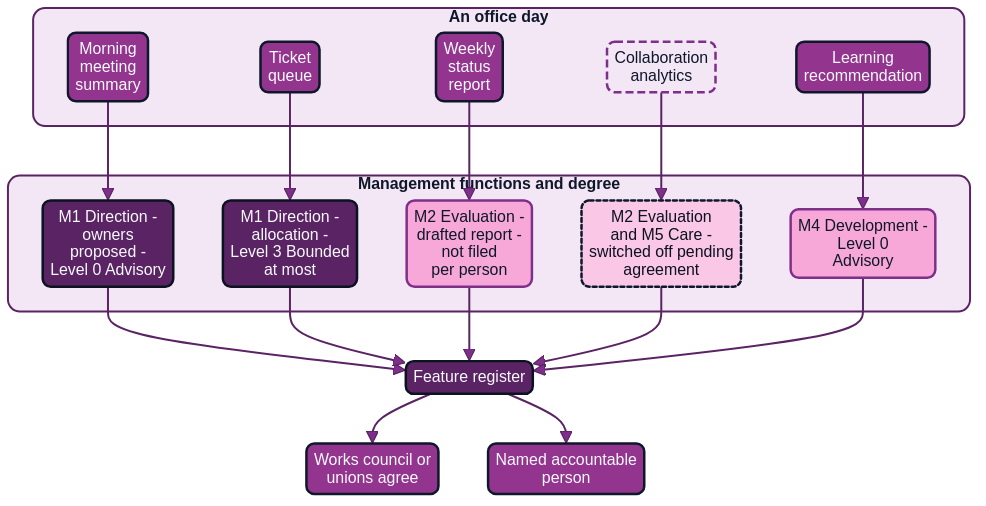
Figure 10.1: An office day seen through its features: what each one assigns, summarises or reports, the management function it performs, its degree of delegation and the feature register that records it.
The assistant that assigns
A meeting ends, and within a minute every participant has a summary drafted from the transcript: the decisions, the open questions and action items, each with an owner and often a due date. This is the most common way the AI boss enters knowledge work, and it is easy to underestimate, because the owner field looks like a record of what people agreed.
The owner field is the point at which a summary becomes an instruction. A human minute-taker who writes "Anna to revise the budget by Friday" records an agreement, and if Anna did not agree, the minute-taker hears about it before the minutes go out. An assistant infers the owner from the transcript. Its proposal may be right, may attach the task to the person who raised the problem rather than the one who accepted it, or may give a task to someone who left the call early. When the summary is sent to all participants, posted to the team channel and turned into tasks in each person's list, the proposal has been executed. In the terms of this book, the assistant performed M1 Direction: it assigned work to a named person and set a date.
Whether that is acceptable depends on the degree of delegation, not on the feature. At Level 0 Advisory the assistant proposes owners and the meeting chair confirms or changes them before anything is distributed; the chair assigns. At Level 1 Assisted the assistant distributes the summary but each owner must accept the task before it appears in the task list. At Level 2 Supervised the summary and tasks go out automatically and the chair can correct them afterwards. The difference is small in the user interface and large in its effect on who is directing whose work. Architecture as Code (Chapter 20) reached the rule that applies here, "agents draft; humans approve", with the named human approval in the audit trail (40, Nordqvist, 2025). For meeting actions the human approval is the chair's, and the default of most products, distribution without that approval, has to be changed deliberately.
The feature also performs M2 Evaluation without saying so. A summary records who spoke, who committed to what and, over weeks, who delivered. Status reports drafted from task lists and chat history tell a line manager which items are late and whose they are. None of this was designed as a performance rating. It becomes an input to evaluation when a manager reads it before a review conversation, and from that moment its errors are errors in the evidence about a person.
Workflow agents
The second route is allocation. Service desks and back offices have long distributed work by queue or skill-based routing. Agentic work tools and autonomous production agents change that routing in two ways: they read the content of the item to classify it and match it to a handler, and they act, so that the ticket appears in a person's list with a priority and a target time without a dispatcher in between.
The usage mode matters here, because it sets whose identity the agent acts with. AI Red Team, Chapter 6, concluded that in Modes 1 to 3 AI acts with a person's identity, while a Mode 5 agent acts with an identity and permissions of its own (43, Nordqvist, 2026). A Mode 3 Agentic work tools deployment that a team lead runs to triage the morning's tickets acts as the team lead: the allocation is the team lead's, made with a tool, and the team lead answers for it. A Mode 5 Autonomous production agents deployment that sits on the ticketing system and allocates every incoming ticket around the clock acts in its own name, within rules someone wrote. The allocation is then a delegated decision, and a handler must be able to find who delegated it, under which rules and at which degree.
Chapter 9 showed, with Hansa Mutual's claims-triage agent, that an allocation, though reversible item by item, shapes earnings, workload and health when it accumulates. In knowledge work allocation also decides who gets the interesting cases, and the interesting cases are how people learn. A workflow agent that sends every complex request to the fastest experienced handler maximises throughput this quarter and starves the juniors of the work from which they would become experienced. That is M4 Development performed by an allocation rule, and it connects to the conclusion of AI Threat, Chapters 6 and 14, that automating junior work removes the route by which experts are made (44, Nordqvist, 2026). A delegation profile for a workflow agent therefore needs a development rule as well as a throughput rule, and Chapter 19 returns to the question of who becomes a manager when the junior work disappears.
Analytics about people
The third route is reporting. Office suites collect telemetry as a by-product of operating, and analytics features turn it into figures: hours in meetings, after-hours messaging, the size of a person's collaboration network, focus time, response latency. Vendors present most of these as wellbeing and collaboration measures, offered to the individual as private nudges and to leaders as aggregated patterns.
The history of one such feature shows where the line runs. In 2020 Microsoft's Productivity Score, which measured organisational adoption of its office suite, offered a preview view that showed activity by named user over 28 days. After public criticism, Microsoft's corporate vice-president Jared Spataro announced that the company was removing user names from the product, that the communications, meetings, content-collaboration, teamwork and mobility measures would aggregate data only at the organisation level, and that the change would ensure that Productivity Score could not be used to monitor individual employees (189, Spataro, 2020). He added that the score was never designed to score individual users. The episode shows that the same telemetry can be presented as adoption analytics or as individual activity figures, and that the difference lies in aggregation and access, which are configuration choices.
An aggregated figure for a department's meeting load informs organisational design and is a legitimate input to a manager's own M5 Care for the team's workload. An individual figure for a named person's focus time, response latency or after-hours activity is a measurement of that person's behaviour at work. Shown to the person alone it can be useful; shown to the person's manager it becomes an input to M2 Evaluation, whatever the vendor calls it. The European Union's AI Act lists AI systems intended to monitor and evaluate the performance and behaviour of persons in work-related relationships among the high-risk systems of Annex III, point 4(b), alongside systems that allocate tasks based on individual behaviour or personal traits (1, European Union, 2024). Many analytics features compute counts rather than infer traits and may fall outside the AI Act's definition of an AI system altogether. The deployer still has to make that determination for each feature and record it, because the same pane can include a model that classifies collaboration patterns or predicts burnout risk, and that model would be within scope.
The agent boss vision
Microsoft's 2025 Work Trend Index, based on a survey of about 31,000 knowledge workers in 31 markets, announced the birth of the "Frontier Firm", an organisation structured around on-demand intelligence and powered by hybrid teams of humans and agents (151, Microsoft, 2025). It described three phases, from AI as an assistant, through agents as digital colleagues taking on tasks at human direction, to humans setting direction for agents that run entire business processes, and proposed a new measure, the human-agent ratio. It introduced the "agent boss", someone who builds, delegates to and manages agents to amplify their impact, suggesting that every worker will need to think like the chief executive of an agent-powered start-up and that, in Frontier Firms, even entry-level employees are managers from their first day. Among the survey's figures, 82 per cent of leaders said they were confident they would use digital labour to expand workforce capacity in the next 12 to 18 months.
Three things deserve to be kept apart: what the report measured, respondents' expectations and plans in a survey commissioned by a vendor of the products in question; what is observable, that agents are being deployed; and what it proposed, a future in which people direct agents. In this book's terms, the claim that every employee becomes an "agent boss" is speculation until it is measured in the work of real teams over time, and this chapter treats it as such. The book uses the phrase only in quotation marks and only when discussing Microsoft's usage.
The vision reverses the direction of this book's question. The "agent boss" is a person who manages agents; the AI boss is a system that manages people. In the office both happen at once. Whether people managing agents is the same activity as agents managing people is the question Part IV answers, beginning with Chapter 16, and the answer depends on the record of who directed whom.
One documented experiment shows how far an agent in a management role stood from the vision in 2025. In Project Vend, Anthropic and Andon Labs let an instance of Claude Sonnet 3.7 run a small automated shop in Anthropic's office for about a month (185, Anthropic, 2025). It sold items below cost, was persuaded through chat messages to hand out numerous discount codes and told customers to pay into an account it had invented. The authors concluded that they would not hire it to run the shop, while arguing that better scaffolding could fix many failures and that AI middle managers were plausibly on the horizon. The experiment shows that the gap between running a task and running a business unit was, in that set-up, large.
What was measured
The productivity evidence on generative AI at work is better than for most management technologies, and it concerns something narrower than management. Each study should be read for what was measured, in whom and over what period.
Brynjolfsson, Li and Raymond studied the staggered introduction of a generative AI assistant that suggested replies to 5,172 customer-support agents (23, Brynjolfsson et al., 2025). The working-paper version reported that access to the assistant raised productivity, measured as issues resolved per hour, by 14 per cent on average (15 per cent in the published version) and by 34 per cent for novice and low-skilled workers, with minimal effect on the most experienced. The published version reports that less experienced and lower-skilled workers improved both the speed and the quality of their output, while the most experienced and highest-skilled saw small gains in speed and small declines in quality. Three findings bear directly on management. Customer sentiment, measured from the text of customer messages, improved. Requests for a manager's intervention, the escalations that customers make when they ask for someone more senior, fell. And retention improved, especially among newer agents. The assistant supported the worker, did not allocate or evaluate work, and reduced the load on the human manager.
Dell'Acqua and colleagues ran a preregistered experiment with 758 consultants at Boston Consulting Group (22, Dell'Acqua et al., 2023). On 18 realistic consulting tasks inside what they called the jagged technological frontier, consultants with access to GPT-4 completed 12.2 per cent more tasks, finished them 25.1 per cent faster and produced results rated more than 40 per cent higher in quality than the control group. On a task designed to fall outside the frontier, consultants with AI were 19 percentage points less likely to reach a correct solution. The frontier is jagged because tasks of similar apparent difficulty fall on different sides of it, and workers could not easily tell which side they were on.
Noy and Zhang gave 453 college-educated professionals occupation-specific writing tasks and randomly gave half of them access to ChatGPT (180, Noy & Zhang, 2023). Time taken fell by 40 per cent and output quality, as graded by evaluators in the same occupations, rose by 18 per cent, and the gap between weaker and stronger writers narrowed. The tasks were short and self-contained, which is why the effect is large and why it does not transfer directly to the long, interdependent work of most offices.
Humlum and Vestergaard linked two large adoption surveys covering about 25,000 workers in 7,000 workplaces in eleven occupations exposed to AI chatbots to Danish employer-employee registers (184, Humlum & Vestergaard, 2025). Using differences between employers' policies as quasi-experimental variation, they estimated precise zeros: no significant effect of chatbot adoption on earnings or recorded hours in any occupation, with average time savings of about 3 per cent reported by users, and weak pass-through of those savings to pay.
Usage data from AI providers complete the picture of what people do with the tools. Handa and colleagues mapped over four million conversations with Anthropic's Claude to the tasks of the United States occupational database O*NET, and found usage concentrated in software development and writing, about 36 per cent of occupations using AI for at least a quarter of their tasks, and 57 per cent of usage suggesting augmentation, such as learning or iterating on an output, against 43 per cent suggesting automation (182, Handa et al., 2025). The authors note that the data come from a single platform.
Read together, these studies support three conclusions for this chapter. First, controlled studies of AI assistance to individual workers show gains in speed and, on suitable tasks, quality, with the largest gains for less experienced workers. That is observable. Second, those gains have not yet shown up as large effects on earnings or hours in the one population-scale study, so the step from task productivity to labour-market change is not established. Third, none of these studies measured AI performing management functions. The customer-support assistant reduced the need for managers to intervene; it did not direct or evaluate the agents. The evidence base for AI that assigns, summarises and reports about people is thin, and Chapter 15 takes up what would count as evidence over years. A survey by Lee and colleagues adds a caution for every summary a manager reads instead of the source: workers who trusted the AI tool more reported applying less critical thinking to its output (29, Lee et al., 2025). The pattern matches the conclusion of AI Threat, Chapters 6 and 14, that relying on AI reduces effort and, among those who trust the tool, checking (44, Nordqvist, 2026).
The transparency paradox
Analytics about people rest on a premise: that more visibility of work yields better management of it. A field study from manufacturing complicates the premise. Ethan Bernstein embedded researchers on the production lines of the world's second-largest mobile-telephone factory, in China and found that workers who were constantly observable hid many of their improvements: the better ways of doing the job that they had worked out among themselves, which deviated from the prescribed method and would have had to be justified if seen (122, Bernstein, 2012). They performed the prescribed method when watched and the better method when not. In a follow-up field experiment, giving production lines a modest increase in group-level privacy, shielding them from routine observation by supervisors, significantly and sustainably improved line performance. Bernstein called this the transparency paradox: maintaining observability can reduce performance by prompting workers to conceal what they do, so that the organisation sees an illusion of transparency rather than the work itself.
The study was of factory work, and its effect sizes should not be transferred to an office. Its mechanism transfers more readily. Knowledge workers who know that their focus time and response latency are visible to their manager have reasons to optimise those figures: to schedule visible meetings, to answer quickly rather than well. The analytics then measure a performance of work arranged for the analytics.
Two consequences follow. Aggregation is a measure for organisational learning as well as for privacy: figures reported at team level, to the team, preserve the space in which people try better ways of working, while individual figures sent upwards close it. And the zone of privacy should be decided and recorded, not left to the product's default. Chapter 13 stages the full debate on surveillance at work; this chapter takes from Bernstein only the rule that the unit of reporting is chosen for learning as well as for control.
When an assistant becomes a boss
Each feature in this chapter began as help for the person using it. Four tests show when it becomes a manager of others, and an organisation can apply them feature by feature.
The first test is the addressee. An assistant that drafts for its user and shows the draft only to that user is assisting. When its output names another person and reaches that person, as an owner in distributed minutes, a ticket in a list or a figure in a manager's dashboard, it is acting on someone other than its user.
The second test is the default. When the person named can decline, and declining is as easy as accepting, the output is a proposal. When the output takes effect unless someone intervenes, and intervention takes effort or courage, the output is an instruction. Most meeting assistants and workflow agents are configured so that their output takes effect.
The third test is the trace. When the output is stored where it can later inform a review, a promotion case or a performance conversation, the feature performs M2 Evaluation, whatever its purpose. A summary read once and discarded does not; a status report filed per person does.
The fourth test is the decision. When nobody decided that the feature should perform a management function, at a stated degree, with a named person accountable, the organisation has an AI boss it did not choose. AI Red Team, Chapters 8 and 28, found the same pattern in security tooling and called Mode 0 Ambient AI the blind spot: vendor AI that acts at an effective autonomy nobody decided (43, Nordqvist, 2026). Office suites ship new features through the vendor's update channel, often enabled by default, so the blind spot opens again with each release.
A feature that passes the first three tests and fails the fourth is the office's AI boss. The remedy is not to forbid the feature but to decide it: to place it on a management function, set its degree of delegation, name the person who answers for its outputs and agree it with the workers' representatives where the law requires.
Technical equipment suited to monitor
German law has asked a version of this question for half a century. Under the Works Constitution Act, BetrVG §87(1) no. 6, the works council has a right of co-determination over the introduction and use of technical equipment designed to monitor the behaviour or performance of employees (9, Germany, 2001). The Federal Labour Court has long read "designed to monitor" (zur Überwachung bestimmt) objectively: what matters is whether the equipment is suited to monitoring, not whether the employer intends to monitor. In its 2016 decision on a blood-donation service's Facebook page, the court held that the works council must co-determine where the employer's page allows visitors to post comments about the behaviour or performance of identifiable employees directly, because the technical equipment itself then collects and stores information about employees that the employer can evaluate (71, Bundesarbeitsgericht, 2016).
The implication for office features follows directly. A meeting assistant that records who committed to which action, a workflow agent that logs who handled which ticket and how fast, and an analytics feature that computes individual focus time are all technical equipment suited to monitor behaviour or performance, whatever the vendor's description. Their introduction and use, including a new feature enabled in an update, are subject to co-determination, and where the parties do not agree, the conciliation committee decides under BetrVG §87(2). The works agreement then states what the feature may record, who sees the result, at what aggregation and for which purposes it may not be used.
Two further provisions of the BetrVG, added by the Works Council Modernisation Act of 2021, address AI directly. Under §90(1) no. 3 the employer must inform the works council in good time about planned work processes and procedures, including the use of artificial intelligence, and consult it; and under §80(3) the works council's need for an expert, where it has to assess the introduction or use of artificial intelligence, is deemed to be given, so that the employer cannot dispute the necessity case by case (9, Germany, 2001). The costs and the choice of expert still need agreement with the employer.
The European instruments point the same way, with less specificity. The GDPR allows member states, by law or by collective agreement, to provide more specific rules for processing employees' personal data, including suitable and specific measures to safeguard the dignity, legitimate interests and fundamental rights of the person, with particular regard to the transparency of processing and to monitoring systems at the workplace, under Article 88 (5, European Union, 2016). Works agreements are such collective agreements. The AI Act requires deployers who are employers, before putting into service or using a high-risk AI system at the workplace, to inform workers' representatives and the affected workers that they will be subject to its use, under Article 26(7) (1, European Union, 2024). Following the Digital Omnibus on AI, Regulation (EU) 2026/1744, the high-risk obligations for systems listed in Annex III apply from 2 December 2027 (2, European Union, 2026); the date is decided law, and the obligations from it are expected. Article 26(7) is an information duty, not a co-determination right, and covers only high-risk systems. In Nordic member states the same ground is covered by the duty to negotiate before an important change in the activity or in conditions of employment, under co-determination acts on the pattern of the Swedish MBL; Chapter 23 compares the models.
For organisational design these provisions add up to a simple rule, stated here as an organisational implication, not legal advice: an office feature that can record or report the behaviour or performance of identifiable people is introduced through the representatives' process, not through the vendor's update channel.
Deciding about office features
An organisation that wants to know where its AI boss sits in the office needs a list of features, not of products. One office suite may contain a dozen features that perform management functions, each with its own default, data and audience. The list is a feature register: an extension of the delegation register of management functions that Chapter 25 defines in full, which itself extends the delegation register of AI Threat, Chapter 26 (44, Nordqvist, 2026). Each entry records what the feature does to whom, which management function it performs, its usage mode, its degree of delegation, who answers for its output, which representatives agreed it and in which jurisdictions it is enabled. AI Governance, Chapter 2, concluded that the usage mode, not the brand, sets the governance (41, Nordqvist, 2026); the feature register applies that conclusion one level down, to the feature.
Practical guide: Building a feature register for office assistants and analytics
Purpose. Establish which features of the office suite, the collaboration tools and the workflow agents assign, summarise or report about people; set their degree of delegation; and record whose agreement they carry before they are relied on.
Roles. The HR director or chief HR officer owns the register; the IT product owner for the office suite supplies the feature inventory; the data protection officer assesses each feature that processes personal data about identifiable workers; the works council or union representatives agree the entries that law or collective agreement makes subject to co-determination or negotiation; line managers name the accountable person in their team; and the workers affected are informed through the worker information notice of Chapter 28.
Steps.
- List every feature, not every product. Include the vendor's preview and default-on features, and subscribe to the vendor's release notes so that new features reach the list before they reach users. Default: review the list every vendor release cycle and at least quarterly.
- Apply the four tests of the previous section to each feature: addressee, default, trace and decision. A feature that names or measures another person passes the first test and enters the register.
- Place each entry on one or more management functions, M1 Direction to M5 Care, and record the usage mode by its exact name.
- Set the degree of delegation per function. Defaults: owners of meeting actions at Level 0 Advisory, the chair confirming before distribution; workflow allocation at Level 2 Supervised until a delegation profile with a development rule and reassignment rights justifies Level 3 Bounded; any feature that reports individual figures to anyone other than the person concerned switched off until agreed. No office feature performs M3 Consequence.
- Decide the unit of reporting. Default: figures about collaboration, focus or wellbeing are shown to the individual alone or aggregated to groups of at least ten people, and never ranked by person.
- Record the purposes for which the output may not be used. Default: no meeting summary, status report or analytics figure is used as evidence in a performance review, disciplinary process or selection decision unless the person concerned has seen and been able to correct it.
- Take each entry through the representatives' process that applies in each jurisdiction, and record the agreement or the pending status per entity. Keep features switched off where agreement is pending.
- Name the accountable person for each entry and the review date, and publish the register to the workers it concerns.
Definition of done. Every enabled feature that names or measures a person has an entry with function, mode, degree, unit of reporting, prohibited uses, accountable person and agreement status; no feature with a pending agreement is enabled in that jurisdiction; the register is published to staff; and a sample of outputs has been checked against the recorded degree at least once.
The register is a file in version control, reviewed like any other policy. The excerpt below shows the shape of two entries, one from each organisation.
# Illustrative: management/office-feature-register.yaml (excerpt)
register: office-feature-register
extends: management/delegation-register.yaml
version: "0.3"
entries:
  - id: FTR-NR-SA-01
    organisation: nordvik-region
    feature: meeting summary with proposed action owners
    systems: [internal-staff-assistant, embedded-assistant-pilot]
    usage_mode: [Mode 4 Built AI applications, Mode 2 Embedded workplace assistants]
    functions:
      M1_Direction: Level 0 Advisory   # the meeting chair assigns
      M2_Evaluation: not_delegated
    addressee: meeting participants after chair confirmation
    unit_of_reporting: meeting
    prohibited_uses: [performance_review_evidence_without_correction]
    accountable: meeting-chair
    delegation_profile: DLG-NR-SA-01
    agreement: {body: central-union-negotiation, status: agreed}
    review_due: "2027-05-31"
  - id: FTR-HM-CA-01
    organisation: hansa-mutual
    feature: wellbeing and collaboration analytics
    systems: [licensed-office-suite]
    usage_mode: Mode 0 Ambient AI
    functions:
      M2_Evaluation: switched_off
      M5_Care: switched_off
    unit_of_reporting: none_until_agreed
    prohibited_uses: [individual_figures_to_managers, ranking_by_person]
    accountable: chief-hr-officer
    decision_record: AIDR-0670
    agreement:
      DE: {body: Konzernbetriebsrat, basis: "BetrVG §87(1) no. 6", status: pending}
      NL: {body: ondernemingsraad, status: pending}
      SE: {body: unions, basis: MBL, status: pending}
    enabled_in: []
    review_due: "2027-06-30"
Worked example: Hansa Mutual keeps collaboration analytics switched off group-wide
Illustrative. Hansa Mutual licenses an office suite whose vendor offers a wellbeing and collaboration-analytics feature: personal insights for each employee, and leader views of meeting load, after-hours activity and collaboration networks for teams. The feature has been switched off since the suite was introduced, because group IT treated it as covered by the group works agreement on IT systems KBV-IT-2024 only for its technical operation, not for any reporting about people. When the vendor announced a release that would enable the personal insights by default, the chief HR officer asked the group AI governance board to decide the feature's status explicitly as part of the board's request for a group policy on AI in management (AIDR-0650). The board decided to keep the feature switched off in every entity, including those outside the European Union, until the Konzernbetriebsrat had agreed a works agreement and each other entity had completed its own consultation. Thomas Brandt, chair of the Konzernbetriebsrat, was informed before the decision and asked that any future proposal state the unit of reporting first.
# Illustrative: Hansa Mutual, decisions/AIDR-0670-collaboration-analytics-off.yaml
adr_id: AIDR-0670
title: Keep wellbeing and collaboration analytics switched off group-wide pending agreement
status: Accepted
date: "2026-12-07"
next_review_due: "2027-06-30"
proposed_by: chief-hr-officer
decided_by: group-ai-governance-board
related: [AIDR-0650, KBV-IT-2024, FTR-HM-CA-01]
feature: wellbeing and collaboration analytics in the licensed office suite
usage_mode: Mode 0 Ambient AI
management_functions_affected: [M2 Evaluation, M5 Care, M4 Development]
context:
  - vendor release enables personal insights by default
  - leader views can show meeting load and after-hours activity for small teams
  - telemetry identifies individual employees; suited to monitor behaviour and performance
decision:
  status_in_all_entities: switched_off
  includes_personal_insights: true
  tenant_setting_owner: group-it-office-suite-product-owner
  vendor_default_changes: blocked_until_register_entry_updated
conditions_for_reconsideration:
  - works_agreement_with_Konzernbetriebsrat_under_BetrVG_87_1_6
  - consultation_completed_per_entity: [NL, SE, NO, PL, UK, CH]
  - unit_of_reporting_defined_first: "individual only, or groups of at least 10"
  - no_individual_figures_to_line_managers
  - no_use_in_objectives_cycle_or_variable_pay
  - dpia_by_group_data_protection_officer
rejected_options:
  - option: enable personal insights only, leader views off
    reason: still a change in technical equipment suited to monitor; agreement needed first
  - option: enable outside Germany where no works council right applies
    reason: one group standard; entity consultation duties differ but none is skipped
informed: [Konzernbetriebsrat, european-works-council, entity-hr-leads]
evidence: evidence://office-suite/tenant-settings/analytics/
The contrast at Nordvik Region is a feature that is enabled, at the lowest degree. The internal staff assistant and the pilot of the embedded workplace assistant propose action lists with named owners at Level 0 Advisory: the chair of each meeting confirms or changes the owners before the summary is distributed. The delegation profile DLG-NR-SA-01 records that the assistants perform M1 Direction at Level 0 Advisory and no M2 Evaluation, and that summaries are not filed per person. Hansa's record keeps a feature off because nobody can yet say how its output will be used; Nordvik's profile keeps a feature on because the person who assigns is named and the output is not kept as evidence about anyone. Both are decisions; the risk lies in features about which no decision was made.
Across the usage modes
In knowledge work the AI boss arrives through several modes at once, and the mode sets whose identity the feature uses and who answers for its output.
| Usage mode | Typical office feature | Management function | Usual degree | Who answers |
|---|---|---|---|---|
| Mode 0 Ambient AI | Collaboration and wellbeing analytics, default-on suggestions in the suite | M2 Evaluation, M5 Care | Effective degree undecided until registered | Nobody, until the feature register names someone |
| Mode 1 Conversational assistants | A manager asks a chatbot to rank a team's contributions | M2 Evaluation | Level 0 Advisory in form, unrecorded in practice | The manager who used it |
| Mode 2 Embedded workplace assistants | Meeting summaries with owners, drafted status reports | M1 Direction, M2 Evaluation | Level 0 Advisory with chair confirmation; often Level 2 Supervised by default | The meeting chair or the user |
| Mode 3 Agentic work tools | A team lead's agent triages and assigns the day's tickets | M1 Direction | Level 1 Assisted to Level 2 Supervised, with the user's identity | The team lead whose identity it uses |
| Mode 4 Built AI applications | An in-house assistant that proposes owners or summarises cases | M1 Direction, M2 Evaluation | As the delegation profile sets | The system owner and the confirming person |
| Mode 5 Autonomous production agents | A workflow agent allocating every incoming case or ticket | M1 Direction, M4 Development | Level 3 Bounded at most, with reassignment rights | The person who delegated the allocation rules |
The table carries the outlook of the chapter. Assistants that assign action items, drafted status reports and office analytics are observable. Workflow agents that allocate knowledge work to people are observable in pilots and production deployments, including the claims-triage agent of Chapter 9, and expected to spread as agentic features are added to service-desk and case-management products. The claim that every employee becomes an "agent boss" is a vendor's projection and remains speculation until it is measured.
Nordvik Region and Hansa Mutual
At Nordvik Region the office AI boss is small and decided. The internal staff assistant, a Mode 4 Built AI applications system (AIDR-0211), and the controlled pilot of the embedded workplace assistant, Mode 2 Embedded workplace assistants, both summarise meetings and propose action lists with named owners at Level 0 Advisory; the meeting chair assigns. Ingrid Halvorsen, the HR director, asked whether anyone reads the proposed owners as instructions anyway, and under her commission AIDR-0600 her team sampled the summaries of 12 meetings in the pilot from December 2026: of 48 action items, 9 carried owners the chair had not confirmed in the meeting, because chairs sometimes distributed the summary without opening it, and 3 of the 9 people said they had treated the item as an instruction. The finding is recorded as AIDR-0620, which changes the pilot's configuration so that a summary with unconfirmed owners cannot be distributed, and adds the check to the review of DLG-NR-SA-01. The Region has no workflow agent allocating office work to people, and negotiated the assistants' use with the unions under its co-determination act.
At Hansa Mutual the office AI boss is larger and more varied. Embedded workplace assistants summarise meetings and draft task lists across the group; the claims-triage agent allocates claims to handlers at Level 3 Bounded; and the wellbeing and collaboration-analytics feature, Mode 0 Ambient AI, stays switched off under AIDR-0670. Hansa's difference is legal plurality: the same feature needs the Konzernbetriebsrat's agreement in Germany, the ondernemingsraad's consent in the Netherlands, union negotiation in Sweden and different processes in Norway, Poland, the United Kingdom and Switzerland. In January 2027 the agent-boss pilot HM-AB-PILOT-01 (AIDR-0652) begins in Jana Petersen's claims team in Hamburg and in an IT service-desk team, where people direct a small set of Mode 5 Autonomous production agents, in claims under mandate manifest MND-HM-CLM-01. Jana Petersen will then be directed by one agent, through allocation, and direct others, through her mandate. Whether those are the same activity is the question Part IV answers.
Summary
The AI manager enters the office as features. Meeting assistants that put names against action items, and workflow agents that place tickets in a person's list, perform M1 Direction; summaries, status reports and analytics become inputs to M2 Evaluation once they are read before a judgement about a person; and allocation rules shape M4 Development by deciding who gets the work from which people learn. Microsoft's claim that every employee becomes an "agent boss" is speculation until it is measured in real teams.
The evidence on generative AI at work is real and narrow: gains in speed and, on suitable tasks, quality, largest for less experienced workers, a jagged frontier beyond which AI made consultants less accurate, and no measurable effect on earnings or hours in Denmark so far. None of these studies measured AI performing management functions, and Bernstein's transparency paradox warns that individual figures can measure a performance arranged for the figures.
An assistant becomes a boss when its output names another person, takes effect by default, leaves a trace that can inform evaluation, and was never decided. German law treats such features as technical equipment suited to monitor under BetrVG §87(1) no. 6, and the AI Act adds Article 26(7) and Annex III, point 4(b). The practical answer is a feature register that places each feature on a management function, sets its degree and unit of reporting, names the person who answers for it and records the representatives' agreement before it is enabled. Hansa Mutual's AIDR-0670 keeps an analytics feature off until that agreement exists; Nordvik Region's assistants run at Level 0 Advisory with the chair as the person who assigns.
This chapter closes Part II's survey of where the AI boss is today. Part III asks what it does to people, beginning with Chapter 11, which stages the debate on autonomy, dignity and control when work is directed by a machine.
Sources
- Microsoft (2025). 2025: The Year the Frontier Firm Is Born. Work Trend Index Annual Report. (151, Microsoft, 2025)
- Spataro, J. (2020). Our commitment to privacy in Microsoft Productivity Score. Microsoft 365 Blog. (189, Spataro, 2020)
- Handa, K., Tamkin, A., McCain, M. et al. (2025). Which Economic Tasks are Performed with AI? Evidence from Millions of Claude Conversations. arXiv:2503.04761. (182, Handa et al., 2025)
- Brynjolfsson, E., Li, D. & Raymond, L. (2025). Generative AI at Work. The Quarterly Journal of Economics, 140(2). (23, Brynjolfsson et al., 2025)
- Dell'Acqua, F. et al. (2023). Navigating the Jagged Technological Frontier: Field Experimental Evidence of the Effects of AI on Knowledge Worker Productivity and Quality. Harvard Business School Working Paper 24-013. (22, Dell'Acqua et al., 2023)
- Noy, S. & Zhang, W. (2023). Experimental evidence on the productivity effects of generative artificial intelligence. Science, 381(6654). (180, Noy & Zhang, 2023)
- Humlum, A. & Vestergaard, E. (2025). Large Language Models, Small Labor Market Effects. NBER Working Paper 33777. (184, Humlum & Vestergaard, 2025)
- Lee, H.-P., Sarkar, A., Tankelevitch, L. et al. (2025). The Impact of Generative AI on Critical Thinking: Self-Reported Reductions in Cognitive Effort and Confidence Effects From a Survey of Knowledge Workers. CHI 2025. (29, Lee et al., 2025)
- Bernstein, E. S. (2012). The Transparency Paradox: A Role for Privacy in Organizational Learning and Operational Control. Administrative Science Quarterly, 57(2). (122, Bernstein, 2012)
- Anthropic (2025). Project Vend: Can Claude run a small shop? (And why does that matter?) Anthropic. (185, Anthropic, 2025)
- Federal Republic of Germany (2001). Betriebsverfassungsgesetz (BetrVG). Gesetze im Internet. (9, Germany, 2001)
- Bundesarbeitsgericht (2016). Beschluss vom 13. Dezember 2016, 1 ABR 7/15. Bundesarbeitsgericht. (71, Bundesarbeitsgericht, 2016)
- European Parliament and Council of the European Union (2016). Regulation (EU) 2016/679 (General Data Protection Regulation). Official Journal of the European Union. (5, European Union, 2016)
- European Parliament and Council of the European Union (2024). Regulation (EU) 2024/1689 (Artificial Intelligence Act). Official Journal of the European Union. (1, European Union, 2024)
- European Parliament and Council of the European Union (2026). Regulation (EU) 2026/1744 (Digital Omnibus on AI). Official Journal of the European Union. (2, European Union, 2026)
- Nordqvist, G. (2025). Architecture as Code. The Architecture as Code Series, Book 1. (40, Nordqvist, 2025)
- Nordqvist, G. (2026). AI Governance: Governing Artificial Intelligence in European Enterprises and Public Authorities. The Architecture as Code Series, Book 2. (41, Nordqvist, 2026)
- Nordqvist, G. (2026). AI Red Team: AI as an Active Part of Cyber Defence in European Enterprises and Public Authorities. The Architecture as Code Series, Book 4. (43, Nordqvist, 2026)
- Nordqvist, G. (2026). AI Threat: Are the Dystopias Coming True? Evidence, Risk and Response for European Enterprises and Public Authorities. The Architecture as Code Series, Book 5. (44, Nordqvist, 2026)