Platform Work: The Algorithm as Dispatcher
Nowhere is the AI boss older or better documented than on the digital labour platforms of ride-hailing and food delivery. Software assigns the next ride or order, sets the pay, collects a customer rating after every task, turns ratings and acceptance into a score that sets who gets the best shifts, and can switch off a person's access to work. Researchers have studied these systems for a decade, European courts and data protection authorities have tested them, and the European Union has written its first rules on algorithmic management for them. This chapter reads that record for what it teaches every employer, because shift-offer and allocation systems inside ordinary organisations increasingly work the same way. It concerns three management functions: M1 Direction, because the platform assigns, sequences and paces the work; M2 Evaluation, because customer ratings and platform metrics rate the person who does it; and M3 Consequence, because pay, priority and deactivation determine a person's income and access to work.
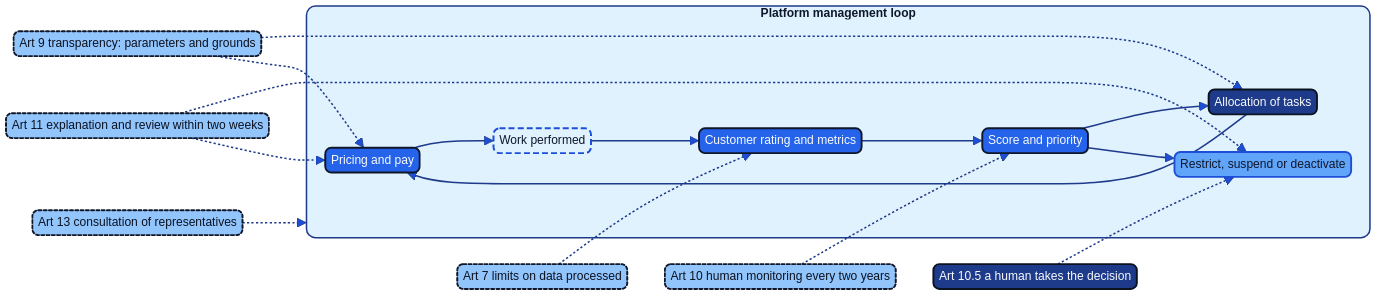
Figure 5.1: The platform management loop of allocation, pricing, rating and deactivation, with the points at which Directive (EU) 2024/2831 requires transparency, human monitoring and human review.
The algorithm as dispatcher
The term algorithmic management entered the literature through a study of ride-hailing. Lee, Kusbit, Metsky and Dabbish described how drivers for Uber and Lyft responded when algorithms assigned work, provided informational support and evaluated their performance, and how drivers used online forums to make sense of those features together (127, Lee et al., 2015). The three verbs in that description, assign, inform and evaluate, are still the right place to start, because each maps onto a management function. Assigning is M1 Direction. Evaluating is M2 Evaluation. And informing, which sounds neutral, turns out to be the channel through which direction is exercised without the appearance of an instruction.
Möhlmann and colleagues sharpened the distinction. A platform uses algorithms along two dimensions: matching, which pairs a task with a worker to clear a market, and control, which monitors and steers how the work is done. Their grounded study of Uber drivers, supplemented by interviews with Uber executives and engineers, found that drivers experience tensions over work execution, compensation and belonging under both, and respond with behaviour that is partly market-like and partly organisation-like (138, Möhlmann et al., 2021). The finding matters for this book because it dissolves a defence that platforms long relied on: that their software merely matches supply and demand. The same system that matches also controls.
The UK Supreme Court described that control concretely in 2021, in the judgment that held Uber's drivers to be workers for the purposes of employment legislation. Among the factors it weighed, Uber fixed the remuneration, dictated the contract terms, constrained the driver's choice to accept rides by monitoring the rate of acceptance and cancellation and logging drivers off the app for ten minutes when too many requests were declined, and used passenger ratings on a scale of one to five, with warnings and eventual termination for drivers whose average fell below a required level (69, UK Supreme Court, 2021). Each of those mechanisms is a management function performed in software: allocation and pacing (M1), rating (M2), and the removal of access to work (M3).
In the vocabulary of Chapter 4, a dispatch platform is a Mode 4 Built AI applications or Mode 5 Autonomous production agents system acting at Level 3 Bounded or Level 4 Autonomous for M1 Direction, using the autonomy levels of AI Red Team, Chapter 6 (43, Nordqvist, 2026), and the usage modes of AI Governance, Chapter 2 (41, Nordqvist, 2026). For dispatch itself, a high degree of delegation is not obviously wrong: a single ride is low-stakes and quickly superseded. The trouble lies elsewhere. The loop that assigns rides also accumulates the data that ranks, prices and finally removes people, at the same degree of delegation unless someone has decided otherwise.
What the research measured
The research on platform work is mostly qualitative: it documents mechanisms and experiences in particular populations, not effect sizes across a workforce. Its strength is that different teams on different platforms describe the same mechanisms.
Rosenblat and Stark conducted a nine-month empirical study of Uber drivers' experiences, drawing on drivers' online forums and interviews. They found that Uber, while presenting drivers as entrepreneurs whose work is characterised by freedom and flexibility, leverages significant indirect control over how they do their jobs, and that the information and power asymmetries produced by the application are fundamental to that control (130, Rosenblat & Stark, 2016). The platform sees every driver's location, acceptance, speed and ratings and the whole market; the driver sees one offer at a time and not the rules that rank them. Rosenblat later developed the account at book length (131, Rosenblat, 2018).
Wood, Graham, Lehdonvirta and Hjorth studied a different population: remote gig workers in Southeast Asia and Sub-Saharan Africa who deliver digital services through online labour platforms, through 107 semi-structured interviews in six countries and a survey of 679 workers. They found algorithmic control central to the operation of every platform they studied. The same mechanisms offered workers high levels of flexibility, autonomy, task variety and complexity, and also resulted in low pay, social isolation, unsocial and irregular hours, overwork, sleep deprivation and exhaustion (134, Wood et al., 2019). The study is not about ride-hailing and the outcomes are self-reported; its value is the pairing of freedom and control, produced by the same design.
Lee and colleagues added that drivers made sense of the algorithm collectively, in forums, because the platform did not explain it (127, Lee et al., 2015). Taken together, the studies describe management that directs by nudge and incentive, evaluates continuously, keeps its rules from the people they govern, and leaves the worker formally free and practically steered. For an employer, the operational point is that soft control is still control: an offer ranked, timed and priced to be accepted is a management instruction in another form and belongs in the same governance.
Pay set by software
Pay is M3 Consequence in this book's terms, and on platforms it is set dynamically: fares and pay vary with demand, time, location and bonuses for completing a number of tasks in a period. Dubal, drawing on a multi-year ethnographic study of on-demand ride-hail drivers in California before and after Proposition 22, named the practice algorithmic wage discrimination: the use of granular data on location, individual behaviour, demand and supply to produce variable, personalised and unpredictable hourly pay for broadly similar work. She stresses that it encompasses not only the payment for completed work but the algorithmic allocation of work, which is itself a major determinant of hourly earnings and a lever of control, and she argues that it runs against longstanding norms of fairness in wage setting and the spirit of equal pay for equal work (144, Dubal, 2023).
The argument deserves to be stated at its strongest, and so does the evidence that complicates it. Dubal's work documents how drivers experience pay they cannot predict or explain, and it identifies a structural possibility: a system that knows how much each person is willing to accept can offer each person less. It does not, and does not claim to, measure how far platforms actually personalise pay to individual reservation wages. Cook, Diamond, Hall, List and Oyer, using data on more than a million Uber drivers in the United States, found a gender earnings gap of roughly 7 per cent and attributed it entirely to three factors: experience on the platform, preferences and constraints over where to work, and driving speed. They found no evidence that customer discrimination or a taste for specific hours explained the gap (139, Cook et al., 2021). The study shows that a pay algorithm with no gender variable can still produce a gender gap through the behaviour it rewards; it does not show that personalised pay never occurs.
Both positions depend on one fact: neither the driver nor, usually, the researcher can see the parameters that set the pay. The remedy both sides can support is transparency of parameters, what inputs set pay, with what weight and how a person's own behaviour affects it, which is what Directive (EU) 2024/2831, the Platform Work Directive, now requires.
Ratings as evaluation
Customer ratings are M2 Evaluation outsourced to people who carry no responsibility for it. A passenger who gives four stars instead of five does not know that the average may determine whether the driver keeps working, and has no duty to be fair or free of bias. The platform sets the threshold and acts on it.
The Italian data protection authority, the Garante per la protezione dei dati personali, recorded how one delivery platform turned such feedback into a score. Foodinho, the Italian subsidiary of the Glovo group, stated during the inspection that its excellence score started from a default value for every new rider and was then adjusted on the basis of customer feedback (15 per cent), feedback from merchants (5 per cent), work in high-demand hours (35 per cent), orders delivered (10 per cent) and platform productivity (35 per cent). Riders with higher scores got priority in choosing delivery slots when more riders had signed up than were needed (194, Garante, 2021). The Spanish Supreme Court described a comparable system at Glovo in Spain: riders were ranked on customer ratings, efficiency on recent orders and work in the hours of highest demand, on a scale up to five points, with a deduction of 0.3 points each time a rider was not available in a slot they had booked unless they justified the absence, and riders with better scores had preferential access to incoming orders (70, Tribunal Supremo & Sala de lo Social, 2020).
Two features recur. Ratings and behavioural metrics are blended into one number, so a rider cannot tell whether a lower score came from a customer, a slow restaurant or a declined order. And the score feeds back into M1 Direction: it sets who chooses first, and so who earns most. An evaluation whose inputs the evaluated person cannot see cannot be corrected when it is wrong.
Deactivation
Deactivation is where platform management reaches M3 Consequence most visibly. A deactivated account means no work and no income, immediately, and for a person who is not an employee there may be no dismissal procedure and no one to ask. The cases that tested it show what happens when a consequence decision is delegated at the same degree as the dispatch that feeds it.
The leading judgment is that of the Amsterdam Court of Appeal of 4 April 2023 in a case brought by four drivers, supported by the App Drivers & Couriers Union and Worker Info Exchange, whose Uber accounts had been deactivated for alleged fraudulent activity (67, Gerechtshof Amsterdam, 2023). Uber's account of its process, as summarised in commentary on the judgment, was that software applying dozens of rules detected possible fraud as a first step, and two members of an operational risk team took the final decision under internal protocols requiring them to consider other facts. The court held that for three of the four drivers the decision to deactivate and terminate the agreement was based solely on automated processing, including profiling, contrary to Article 22 of the General Data Protection Regulation (Regulation (EU) 2016/679, the GDPR) (5, European Union, 2016). Uber had not shown how the human factor influenced the decision, the court found no evidence that the drivers had been contacted or given a chance to state their view, and, as reported, it found the limited human involvement to be not much more than a symbolic act. For the fourth driver, with whom Uber had held a personal interview before deactivation, the court accepted that there had been real human intervention. In a parallel judgment against Ola, the same court ordered disclosure of meaningful information about automated decisions, including drivers' earnings profiles and fraud probability scores (68, Gerechtshof Amsterdam, 2023).
The difference between the drivers is the most practical lesson of the platform cases. The organisation chart showed humans in the loop for all four; what distinguished the decision the court accepted was evidence of what the human did. This is the conclusion that AI Governance reached as F21: human oversight must be designed, not declared, with an interruption path, an override log and the authority to use them, and approvals given in seconds are a signal of rubber-stamping (41, Nordqvist, 2026). The Amsterdam court applied the same test from the outside.
The matter did not end there. On 21 August 2026 the Dutch data protection authority, the Autoriteit Persoonsgegevens, announced that it had fined Uber €824,990,000 because, between 2018 and 2022, drivers' accounts were deactivated automatically, temporarily on a suspicion of fraud or too low customer ratings and permanently on persistently low ratings, with no human assessment; the authority found that Uber had breached the GDPR's prohibition of solely automated decision-making and had not informed drivers sufficiently about it (211, Autoriteit Persoonsgegevens, 2026). Uber has appealed against the fine, so the decision is observable but not final. Its significance is that the question of whether a deactivation had a real human decider has moved from individual litigation to supervisory enforcement.
Courts and authorities
Italy: the Bologna order and the Garante
On 31 December 2020 the labour section of the Tribunal of Bologna, in a claim brought by unions against Deliveroo Italia, declared the platform's self-service booking system for work sessions potentially discriminatory. Riders' access to booking windows depended on statistics of reliability and participation, and late cancellation or failure to log in to a booked session lowered the rider's standing whatever the reason. The unions argued, and the court accepted, that the system's blindness to the reason for absence, whether a strike, illness or the care of a child, placed riders exercising legitimate rights at a particular disadvantage, which the court framed as indirect discrimination under the Italian legislation implementing Directive 2000/78/EC (196, Purificato, 2021). The Garante's own inspection of Deliveroo described the same mechanism: the booking system ranked riders on their availability in peak hours and the reliability of that availability, measured as actual participation in booked sessions or cancellation before the start (195, Garante, 2021).
The Garante then fined both major delivery platforms. On 10 June 2021 it fined Foodinho €2,600,000 in respect of the data of 18,684 riders. Among many findings, it held that the company had violated GDPR Article 22(3): although the automated decisions about riders could rest on the necessity of the contract, the company had not implemented measures giving riders at least the right to obtain human intervention, to express their point of view and to contest the decision, and riders were not aware that they could (194, Garante, 2021). It ordered the company to verify periodically the accuracy of its algorithmic systems, including scoring and order allocation, to minimise the risk of discriminatory effects. The decision also recorded the Italian rule, in Article 47-quinquies of Legislative Decree 81/2015, that excluding riders from the platform or reducing their work opportunities because they did not accept work is prohibited. On 22 July 2021 the Garante fined Deliveroo Italy €2,500,000 in respect of about 8,000 riders, finding automated processing including profiling, both in the evaluation of reliability and availability that gave priority in booking sessions until 2 November 2020 and in the allocation of orders within booked sessions through an algorithmic system called Frank, again in violation of Article 22(3) (195, Garante, 2021).
The Italian decisions treat the score and the allocation, not only the deactivation, as automated decisions that need safeguards, and require the platform to test its own algorithms: the move from review of single decisions to oversight of the system, which the Platform Work Directive later made general.
Employment status
This chapter does not settle whether platform workers are employees; what matters is how the courts reasoned. The UK Supreme Court found Uber's drivers to be workers largely because of the controls described above, the acceptance-rate penalties and the rating thresholds among them (69, UK Supreme Court, 2021). The Spanish Supreme Court, in its plenary judgment of 25 September 2020 on a Glovo rider, held that the relationship was one of employment. It reasoned that Glovo did not merely hand the rider a task but set how it was to be done and at what price, and had established means of control operating on the activity itself, not only on the result, through the algorithmic management of the service, the ratings of riders and constant geolocation (70, Tribunal Supremo & Sala de lo Social, 2020).
The courts read algorithmic management as evidence of an employer: the functions an algorithm performs are management functions in law as well as in practice, and bring the employer's duties with them.
The Rider law and the Platform Work Directive
Spain legislated first. Law 12/2021 of 28 September, the "Rider law", did two things (77, Jefatura del Estado, 2021). It added to the Workers' Statute a presumption that the paid delivery of goods for employers that exercise their powers of organisation, direction and control directly, indirectly or implicitly through the algorithmic management of the service or of working conditions, by means of a digital platform, falls within the scope of employment law. And it added a new letter (d) to Article 64.4 of the Workers' Statute, giving the works council the right to be informed by the company of the parameters, rules and instructions on which algorithms or AI systems are based that affect decisions which may bear on working conditions and on access to and retention of employment, including profiling. The second provision is easily missed: it applies to every employer in Spain with a works council, not only to platforms.
The European Union followed with Directive (EU) 2024/2831 on improving working conditions in platform work, the Platform Work Directive (47, European Union, 2024). Article 5 establishes a rebuttable legal presumption of an employment relationship where facts indicating direction and control are found, with the burden on the platform to rebut it. Chapter III, Articles 7 to 15, regulates algorithmic management, and it maps closely onto the platform loop of Figure 5.1. Chapter 22 treats its interaction with the GDPR in detail; the summary here is what an employer needs to benchmark against.
- Limits on processing (Article 7). No processing of data on emotional or psychological state, private conversations, activity outside platform work, the exercise of fundamental rights such as freedom of association, or protected characteristics, and no biometric identification against a database.
- Impact assessment (Article 8). A data protection impact assessment under GDPR Article 35, with the views of the people concerned and their representatives.
- Transparency (Article 9). The platform must inform people performing platform work, their representatives and, on request, the competent authorities of the systems in use, the categories of decision they take or support, the categories of data and the main parameters and their relative importance, including how the person's own data or behaviour influences decisions, and the grounds for decisions to restrict, suspend or terminate an account or to refuse payment. It is due on the first working day, before changes and on request; Article 9(6) adds portability of ratings and reviews.
- Human oversight (Article 10). The platform must oversee the systems and, with the involvement of workers' representatives, evaluate the impact of individual decisions regularly and at least every two years, with sufficient staff who have the competence, training and authority to override automated decisions and who are protected from adverse treatment for doing so. Article 10(5) states that any decision to restrict, suspend or terminate the contractual relationship or account, or any decision of equivalent detriment, shall be taken by a human being.
- Human review (Article 11). People have the right to an explanation of any decision taken or supported by an automated system, without undue delay, and to a designated contact person with the competence and authority to discuss it. Decisions to restrict, suspend or terminate an account, to refuse payment or on contractual status require a written statement of reasons at the latest on the day they take effect. A request for review must be answered in writing within two weeks, and a decision that infringed the person's rights must be rectified within two weeks or compensated.
- Safety and health (Article 12). Platforms must assess the risks of their systems to platform workers' safety and health, including psychosocial and ergonomic risks, and must not use them in a way that puts undue pressure on workers or puts their physical or mental health at risk.
- Information and consultation (Articles 13 to 15). Representatives are consulted on introducing or substantially changing these systems and may be assisted by an expert.
Member states must transpose the Directive by 2 December 2026 (Article 29). As this chapter is written, that deadline is weeks away; how each member state transposes it, and how the presumption and the human-decision rule work in practice, are expected rather than observable. The Commission must review the Directive by 2 December 2029 (Article 30).
The AI Act, Regulation (EU) 2024/1689, frames the same systems from the side of AI. Annex III, point 4(b), lists systems intended to make decisions affecting terms of work-related relationships, promotion or termination, to allocate tasks based on individual behaviour or personal traits, or to monitor and evaluate performance and behaviour (1, European Union, 2024). The Digital Omnibus, Regulation (EU) 2026/1744, set the date from which the high-risk requirements apply to Annex III systems at 2 December 2027 (2, European Union, 2026). Deployers who are employers must inform workers' representatives and affected workers before putting such a system into service (Article 26(7)), and affected persons have a right to an explanation of the role of the system in a decision (Article 86). Chapter 21 treats these provisions. An allocation system that uses a person's acceptance history, speed or reliability to rank who is offered what is allocating on individual behaviour.
Lessons beyond the platform
Most employers do not run a platform, but many run systems that work the same way. A hospital's open-shift module that sends vacant shifts to staff who opted in and gives each to whoever accepts first is a dispatcher. A claims system that allocates the next case to the handler with capacity is a dispatcher. A field-service planner that routes engineers and records their completion times is a dispatcher with a rating attached. Chapter 9 examines scheduling and allocation at length; here the point is narrower: the platform cases show where such systems go wrong.
First, an allocation system records behaviour it does not need: who accepted, how quickly, who declined. Second, the record becomes an input: someone switches on a feature that offers shifts first to people who usually accept, or a supplier ships one as a default. Acceptance history has become a hidden rating, M2 Evaluation that no one designed, and the system now allocates tasks based on individual behaviour. Third, the rating reaches M3 Consequence: fewer offers mean fewer hours and less pay, and a person who stops receiving offers has in effect been deactivated without any decision anyone can point to. The Bologna case is the warning for the second step: a reliability measure that cannot see why someone declined penalises illness, care and collective action alike.
AI Red Team recorded as F57 that Mode 0 is the blind spot: vendor AI in licensed products may already act at an effective autonomy nobody decided, so its use and autonomy are established, recorded and required by contract before they are relied on (43, Nordqvist, 2026). Supplier features that weight allocation by reliability are that blind spot in people management. AI Threat recorded as F69 that small delegations add up to a sum visible only in a delegation register (44, Nordqvist, 2026); each step above is small, and the register is where the sum shows. For a public employer, AI Governance added F31: the line between decision support and automated decision is drawn in the data model and the audit log (41, Nordqvist, 2026). Whether an acceptance rate is stored, and for how long, is that line.
The Platform Work Directive is therefore useful beyond its scope. It is the most detailed written standard for algorithmic management the European Union has adopted, and each article names a question an employer can ask of its own dispatcher, finding the gaps before a works council, a court or a supervisor does.
Practical guide: Testing an internal shift-offer or allocation system against the Platform Work Directive's algorithmic-management chapter
Purpose. Establish whether an internal system that offers, allocates or routes work behaves like a platform dispatcher, and close the gaps against the standards of Chapter III of Directive (EU) 2024/2831, even though the Directive does not apply.
Roles. The HR owner of the system (accountable), line managers who use it, the supplier contact, the data protection officer, union, works council or safety representatives, and two or three workers who receive offers.
Steps.
- Map the loop. Draw the system's version of Figure 5.1: what it allocates, how it weights an offer, what it records and computes about each person, and what can follow for a person. Record the mode and degree of delegation per function in the delegation profile.
- Inventory the personal data. List every behavioural field (acceptances, declines, response times, cancellations, completion times), whether allocation needs it, who sees it and how long it is kept. Remove anything that infers health, emotion or union activity (Article 7).
- Find the hidden ratings. Ask the supplier in writing whether any configuration, default or planned feature uses a person's past behaviour to order, filter or time offers. Treat a yes, or a non-answer, as allocation based on individual behaviour under AI Act Annex III, point 4(b), until shown otherwise.
- Write the parameters (Article 9). State the main parameters of allocation and their relative importance in language a worker understands; if they cannot be written down, record the gap.
- Name the human decider for every consequence. For any outcome that restricts a person's access to work or pay, name the role that decides and the record that shows the decision (Article 10(5)). No such outcome follows automatically from a threshold.
- Set the review path. Give each worker a named contact for questions about offers and allocation, and a default response time of two weeks for a written answer to a request for review (Article 11), shorter where the collective agreement or works agreement requires.
- Schedule the system evaluation. Agree with the representatives an evaluation of the system's effects on hours, earnings and equal treatment at least every two years (Article 10(1)), and annually while it is new.
- Assess the work-environment risk of offer timing and response windows with the safety representatives (Article 12).
- Record the result as a versioned assessment linked to the delegation profile and an AI Decision Record, and feed the worker-facing parts into the worker information notice of Chapter 28.
Definition of done. Every behavioural field has a stated purpose, owner and retention; the main parameters are written in plain language; no consequence follows from a threshold without a named human decider; the review path and the evaluation date are in the delegation profile; the representatives have seen the assessment and their comments are recorded.
Worked example: A Platform Work Directive benchmark of open-shift offers in Nordvik Region's ShiftWise (illustrative)
Nordvik Region's ShiftWise drafts rosters at Level 2 Supervised, but its one Level 3 Bounded class, offering open shifts to staff who opted in, behaves like platform dispatch. In the supplier's default the offer went to all eligible staff at once and the first to accept got the shift; at the negotiation of 20 January 2027 the union for municipal and care workers obtained a published rotating order instead, which moves one place with each offer and uses nothing about the person (Chapter 4). Ingrid Halvorsen, the HR director, asked under the commission AIDR-0600 whether acceptance rates are stored and used. The benchmark found that the supplier's log kept each person's offers, responses and response times for 24 months, and that a supplier feature ordering offers by past acceptance existed but was switched off. The Region recorded its decision as AIDR-0625.
assessment:
  id: PWD-BENCH-NR-SW-01
  system: ShiftWise open-shift offers
  delegation_profile: DLG-NR-ROS-01
  decision_record: AIDR-0625
  commission: AIDR-0600
  benchmark: "Directive (EU) 2024/2831, Chapter III (not applicable; used as benchmark)"
  scope: "Hospital and home-care staff who opted in to open-shift offers"
  owner: hr-director
  reviewed_with: [union-for-municipal-and-care-workers, union-for-nurses-and-midwives, data-protection-officer]
  date: 2027-01-20
degrees_of_delegation:
  M1_Direction: "Level 3 Bounded: offers in a published rotating order within working-time rules; acceptance-history ordering off and to stay off"
  M2_Evaluation: "None intended; acceptance history stored by supplier default"
  M3_Consequence: "None; Level 4 Autonomous excluded"
findings:
  - article: "7"
    question: "Is behaviour recorded beyond what allocation needs?"
    result: gap
    detail: "Offers, responses and response times kept per person for 24 months"
    action: "Retention reduced to 90 days for dispute handling; no reporting per person"
  - article: "9"
    question: "Are the main parameters and their weight written for staff?"
    result: partial
    detail: "Eligibility rules documented; ordering of offers not documented"
    action: "Plain-language description added to the worker information notice"
  - article: "9 and Annex III 4(b) of the AI Act"
    question: "Does any feature allocate on individual behaviour?"
    result: controlled
    detail: "Supplier reliability weighting exists, switched off"
    action: "Contract change: feature stays off unless a new AIDR and negotiation"
  - article: "10(5)"
    question: "Can a threshold restrict a person's access to offers?"
    result: met
    detail: "No automatic exclusion; unit manager decides any restriction"
  - article: "11"
    question: "Is there a named contact and a review time?"
    result: gap
    action: "HR business partner per sector named; written answer within 14 days"
  - article: "10(1)"
    question: "Is the system's effect on hours and equal treatment evaluated?"
    result: gap
    action: "Annual evaluation with the central work-environment committee"
residual_risk: "Fast responders on mobile phones receive more offers; monitored in the annual evaluation"
The record answers Halvorsen's question in a form a union, a supervisor and the person who missed an offer can all read: acceptance history was stored, it was not used, and it can no longer quietly become a rating.
The platform lesson for employers
The platform cases read together give a sequence of findings that is now observable: dispatch, dynamic pay, customer rating and deactivation by software are in operation across Europe; courts in the Netherlands, Italy, Spain and the United Kingdom and data protection authorities in Italy and the Netherlands have found specific practices unlawful or inadequately safeguarded; and the remedy every decision points to is the same, a person who actually decides, on reasons the affected person can see and contest. The transposition of the Platform Work Directive by 2 December 2026 and the application of the AI Act's high-risk requirements to Annex III systems from 2 December 2027 are expected, as is supervisory and court practice that applies them. The spread of platform logic into employment is observable in open-shift and allocation modules that already order offers and record responses, and expected in AI agents that allocate work to people, of the kind Chapter 10 examines. Whether employers outside the platform economy will adopt the Directive's standards voluntarily, or will be held to them by analogy, is speculation.
The cases answer the book's open question Q2, who is accountable for a consequence an AI recommended and a person accepted without reading, at least negatively: an approval that left no trace of what the human considered was treated as no human decision. They begin to answer Q3: what a worker, a court and a supervisor can each read is a record of the parameters, the reasons and the decider, which Chapter 25 makes into the Management Decision Record and Chapter 27 into the contestation record.
Across the degrees of delegation
| Function on a platform | Typical mode and degree in the cases | What the cases found | Degree this book recommends for an employer's dispatcher |
|---|---|---|---|
| M1 Direction: allocation of tasks | Mode 4 or Mode 5; Level 3 Bounded to Level 4 Autonomous | Low stakes per task, but allocation also carries priority and earnings | Level 3 Bounded within written rules, with no behavioural weighting unless negotiated and recorded |
| M3 Consequence: pay and price | Mode 4 or Mode 5; Level 4 Autonomous | Parameters unknown to workers; personalised pay argued, gender gap measured | Pay rules set by people under the collective agreement; software applies them at Level 2 Supervised |
| M2 Evaluation: ratings and scores | Mode 4; Level 3 Bounded or Level 4 Autonomous | Blended scores, customer judgements without accountability, blindness to reasons | Level 0 Advisory or Level 1 Assisted; no score feeds allocation without a delegation profile |
| M3 Consequence: restriction and deactivation | Mode 4 or Mode 5; in practice Level 4 Autonomous for some drivers | Solely automated, contrary to GDPR Article 22; now excluded by Directive Article 10(5) | Level 1 Assisted at most, with a named human decider; Level 4 Autonomous never |
Nordvik Region and Hansa Mutual
Neither organisation runs a platform, but both run dispatchers. At Nordvik Region, the worked example found ShiftWise at the second step of the platform pattern: acceptance history kept by default, a reliability feature available but off. Under AIDR-0625 acceptance data is kept only for dispute handling, the feature stays off by contract, and the open-shift rules go into the worker information notice of Chapter 28. ShiftWise is already treated as high-risk under Annex III, point 4(b), so the benchmark adds evidence rather than law: the evidence the unions asked for under the co-determination act before the module spreads further in home care.
At Hansa Mutual, the claims-triage agent allocates claims to handlers at Level 3 Bounded under DLG-HM-CTA-01, much as a dispatcher allocates rides, and the team leader can reassign. Jana Petersen's claims team in Hamburg asked whether the allocation rules favour fast handlers. The benchmark found that the rules route the next claim to the handler with the fewest open claims of the right type, so handlers who close claims quickly receive more; no rule uses throughput as a weight, but this one produces the effect. Hansa recorded the finding in AIDR-0675, disclosed the parameters to the team and to the Konzernbetriebsrat under KBV-IT-2024, added a daily cap per handler that team leaders can adjust, and referred the question of whether open-claim counts are individual behaviour to the Annex III reassessment AIDR-0651.
Nordvik's risk is a hidden rating in a procured system whose defaults the supplier controls, so its remedy is contractual. Hansa's is a built agent that shapes workload per person without anyone deciding that it should, so its remedy is a negotiated parameter and a cap. Both used the Directive as a benchmark although it does not apply to them, and both found that it asked questions they had not.
Summary
Platform work is where the AI boss is most fully developed and best documented. Dispatch platforms perform M1 Direction by allocating and pacing tasks, M2 Evaluation by turning customer ratings and behavioural metrics into scores, and M3 Consequence by setting pay, priority and access to work. The research measured soft control rather than instruction: information asymmetries, nudges, blended scores and rules reconstructed by workers in forums, with flexibility and autonomy reported alongside low pay, isolation, irregular hours and exhaustion.
European institutions tested the loop at every point. The Bologna tribunal found a booking system blind to the reasons for absence potentially discriminatory; the Garante fined Foodinho and Deliveroo for automated decisions without the safeguards of GDPR Article 22(3); the Amsterdam Court of Appeal accepted a human decision only where there was evidence of what the human did; the Spanish and UK supreme courts read algorithmic control as evidence of an employer; and the Dutch authority's 2026 fine against Uber, under appeal, moved the question into supervisory enforcement.
Spain's Rider law gave every Spanish works council a right to the parameters of algorithms that affect working conditions, and Chapter III of the Platform Work Directive, due for transposition on 2 December 2026, sets limits on processing, transparency of parameters, system-level oversight, review within two weeks and a human decision on any restriction, suspension or termination. Outside platforms, acceptance history in open-shift offers and allocation agents can become a hidden rating, and allocation on individual behaviour brings a system within AI Act Annex III, point 4(b). The practical guide tests an internal dispatcher against the Directive.
The chapter's conclusion for M3 Consequence is the book's rule seen from the platform floor: access to work is not switched off by a threshold, and the human who decides leaves a record of what they considered. Chapter 6 turns from the dispatcher to the shop floor, where the same loop sets the pace of work in warehouses and care visits and where M1 Direction becomes M5 Care.
Sources
- Lee, M. K., Kusbit, D., Metsky, E. & Dabbish, L. (2015). Working with Machines: The Impact of Algorithmic and Data-Driven Management on Human Workers. Proceedings of CHI 2015. (127, Lee et al., 2015)
- Möhlmann, M., Zalmanson, L., Henfridsson, O. & Gregory, R. W. (2021). Algorithmic Management of Work on Online Labor Platforms: When Matching Meets Control. MIS Quarterly. (138, Möhlmann et al., 2021)
- UK Supreme Court (2021). Uber BV and others (Appellants) v Aslam and others (Respondents), [2021] UKSC 5. The Supreme Court. (69, UK Supreme Court, 2021)
- Nordqvist, G. (2026). AI Red Team: AI as an Active Part of Cyber Defence in European Enterprises and Public Authorities. The Architecture as Code Series. (43, Nordqvist, 2026)
- Nordqvist, G. (2026). AI Governance: Governing Artificial Intelligence in European Enterprises and Public Authorities. The Architecture as Code Series. (41, Nordqvist, 2026)
- Rosenblat, A. & Stark, L. (2016). Algorithmic Labor and Information Asymmetries: A Case Study of Uber's Drivers. International Journal of Communication. (130, Rosenblat & Stark, 2016)
- Rosenblat, A. (2018). Uberland: How Algorithms Are Rewriting the Rules of Work. University of California Press. (131, Rosenblat, 2018)
- Wood, A. J., Graham, M., Lehdonvirta, V. & Hjorth, I. (2019). Good Gig, Bad Gig: Autonomy and Algorithmic Control in the Global Gig Economy. Work, Employment and Society. (134, Wood et al., 2019)
- Dubal, V. (2023). On Algorithmic Wage Discrimination. Columbia Law Review. (144, Dubal, 2023)
- Cook, C., Diamond, R., Hall, J. V., List, J. A. & Oyer, P. (2021). The Gender Earnings Gap in the Gig Economy: Evidence from over a Million Rideshare Drivers. The Review of Economic Studies. (139, Cook et al., 2021)
- Garante per la protezione dei dati personali (2021). Ordinanza ingiunzione nei confronti di Foodinho s.r.l. – 10 giugno 2021 [doc. web n. 9675440]. Garante Privacy. (194, Garante, 2021)
- Tribunal Supremo, Sala de lo Social (2020). Sentencia 805/2020, de 25 de septiembre de 2020, recurso 4746/2019, ECLI:ES:TS:2020:2924 (Glovo riders). (70, Tribunal Supremo & Sala de lo Social, 2020)
- Gerechtshof Amsterdam (2023). Judgment of 4 April 2023, ECLI:NL:GHAMS:2023:793 (drivers and App Drivers & Couriers Union v Uber). Rechtspraak.nl. (67, Gerechtshof Amsterdam, 2023)
- European Parliament and Council of the European Union (2016). Regulation (EU) 2016/679 (General Data Protection Regulation). Official Journal of the European Union. (5, European Union, 2016)
- Gerechtshof Amsterdam (2023). Judgment of 4 April 2023, ECLI:NL:GHAMS:2023:804 (drivers and App Drivers & Couriers Union v Ola Netherlands). Rechtspraak.nl. (68, Gerechtshof Amsterdam, 2023)
- Autoriteit Persoonsgegevens (2026). Uber fined nearly 825 million euros for automated driver blocking. Press release, 21 August 2026. (211, Autoriteit Persoonsgegevens, 2026)
- Purificato, I. (2021). Behind the Scenes of Deliveroo's Algorithm: in the Blindness of "Frank" its Discriminatory Potential. Italian Labour Law e-Journal. (196, Purificato, 2021)
- Garante per la protezione dei dati personali (2021). Ordinanza ingiunzione nei confronti di Deliveroo Italy s.r.l. – 22 luglio 2021 [doc. web n. 9685994]. Garante Privacy. (195, Garante, 2021)
- Jefatura del Estado (2021). Ley 12/2021, de 28 de septiembre (the "Rider law"). Boletín Oficial del Estado. (77, Jefatura del Estado, 2021)
- European Parliament and Council of the European Union (2024). Directive (EU) 2024/2831 of 23 October 2024 on improving working conditions in platform work. Official Journal of the European Union. (47, European Union, 2024)
- European Parliament and Council of the European Union (2024). Regulation (EU) 2024/1689 laying down harmonised rules on artificial intelligence (Artificial Intelligence Act). Official Journal of the European Union. (1, European Union, 2024)
- European Parliament and Council of the European Union (2026). Regulation (EU) 2026/1744 (Digital Omnibus on AI). Official Journal of the European Union. (2, European Union, 2026)
- Nordqvist, G. (2026). AI Threat: Are the Dystopias Coming True? Evidence, Risk and Response for European Enterprises and Public Authorities. The Architecture as Code Series. (44, Nordqvist, 2026)