Autonomy, Dignity and Control: Being Managed by a Machine
Part II described the AI boss at work: the dispatcher on the platform, the rate in the warehouse, the screen in hiring, the score in the performance review, the roster and the office assistant that hands out action items. Part III asks what this does to the people managed. This chapter opens the part with the most basic question: what happens to a person's autonomy, dignity and sense of control when the instructions, the pace and the judgement of their work come from a system rather than from a manager they can talk to. It concerns three of the five management functions defined in Chapter 2: M1 Direction, because the system now assigns, sequences and paces the work; M2 Evaluation, because the same system often measures and rates it; and M5 Care, because the duty to notice a person in difficulty, and to hear their voice, has traditionally been carried by a human relationship that algorithmic direction can remove.
The chapter stages the first of the five debates of Part III in the form AI Threat used for its own debates: the case for concern, the case for calm, where the positions meet and what can be done, followed by a verdict (44, Nordqvist, 2026). Before the debate it sets out what studies of platform, warehouse and office work measured, and three models of work psychology that explain the findings: self-determination theory, the job characteristics model and the job demand and control model.
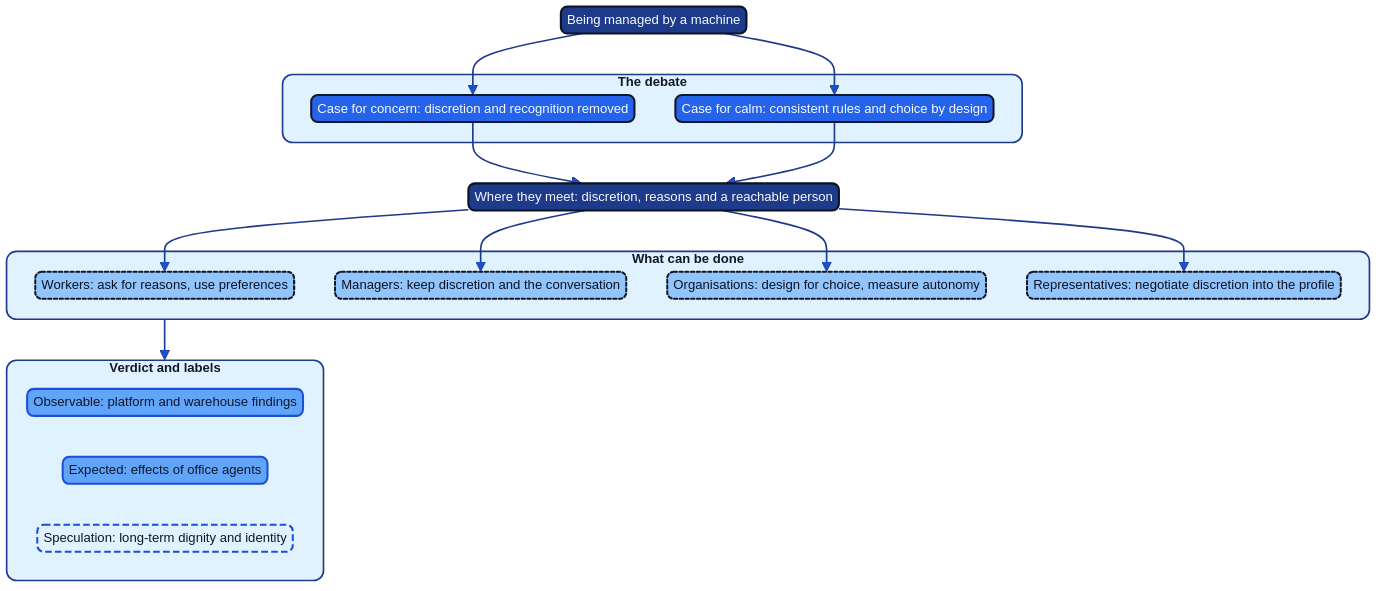
Figure 11.1: The debate on autonomy and dignity under algorithmic management, its common ground, the actions that follow and the labels of the verdict.
Being managed by a machine
The best evidence on what algorithmic direction feels like comes from qualitative research with the people who work under it, and most of that research was done on platforms, where algorithmic management first ran at scale. Min Kyung Lee and colleagues studied drivers for two ridesharing services in the United States through a qualitative study of how drivers responded when algorithms assigned work, gave them information and evaluated their performance, and how they used online forums to make sense of the system together (127, Lee et al., 2015). Alex Rosenblat and Luke Stark followed driver experience on one platform over nine months and concluded that the company exercised significant indirect control over how drivers did their jobs, built on information and power asymmetries: the application knew far more about the work than the people doing it (130, Rosenblat & Stark, 2016). Mareike Möhlmann and colleagues, studying the same platform's drivers and supplementing their accounts with interviews with the platform's executives and engineers, found that algorithmic matching and algorithmic control together produce tensions for workers around how the work is executed, how it is paid and whether they belong to anything (138, Möhlmann et al., 2021).
The study that most complicates a simple story is Alex Wood and colleagues' work on remote freelancers in Southeast Asia and Sub-Saharan Africa, based on 107 interviews in six countries and a survey of 679 workers. Algorithmic control was central to how the platforms operated, and it gave workers high levels of flexibility, autonomy, task variety and complexity. The same mechanisms were associated with low pay, social isolation, unsocial and irregular hours, overwork, sleep deprivation and exhaustion (134, Wood et al., 2019). Autonomy over when and how to work coexisted with dependence on a rating and ranking system the workers could not see into.
Warehouses show a different pattern, in which the system directs not only which task comes next but how fast it is done. Alessandro Delfanti's study of Amazon's warehouses describes technologies whose aim is to standardise, measure and discipline human work rather than replace it, and workers who struck under the banner "we are not robots" (140, Delfanti, 2021). The workers' own words name a loss of standing, not only of discretion; Chapter 6 set out what rate systems measure.
Katherine Kellogg, Melissa Valentine and Angèle Christin drew the research together in a review that sorts algorithmic control into six mechanisms, the "6 Rs": employers direct workers by restricting and recommending, evaluate them by recording and rating, and discipline them by replacing and rewarding. They also documented that workers resist, individually and collectively, through tactics the authors call algoactivism (137, Kellogg et al., 2020). Their framing matters for this book because it maps directly onto the management functions: restricting and recommending are M1 Direction, recording and rating are M2 Evaluation, and replacing and rewarding reach into M3 Consequence.
For office work the evidence is thinner. Chapter 10 described the office assistants and workflow agents that now propose owners for action items and allocate tickets and cases, but there are few published studies of how people experience being directed by them. The closest large-scale evidence comes from employers. An OECD survey of over 6,000 firms in France, Germany, Italy, Japan, Spain and the United States found algorithmic management tools already common in most of the countries studied; managers perceived that the tools often improved the quality of their decisions and their own job satisfaction, but cited unclear accountability, difficulty in following the tools' logic and inadequate protection of workers' health (149, Milanez et al., 2025). That is evidence about managers' perceptions, not about the experience of the people managed. A discussion paper for the European Agency for Safety and Health at Work mapped AI-based worker-management technologies through patent data and found only a marginal fraction of patents aimed at improving human wellbeing (87, European Agency for Safety and Health at Work, 2024), which suggests that the systems are rarely designed with the managed person's experience as a goal.
Autonomy, competence and relatedness
Three models from work psychology explain why these findings matter and predict where harm will appear. The first is self-determination theory. Richard Ryan and Edward Deci, summarising a body of research across domains including work, health care and education, postulated three innate psychological needs, competence, autonomy and relatedness, which when satisfied yield enhanced self-motivation and mental health and when thwarted lead to diminished motivation and wellbeing (118, Ryan & Deci, 2000). Autonomy in this sense does not mean independence from others; it means experiencing one's actions as one's own, endorsed rather than merely complied with.
The three needs map onto algorithmic direction with uncomfortable precision. Autonomy is affected when a system sets the sequence and the pace and gives no reason. Competence is affected when the feedback a person receives is a score whose basis they cannot see, so that they cannot tell whether they did the work well or merely fast. Relatedness is affected when the manager who assigned the work, and noticed how it went, is replaced by an interface, and colleagues become competitors in a ranking rather than people one arranges things with.
The second model is J. Richard Hackman and Greg Oldham's job characteristics model, which proposed that five core characteristics of a job, skill variety, task identity, task significance, autonomy and feedback from the job, shape three critical psychological states: experienced meaningfulness of the work, experienced responsibility for its outcomes, and knowledge of its results. These states in turn drive internal motivation, satisfaction and performance, more strongly for people with a high need for growth at work (106, Hackman & Oldham, 1976). In the model, autonomy is the characteristic that produces experienced responsibility: a person who decides how to do the work feels responsible for how it turns out.
Algorithmic management acts on all five characteristics. A system that breaks a visit round or a claims queue into individually assigned tasks can reduce task identity; one that prescribes the method reduces autonomy; one that reports throughput but not quality changes what feedback means. The choices a designer makes for such a system are job design decisions, whether or not anyone recognises them as such. This is the book's reading of the models, which predate algorithmic management by decades.
Demand and control
The third model is Robert Karasek's. Using national survey data from the United States and Sweden, Karasek proposed that mental strain arises from the interaction of two features of a job: the psychological demands it makes, and the worker's decision latitude, meaning the authority to make decisions about the work and the discretion to use one's skills (107, Karasek, 1979). High demands with high latitude make an active job; high demands with low latitude make a high-strain job, in which the worker carries the load without the means to manage it. The model reconciled earlier research that had examined demands and control separately, and implied that strain can be reduced by increasing latitude.
Arnold Bakker and Evangelia Demerouti later generalised the idea in the job demands-resources model, which treats autonomy as one of several job resources, alongside support and feedback, that buffer the effect of demands on wellbeing (120, Bakker & Demerouti, 2007). Both models point the same way for the AI boss. A system that raises the pace of work while removing the worker's control over sequence, method and breaks moves a job towards high strain. A system that raises demands but leaves or adds discretion, for example by letting workers choose among offered tasks, need not.
European law has long encoded the same insight. The Framework Directive on safety and health at work lists among the general principles of prevention "adapting the work to the individual", with a view, in particular, to "alleviating monotonous work and work at a predetermined work-rate and to reducing their effect on health" (Council Directive 89/391/EEC, Article 6(2)(d)) (49, Council of the European Communities, 1989). Swedish work-environment law states that strongly controlled or tied work shall be avoided or limited, that work should give opportunities for variety, social contact and cooperation, and that working conditions should give opportunities for self-determination and professional responsibility (Arbetsmiljölag, chapter 2, section 1) (75, Sveriges riksdag, 1977). The Platform Work Directive applies this directly to algorithmic management: digital labour platforms shall evaluate the risks of automated monitoring and decision-making systems to platform workers' safety and health, including psychosocial risks, and shall not use them in a manner that puts undue pressure on platform workers (Directive (EU) 2024/2831, Article 12(1) and (3)) (47, European Union, 2024).
For an organisation, the implication is architectural. Decision latitude is a property of the delegation profile. When a delegation profile sets M1 Direction at Level 3 Bounded, the bounds determine how much latitude is left to the worker as well as to the manager, and Chapter 14 takes the consequences for health further.
Algorithm aversion and appreciation
People do not respond to algorithmic judgement in one way. Berkeley Dietvorst, Joseph Simmons and Cade Massey showed in five studies that people are especially averse to algorithmic forecasters after seeing them perform, even when the algorithm outperformed a human, because confidence in an algorithm falls faster than confidence in a person after the same mistake (157, Dietvorst et al., 2015). Jennifer Logg, Julia Minson and Don Moore found the opposite tendency in six experiments: lay people adhered more to advice when they thought it came from an algorithm than from a person. The effect waned when people chose between an algorithm's estimate and their own, and experienced professionals relied less on algorithmic advice than lay people did, which hurt their accuracy (168, Logg et al., 2019).
The study that tested management directly is Min Kyung Lee's online experiment with four managerial decisions, some requiring what participants saw as mechanical skills and some requiring human skills. For the mechanical tasks, algorithmic and human decisions were perceived as equally fair and trustworthy; the human manager's fairness was attributed to authority, the algorithm's to efficiency and objectivity. For the human tasks, algorithmic decisions were perceived as less fair and trustworthy and evoked more negative emotion, attributed to the algorithm's perceived lack of intuition and to the dehumanising experience of being evaluated by machines. Human decisions evoked some positive emotion because of the possibility of social recognition (165, Lee, 2018).
Lee's result is the most useful single finding for this chapter, because it separates the management functions. People in her experiment accepted algorithmic assignment and scheduling about as readily as human assignment, which is most of M1 Direction. They resisted algorithmic evaluation, which is M2 Evaluation, and what they missed was recognition, which is part of M5 Care. It was an online experiment with hypothetical decisions, not a field study over time.
Measuring autonomy and fairness
Most organisations measure a system's output when it goes live and the workers' experience, at best, in an annual engagement survey that cannot separate the effect of one system from everything else. The guide and worked example below measure autonomy in one unit, before and after the change, in a way that protects the people who answer.
Practical guide: Measuring autonomy and perceived fairness before and after an AI system takes over part of M1 Direction
Purpose. Find out, before and after a system takes over part of M1 Direction, whether the people directed by it experience more or less autonomy, competence, relatedness and fairness, so that the delegation profile can be adjusted on evidence rather than on anecdote.
Roles. The line manager of the unit is accountable for running the measurement and acting on it. HR provides the survey tool and the analysis. The workers' representatives, the union or works council, agree the questions, the reporting rules and the use of the results before anything is sent. The data protection officer reviews the legal basis, the minimisation and the retention. The safety representative takes part where the results bear on the work environment. The workers affected answer voluntarily and see the results first.
Steps.
- Name the change. Record which system, which delegation profile and which part of M1 Direction the measurement concerns, and the date of go-live. A measurement without a named change cannot be interpreted.
- Agree before measuring. Present the purpose, the questions and the reporting rules to the representatives and record their agreement, under the co-determination procedure that applies: in Germany, BetrVG §87(1) no. 6 where the survey or its tool could serve to monitor behaviour or performance (9, Germany, 2001); in Sweden, the duty to negotiate under MBL (205, Sveriges riksdag, 1976). State in writing that results are never used for M2 Evaluation or M3 Consequence of any individual.
- Keep it short. Use 12 to 16 statements on a five-point scale, covering decision latitude over sequence, method and pace; the three needs of self-determination theory; whether reasons are given; whether a person can be reached; and perceived fairness of how work is allocated. Add two open questions: what has become easier, and what has been lost.
- Protect the respondents. Collect anonymously, never link answers to the HRIS, set a minimum reporting group of ten, and report subgroups such as contract type only where every subgroup reaches the minimum. Default: delete raw responses 90 days after the last wave.
- Measure three times. Default: a baseline four weeks before go-live, a first follow-up three months after and a second nine months after, so that novelty and teething problems are not mistaken for the lasting effect. Where the system is rolled out in stages, measure a unit not yet live at the same times as a comparison (Chapter 15).
- Report to the people first. Present the results at a workplace meeting of the unit before anyone else sees them, then to the representatives and to the system owner.
- Act and record. Where autonomy or fairness falls by more than half a scale point on any dimension, or the open answers name a specific loss, review the delegation profile with the representatives and record the outcome, including a decision to change nothing and why.
Definition of done. The agreement with the representatives is recorded; all three waves have run; results have been reported at unit level only, first to the unit; and every agreed action, or the decision not to act, is recorded against the delegation profile. Adapt the thresholds, the timing and the minimum group size to the collective agreement or works agreement and to the size of the unit.
Worked example: An autonomy and fairness survey for the Strandvik home-care unit
The following plan is illustrative. It belongs to Nordvik Region's Strandvik home-care unit, whose roughly 35 assistant nurses and care assistants, a third of them part-time or hourly, are the first in home care to work with ShiftWise visit schedules and routes under the delegation profile DLG-NR-ROS-01 (AIDR-0602). It lives in version control beside the delegation register (Chapter 25).
survey_plan:
  id: SVY-NR-STV-01
  status: illustrative
  title: Autonomy and fairness before and after ShiftWise routes
  unit: Strandvik home-care unit
  line_manager: Mikael Strand
  change:
    system: ShiftWise
    delegation_profile: DLG-NR-ROS-01
    decision_record: AIDR-0602
    function: M1 Direction
    scope: visit schedules and routes; open-shift offers to staff who opted in
  agreed_with:
    - body: union for municipal and care workers
      procedure: negotiation under the co-determination act
    - body: safety representative, Strandvik unit
  reviewed_by: data protection officer
  waves:
    - {name: baseline, timing: go-live minus 4 weeks}
    - {name: follow-up-1, timing: go-live plus 3 months}
    - {name: follow-up-2, timing: go-live plus 9 months}
  comparison_unit: next home-care unit in the rollout, same waves
  scale: 1 strongly disagree to 5 strongly agree
  dimensions:
    latitude: [I can decide the order of my visits when the situation requires it,
               I can take the time a visit needs]
    autonomy: [I can influence how my work is planned]
    competence: [I know whether I have done my work well]
    relatedness: [I can arrange things with my colleagues when I need to,
                  My manager knows how my work is going]
    reasons: [When my route changes I am told why]
    recourse: [I know whom to contact if a route does not work]
    fairness: [Extra shifts are offered fairly, Routes are shared out fairly]
  open_questions:
    - What has become easier in planning your work?
    - What have you lost, if anything?
  reporting:
    level: unit
    minimum_group_size: 10
    subgroups_allowed: [contract type, only if every group reaches the minimum]
    first_audience: workplace meeting of the unit
    then: [union, safety representative, ShiftWise system owner]
    prohibited_uses: [M2 Evaluation of individuals, M3 Consequence of individuals]
  data:
    anonymous: true
    linked_to_hris: false
    raw_response_retention_days: 90
  action_threshold: fall of more than 0.5 on any dimension, or a named loss
  action_owner: Mikael Strand, with the union, recorded against DLG-NR-ROS-01
The plan does not measure productivity, which Chapter 15 treats. It asks about the informal arrangements between colleagues as well as about the system, because a system can widen formal choice while removing informal choice, and only the second open question is likely to find that.
The debate
The debate is between two readings of the same research: one sees the removal of the discretion and the relationship through which people exercise skill and are recognised, the other the replacement of an often arbitrary supervisor by consistent rules that can be designed to give people more choice. The four steps below give each its strongest form.
The case for concern
The case for concern starts from what workers report. Drivers, freelancers and warehouse staff describe work directed by systems they cannot see into, which hold more information about the work than they do and use it to steer them indirectly (130, Rosenblat & Stark, 2016). Even where platform work offers formal autonomy over hours and tasks, the same studies record isolation, overwork and exhaustion (134, Wood et al., 2019), and tensions about belonging that no amount of formal flexibility resolves (138, Möhlmann et al., 2021). Read through Karasek's model, the result is a move towards high strain: demands set by the system, latitude taken by it (107, Karasek, 1979).
The second strand concerns recognition. Lee's experiment found that people valued human decisions partly for the social recognition they carry, and experienced being evaluated by machines as dehumanising (165, Lee, 2018). In self-determination theory, relatedness is a need, not a nicety (118, Ryan & Deci, 2000). A manager who assigns work also sees the person who does it, notices when they struggle and hears what they say about the work. When the assignment moves to a system, those functions do not move with it; they simply stop, unless someone designs them back in. This is the gap that Q11 names: what replaces the manager's judgement in care for health, safety and voice when direction is done by a system that does not notice a person in difficulty.
The third strand concerns the direction of design. The patent analysis for EU-OSHA found that only a marginal fraction of AI worker-management patents aimed at improving wellbeing (87, European Agency for Safety and Health at Work, 2024), and Kellogg and colleagues placed algorithmic control in a long history of employers adopting production technologies to extract more value from labour, with workers resisting (137, Kellogg et al., 2020). On this reading, autonomy-preserving designs are possible but not the default, and defaults decide most deployments. The concern does not depend on bad intent. It depends only on optimising what is easy to measure, throughput and utilisation, while the costs to autonomy and dignity remain unmeasured and therefore invisible.
The case for calm
The case for calm begins with the human manager as the realistic alternative. Many workers have experienced supervisors who allocate the best shifts and the easiest work to favourites, apply rules inconsistently and cannot be held to a standard because no standard is written down. A system that allocates by stated rules, the same for everyone, can remove that arbitrariness. Lee's experiment supports the claim for the work most of M1 Direction consists of: for assignment and scheduling, people perceived algorithmic decisions as fair and trustworthy as human ones, and attributed their fairness to efficiency and objectivity (165, Lee, 2018). Logg and colleagues found that lay people often adhere more readily to algorithmic advice than to human advice (168, Logg et al., 2019), so acceptance is not the obstacle it is sometimes assumed to be.
The second strand is that algorithmic direction can widen choice. The same remote freelancers whose isolation Wood and colleagues documented reported high levels of flexibility, autonomy, task variety and complexity (134, Wood et al., 2019). In shift work, a system that lets staff state preferences, see open shifts and accept them directly gives individuals a choice that used to depend on asking a planner. The job characteristics model treats autonomy and feedback as design variables (106, Hackman & Oldham, 1976); a system can be configured to raise both, for example by showing workers their own results and letting them choose among tasks. Managers in the OECD survey reported that the tools often improved the quality of their decisions (149, Milanez et al., 2025), which can free time for the human part of the job.
The third strand is that the studies driving the concern describe particular settings, mostly platforms and warehouses with weak worker representation and business models built on cost. Europe already has the instruments to set different terms: the Framework Directive's principle of adapting work to the individual (49, Council of the European Communities, 1989), the Platform Work Directive's prohibition of undue pressure (47, European Union, 2024), the AI Act's classification of systems that allocate tasks or monitor and evaluate workers as high-risk under Annex III, point 4(b), and its duty on deployers who are employers to inform workers' representatives and affected workers before such a system is put into service (Article 26(7)) (1, European Union, 2024), together with co-determination rights in many member states. On this view, the harms documented elsewhere are the product of business models and weak institutions, not of algorithms as such.
Where the positions meet
The positions agree on more than their advocates usually admit. Both accept that the effects measured on platforms and in warehouses are real: formal flexibility combined with isolation, opacity and pressure. Both accept that the same technology can widen or narrow a worker's choice, and that which it does is a design decision. Both accept Lee's distinction: people accept systems for allocating and scheduling far more readily than for evaluating them, and what they miss in algorithmic evaluation is recognition.
Above all, both agree that three properties decide the outcome. The first is discretion: how much latitude the design leaves to the worker and to the manager, which in this book's terms is set by the degree of delegation and the bounds of the delegation profile. The second is reasons: whether a person directed by the system can find out why, which the Platform Work Directive requires for decisions taken or supported by automated systems (Article 11(1)) (47, European Union, 2024). The third is a reachable person: whether there is someone who can be asked, who can change the instruction and who notices the worker as a person, which is the human relationship the concern fears losing and the calm assumes can be kept. The concern describes what happens when these are left to default; the calm describes what is possible when they are designed.
What can be done
Workers can ask for the reasons behind an instruction, a route or an allocation, use the preference settings a system offers and record when they do not work, and raise loss of discretion as a work-environment issue with the safety representative, not only as a matter of taste. Chapter 28 describes the worker information notice they should receive.
Line managers can keep the discretion the delegation profile leaves them and use it visibly: change an instruction when the situation requires it and record why, so that the record shows the manager is in charge of the work rather than a relay for the system. They can keep the conversation that algorithmic direction no longer requires: regular contact with each person they manage, in which the subject is the person and the work, not the figures. This is the core of M5 Care when M1 Direction has moved, and Chapter 29 develops it into the manager's transformed role.
Organisations can design for choice and recourse rather than leave them as a residue. In practice that means writing the bounds of each delegation profile with the worker's latitude in mind, giving reasons with every instruction that departs from the expected, naming a person who can be reached, and measuring autonomy and perceived fairness as the practical guide above describes. They can treat a system's job design consequences as part of its approval.
Workers' representatives can negotiate discretion into the delegation profile itself: preference rules, the right to swap, limits on the share of work that is assigned rather than chosen, and the conditions under which a manager may override the system. In Germany the works council's co-determination right over technical equipment suited to monitor behaviour or performance (BetrVG §87(1) no. 6) gives it a seat at that table, and its duty, together with the employer, to promote the independence and initiative of employees and working groups (BetrVG §75(2)) gives it a reason to use the seat (9, Germany, 2001). Chapter 23 treats co-determination in full.
Worked example: A bounded preference rule in a delegation profile
The following excerpt is illustrative. It shows how Jana Petersen's Hamburg claims team at Hansa Mutual negotiated discretion into the profile under which the claims-triage agent allocates claims to handlers at Level 3 Bounded. The full profile is shown in Chapter 9 and the register in Chapter 25.
delegation_profile:
  id: DLG-HM-CTA-01
  status: illustrative
  version: 1.1.0
  system: claims-triage agent
  function: M1 Direction
  level: Level 3 Bounded
  change_in_this_version: bounded preference rule for complex claims
  preference_rule:
    id: PREF-01
    who_may_state_preferences: handlers in the Hamburg claims team
    what: up to three complex-claim categories a handler prefers to handle
    weight: considered after deadlines, competence and workload balance
    cap: preferred claims at most 30 per cent of a handler's weekly allocation
    protection_for_development: >-
      at least one complex claim a week continues to go to each handler in
      the first two years of service, whatever the preferences of others
    visibility: the handler and the team leader only
    prohibited_uses: [M2 Evaluation, M3 Consequence]
  override:
    who: team leader
    record: Management Decision Record for every reassignment
  agreed_with: Konzernbetriebsrat, under KBV-IT-2024
  review: three months after go-live of version 1.1.0, with outcome data by handler group
  accountable_owner: Jana Petersen, claims team leader
The cap and the protection for handlers early in their careers are the parts that took longest to agree. Without them, a preference rule that gives experienced handlers the complex claims they enjoy would take away the claims through which newer handlers learn, which is the route by which experts are made (F66; AI Threat, Chapter 14) (44, Nordqvist, 2026), and would turn an M1 Direction rule into a question of M4 Development.
Verdict
The verdict divides by management function and by the strength of the evidence.
For M1 Direction, it is observable that algorithmic direction on platforms and in warehouses is associated with reduced control over pace and method, opacity about how work is assigned, and isolation, even where formal flexibility is high; qualitative studies and surveys in several countries document it (134, Wood et al., 2019) (138, Möhlmann et al., 2021) (140, Delfanti, 2021). It is equally observable, in experimental evidence, that people accept algorithmic assignment and scheduling about as readily as human assignment (165, Lee, 2018). The harm is therefore not inherent in the delegation of direction; it follows from how much discretion the design leaves and from the business model it serves.
For M2 Evaluation, the evidence that people experience algorithmic evaluation as less fair and as dehumanising is experimental, from hypothetical decisions; that it holds in the workplace is expected, supported by the qualitative accounts but not yet measured in European employment over time. Chapter 12 examines fairness and contestability in evaluation in full.
For M5 Care, the loss of the human relationship through which people are recognised and through which a manager notices a person in difficulty is consistent with all three models of work psychology and with workers' own accounts. That this loss occurs wherever direction is automated without redesign is expected. Effects on autonomy in knowledge work directed by office agents are expected and under-researched. Long-term effects on dignity and on people's identity at work, measured over years rather than months, are speculation until someone measures them, which is also why Q4 remains open.
European law already states the standard against which these effects are judged. The Charter of Fundamental Rights provides that human dignity is inviolable (Article 1) and that every worker has the right to working conditions which respect his or her health, safety and dignity (Article 31(1)) (48, European Union, 2012). The Council of Europe's Framework Convention on Artificial Intelligence obliges each party to adopt or maintain measures to respect human dignity and individual autonomy in relation to activities within the lifecycle of AI systems (Article 7) (59, Council of Europe, 2024). They are not a design specification, but they name what the delegation profile and the oversight design must protect. That the Platform Work Directive's provisions on algorithmic management will apply in the member states once they have transposed it, by 2 December 2026, is expected; how strictly undue pressure will be interpreted is not yet known.
What can be influenced is the part that decides the outcome: the discretion a delegation profile leaves, whether reasons are given, whether a person can be reached, whether autonomy is measured, and whether workers and their representatives take part in setting the bounds.
Across the degrees of delegation
| Degree of delegation for M1 Direction | Who sets the instruction | Effect on the worker's latitude | Design lever |
|---|---|---|---|
| Level 0 Advisory | Manager, with a system's proposal | Unchanged; the conversation remains | Show the proposal to the worker too |
| Level 1 Assisted | Manager, from a system's draft | Mostly unchanged; risk of the draft becoming the default | Record changes to the draft and why |
| Level 2 Supervised | System, approved by the manager | Depends on whether the manager uses the approval to restore discretion | Approval time and changes in the oversight record |
| Level 3 Bounded | System, within bounds | Set by the bounds; no person mediates the instruction | Preference rules, swap rights, reasons, a named contact |
| Level 4 Autonomous | System, without bounds per instruction | Lowest; reasons and recourse only if designed | Not recommended where the instruction paces the person |
The usage mode shapes the same picture. The effect on autonomy is largest for Mode 4 Built AI applications and Mode 5 Autonomous production agents directing work at Level 3 Bounded, such as a rostering system that offers shifts or an agent that allocates claims, because no person stands between the instruction and the worker. In Mode 2 Embedded workplace assistants and Mode 0 Ambient AI the direction is softer, a proposed owner for an action item or a nudge in a calendar, but also less visible, which is why Chapter 10 asked organisations to register such features. At Level 2 Supervised the manager can restore discretion that the system removed, and whether that happens is itself a design choice, made in the approval workflow and visible in the oversight record (Chapter 26), not a by-product.
Nordvik Region and Hansa Mutual
In the Strandvik home-care unit, ShiftWise routes take over much of the visit planning that Mikael Strand used to do by hand. The assistant nurses and care assistants gain the ability to state preferences and to accept open shifts directly, an M1 Direction class that DLG-NR-ROS-01 sets at Level 3 Bounded for staff who opted in. Some lose the informal swaps they used to arrange with each other, which no system field records. The unit runs the survey SVY-NR-STV-01, agreed with the union and the safety representative and reported at unit level only, before go-live and twice after, with the next home-care unit in the rollout as a comparison. Mikael Strand keeps a short weekly conversation with the team, because the route no longer requires him to speak to anyone.
At Hansa, claims handlers in Jana Petersen's team describe the claims-triage agent's allocation as fairer than the old practice of taking claims from a shared queue, where the fastest readers of the queue chose first. Experienced handlers miss choosing the complex claims they enjoy. The team agrees the bounded preference rule PREF-01 in version 1.1 of DLG-HM-CTA-01, with a cap and a protection for handlers early in their careers, and the Konzernbetriebsrat under Thomas Brandt welcomes it as an example of discretion negotiated into the profile. The difference follows their settings: Nordvik measures autonomy where algorithmic direction is new, while Hansa adjusts a system that has directed its handlers for years, with a works council that can make discretion a condition of agreement.
Summary
Being managed by a machine changes the experience of work most visibly in M1 Direction, where a system assigns, sequences and paces the work, and in M2 Evaluation, where it often measures it, and most quietly in M5 Care, where the relationship through which people are recognised and noticed can disappear without anyone deciding that it should. Studies of platform and warehouse work document formal flexibility alongside opacity, isolation and pressure.
Self-determination theory, the job characteristics model and Karasek's demand and control model explain the findings and locate the harm: in the loss of autonomy, competence feedback and relatedness, and in jobs that move towards high demands with low latitude. European law, from the Framework Directive's principle of adapting work to the individual to the Platform Work Directive's prohibition of undue pressure and Swedish law's limit on strongly controlled work, already states the standard.
The debate showed two strong positions that meet on three properties: discretion, reasons and a reachable person. People accept algorithmic assignment far more readily than algorithmic evaluation, and what they miss is recognition. The chapter showed how to measure autonomy before and after a change and how to negotiate discretion into a delegation profile.
The verdict is that the measured effects on autonomy in platform and warehouse work are observable, effects in office work under agents are expected and under-researched, and long-term effects on dignity and identity are speculation until measured over years. What decides the outcome is design and negotiation. Chapter 12 turns from autonomy to fairness: what happens when the system that evaluates people is biased, and when the appeal never comes.
Sources
- Nordqvist, G. (2026). AI Threat: Are the Dystopias Coming True? Evidence, Risk and Response for European Enterprises and Public Authorities. The Architecture as Code Series, Book 5. (44, Nordqvist, 2026)
- Lee, M. K., Kusbit, D., Metsky, E. & Dabbish, L. (2015). Working with Machines: The Impact of Algorithmic and Data-Driven Management on Human Workers. Proceedings of CHI 2015, ACM. (127, Lee et al., 2015)
- Rosenblat, A. & Stark, L. (2016). Algorithmic Labor and Information Asymmetries: A Case Study of Uber's Drivers. International Journal of Communication, 10. (130, Rosenblat & Stark, 2016)
- Möhlmann, M., Zalmanson, L., Henfridsson, O. & Gregory, R. W. (2021). Algorithmic Management of Work on Online Labor Platforms: When Matching Meets Control. MIS Quarterly, 45(4). (138, Möhlmann et al., 2021)
- Wood, A. J., Graham, M., Lehdonvirta, V. & Hjorth, I. (2019). Good Gig, Bad Gig: Autonomy and Algorithmic Control in the Global Gig Economy. Work, Employment and Society, 33(1). (134, Wood et al., 2019)
- Delfanti, A. (2021). The Warehouse: Workers and Robots at Amazon. Pluto Press. (140, Delfanti, 2021)
- Kellogg, K. C., Valentine, M. A. & Christin, A. (2020). Algorithms at Work: The New Contested Terrain of Control. Academy of Management Annals, 14(1). (137, Kellogg et al., 2020)
- Milanez, A., Lemmens, A. & Ruggiu, C. (2025). Algorithmic management in the workplace: New evidence from an OECD employer survey. OECD Publishing. (149, Milanez et al., 2025)
- European Agency for Safety and Health at Work (2024). Worker management through AI – From technology development to the impacts on workers and their safety and health. EU-OSHA. (87, European Agency for Safety and Health at Work, 2024)
- Ryan, R. M. & Deci, E. L. (2000). Self-determination theory and the facilitation of intrinsic motivation, social development, and well-being. American Psychologist, 55(1). (118, Ryan & Deci, 2000)
- Hackman, J. R. & Oldham, G. R. (1976). Motivation through the design of work: Test of a theory. Organizational Behavior and Human Performance, 16(2). (106, Hackman & Oldham, 1976)
- Karasek, R. A. (1979). Job Demands, Job Decision Latitude, and Mental Strain: Implications for Job Redesign. Administrative Science Quarterly, 24(2). (107, Karasek, 1979)
- Bakker, A. B. & Demerouti, E. (2007). The Job Demands-Resources model: state of the art. Journal of Managerial Psychology, 22(3). (120, Bakker & Demerouti, 2007)
- Council of the European Communities (1989). Council Directive 89/391/EEC on the introduction of measures to encourage improvements in the safety and health of workers at work. Official Journal of the European Communities. (49, Council of the European Communities, 1989)
- Sveriges riksdag (1977). Arbetsmiljölag (1977:1160). Sveriges riksdag. (75, Sveriges riksdag, 1977)
- European Parliament and Council of the European Union (2024). Directive (EU) 2024/2831 on improving working conditions in platform work. Official Journal of the European Union. (47, European Union, 2024)
- Dietvorst, B. J., Simmons, J. P. & Massey, C. (2015). Algorithm aversion: People erroneously avoid algorithms after seeing them err. Journal of Experimental Psychology: General, 144(1). (157, Dietvorst et al., 2015)
- Logg, J. M., Minson, J. A. & Moore, D. A. (2019). Algorithm appreciation: People prefer algorithmic to human judgment. Organizational Behavior and Human Decision Processes, 151. (168, Logg et al., 2019)
- Lee, M. K. (2018). Understanding perception of algorithmic decisions: Fairness, trust, and emotion in response to algorithmic management. Big Data & Society, 5(1). (165, Lee, 2018)
- Federal Republic of Germany (2001). Betriebsverfassungsgesetz (BetrVG). Gesetze im Internet. (9, Germany, 2001)
- Sveriges riksdag (1976). Lag (1976:580) om medbestämmande i arbetslivet. Sveriges riksdag. (205, Sveriges riksdag, 1976)
- European Parliament and Council of the European Union (2024). Regulation (EU) 2024/1689 laying down harmonised rules on artificial intelligence (Artificial Intelligence Act). Official Journal of the European Union. (1, European Union, 2024)
- European Union (2012). Charter of Fundamental Rights of the European Union. Official Journal of the European Union, C 326. (48, European Union, 2012)
- Council of Europe (2024). Framework Convention on Artificial Intelligence and Human Rights, Democracy and the Rule of Law (CETS No. 225). Council of Europe. (59, Council of Europe, 2024)